


Rebecca: "A Sensorial Manifesto". Benni Bosetto at Pirelli HangarBicocca in Milan
30.06.2026
It is a nightmare, but a familiar one, something we have experienced so often that it no longer scares us. The anxiety that once woke us up in a sweat now became curiosity. Disgust was replaced by a calm acceptance of strange images, and we stopped reacting on instinct.
The sensation of being inside a dream is reinforced by the distorted passage of time. I recorded my first voice note while visiting Rebecca at 1:46 p.m., and the last at 3:50 p.m., with little awareness of where those two hours disappeared within the 1,400 square metres of the Shed at Pirelli HangarBicocca in Milan.
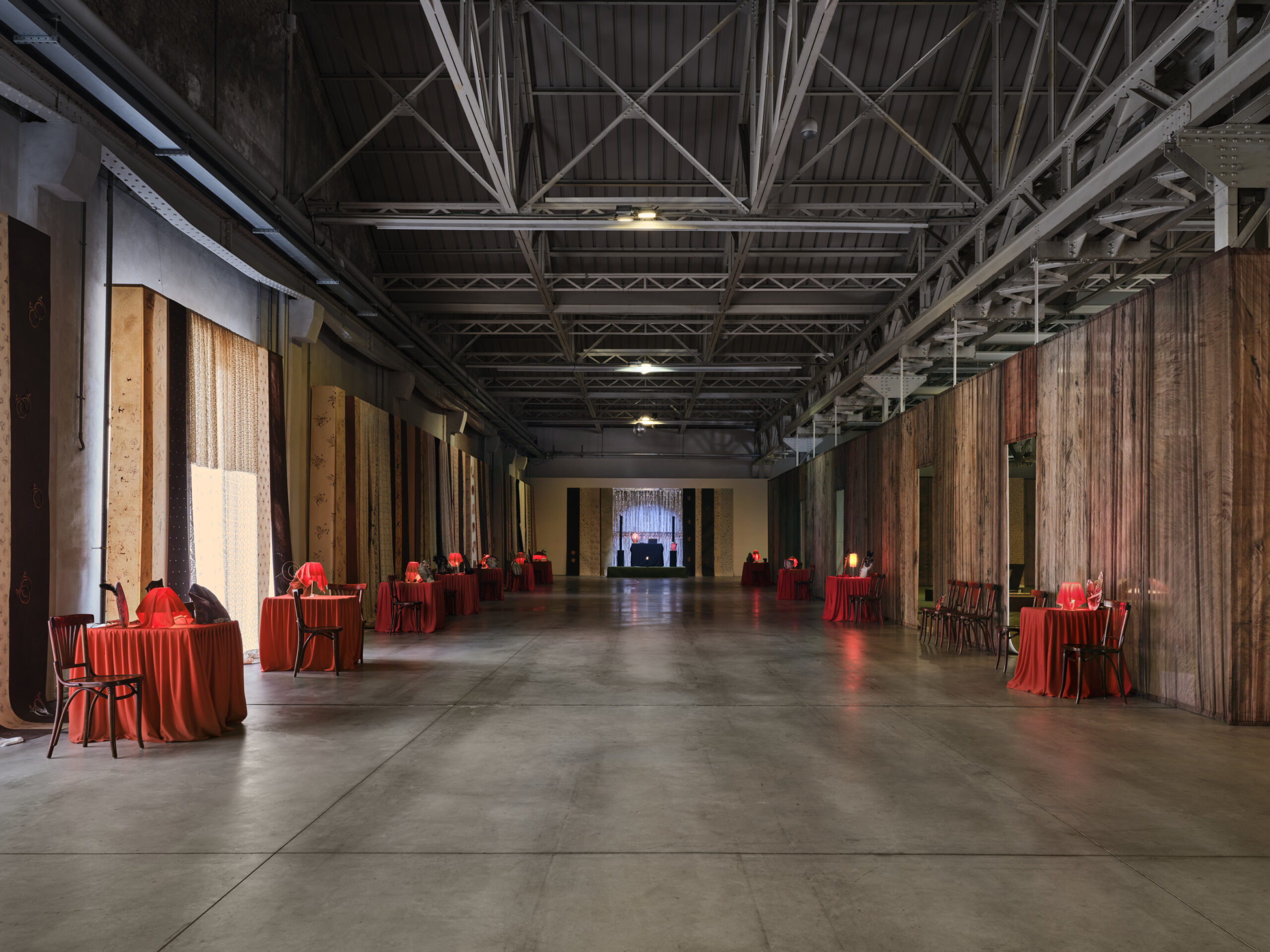
Benni Bosetto, Rebecca, Exhibition view, Pirelli HangarBicocca, Milan, 2026, Courtesy the artist and Pirelli HangarBicocca, Milan. Photo Agostino Osio
Conceived as an environment to inhabit, Rebecca is Benni Bosetto’s (born in Merate, 1987; lives and works in Milan) first solo exhibition in a museum setting. The title takes its cue from the eponymous 1938 novel by Daphne du Maurier, in which the house itself is the protagonist, preserving the memory of the deceased woman who shares its name.
I have previously reflected on the themes of home and domesticity in the essay Casa e domesticità nell’arte contemporanea, published in Kabul Magazine in 2021 (click here to read).
The exhibition unfolds across three zones—heart, belly, and cheek—separated by a profusion of curtains adorned with dinamic drawings and works including La bocca (2022), La guancia (2026), Le porte (2026), Le cellule (2026), and Gli occhi (2026). Together, these elements form a hybrid environment poised between architecture and a living organism.
By “dynamic” I don’t mean animated or media-based works. Rather, the drawings gradually develop towards increasingly erotic imagery: an apple slowly assumes the shape of a pair of buttocks; what initially appears to be a musical note painted in watercolour gradually reveals itself as the body of a man lying on his back, his penis exposed. Elsewhere, what seems to be a flower bud transforms into a genital organ. The transformation is only fully apparent when comparing the first image with the last. Seen as a whole, however, the sequence evokes an image in a continual state of becoming.
As stated by the Second Law of Thermodynamics, entropy always increases within a closed system. An organism, however—as the one this exhibition proposes—is not a closed system. It constantly exchanges energy and matter with its surroundings, maintaining equilibrium through perpetual movement and transformation.
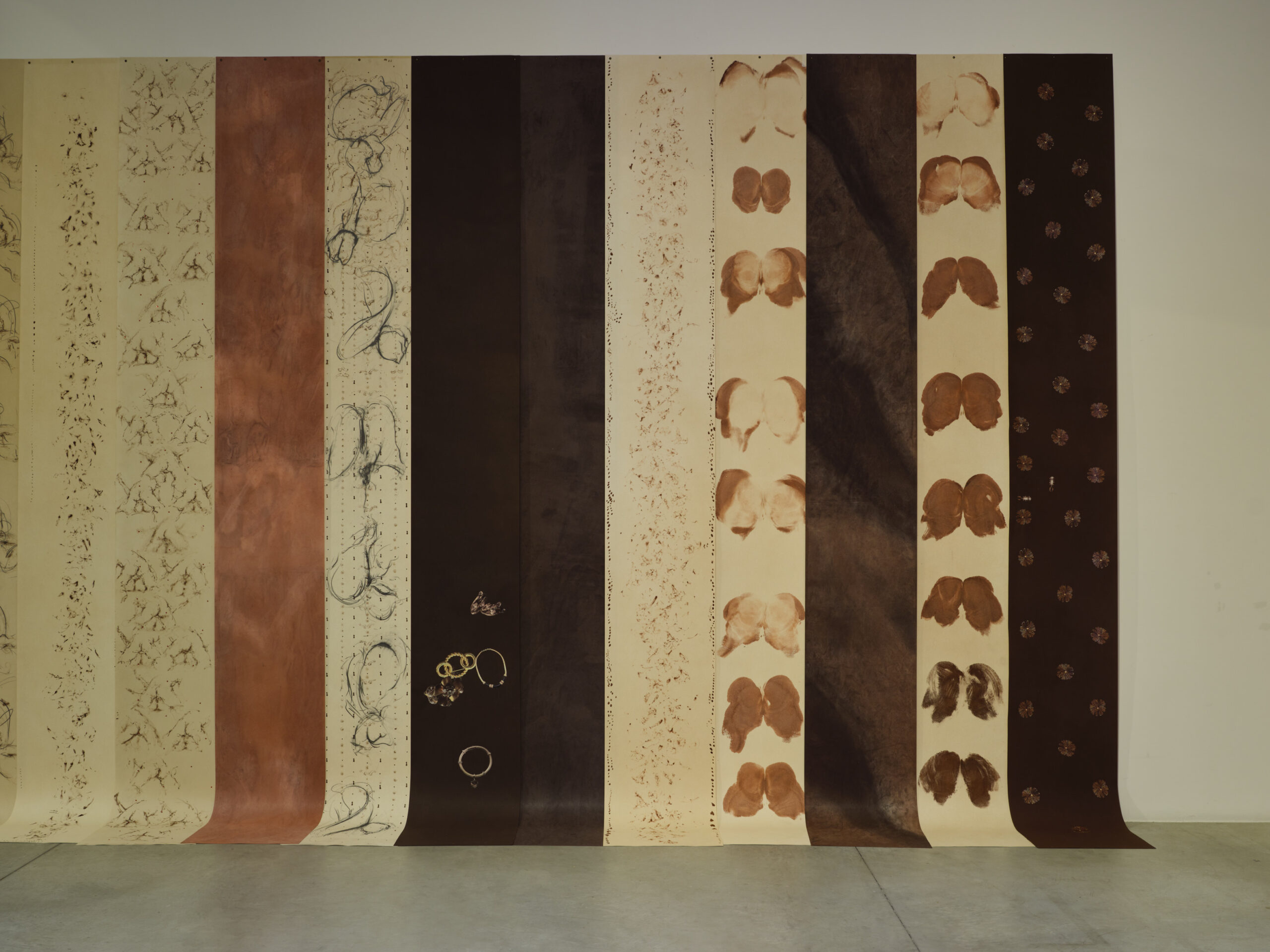
Benni Bosetto, Le cellule (detail), 2026 Installation view, Pirelli HangarBicocca, Milan, 2026. Produced by Pirelli HangarBicocca Courtesy the artist and Pirelli HangarBicocca, Milan. Photo Agostino Osio
Working across drawing, installation, sculpture, and performance, while drawing on literary, anthropological, popular, and cinematic sources alongside psychoanalytic theory and art history, Bosetto explores the physicality of the body through the immense female organism that is Rebecca. She examines it as a site of identity, in the context of interspecies relations, in its relationship with the environment, and, ultimately, as an expression of eroticism and the freedom of desire. For Bosetto, the body is an active instrument for engaging with the world—as both organic matter and symbolic form—and the true center of her artistic research.
For reasons that remain somewhat mysterious, most visitors begin their journey in the heart, the elongated space located to the left of the entrance. It might seem more intuitive to walk straight into the central area—the belly—yet few do. Perhaps psychophysiology makes us instinctively gravitate towards the predominance of red light in this section, or perhaps it is simply natural to move from left to right in a clockwise direction. I prefer to imagine another explanation: that approaching the belly—the domain of intuition, of the so-called gut feeling—requires caution, especially when the living structure lies exposed. After all, the heart appears far more resilient.
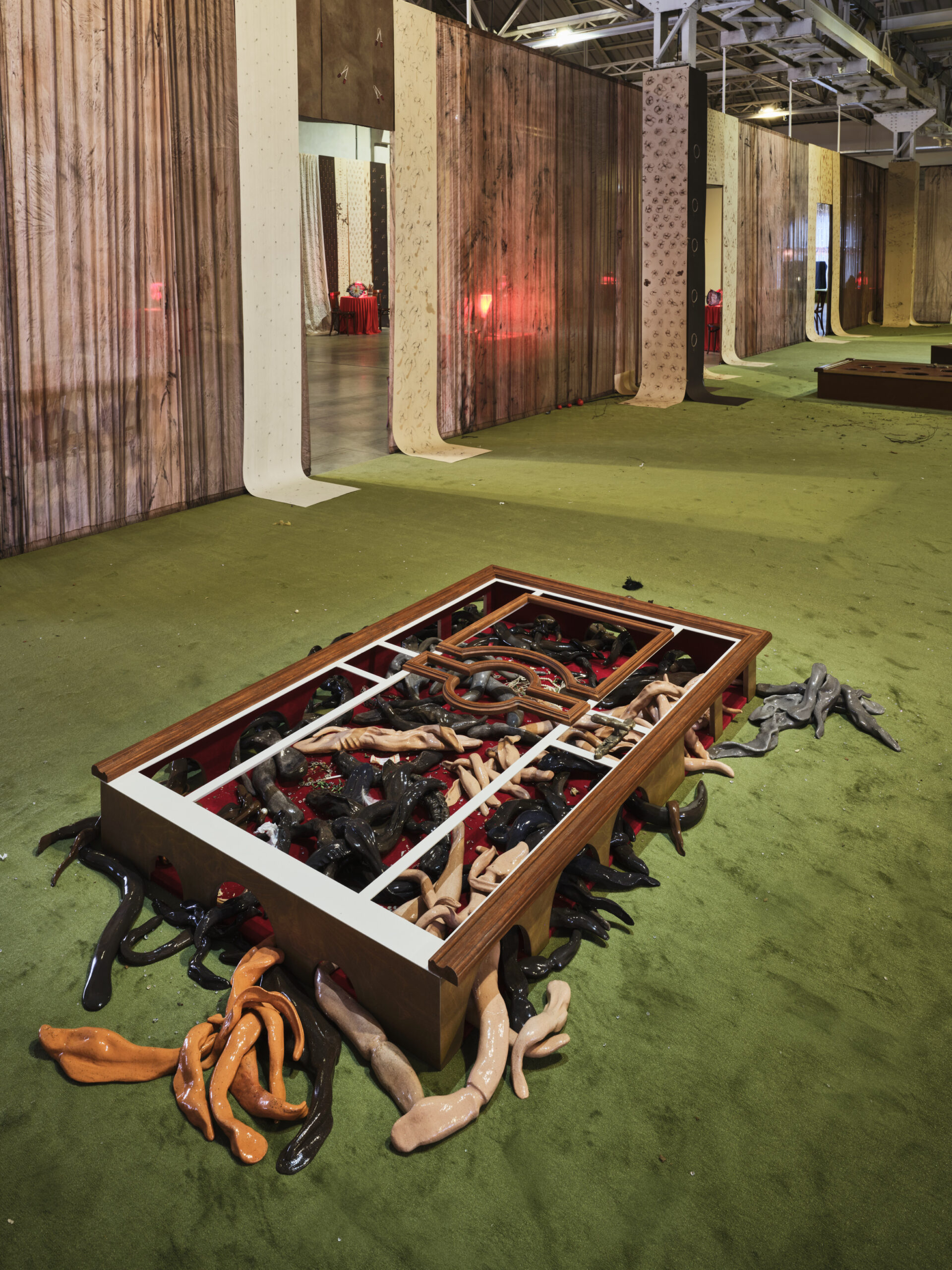
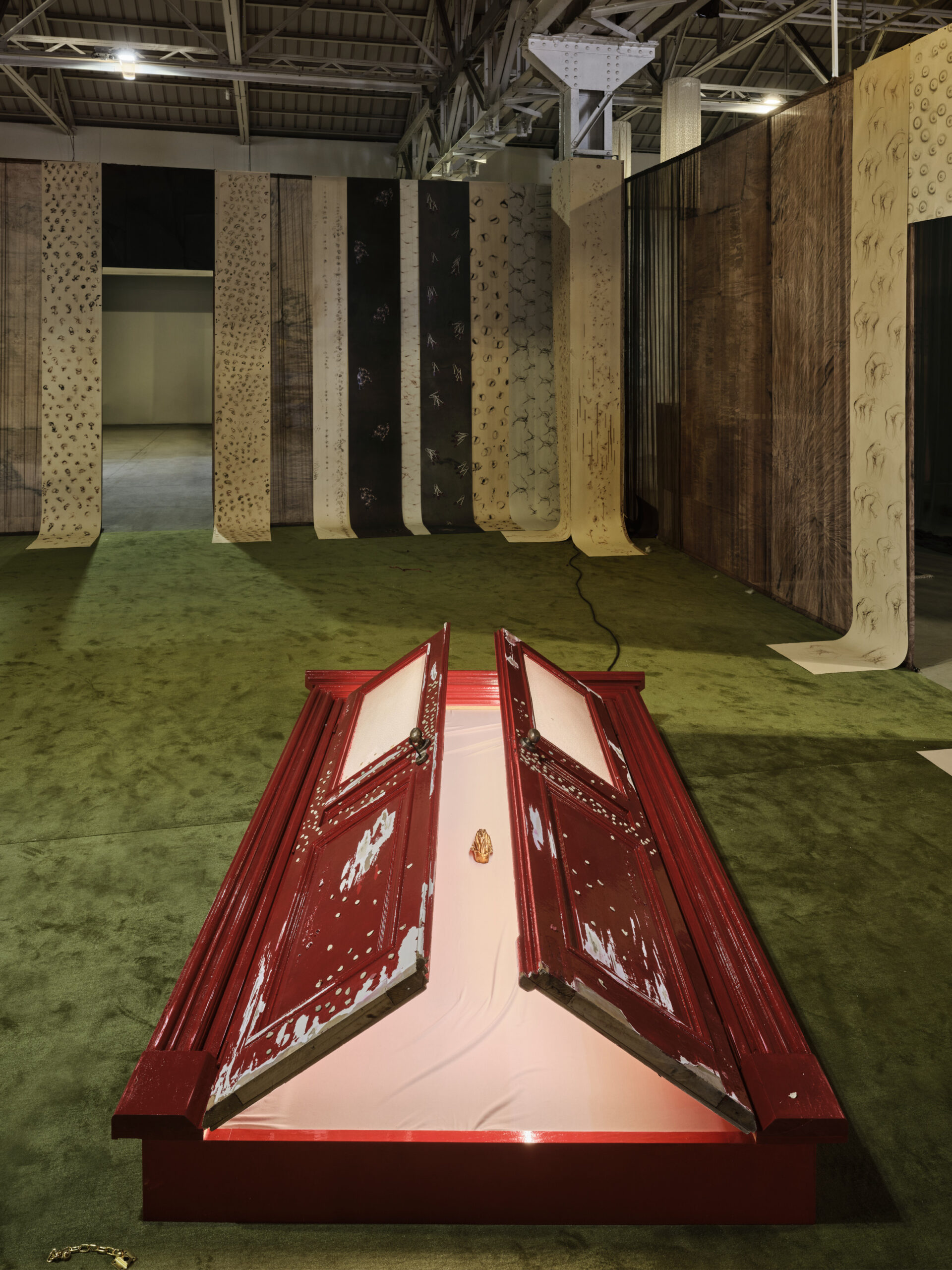
Benni Bosetto, Porta della spogliarellista, 2026 Installation view, Pirelli HangarBicocca, Milan, 2026. Produced by Pirelli HangarBicocca, Courtesy the artist and Pirelli HangarBicocca, Milan. Photo Agostino Osio (left); Benni Bosetto, Porta pannocchia, 2026 Installation view, Pirelli HangarBicocca, Milan, 2026. Produced by Pirelli HangarBicocca Courtesy the artist and Pirelli HangarBicocca, Milan. Photo Agostino Osio (right);
At the heart, Bosetto approaches artistic language also through classical dance, emphasising disciplined gesture and an acute awareness of the body as an expressive instrument. This takes form in Tango (II version) (2023–26), an installation and performance inspired by tango and the traditional milonga. Performers wearing headpieces depicting plants and animals enact an interspecies choreography. The work reflects upon falling in love as a process of intoxication and examines the physicality of emotion, while playfully engaging with clichés and archetypes surrounding romantic love. Throughout, Bosetto’s radical commitment to craftsmanship and embodied artistic practice remains one of the defining elements of her work.
The belly is entered through a keyhole. The motif repeats and multiplies across the textile that the entrance is made of. Details are extraordinarily important here, as they are in every dream. Without dedicating sufficient time and attention to exploration, one might easily miss a shell fitted with the legs of a doll, or a tiny human figure nestled in cotton wool within the narrow crack of a door. This continuous process of discovery induces a kind of hypnosis. The exhibition is punctuated by apparent coincidences that gradually reveal themselves not to be coincidences at all.
It is remarkable how details emerge over time, or through repeated attempts. Whether this is simply part of human nature—that we refine our gaze and perception through repetition—or not, Bosetto has succeeded in turning this dynamic into an experience.
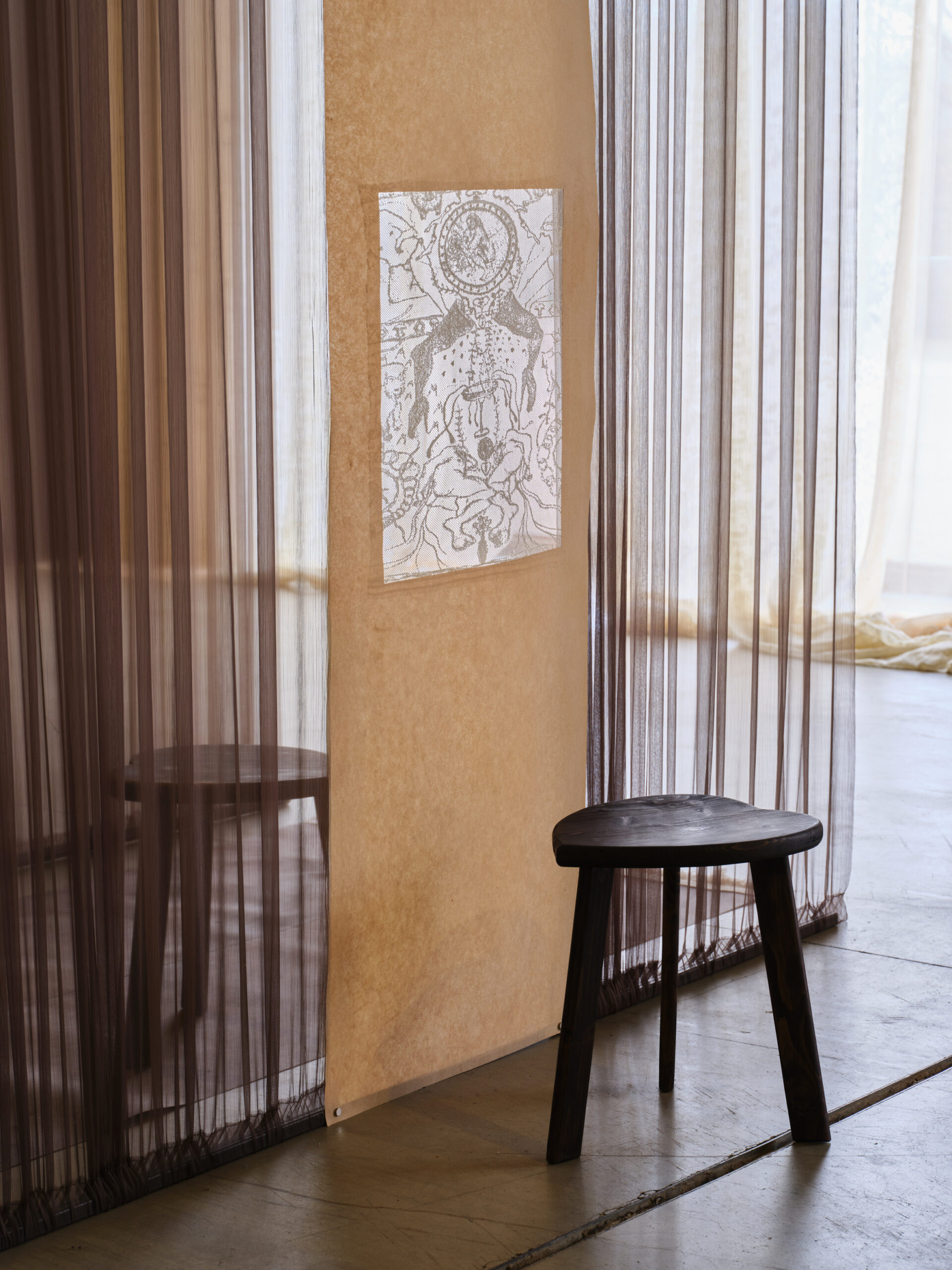
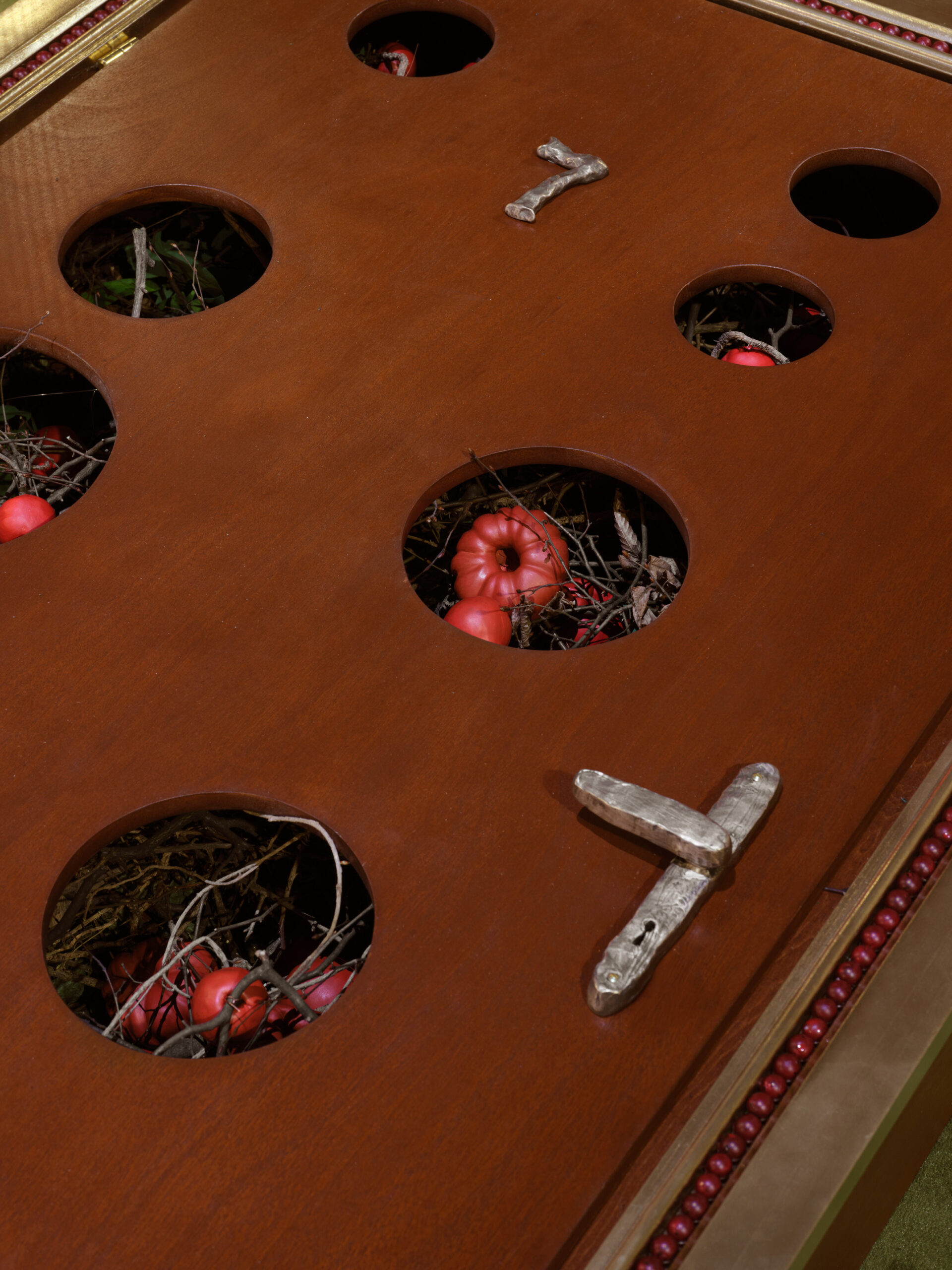
Benni Bosetto, Confessionale animale, 2026, Installation view, Pirelli HangarBicocca, Milano, 2026. Produced by Pirelli HangarBicocca Courtesy l’artista e Pirelli HangarBicocca, Milan. Photo Agostino Osio (left); Benni Bosetto Porta pomi d’oro (detail), 2026, Installation view, Pirelli HangarBicocca, Milan, 2026. Produced by Pirelli HangarBicocca Courtesy the artist and Pirelli HangarBicocca, Milano. Photo Agostino Osio (right);
Wallpaper, lace, curtains, transparent fabrics and decorative bows create an environment that feels enveloping and protective.
Yet these materials are not simply comforting. They also evoke childhood and nostalgia, as in the act of hiding behind the curtains in Gli occhi (2026). At other moments, the fabrics move almost imperceptibly, stirred by an invisible current of air. The source of the movement remains elusive, suggesting that the exhibition itself is conceived to live and never entirely under our control.
At the same time, unsettling forms proliferate: doorknobs levitate above horizontally positioned doors whose openings face the floor; moths, flies and beetles appear throughout; rounded ceramic masses seem to crawl out of cracks and hidden recesses.
Immersion in this surreal, dreamlike and strangely organic environment is interrupted only by the sharp, recurring crackle of gallery walkie-talkies, now an almost permanent characteristic of HangarBicocca. Their sound abruptly returns visitors to reality.
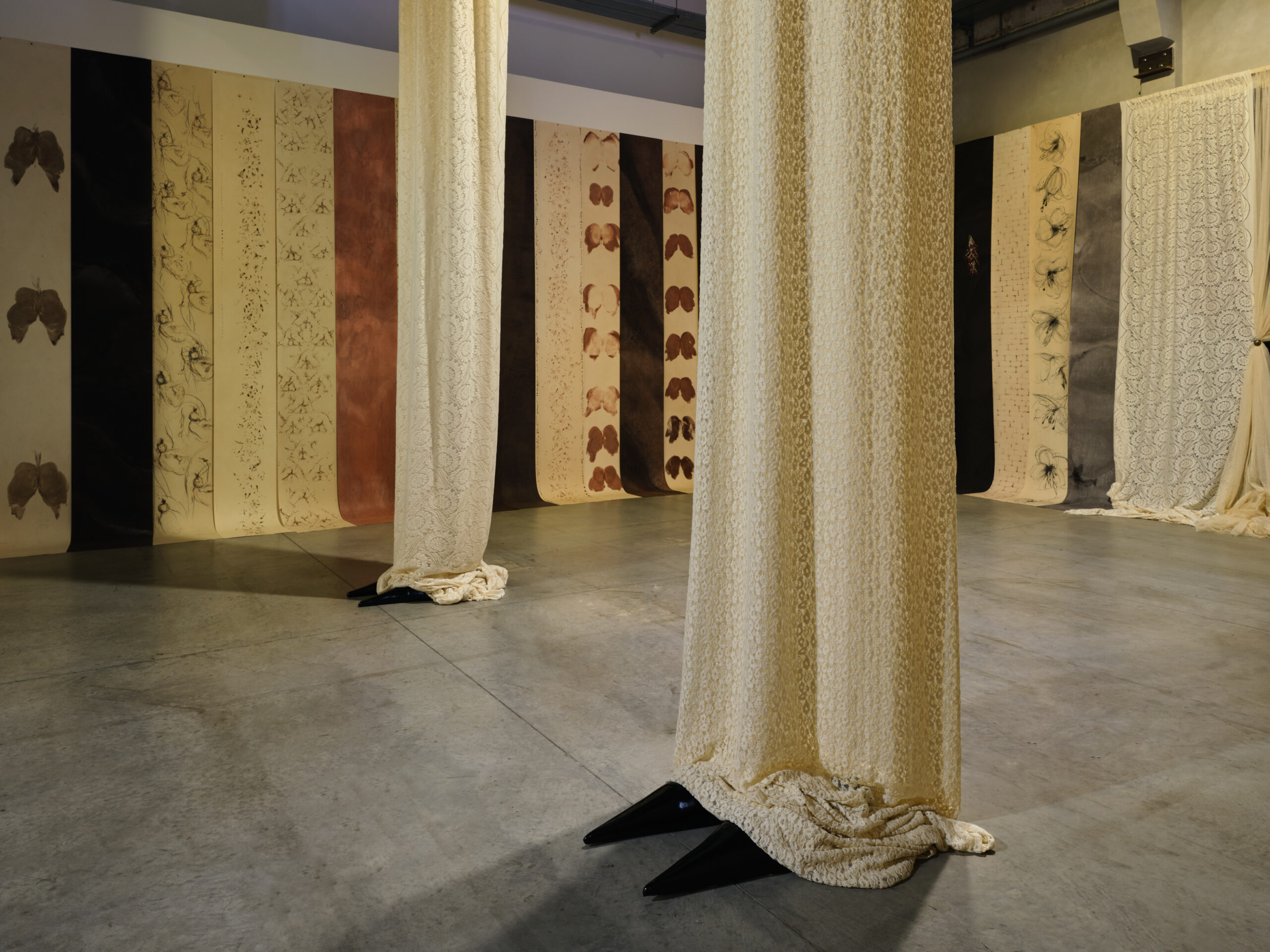
Benni Bosetto, Gli occhi, 2026, installation view, Pirelli HangarBicocca, Milan, 2026. Produced by Pirelli HangarBicocca. Courtesy the artist and Pirelli HangarBicocca, Milan. Photo Agostino Osio
Exhibitions at Pirelli HangarBicocca—from Anselm Kiefer’s permanent installation The Seven Heavenly Palaces (2004–2015) to Take Me (I’m Yours) (2017–18), Neïl Beloufa’s Digital Mourning (2021–22), and Nari Ward’s Ground Break (2024)—have consistently embraced the institution’s monumental scale without hesitation. Every square metre appears carefully considered, never accidental, even (or some would say: especially) when deliberately left empty. I suspect a similar intentionality lies behind the seemingly casual fragments scattered throughout Rebecca: scraps of old newspapers and cardboard, crumbs on the floor, coiled cables placed among meticulously arranged objects. These details are essential because they fracture the illusion of total scenography. Without them, the exhibition might risk becoming overly theatrical—even though Bosetto herself openly acknowledges her fascination with the codes of staging.
Ultimately, the exhibition is grounded in sensitivity, emotion and transformation as collective experience. Bosetto and curator Fiammetta Griccioli seek to cultivate a sense of lightness, rest and pleasure, consciously opposing the pervasive cult of productivity. Rebecca becomes a “sensorial manifesto” that reflects upon the tensions defining contemporary life: freedom and control, self-determination and constraint, productivity and desire. To resist the logic of efficiency is one of the central ambitions of the slow making of this exhibition. Up to the point that even daydreaming itself is proposed as a form of resistance.
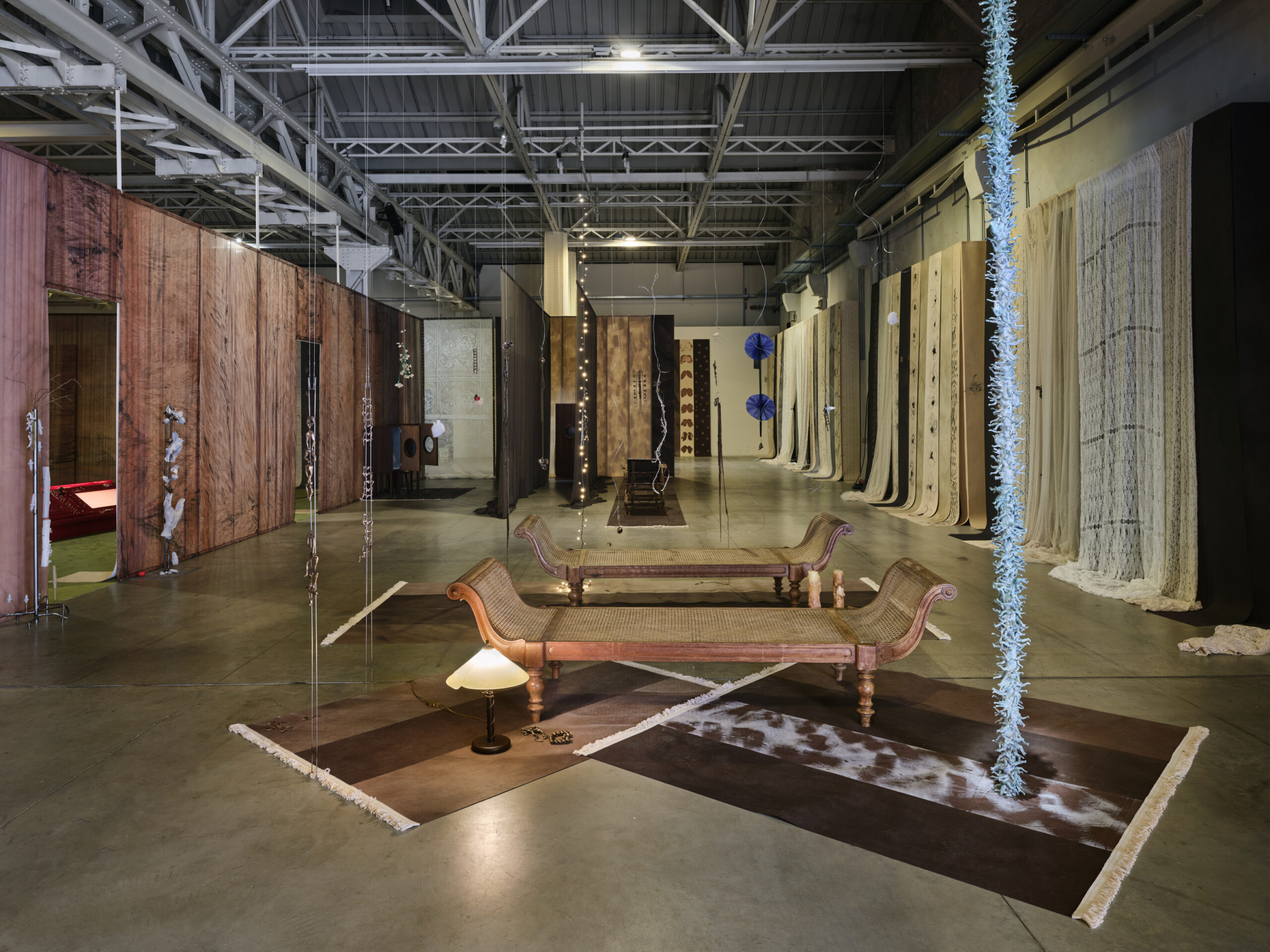
Benni Bosetto, Rebecca, Exhibition view, Pirelli HangarBicocca, Milan, 2026. Courtesy the artist and Pirelli HangarBicocca, Milan. Photo Agostino Osio