


– and the world apart, twice ( horizont ) –
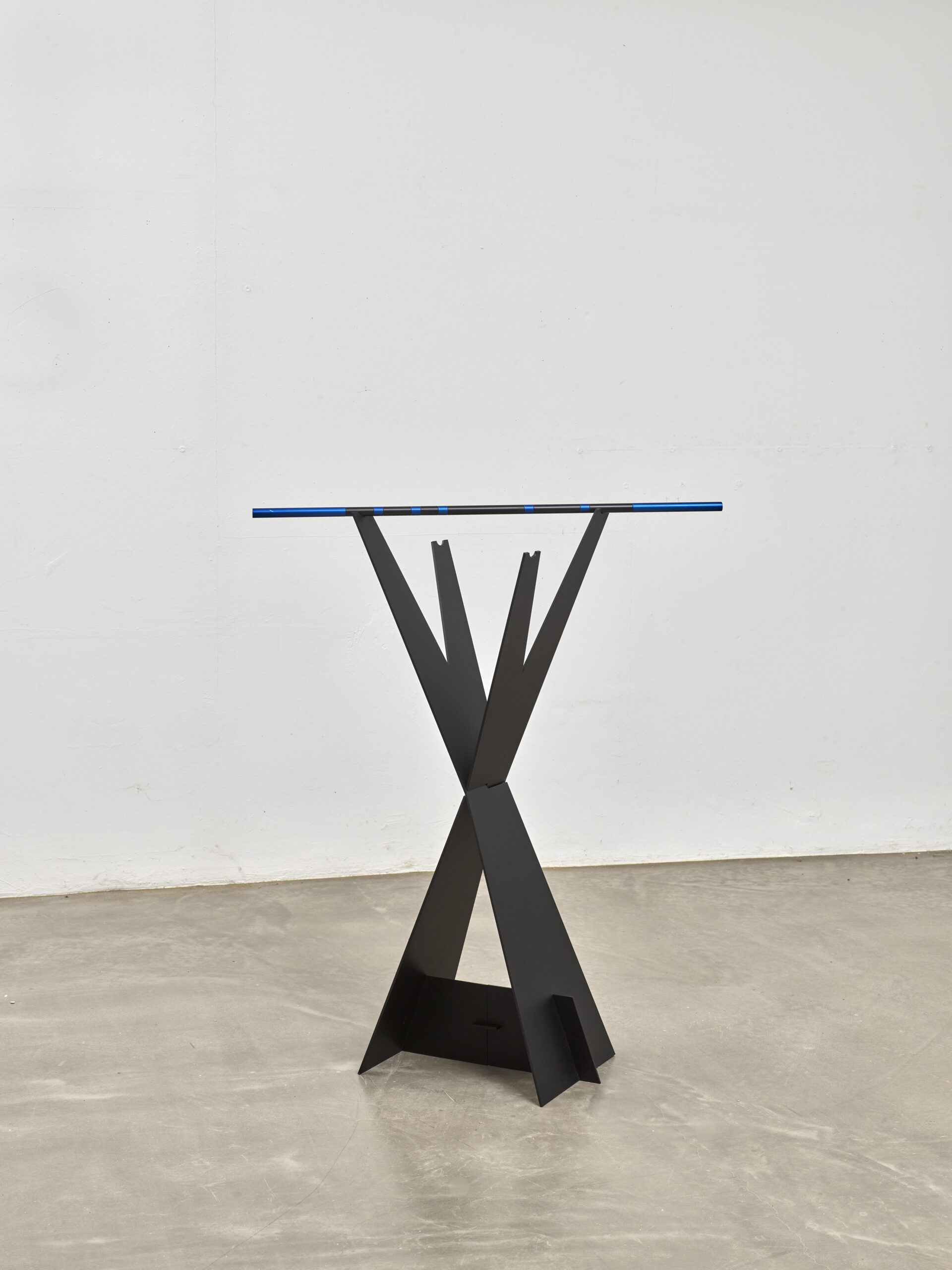
“The question for me was about language as a material. And about pushing the objects into a context of meaning. How to do that in the physical world? How to make objects which incorporate this process instead of being victims of it? In a way I didn’t have to look at objects to learn about sculpture. I could just refigure or reconstruct shapes which were already existing in language, like metaphors or common places. The idea of language as a place for the work was the true incentive”
Harald Klingelhöller
__________
Harald Klingelhöller’s first exhibition at the Tucci Russo gallery took place in 1993.
Since the mid-1980s, Harald Klingelhöller has occupied a unique position at the intersection of sculpture and language. Defining himself as a “linguistic flaneur,” he transforms the written and spoken word into three-dimensional form. His practice creates a tension between narrative elements and visual art, employing a wide range of materials — from fragile paper, cardboard, and glass mirrors to heavy steel and granite.
Klingelhöller’s sculptures can be read as spatial transcriptions of language, playing with intonation, repetition, and the linear flow of letters. The metaphorical and poetic phrases he utilizes — drawn from the press, poetry, or medical and legal texts — are far more than mere titles. Instead, they establish a framework where language and object coexist without ever being entirely congruent. It is precisely this lack of congruence that Klingelhöller explores: the unpredictable relationship between the word and the parallel world of objects.
This open-ended dialogue allows his oeuvre to serve as a metaphor for a specific understanding of art: one that insists on the autonomy of the work while simultaneously inviting discourse on its meaning.
In the exhibition, entitled – and the world apart, twice ( horizont ) -, the works on display are dated 2026 and thus represent the most recent evolution of the artist’s aesthetic; they are presented at different levels: suspended, on the floor or, in the case of the (Horizont) series, along a horizon line, supported by a lectern, onto which the words comprising the title are metaphorically transferred.
The suspended works are to be understood as constellations, in which previously created sculptures reappear in the form of their shadows (altered in size and multiplied as distorted three-dimensional silhouettes). They reveal a level of balance and resonance with what is evoked by the words that gave each earlier sculpture its title.
“In the journey from the object to its shadow, from the object to its concept, and from the Event to memory, something always remains in an infinite space that we do not know.”
The moment of suspension enters the imagination.
The floor-standing works, such as the ‘stars’, are made of solid metal forms (copper, brass, lead and powder-coated sheet steel) with a trapezoidal cross-section, each with one end at a right angle and the other cut diagonally. The wider, parallel trapezoidal surface faces upwards, and its dimensions are determined by the respective sizes of the words printed in the title (mostly in bold, uppercase Neue Helvetica).
The star-shaped sculptures represent a transformation of everything evoked by the words in the title into a condensed form, creating a new, non-identical presence. As the project developed, the idea of a complete transfer was abandoned, and the star shape came to be understood as a further form of presence for what has already been evoked and what remains to be evoked.
__________
Harald Klingelhöller (Mettmann, Germany, 1954) lives and works in Düsseldorf, Germany. Since the 1980s his work has been exhibited in numerous museums, institutions, galleries and art events around the world such as: Skulptur Projekte Münster, Germany (1987); P.S.1., New York, USA (1987); Kunsthalle Bern, Switzerland (1988); Contemporary Arts Museum Houston, USA (1989); Whitechapel Art Gallery, London, UK (1990); Stedelijk Van Abbemuseum, Eindhoven, Netherlands (1990); Art Gallery of York University, Toronto, Canada (1996); Lenbachhaus, Munich (1997); Städtische Galerie, Karlsruhe, Germany (2005); Serralves Museum, Porto, Portugal (2007); Musée d’Art Moderne Grand-Duc Jean, Luxembourg (2009); Skulpturenpark Waldfrieden, Wüppertal, Germany (2013); Skulpturenhalle, Neuss, Germany (2022). He took part in Documenta 9 in Kassel in 1992.