


All of a Sudden, Between Us
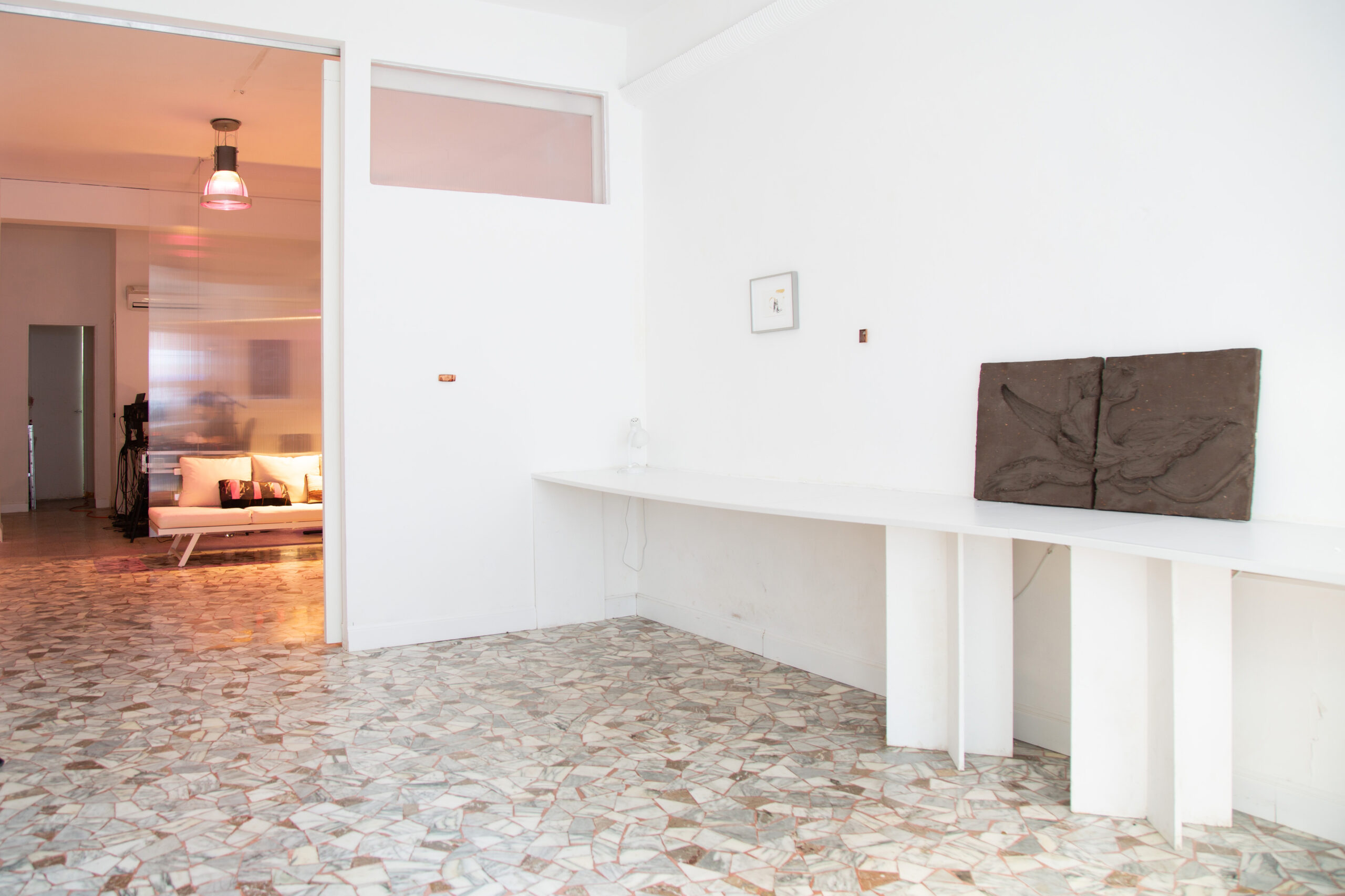
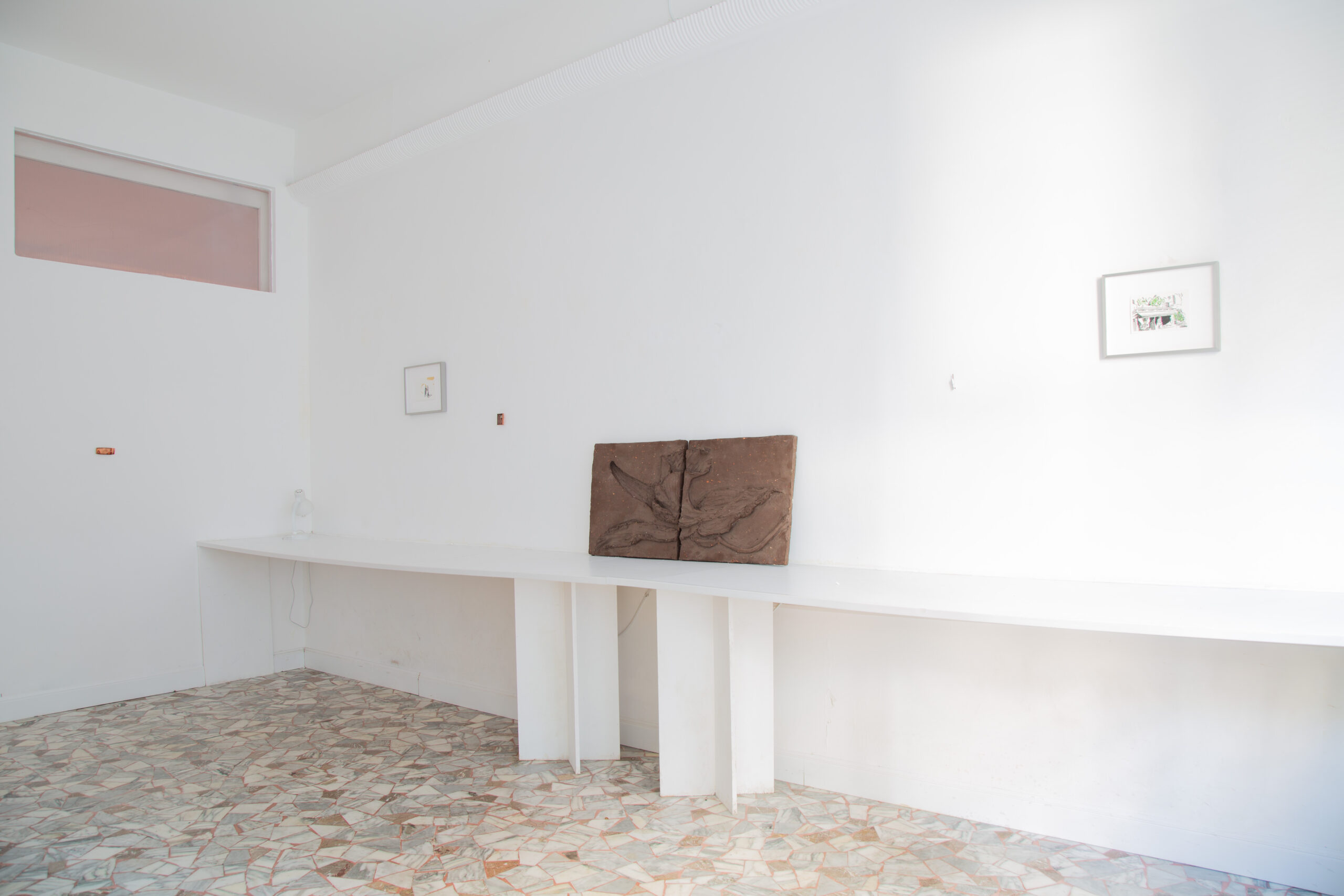
All of a Sudden, Between Us emerges from a constellation of encounters, friendships and shared trajectories developed over the years between Rome and Denmark. The project takes shape from curatorial research begun during a period spent in Denmark and continued through exchanges with Danish artists, or artists based in Denmark, met in both institutional and independent contexts: conversations, returns, unexpected proximities, connections built over time.
With this project, 10 documents continues its public research program dedicated to affection as a relational force: that which moves bodies, shapes communities, and redefines critical thought. Through exhibitions, workshops, publications, and sonic and performative acts, 10 documents investigates how relationships, bonds, and proximity can become aesthetic, political, and social material.
The title points to the sudden emergence of something that happens “between” people: a tension, a presence, a resonance that surfaces in the fragile space of encounter. From this perspective, the exhibition is not built around a unified narrative, but as a field traversed by diverse practices, generating unexpected continuities between experiences and sensibilities. The works on view bring together artists of the same generation — Alberte Agerskov, Erdal Bilici, Mads Dallas Borre, Aia Sofia Coverley Turan, Vala T. Foltyn, Benjamin Savi — alongside materials from the Henning Christiansen Arkiv, opening the exhibition to different temporalities. They move across installation, sculpture, screen printing, sound, video, drawing, text and archival materials.
All of a Sudden, Between Us thus approaches the exhibition as a temporary space of cohabitation, where artistic, affective, and research bonds keep transforming one another.
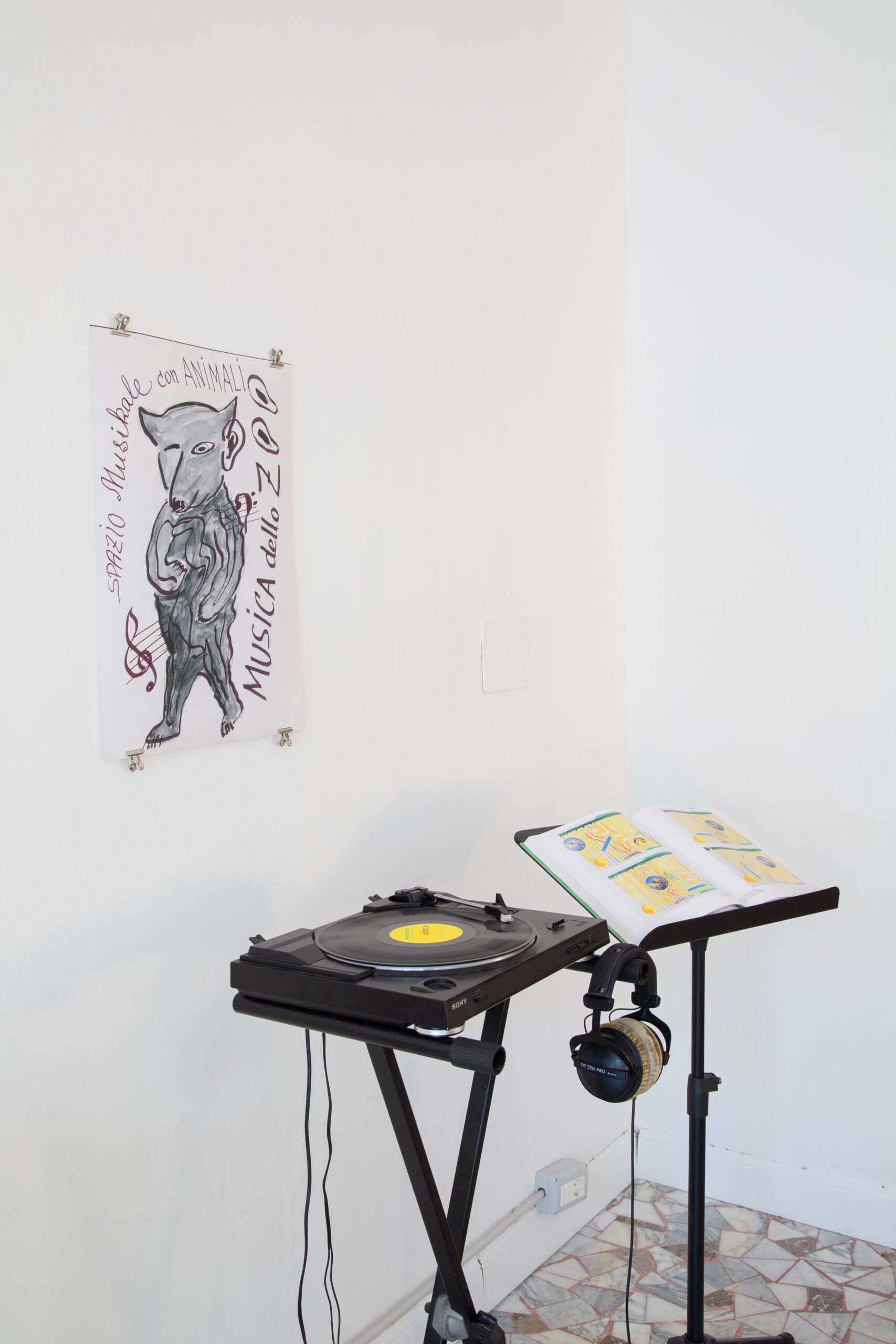
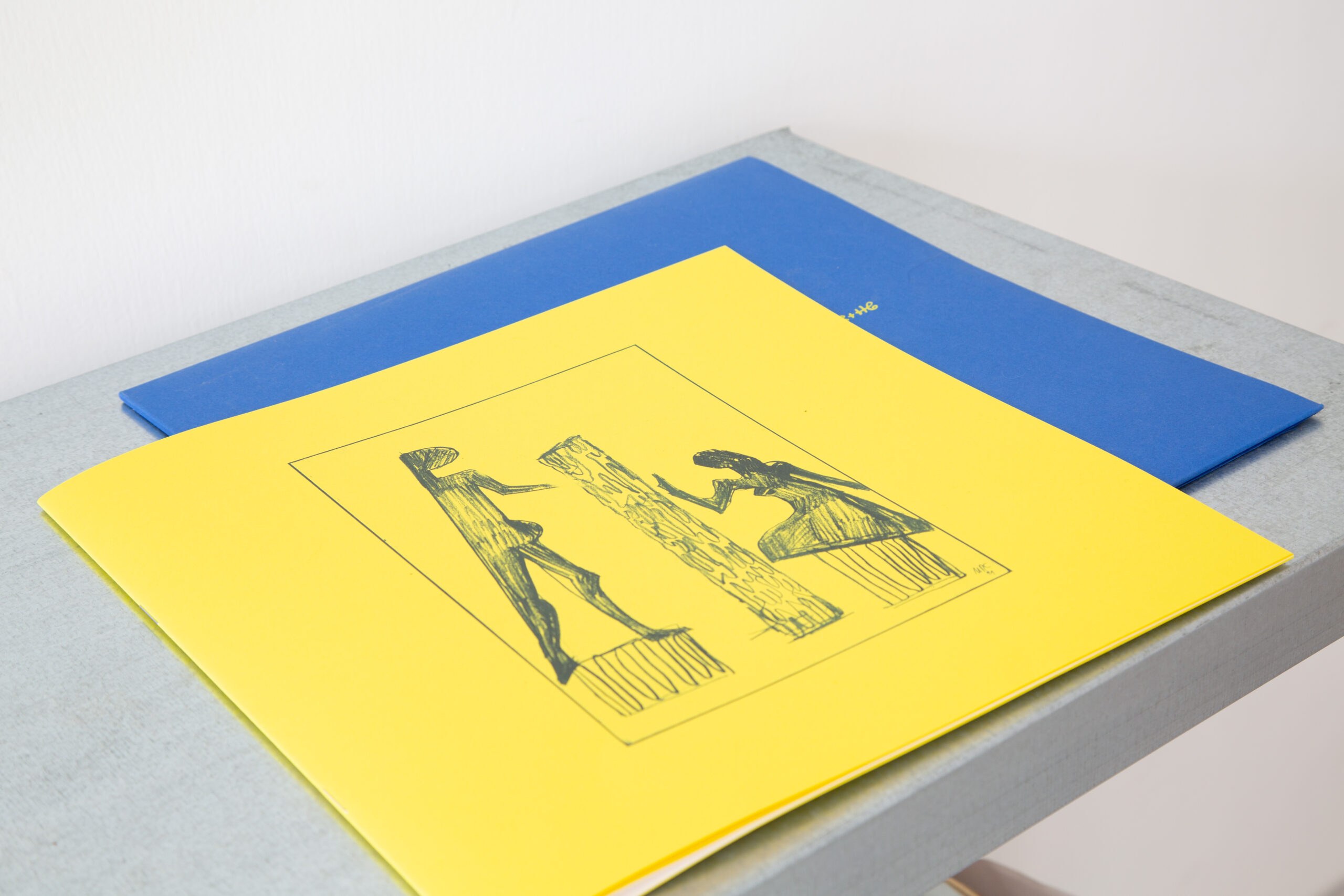
The exhibition begins with materials from the Henning Christiansen Arkiv. A central figure of the Fluxus movement, Henning Christiansen (1932–2008) introduces a different temporal register: his works precede the others by decades and initiate a dialogue across generations, practices, and imaginaries. On view are posters and scores from Symphony Natura op. 170 (1985), recorded at the Rome Zoo with Lorenzo Mammi and first performed as a site-specific installation for eight loudspeakers; the vinyl Mediterranean Music Water op. 203, recorded with Ursula Reuter Christiansen at Teatro Gebel Hamed in Erice in 1991; and the extensive monographic publication on Christiansen — over 500 pages, the most important on his work to date. That both recordings were made in Italy places the archive within the same Denmark–Italy geography the exhibition moves through.
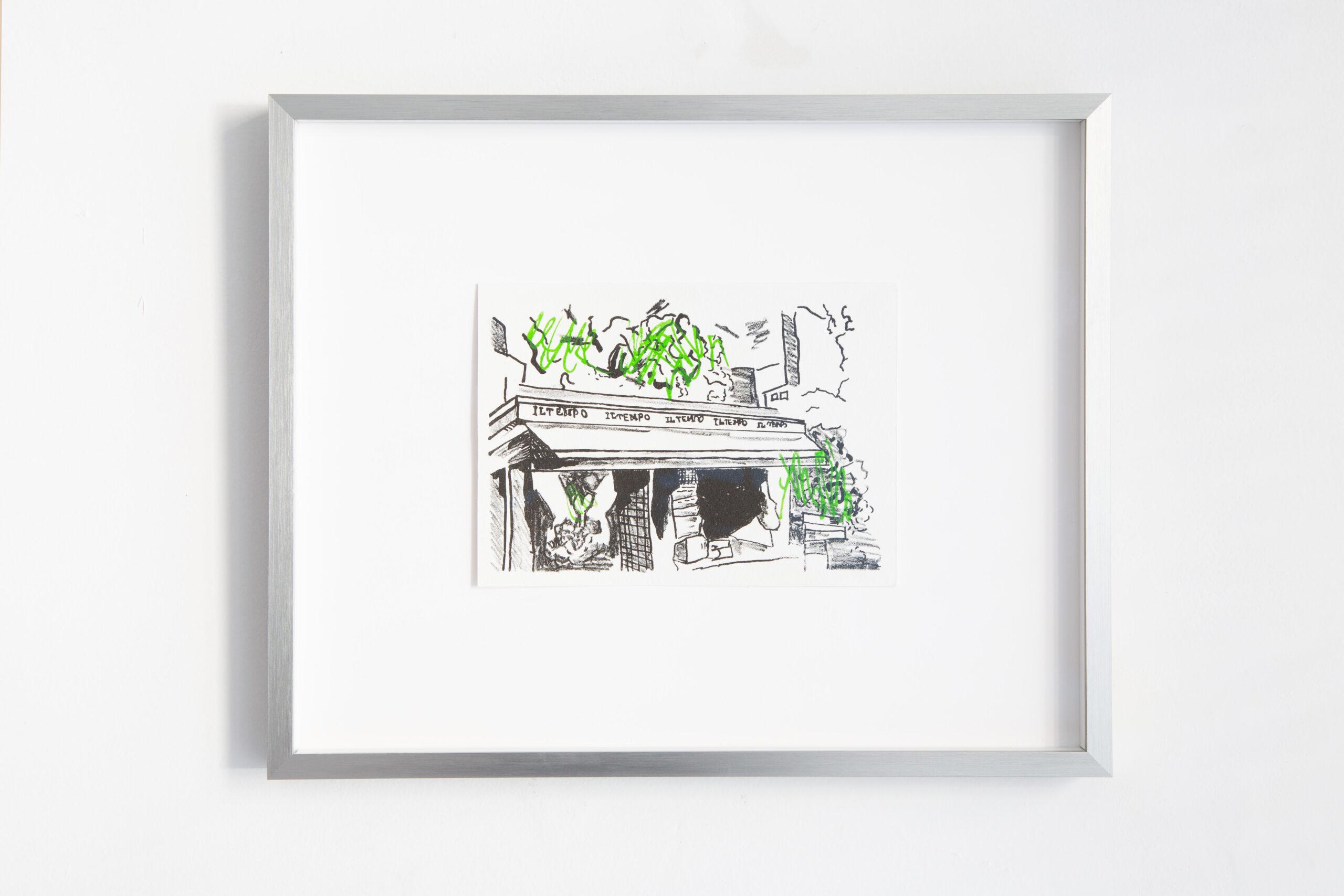
This geography returns in two works by Benjamin Savi from the series Postcards from Rome (2025). Hand-printed with the Eugene Brisset star-wheel press by the Bulla sisters at Litografia Bulla and reworked through layered applications of color that mimic unpredictable marks — coffee stains, crayon, pen — the works take up Piranesi’s etchings and early postcards of Roman views, filtered through Savi’s recent explorations of the city. Made in Rome during a residency at the Circolo Scandinavo, the prints open a dialogue between modes of representing the past and the present. The interplay between the graphic gesture, its erasure and its legibility highlights the instability of written communication, with screen printing turning ephemeral traces of daily life into reproducible forms.
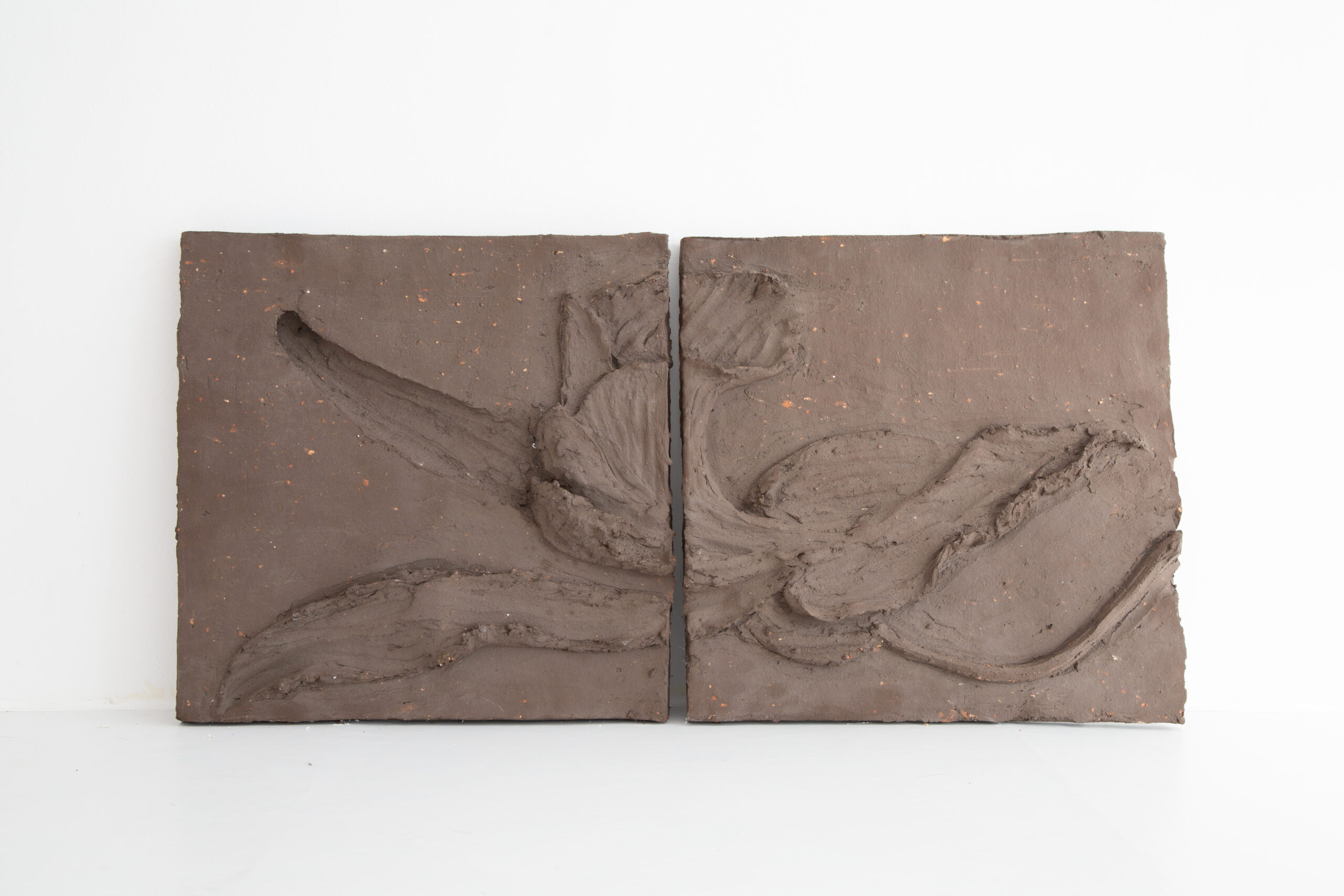
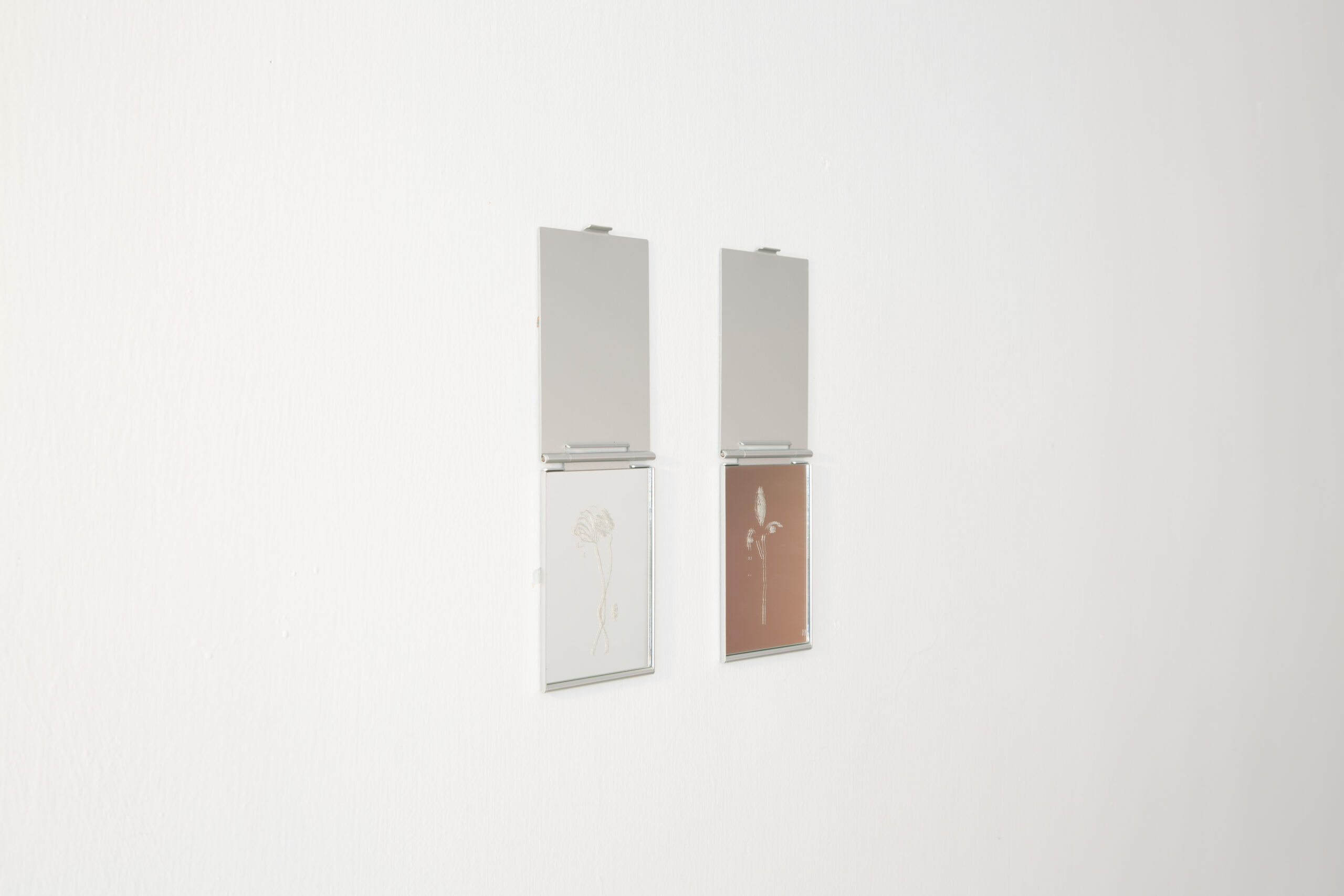
Alberte Agerskov works across even longer spans of time. BF 03 (Bad Flowers 03) (2025), a diptych in fired English and German clay brick, and PM 02, PM 03 (Pocket Mirror 02, 03) (2025), engraved aluminium mirrors, come from her research on Silphium — a wild contraceptive that grew in the forested meadows of Cyrene, a former Greek colony, around 600 BC and was gone by around 100 BC: the first plant recorded as extinct through human use. Agerskov operates trans-historically, reading present concerns — among them the West’s role in the history of contraception — through the plant’s obscured record. The same flower reappears in both works, shifting in scale. In the clay, a material long associated with the building of dwellings, it is enlarged; on the surface of the mirrors, objects tied to feminine imaginaries of self-care and intimacy, it is reduced.
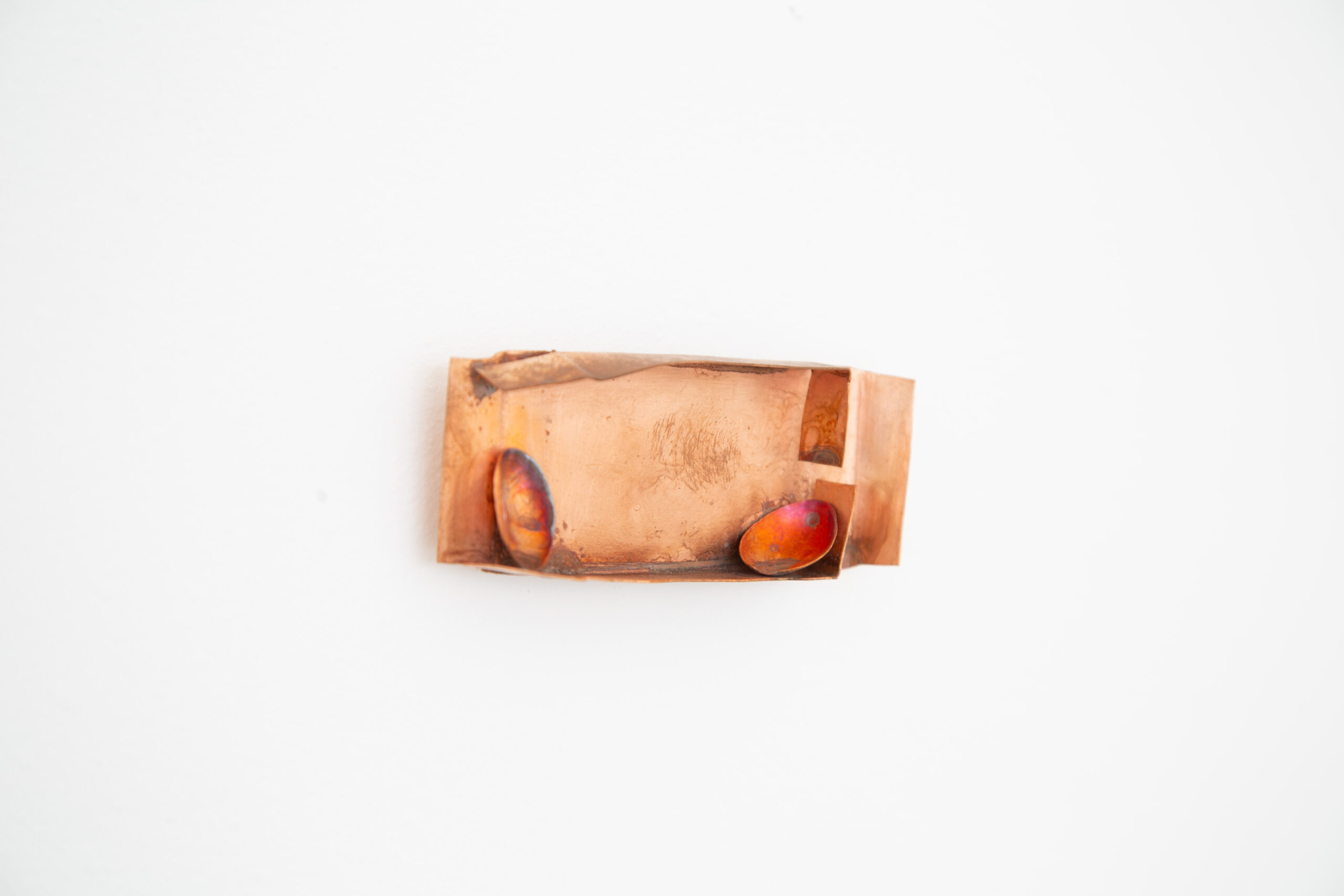
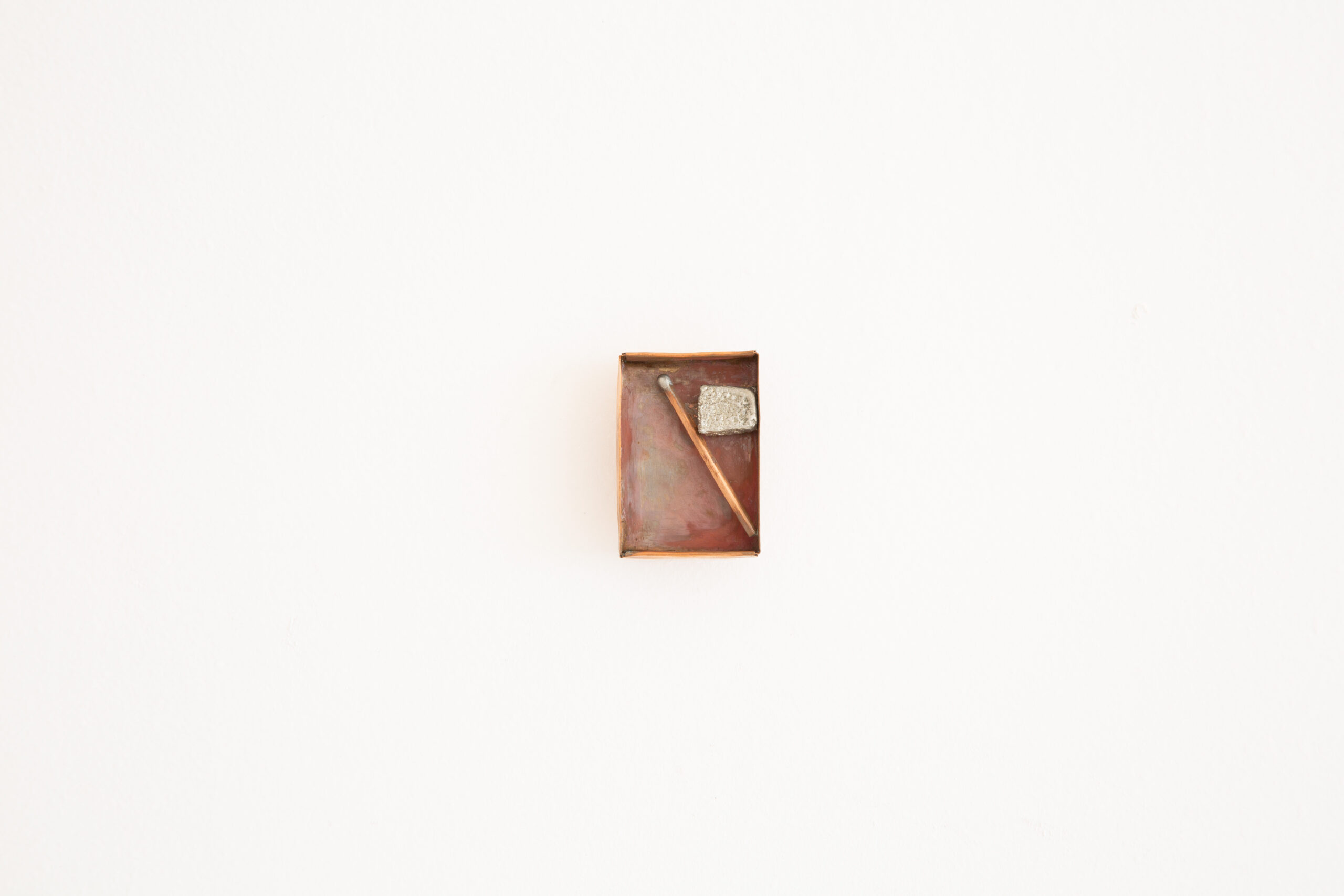
The works shown by Aia Sofia Coverley Turan also operate on a small scale, drawing on histories of repression and resistance rooted in the artist’s Kurdish identity. Her copper sculptures, from the series Cluttered Paradise (2023–2025), are shaped as matchboxes that recall tiny portable architectures, sometimes holding perishable elements such as sugar cubes and pistachio shells. These works question the capacity of objects to hold memories, to take in stories, events and affections, showing how forms of belonging can emerge through everyday rituals. Copper — a material strongly tied to the craft traditions of Turkey — changes over time, oxidizing, darkening and absorbing the marks of touch. For Coverley Turan, this mutability reflects the fluid, layered nature of identity and of diasporic experience, suspended between strangeness and familiarity.
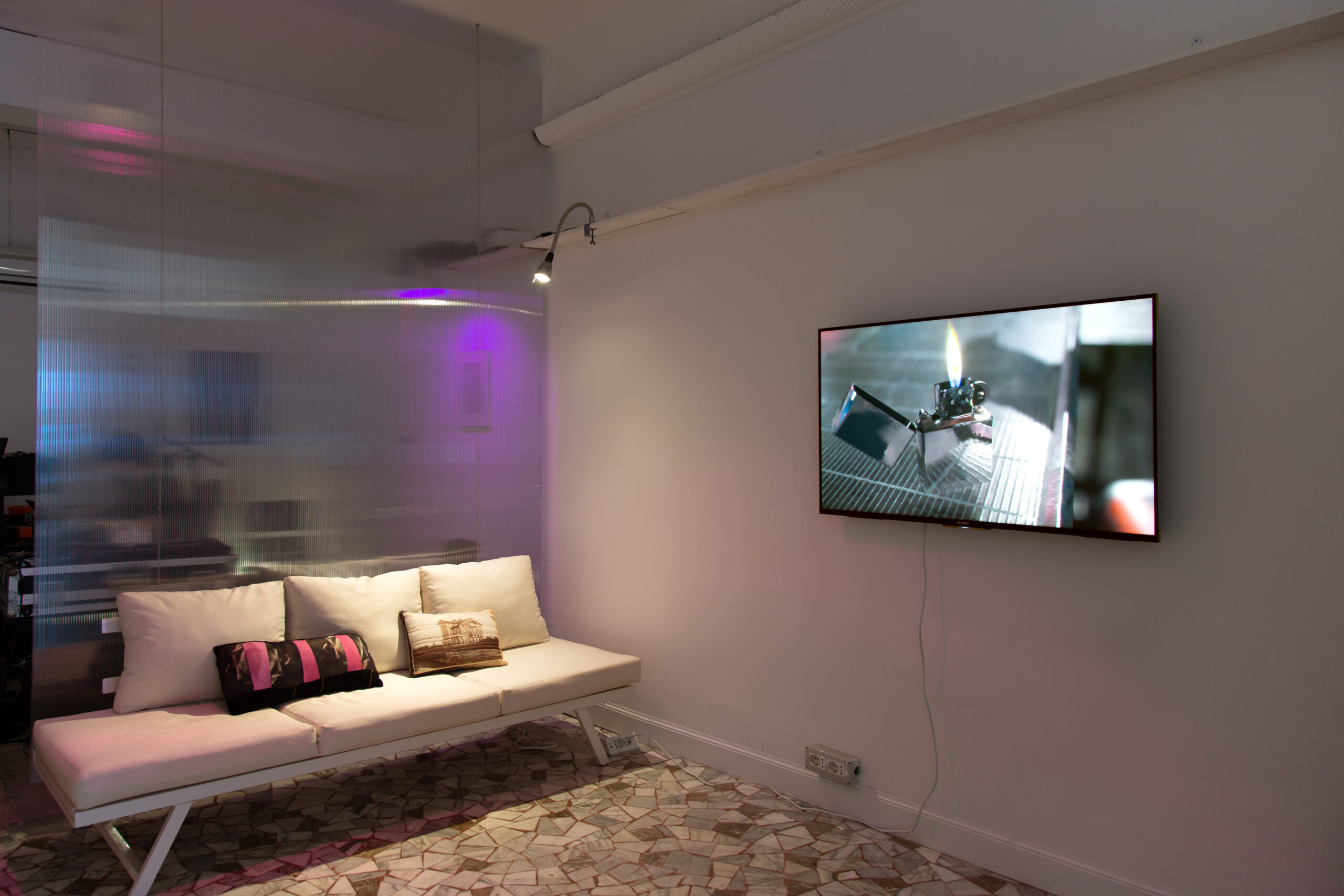
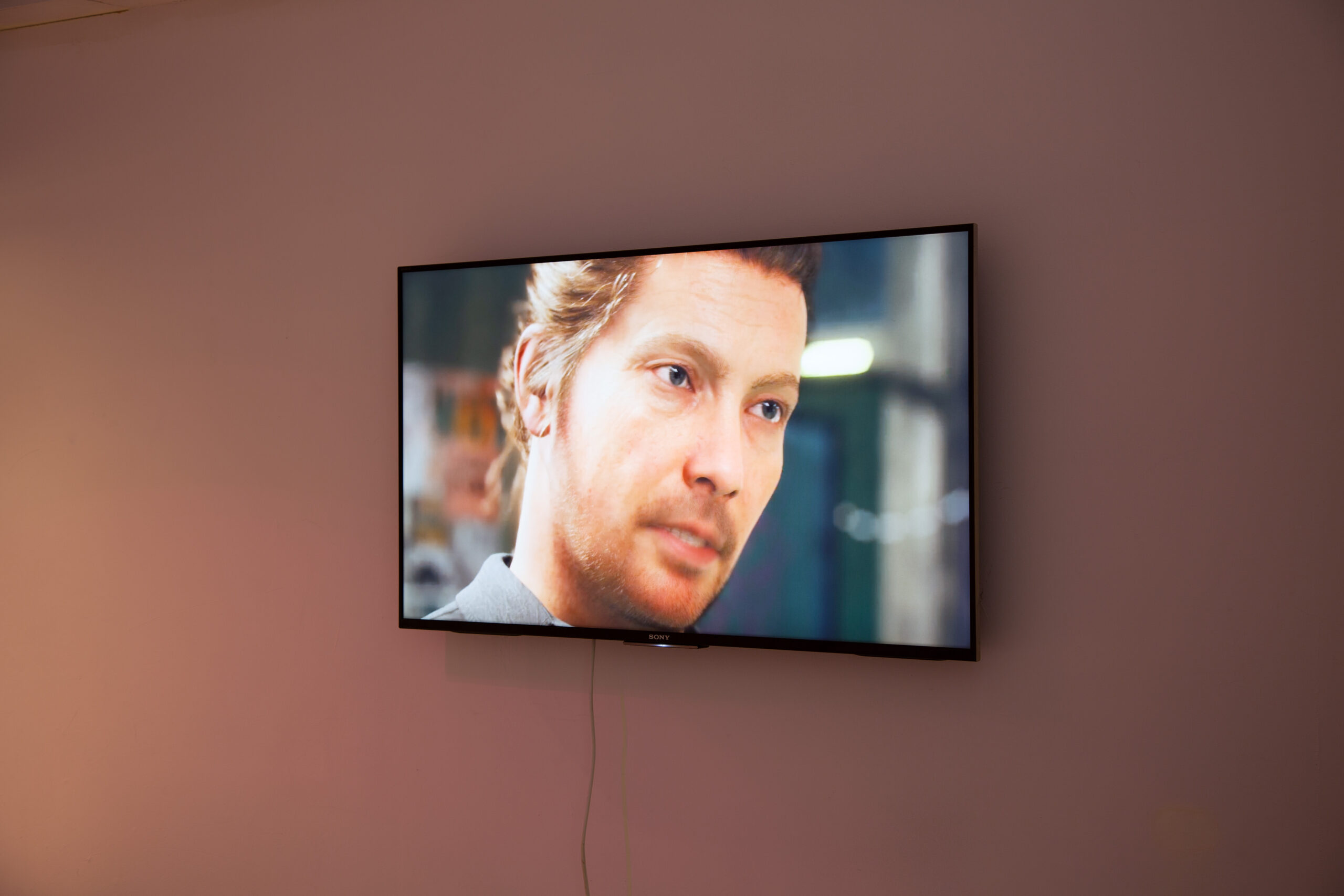
The second room opens with Rest (2025), in which Erdal Bilici shifts the reflection toward the thresholds of perception and the technological mediation of memory. Born from a field trip in search of a cave, the video gathers fractured environments and narratives voiced by 3D-animated characters, moving between two registers: the post-industrial sites and early Christian iconography of the Danish island of Møn, and rendered digital landscapes. What at first appears linear dissolves into textures of time: a montage of states of mind in which perception slips between illusion and clarity, fiction and memory, simulation and embodied experience. The cave — archaeological site and figure of withdrawal — becomes the spatial articulation of a threshold at once geological, technological, and psychic.
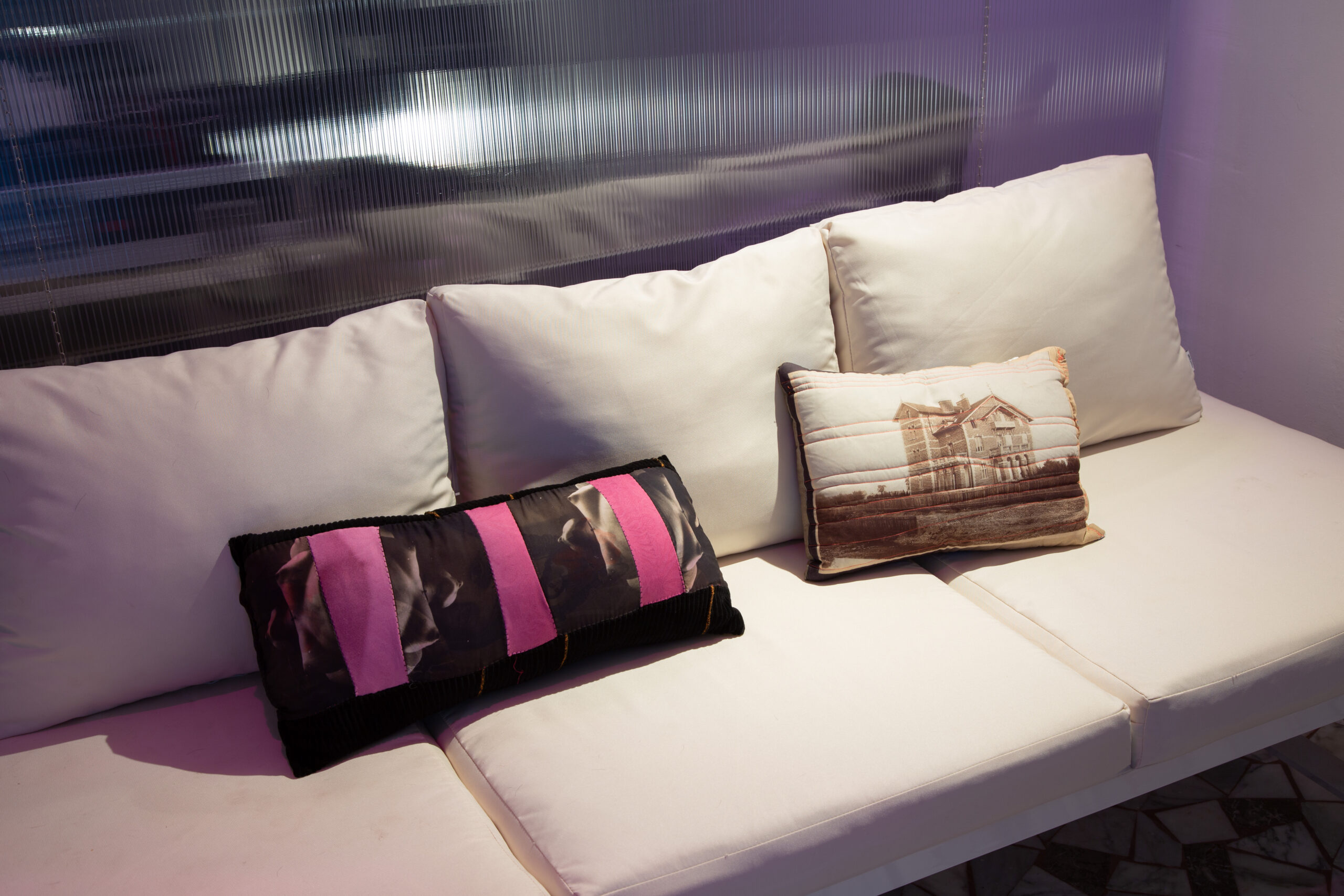
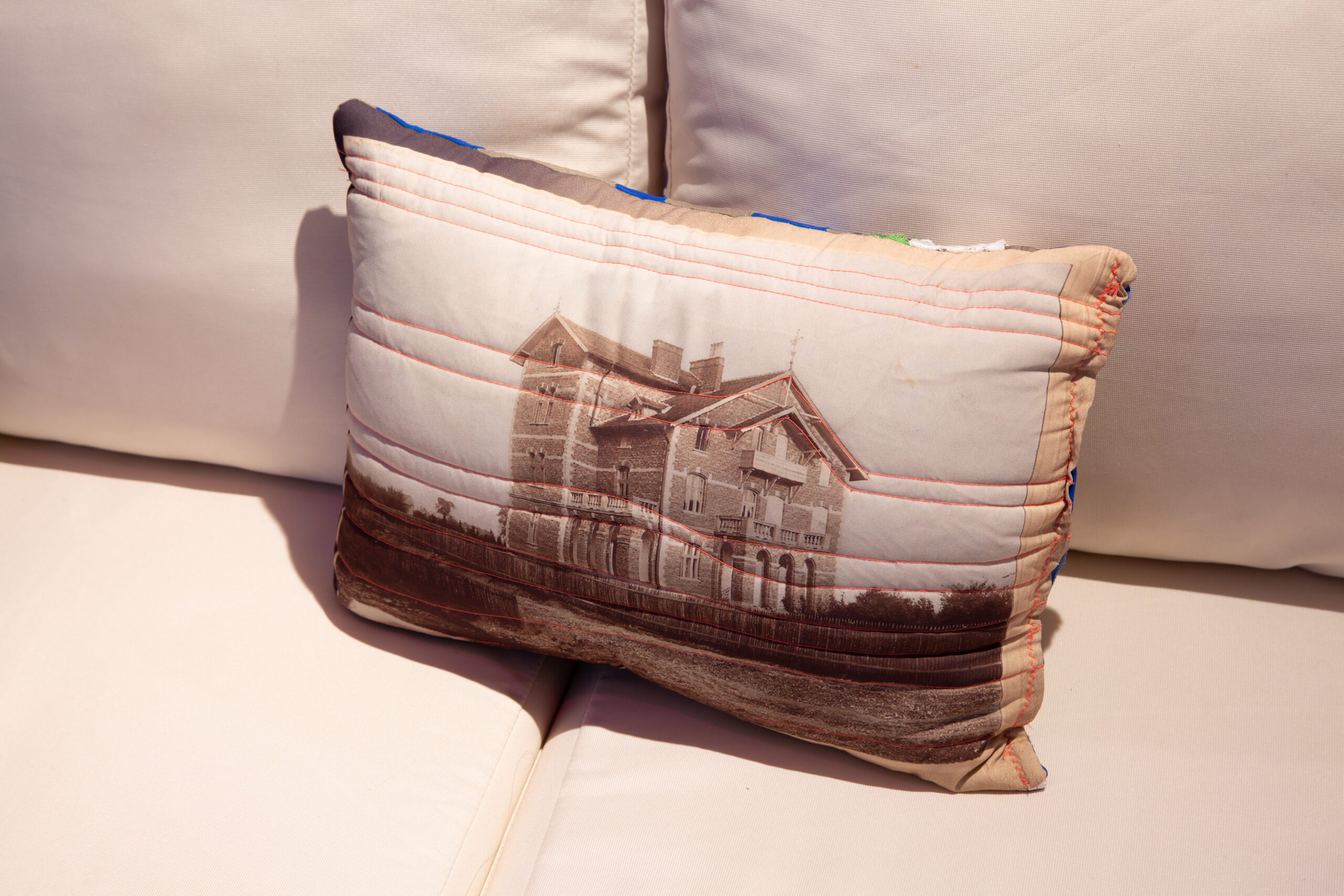
Vala T. Foltyn’s new textile works, Untitled (Szwedzka 8) (2026), bring into the room traces of an archive transposed into domestic objects. The cushions come from her ongoing research on Szwedzka 8, an early-twentieth-century villa in Kraków that holds stories of resistance from the Second World War, and which was also the home where the artist lived between 2014 and 2018. With the collective Lamella, the villa became Kraków Art House — a refuge, an exhibition space and a think tank that hosted the city’s queer community, until her forced eviction and departure from Poland. Photographs, objects and layered images of the place’s inhabitants and ghosts have travelled with her all the way to Denmark, where Foltyn now lives, becoming the material of these new works. Soft and tactile, the cushion holds the trace of bodies and turns the archive into something to be touched, leaned against, lived with.
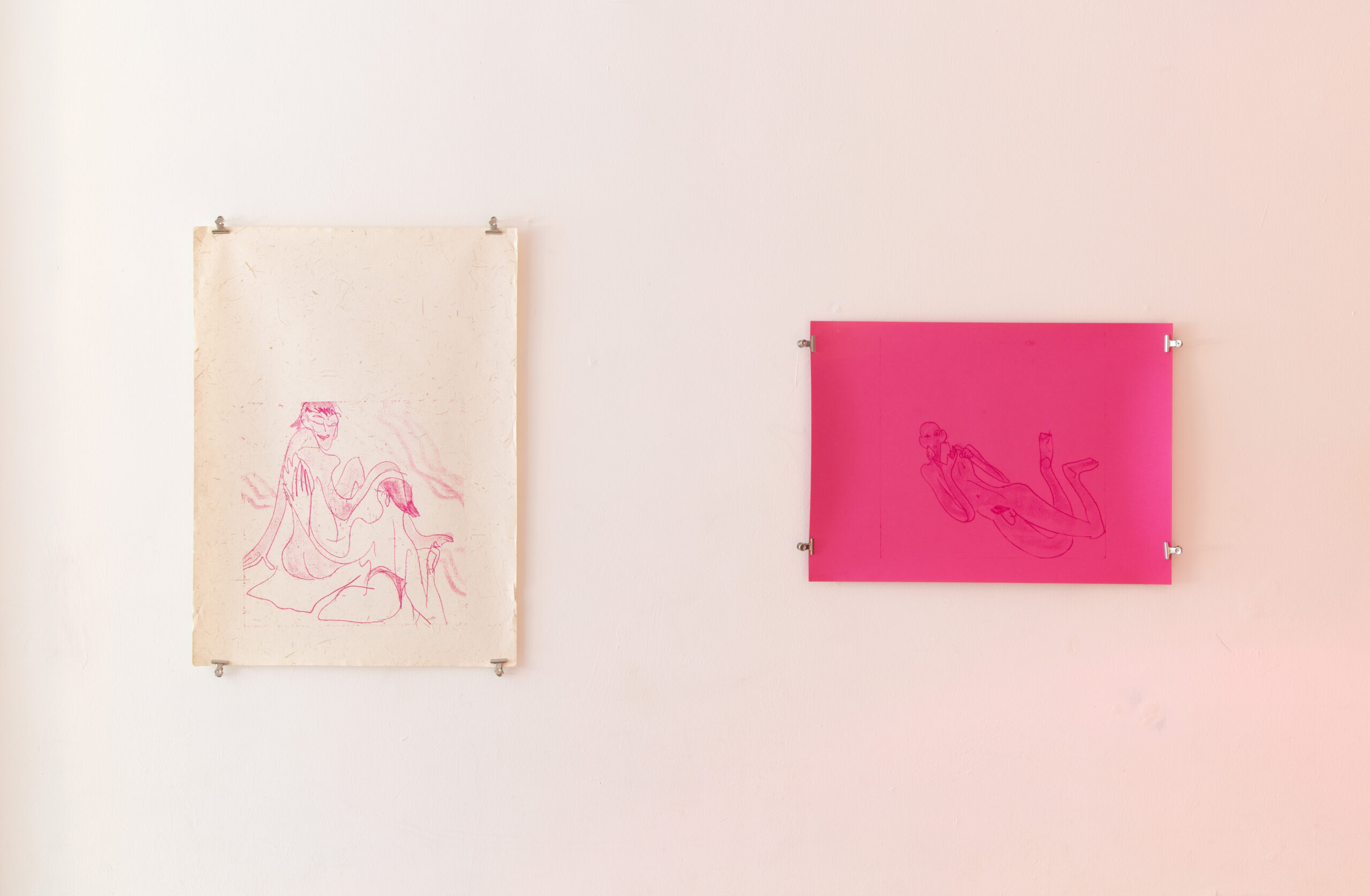
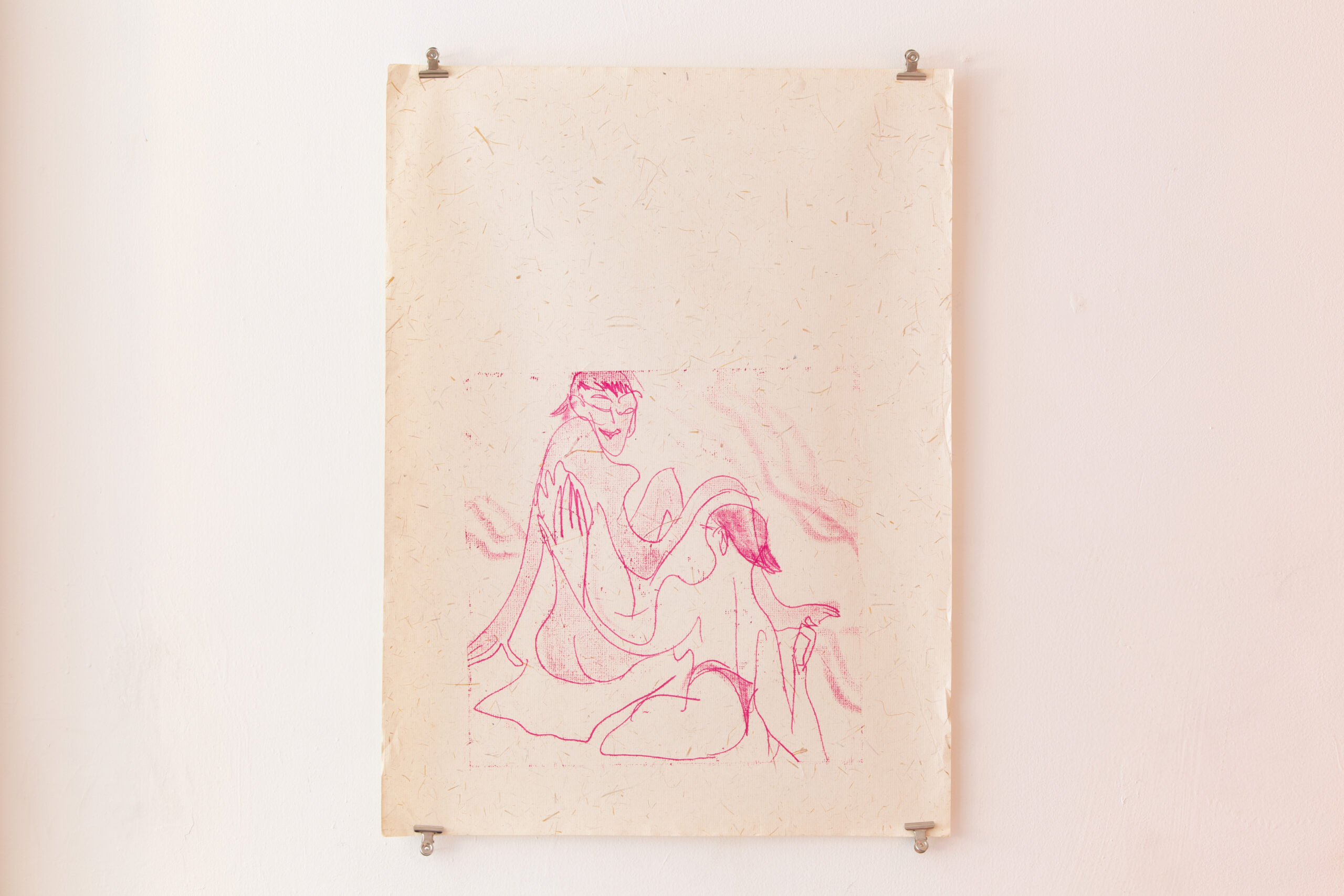
The same attention to the domestic takes a different inflection in the monotypes of Mads Dallas Borre, Sunscreen (2023) and Untitled (2023). Part of an ongoing series, the works portray everyday life outside the gaze of authority and normative influence: scenes of intimacy, concentration, sex, reading, contemplation and distraction set in messy and unruly interiors. Such scenes — “queer bodies in queer settings, and in their own queer time,” as the artist describes them — recur throughout Borre’s work and shift shape depending on the material or medium. The monotype, bound to the singular gesture, becomes itself an occurrence that cannot be repeated.
__________
Alberte Agerskov (Skive, 1993) is an artist and architect exploring the relationship between body and place through ideas of porosity and desire. Drawing on new materialist feminisms, she works across sculpture, performance, text and video. She holds a BA in Architecture from the Royal Danish Academy and an MA in Fine Art from Central Saint Martins. She has exhibited at Esposizione Sud Est, Den Frie Udstillingsbygning, Galleria Continua, and the Architectural Association in London.
Erdal Bilici (Van, 1985) is an artist from the Kurdish region of Turkey, based in Copenhagen. Working across video, installation, performance and sculpture, he explores how media shape our senses, memories and desires. His work has been presented at Kunsthal Charlottenborg, Kunsthal 44Møen, Den Frie, Bilsart Istanbul, and the Julia Stoschek Foundation. He also co-organises artist-run platforms in Copenhagen, including dummy and Jennifee-See Alternate.
Mads Dallas Borre (Gentofte, 1988) is an artist based in Aarhus. He holds an MFA from the Jutland Art Academy (2019) and Newcastle School of Art (2018). Working across sculpture, drawing, sound and performance, his practice unfolds in context-specific installations where fragments, queerness, repetition, poetry and improvisation meet a sustained attention to materials. Recent solo exhibitions include Sissy Morphology at Politikens Forhal in Copenhagen (2024) and A Thousand Lost Handkerchiefs at Jyllands-Posten in Aarhus (2024). He has further exhibited at ARoS, O—Overgaden, Bergen Kunsthall, Museum KØN, Kunsthal Aarhus, and Den Frie. He received the Aarhus Art Prize – Solo Prize (2023) and the Carl Nielsen Talent Award as a composer (2024).
Aia Sofia Coverley Turan (Copenhagen, 1994) graduated from the Royal Danish Academy of Fine Arts in 2019. Through the interplay of light and heavy materials, the sketched and the cast, she investigates how language, cultural history, and the political dimensions of emotion shape us individually and collectively. She has exhibited at HFKD, 44Møen, Den Frie, Lateral Roma, Simian, Heerz Troya, and KØS Museum of Art in the Public Space. Her works are part of the Danish Arts Foundation’s and Copenhagen Municipality’s collections.
Vala T. Foltyn (Nowa Sól, 1986) is a performance and installation artist, queer witch, and art researcher, founder of Lamella the House of Queer Arts, based in Copenhagen. Her practice develops a methodology of queering and witching the archives as a strategy of resistance and a mapping of territories of violence. She holds an MFA in Artistic Research from Malmö Art Academy and has been in residence at Art Hub Copenhagen. Her work has been presented at Zachęta Art Museum, Zamek Ujazdowski CSW, Bunkier Sztuki, MOCAK, and the Modern Art Museum in Warsaw.
Benjamin Savi (Copenhagen, 1992) lives and works in Denmark. His work spans painting, drawing, graphic art and installation, marked by a strong dialogue with the stylistic and historical traditions of each medium. In recent years he has collaborated with graphic workshops in Denmark and abroad, where diverse local contexts have become integral to his practice. He graduated from the Royal Danish Academy of Fine Arts in 2019 and has exhibited at Kastrupgårdsamlingen, Fea Initiative, COI, and The Elizabeth Foundation for the Arts.
Henning Christiansen (Copenhagen, 1932 – Møn, 2008) was a Danish composer and a central figure of the Fluxus movement. Resisting the idea of the isolated artistic genius, he developed a collaborative practice across music, performance, and visual art, working with Joseph Beuys, Nam June Paik, Bjørn Nørgaard and his wife and lifelong collaborator Ursula Reuter Christiansen. From 1985 he was professor of multimedia at the Hochschule für bildende Künste in Hamburg. He lived on the island of Møn for nearly forty years, where he co-founded the artists’ colony 44Møen. The Henning Christiansen Arkiv preserves and activates his legacy.
__________
10 documents is a platform for artistic, curatorial, and theoretical research developed through public research programs, each dedicated to a different object of inquiry. Through exhibitions, gatherings, publications, conversations, and sonic or performative acts, it creates a living archive each time — a collective lexicon built through presence, reiteration, and listening. Inspired by the Documents journal directed by Georges Bataille in 1929–1930 — and its appendix in particular — it treats documents as matter and language as an index. Founded in 2025 by Ginevra Ludovici and Flavio Michele, 10 documents falls for almost anything.