

Fantastica ma non troppo (in English)
by Dobroslawa Nowak
24.12.2025
Clicca qui per leggere la versione italiana
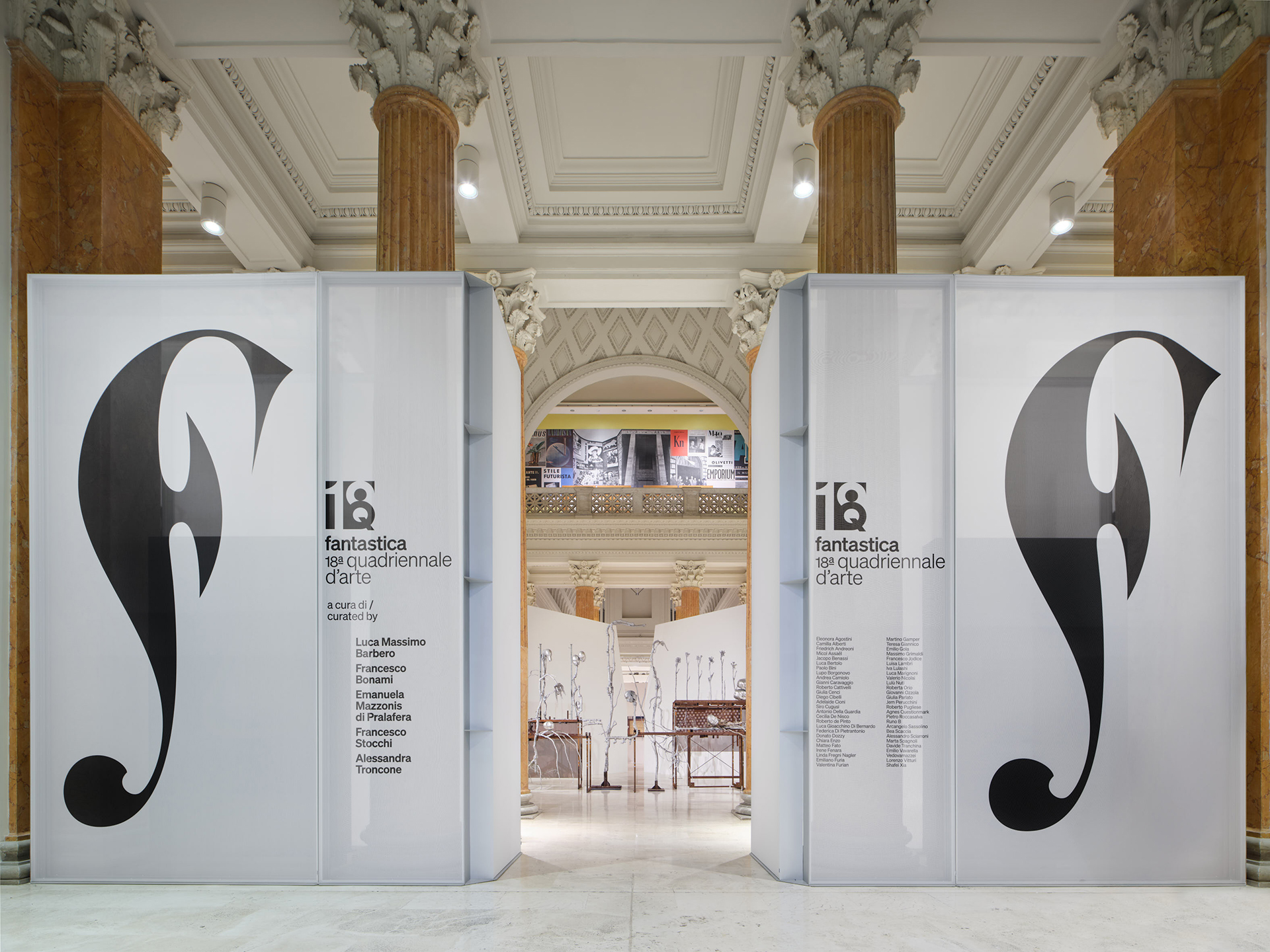
Fantastica approaches the first quarter of the twenty-first century in Italian art as a field of plural positions rather than a linear narrative. Works by fifty-four artists, born between the 1960s and the late 1990s, are arranged along five curatorial paths shaped by Luca Massimo Barbero, Francesco Bonami, Emanuela Mazzonis di Pralafera, Francesco Stocchi, and Alessandra Troncone, following the vision of the late art critic Luca Beatrice, who conceived the exhibition before his passing earlier this year.
The most compelling issue raised by Fantastica does not concern the quality of the exhibition or the selection of artists and thematic areas—these, while imaginative and carefully chosen, are nonetheless well known in relation to the last few decades of institutional curatorial practice. The exhibition is remarkably well-executed. What proves truly compelling is a more Heideggerian doubt: whether we can understand the conditions of knowing not as neutral tools, but as forms of existential entanglement with the world, with both subject and observers situated in the present. In this sense, Fantastica frames art as a situated experience rather than detached observation, raising the question of how being-in-the-world makes knowledge possible at all.
That’s why, beyond mere intellectualization or evaluative judgment of particular artists, their works, and the curatorial choices per se, the pressing question becomes: to what extent do the artists—and the curators who shape their presentation—constitute a space in which we might apprehend ourselves, recognizing our own presence and entanglement within the world they construct?
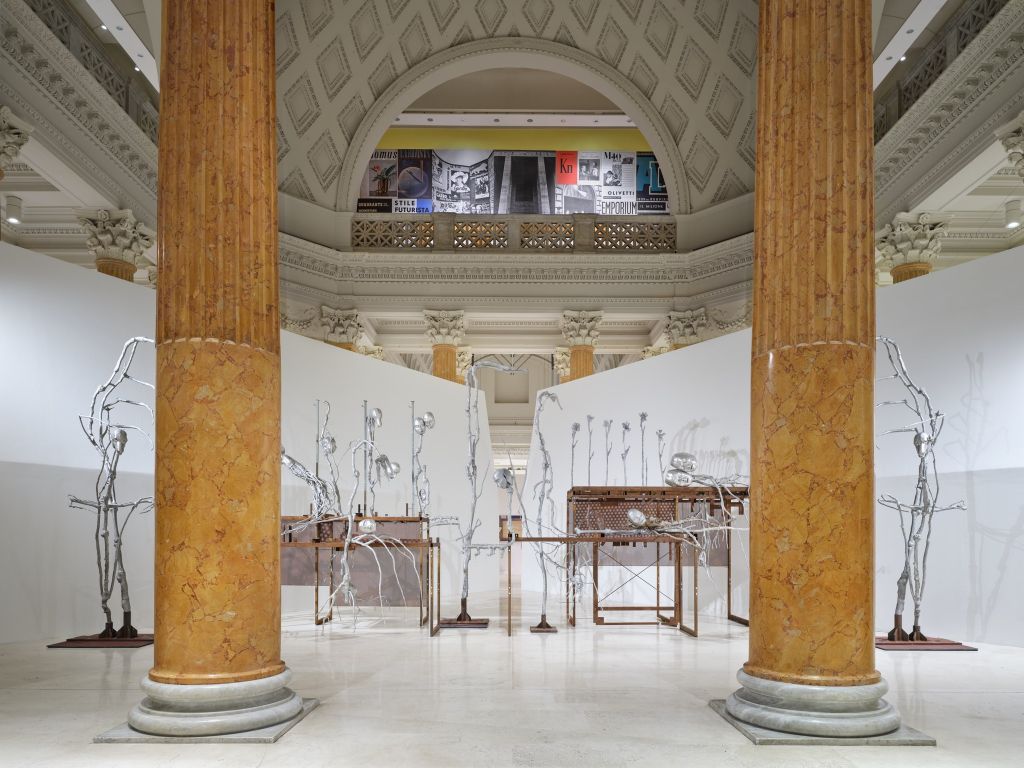
From the very first steps into the spacious atrium of the Palazzo delle Esposizioni—before encountering the first work of the exhibition, Giulia Cenci’s expansive post-apocalyptic installation secondary forest (2024), included in the section Memory Full. A Room of One’s Own curated by Francesco Bonami—we are confronted with a loud, abrasive scraping. The sound originates from the monstrous mechanical arms of a hydraulically operated grabber, which moves unpredictably through the vast, echoing hall to the left of the main entrance. This is Arcangelo Sassolino’s Hunger (2002), whose unsettling noise persists like an auditory afterimage, accompanying us through nearly the entire exhibition.
To temper this tension and remind us that we are still within a museum—a space for inquiry and provocation rather than sheer fear—Luca Bertolo’s large-scale Welcome (2025) nonchallantly “thrown” at the entrance. An ironic contemporary reworking of ancient floor mosaics, its tesserae spell out a word—now the title of the work—more commonly found printed on modern doormats.
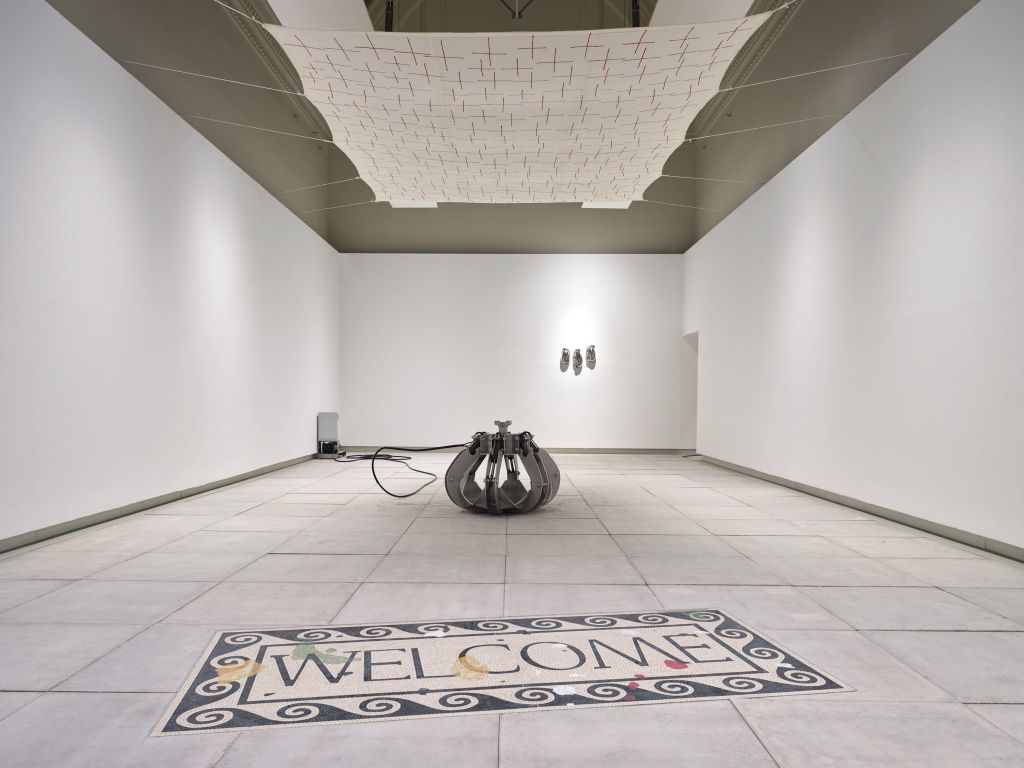
Following in the footsteps of the 1938 Exposition Internationale du Surréalisme, the Untitled section curated by Francesco Stocchi, which includes Hunger, Welcome and other works by a group of nine artists, functions as a laboratory. Rather than illustrating a concept, Untitled opens a space for collective creative action. Artists are engaged in every stage—from conception to spatial design—reclaiming authorship not only of the works themselves but also of the conditions in which they are presented.
On the one hand, it has been a long time since artworks were merely objects to look at. On the other hand, this evolution has been gradual—from interactive works that invite participation we prefer to ignore, to experiences so elementary and transparent that the work becomes uninteresting, to installations so meticulously conceived that they provoke fear, curiosity, and a strange compulsion to approach and retreat at the same time. Whether or not we appreciate the artist’s modus operandi: his industrial installation entwines us with the space, commanding attention and bodily engagement. Moreover, if the work’s forceful appearance in the here and now wasn’t enough, it lingers audibly with us throughout nearly the entire exhibition. Is being intense and obvious the only or the best way to do art? No, but for some it seems to work.
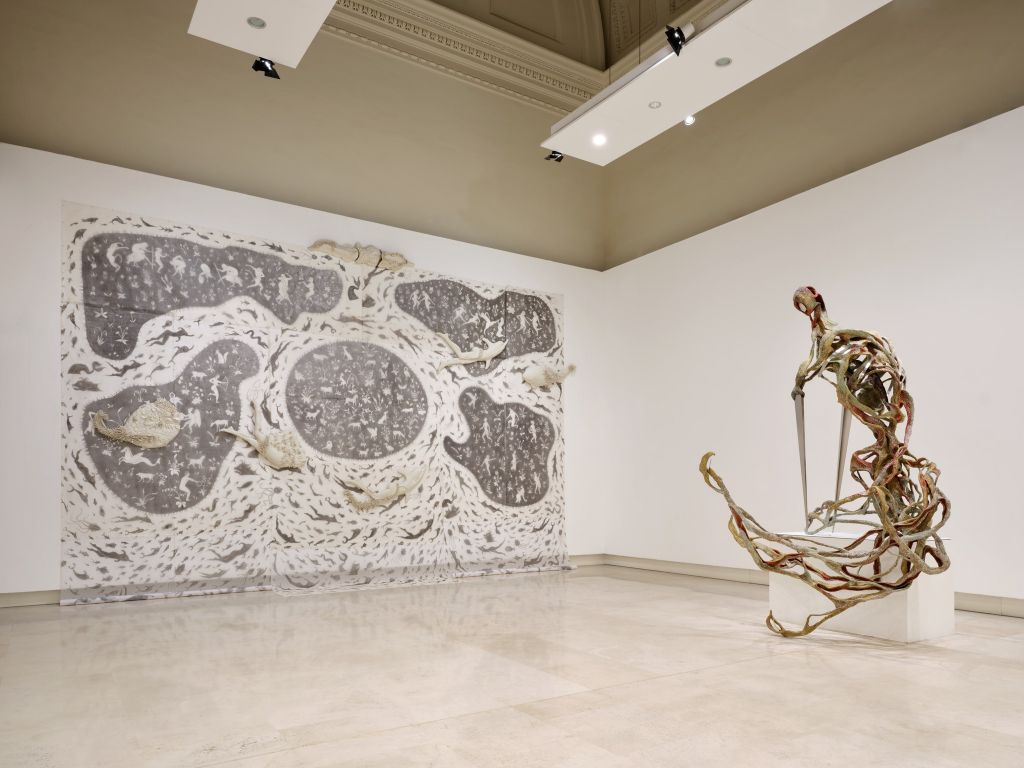
Francesco Bonami emphasizes independence and autonomy by referencing Virginia Woolf’s feminist essay A Room of One’s Own. In this curated section, the artists do not follow a single theme, except for their shared exploration of what Woolf described as an “invisible room of one’s own”: a private world within countless others. The assertion “I am here” is expressed not as domination, but as a presence that transcends gender, ethnicity, nationality, or class. This celebration of personal space, a glorified internal refuge, becomes a statement. Here, space is psychological, intellectual, and mental, resembling a carefully guarded, intimate piece of land, a private garden to nourish. The feeling resonates throughout the section, from Giulia Cenci’s open-ended reflection on humanity, to Roberto Cattivelli’s intimate series of graphite-on-paper drawings and Chiara Enzo’s miniature acquarelle and pastel paintings deeper inside.
Allowing this undefined, uncategorized expression of one’s world is probably the most fitting curatorial response to the multiple existential crises and competing polarities artists face today—torn between the traditional and the digital, autonomy and institutional frameworks, intimacy and public exposure, political engagement and aesthetic withdrawal, precarity and professionalization, visibility and invisibility, and, finally, the desire to commercialize and the resistance to doing so.
Speaking of commercialization, on the right side of the entrance we encounter a questionable practice in the section The Unfinished Body, curated by Alessandra Troncone. In Lifeweave (2025), Emilio Vavarella unapologetically markets his technology-driven product, supported by an extensive list of philosophers—from Vilém Flusser and Byung-Chul Han to Michael Fried and Graham Harman—as well as institutions such as Harvard and MIT. We are accustomed to artworks accompanied by curatorial essays following the familiar formula of two philosophers, one sociologist, and one poet; here, however, this approach verges on parody. The resulting “showroom” logic stands in sharp contrast to what Francesco Bonami sought to celebrate in his nearby section, making the encounter feel particularly dissonant.
Beyond evaluating this specific concept or product, a broader question arises: is a museum—especially one with the historical significance of the Quadriennale d’Arte—the appropriate venue for promoting sales-driven practices?
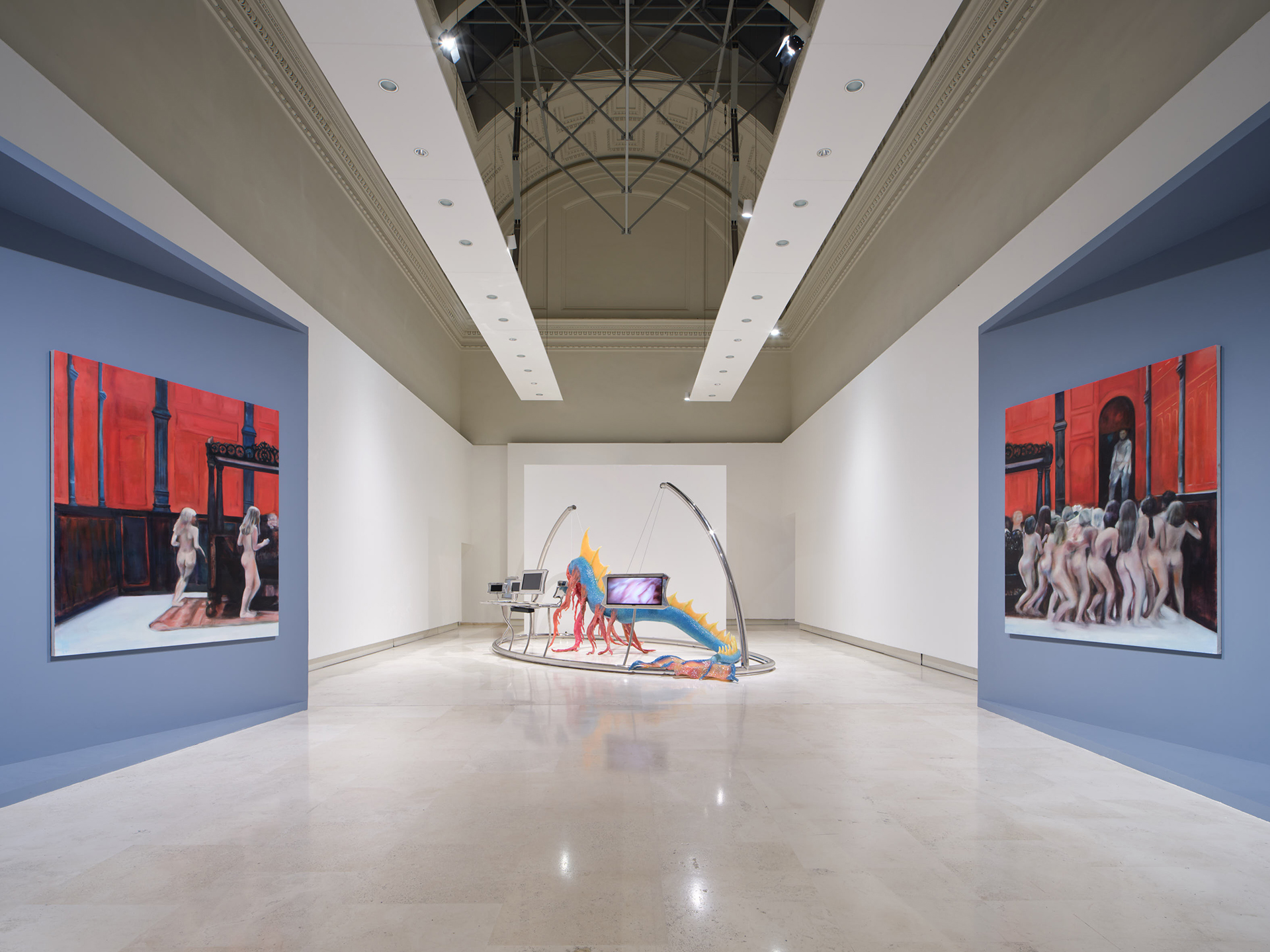
The Unfinished Body, curated by Troncone, encourages a reconsideration of how the human and non-human body are narrated today, engaging myth, science, and social transformation through works that cultivate complex, layered perspectives. Incompleteness is framed as a productive state: a condition of openness, mutation, and relationality. Drawing on genetic research and hybrid imaginaries, the works propose the body as a site of transition rather than essence, inviting readings that reflect broader social and technological transformations.
While the works of nine artists in this section—alongside Iva Lulashi’s compelling pictorial practice, Agnes Questionmark’s coherent explorations, and Valentina Furian’s video Aaaaaaa (2025), presented in complete darkness without a conventional bench, transferring us to an even deeper and more mysterious dimension where body needs to locate itself afresh—add insight, the sales-driven atmosphere established in the first room weaken the overall experience of this section.
In today’s image-saturated world, where selfies, memes, and an endless stream of social media content dominate our attention, art must contend with this visual overload. The Time of Images. Images out of control? section traces the evolution of photography in Italy from 2000 to 2025, showcasing the work of eleven artists whose pieces prompt us to reconsider the value and responsibility of what we see. Emanuela Mazzonis di Pralafera has undertaken the difficult—and impressive—task of exploring photography, a medium often assumed to have nothing new to say. Yet here, the curator goes deeper, unafraid to expand the topic across multiple dimensions: time (as seen in Linda Fregni Nagler’s News from Wonderland, 2023), authorship (Irene Fenara’s Self Portrait from Surveillance Camera, 2018–ongoing), and even challenging traditional notions of both art-making and curating, as demonstrated in Jacopo Benassi’s continuously deconstructing body of works.
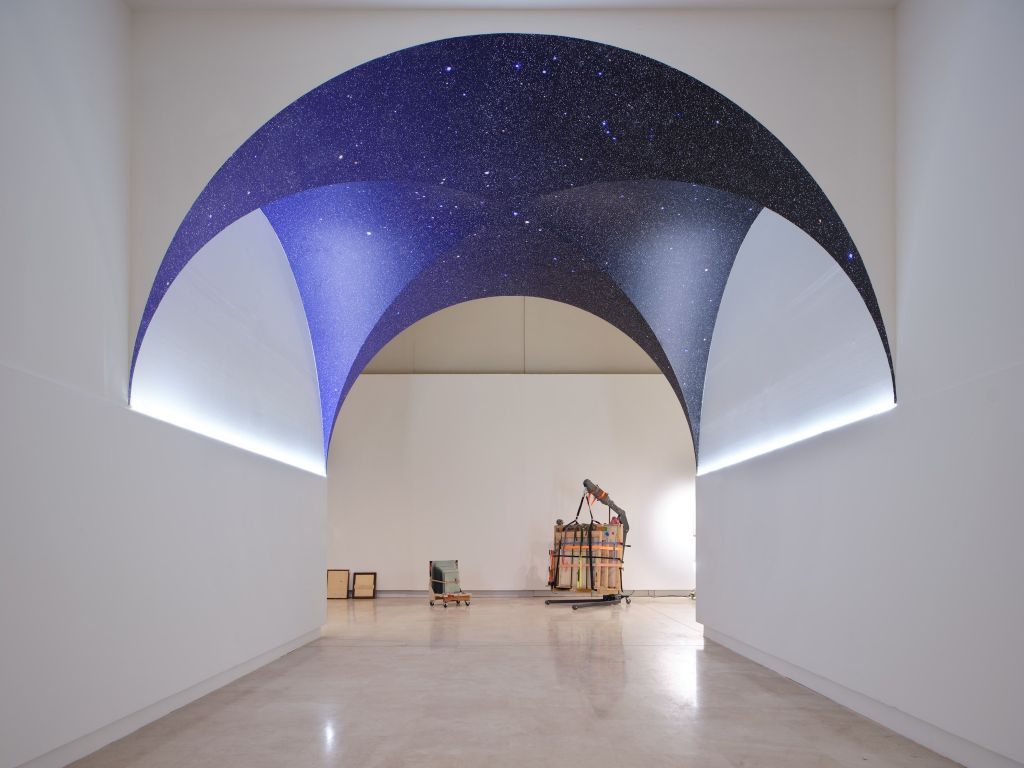
Whether or not the curator of The Time of Images. Images out of control? arrives at definitive conclusions is secondary. What truly deserves recognition is the courage to tackle such a complex subject. Today, photography could hardly be further from merely documenting reality; at its closest, it denies it. What this section actually does is interrogate reality and delight in complicating what seeing entails. The Time of Images. Images out of control? concludes with a video referencing the end of time and black holes—an ambitious, chaotically and joyfully failing attempt to capture everything we know about imagining.
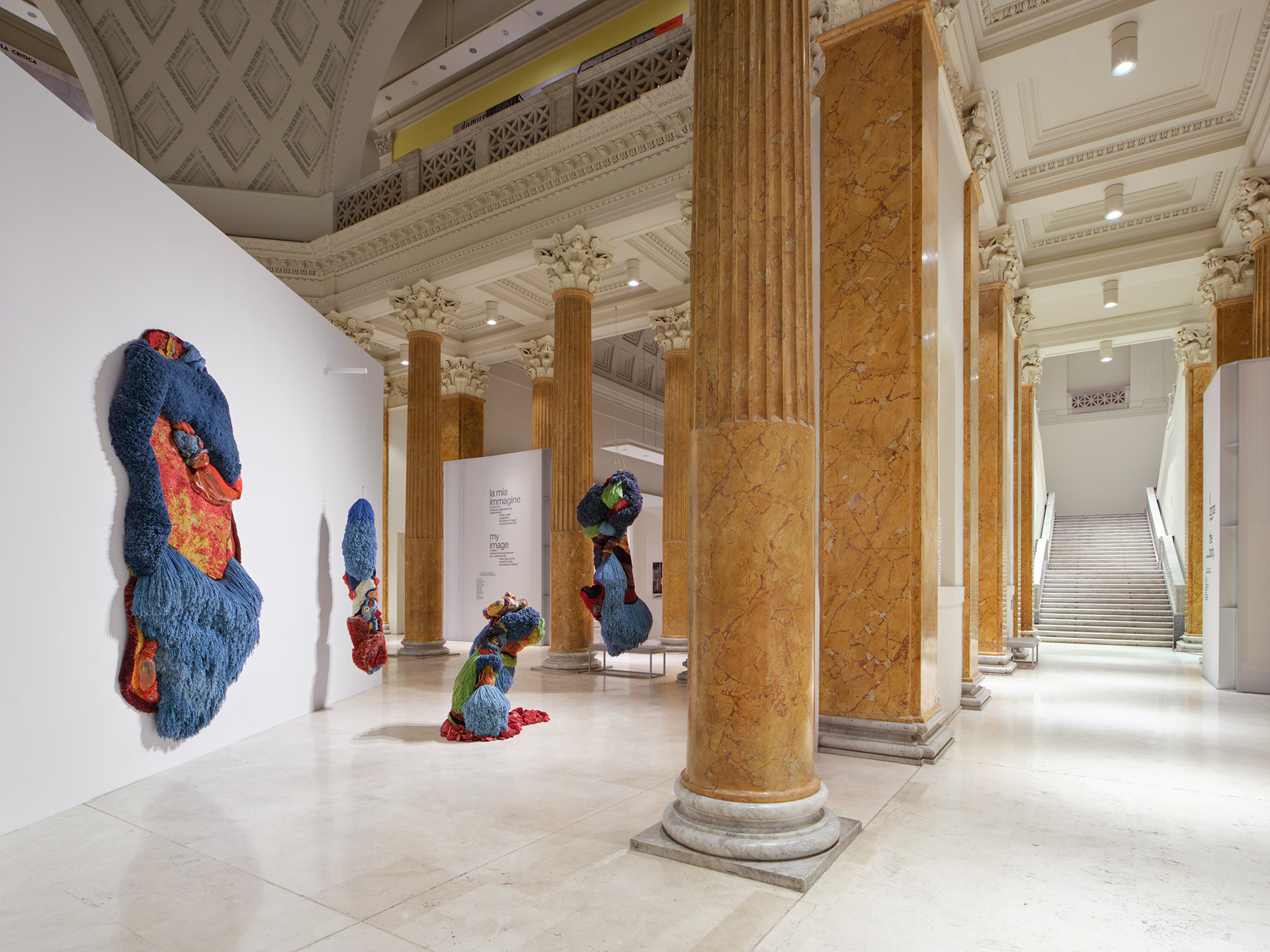
My image is what I choose to be represented by—a self-portrait. Food, cats, gyms, myself, travels, and various trinkets, curated by Luca Massimo Barbero, explores the complexities of self-representation. Through the works of thirteen artists spanning three generations, the exhibition embraces the tension inspired by a rare private work by Lucio Fontana, where the front declares ‘Io sono un santo’ (“I am a saint”) and the back counters with ‘Io sono una carogna’ (“I am a skank”). This section presents a subtle dialogue between diverse and sometimes contradictory subjectivities, exploring the fluid boundaries of representation and identity, offering not a simple reflection, but a deeper experience—an opportunity to see beyond oneself.
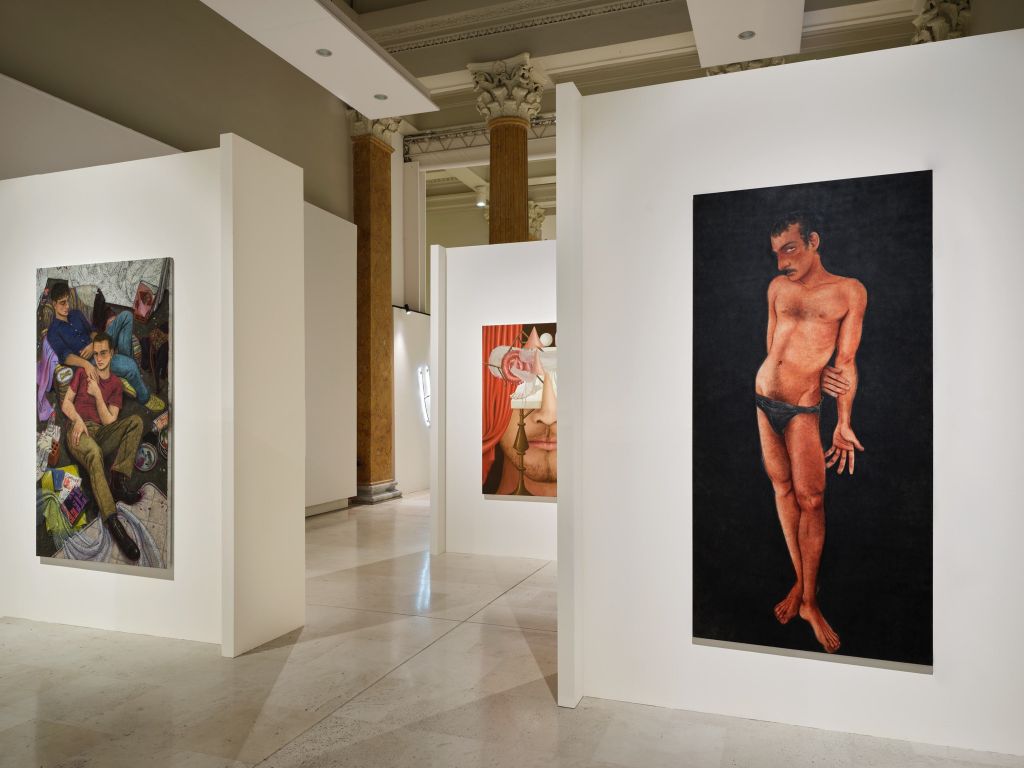
Barbero’s section begins with self-portraiture but quickly displaces it. The mirror, understood through Jean Cocteau’s Orpheus, functions as a threshold rather than a surface: a passage between subject and representation. The artists oscillate between exposure and withdrawal, treating identity as something enacted rather than declared.
Painting dominates, but not as a stable language; it is porous, contradictory, indirect—sometimes ironic, other times severe. At this stage, the first thing that comes to mind is the universality of painting—many of the works feel almost timeless. Matteo Faro takes this concept to another level, using the term “approx” in the labels of his works—usually employed for historical painters—to indicate the chronological references of his paintings and drawings produced between 2015 and 2025, which were in turn created d’après works by other artists, all dating back to the 1930s. As we move through the space, the energy becomes intense, or even joyful, filled with portraits and genre scenes, almost resembling a gigantic social media feed brought to life—through La testa. I piedi (2025) by Roberto de Pinto, Scavenger V. Self-Portrait 2025) by Marta Spagnoli, and the disarming What’s To Become of the Boy? (2025) by Emilio Gola. Not all works are cheerful, but most convey an image of contentment. This section celebrates the vitality of painting in its contradictions, its capacity to inspire curiosity, and its ironic potential.
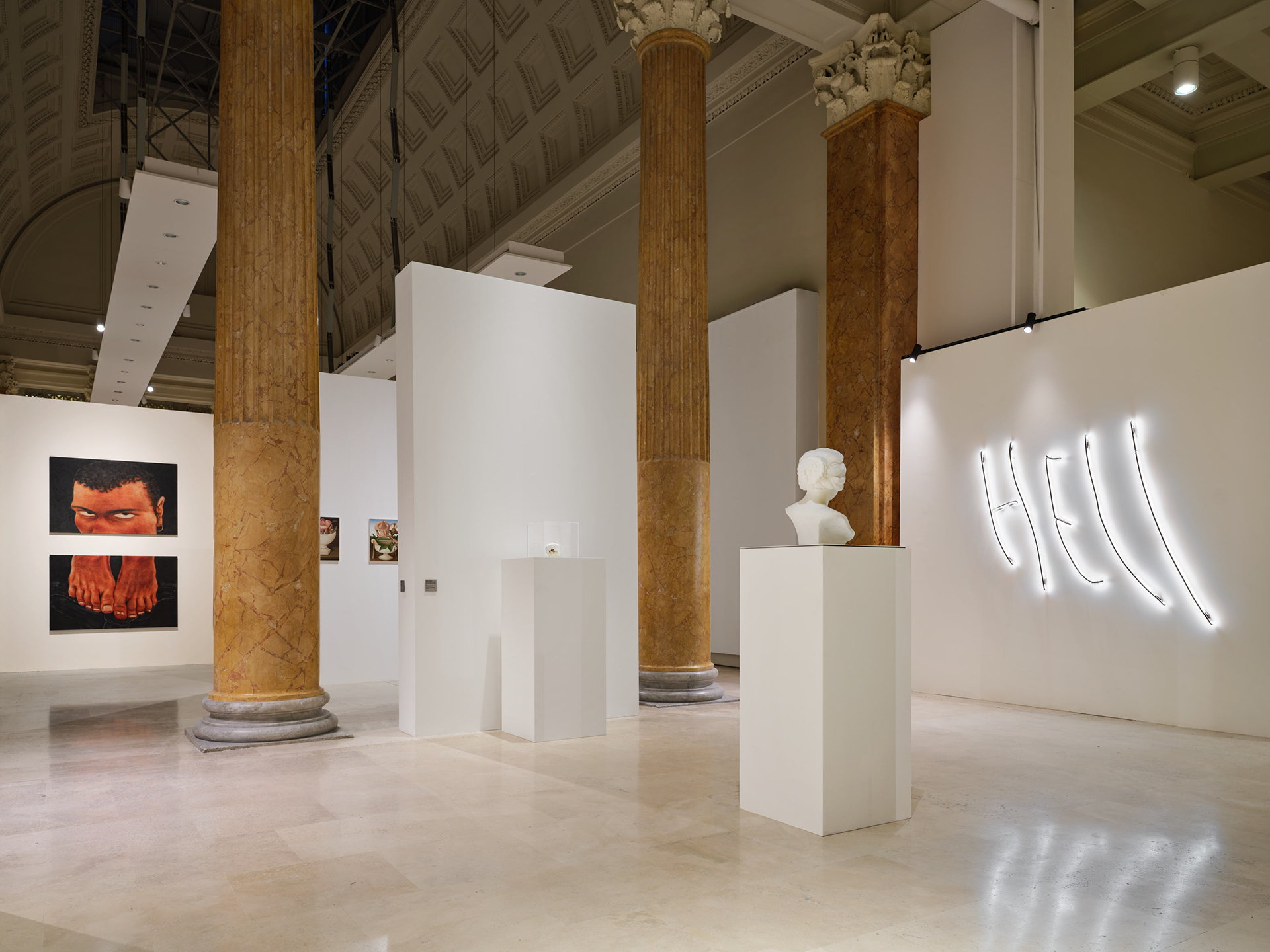
The next room begins with Luisa Lambri’s monochrome abstractions, moves through Paolo Bini’s early-digital–inspired acrylic paintings, and flows into Gianni Caravaggio’s curious explorations of the birth of an idea. Adding to this is Vedovamazzei, operating since the 1990s, tirelessly paradoxical and destabilizing—refusing to offer any easy resolution and forcing viewers to remain intellectually alert at all times.
In the end, Fantastica leaves us suspended between observation and participation, reflection and imagination. Its title, simultaneously meaning “fantastic” in the feminine form and the verb “to fantasize,” operates on two levels: whether as a description or an invitation and a gentle command—to dream, to imagine, to engage actively with art and the world it frames. This duality mirrors the experience of the exhibition itself, where the works managed to refuse passive consumption and instead ask us to negotiate our presence within their spaces.
Dobroslawa Nowak