


Syncopation
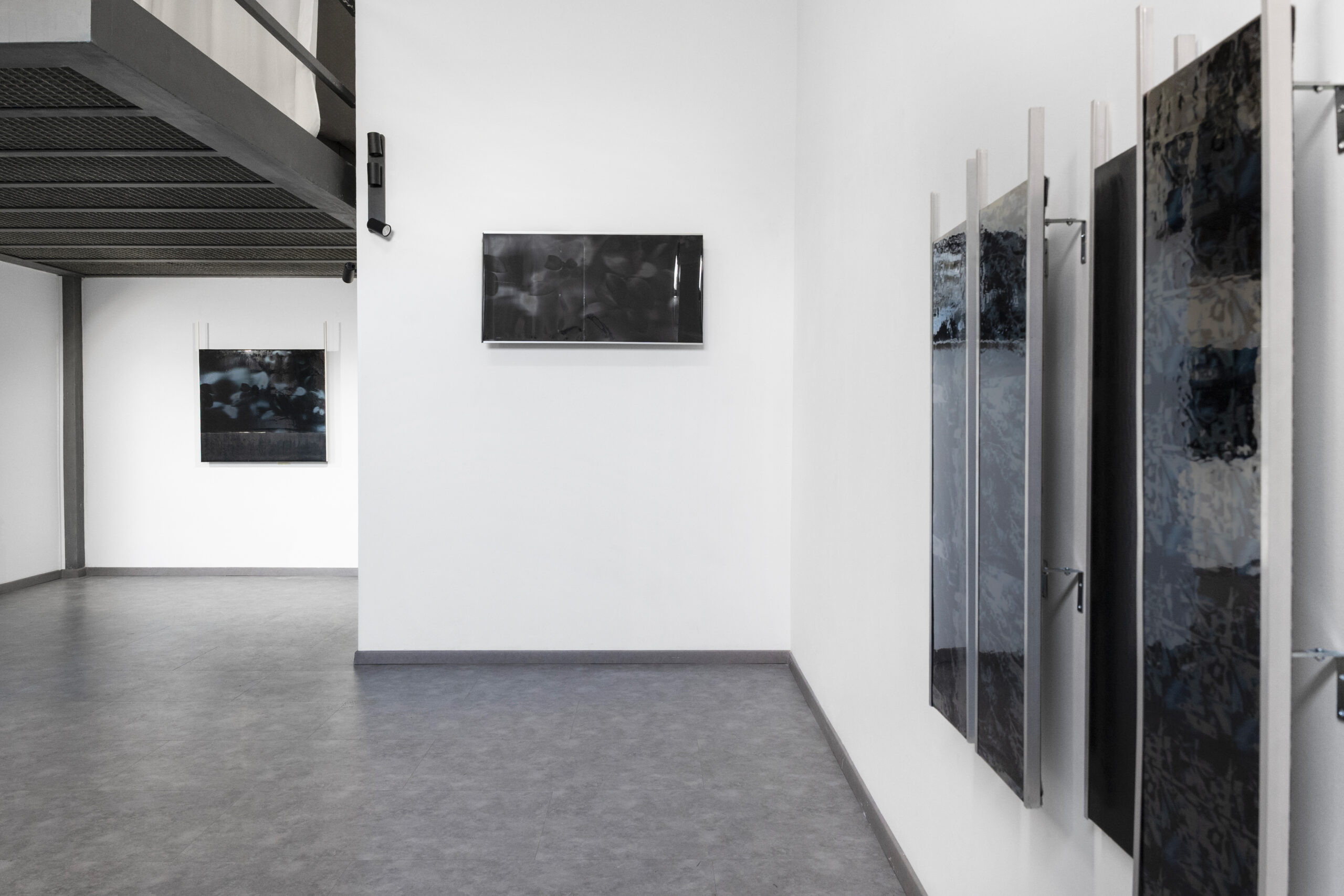
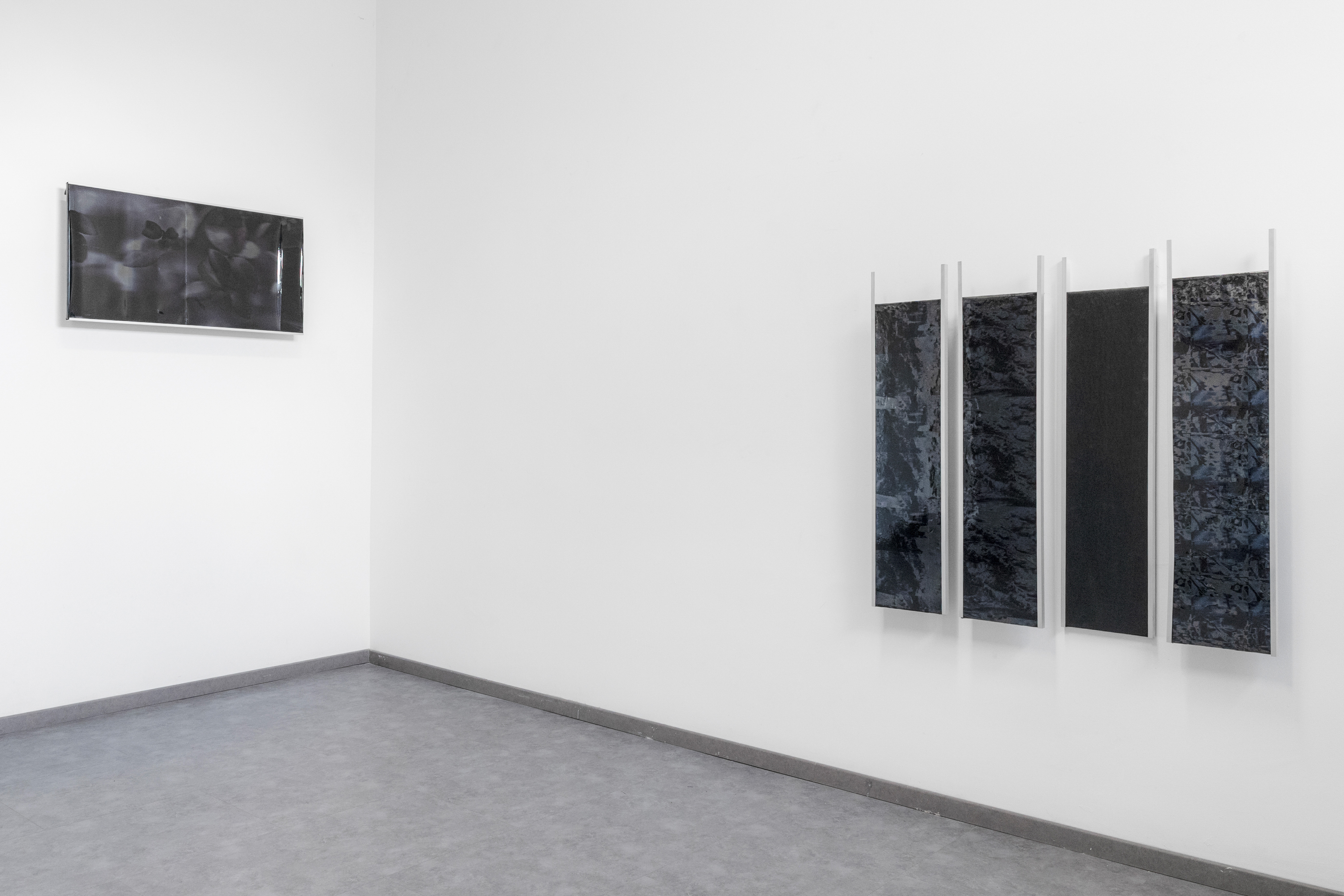
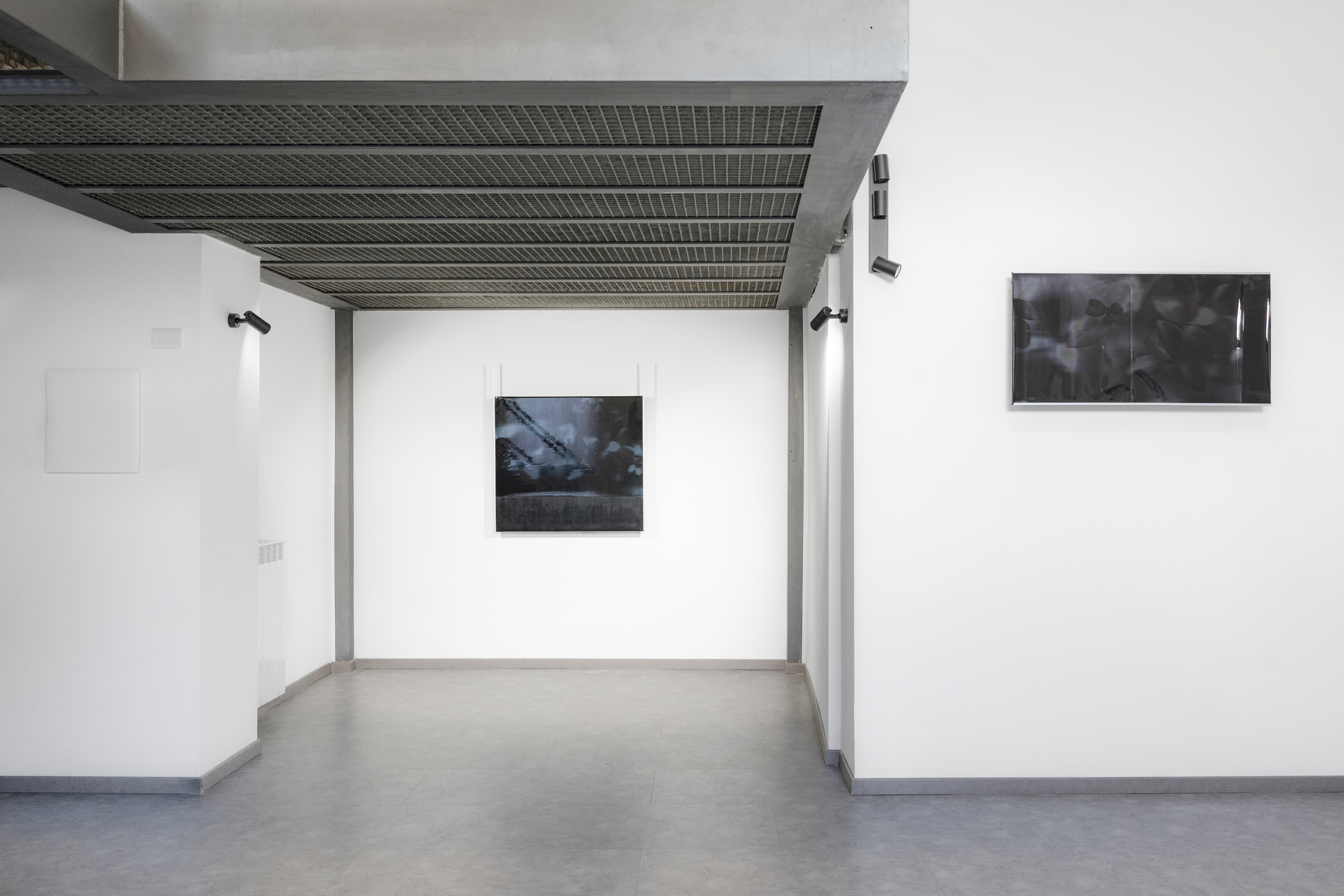
Looking out onto the world today has an effect much like setting out along a dark, poorly lit path and accepting the possibility that, at some point along the way, we may find ourselves swallowed up. The void that opens before our eyes is not to be understood as a vacant space but, on the contrary, as an infinite sea of stimuli, images, meanings, data and symbols, in which whoever navigates has lost every point of reference, often without even fully realising it.
Within a space more undefined now than ever, in which desires, choices and forms of awareness struggle to be wholly authentic and unconditioned expressions, it is easy to lose one’s way. And yet it is precisely in a condition of uncertainty that one may attempt to bring something authentic to the surface: this is exactly what Sofia Guzzo (*1994) has managed to do through her works.
This widespread disorientation also, and above all, marks by reflection the increasingly ephemeral nature of a collective language that is no longer articulated through words and concepts but through images. The latter race, or rather scroll, through our hands, yet remain elusive, for they lack any autonomy of their own. An image, for us today, is first and foremost an instantaneous stimulus, a set of recorded pixels to be shared in the ether.
The black of the screen, in this sense, presents itself as a necessary reset, one that interrupts the incessant flow of this hyper-production and breaks the spell. To introduce a displacement within standard repetition is what in music is called syncopation, a term that, besides giving the exhibition its title, refers to that accentuation of the rhythmic pulse capable of breaking the regular course of time and giving rise to new expressive codes precisely from an unforeseen interruption.
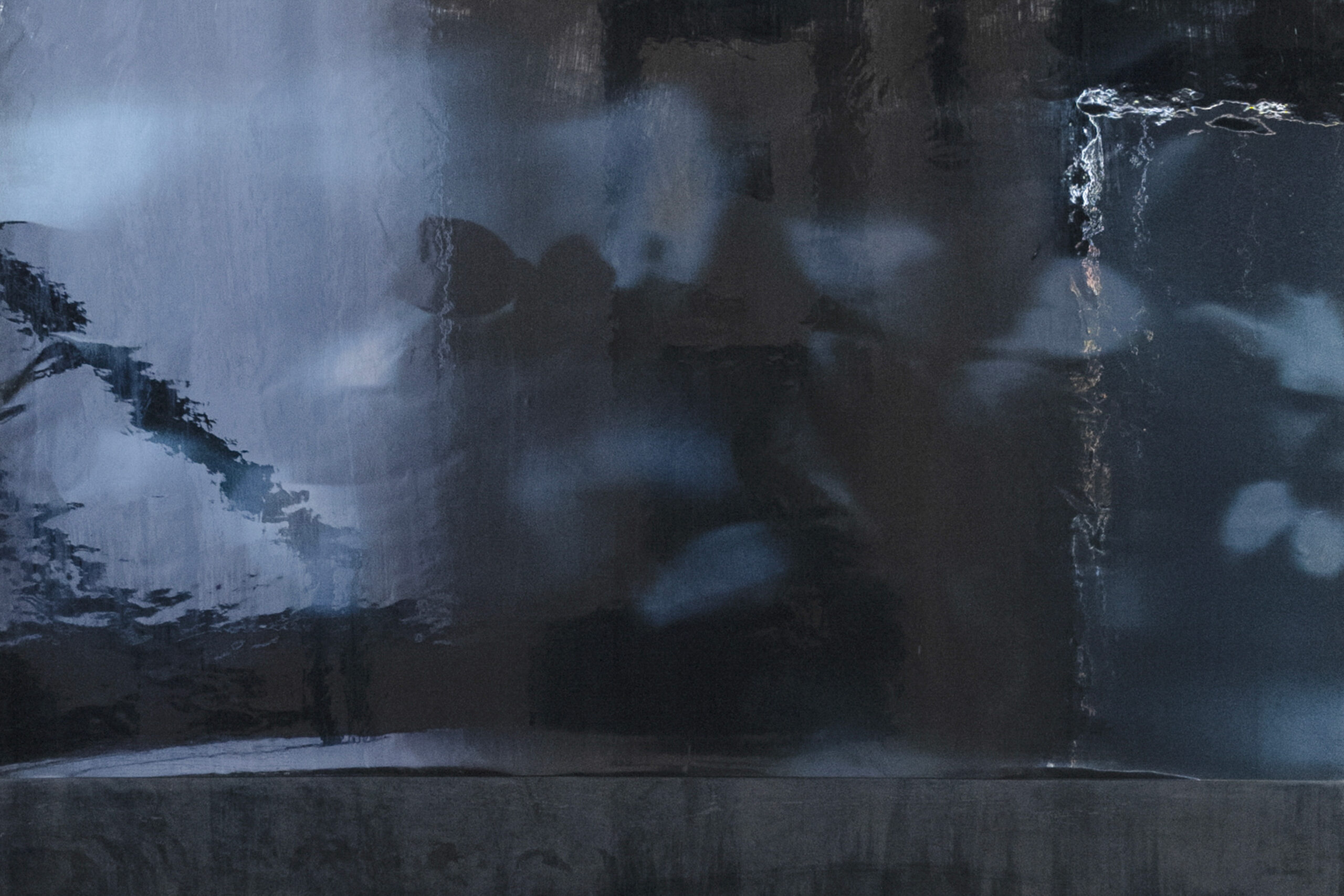
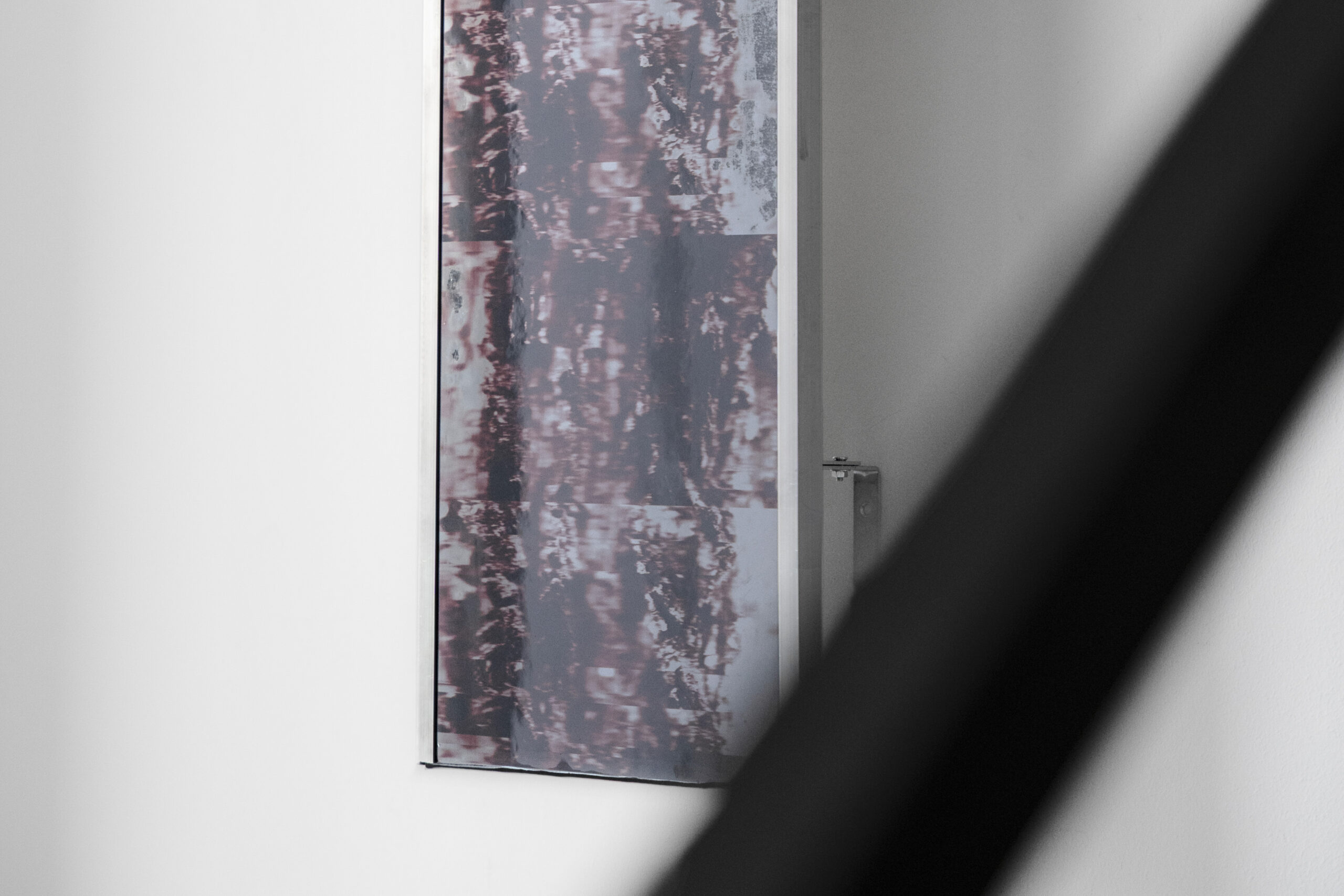
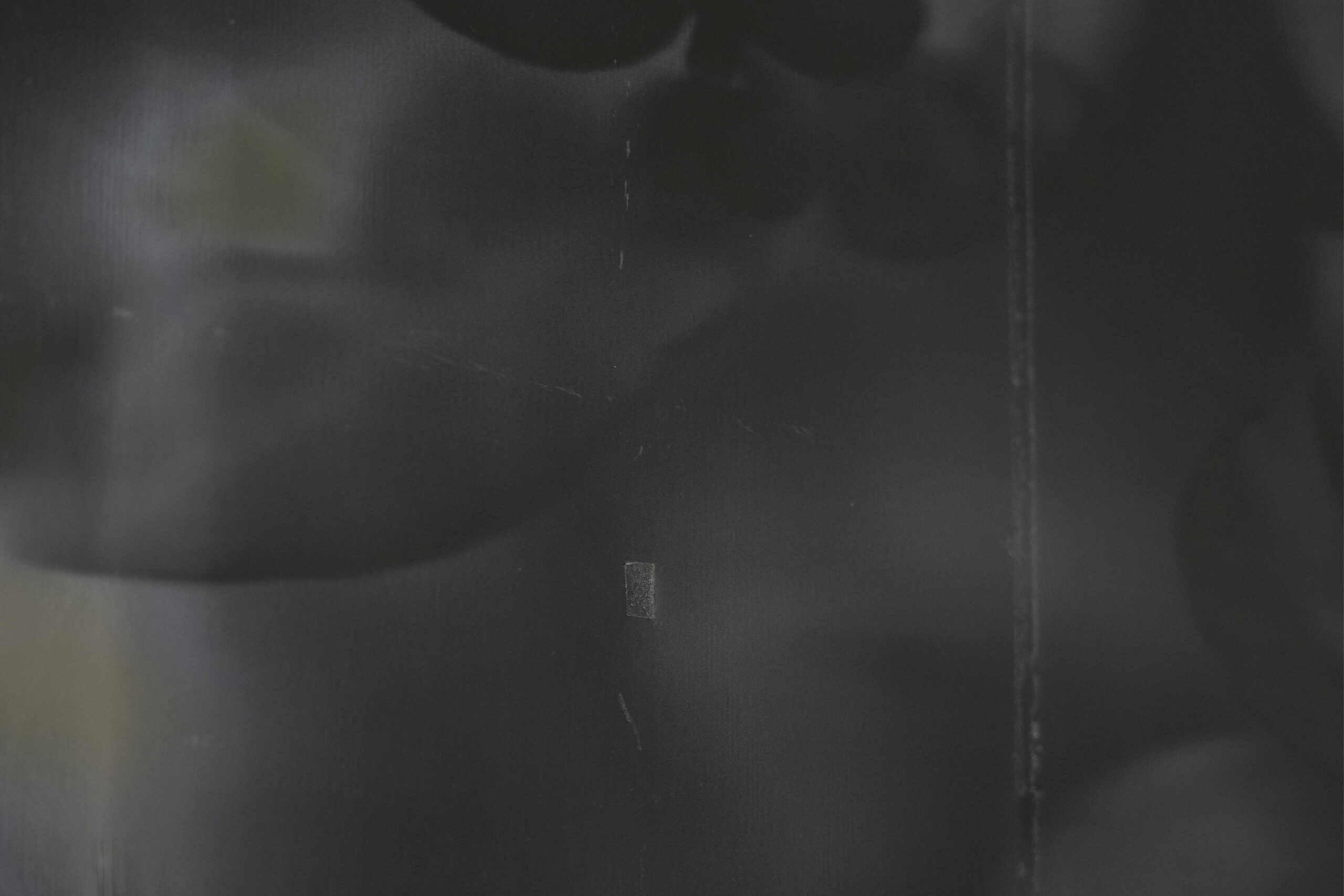
Guzzo’s monochrome is not an erasure that results in oblivion. Something always endures; it can still be glimpsed beyond the layers of a surface in which the image meets space and becomes, to recall Giuliana Bruno’s reflections in Surface: Matters of Aesthetics, Materiality, and Media (2014), a living membrane, like that of a skin joining the subject to the world. Once again, the images must be pursued, yet they exist within blurred contours in which the link to the real remains indissoluble: details of flowers, bark and roots, gathered in the park near the artist’s studio, scanned and subsequently printed on industrial
film, become here shadows cast into black hole that fails to absorb them entirely but, on the contrary, makes possible a palpable coexistence on the same plane.
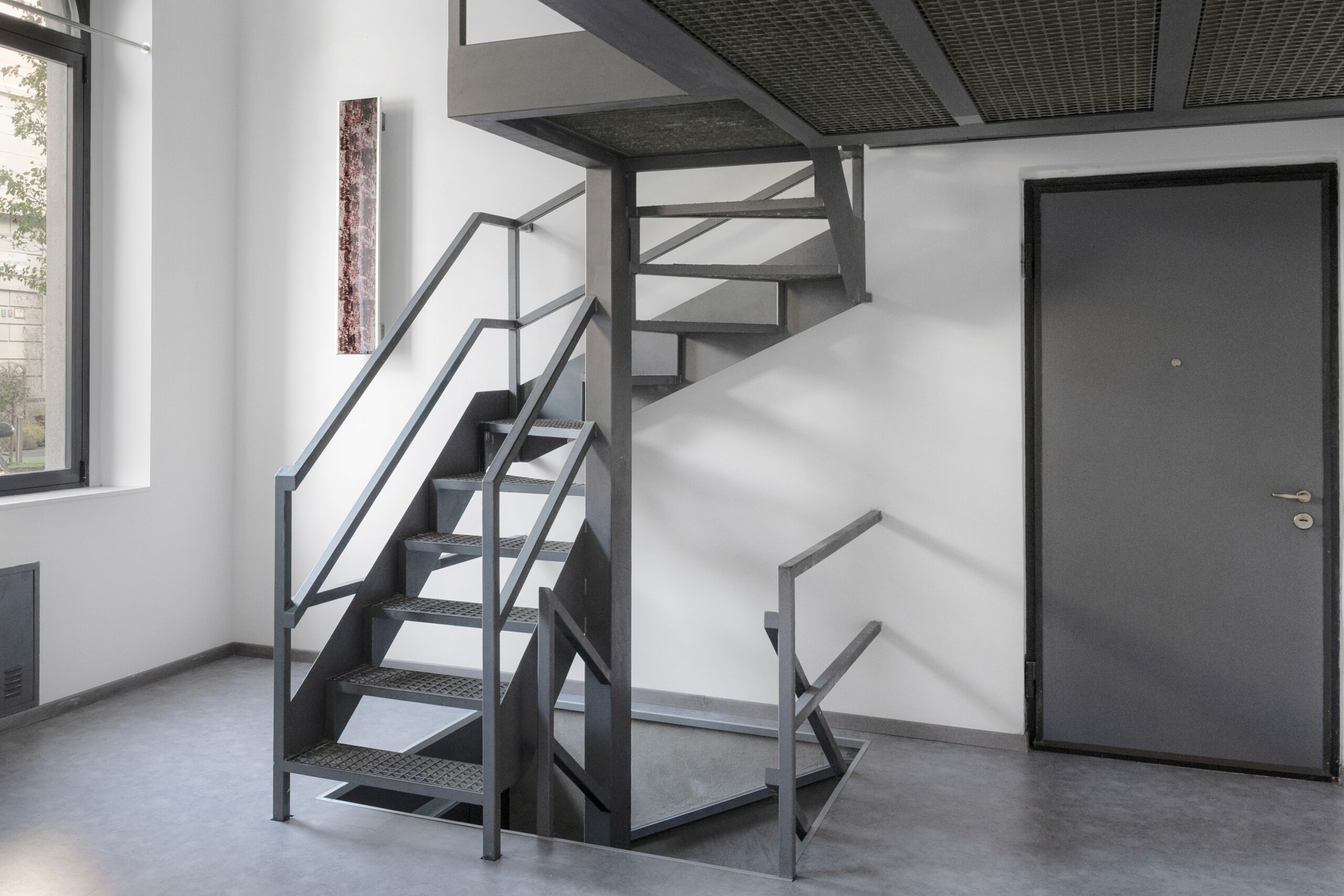
In her works, the perceptual field regains a physical and tactile consistency, capable of activating a friction between the reproduced image and the represented one. The artist does not merely move from the real object to its photographic recording; the divergence she produces through a physical scan remains bound to its material referent, admitting other real elements of the everyday, such as the marks of adhesive tape, traces of paint or the gloss of the black rubber typical of escalator handrails. Each passage leaves a trace and composes a landscape in which the natural and the urban, private and public space, vegetal and industrial matter coexist, perfectly mirroring the post-medial condition in which we are immersed, albeit in the form of images that have finally regained their true essence.
On the gallery’s lower level, the shift from mere contemplation to total physical immersion intensifies. Here, enveloped in darkness, an audio track transmits the unaltered recording of an industrial machine, while a perfume, created by the artist in collaboration with the perfume house Rhizome, simulates the smell of wet asphalt through a blend of synthetic and natural notes. The mind returns to that dark path, which now smells of the city after a storm has passed: damp vegetation, dirty water on the pavements and fresh air invade the senses.
Through photography, sound and scent, Guzzo thus evokes a fragmented landscape that engages all the senses and heightens the imaginative power of something we can no longer simply ascribe to the term “image”. The near-absolute black, the perfume and the audio track become impalpable elements that provide no precise references but invite an individual reconstruction, drawing on memories, places and sensations that only the body preserves. In a present that attempts to standardise everything according to the same predetermined patterns, the work is that syncopated vibration capable of restoring to each of us the one thing that cannot be replicated: the singularity of our own perception.