



6 Art City Bologna Exhibitions You Can Still Visit (Until Spring)
10.02.2026
The 14th edition of Art City has just come to a close—the annual weekend that, coinciding with Arte Fiera, transforms the city of the Two Towers into a stage for contemporary art. More than three hundred events—ranging from the Special Program to an entire map of exhibitions hosted by institutions, galleries, and project spaces—invite the public to take part through accessible and inclusive proposals, embedded in the urban fabric with the aim of preserving it, caring for it, and telling its stories.
During the feverish days in which Bologna captures the attention of media outlets, editorial teams, and press offices, wandering through the city without a destination and without haste can feel like a subversive act; not having a checklist of exhibitions to tick off becomes a small revolutionary gesture.
Slowness and patience are the foundations of an honest and conscious cultural experience, yet they are also demonized by a system built on views, performance, and content production—one in which artworks and exhibition designs are often perceived as potential web products rather than as physical presences to engage with in the moment. This is why, especially for those who work in the cultural field, it can sometimes be difficult—if not frustrating—to accept that it is impossible to visit, photograph, and document everything.
This guide to exhibitions that are still on view is the result of an effort to respect human and physiological rhythms. It does not claim to be exhaustive—of a program comprising over three hundred events, much remains unexplored—but rather aims to encourage reflection that is neither forced nor accelerated.
Etel Adnan e Giorgio Morandi. Vibrazioni - Museo Morandi (until 3 May) Curated by Daniel Blanga Gubbay
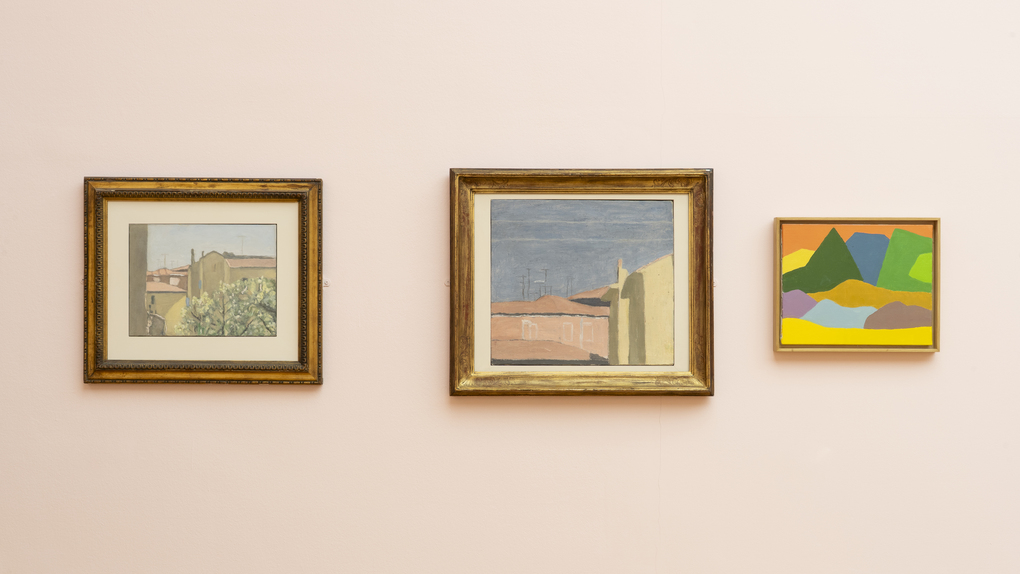
Etel Adnan e Giorgio Morandi. Vibrazioni, exhibition view, Museo Morandi, ph Ornella De Carlo
Etel Adnan traveled extensively: the daughter of a Syrian Muslim father and a Greek Christian mother, she held Lebanese, French, and American citizenship. Giorgio Morandi, by contrast, rarely left Bologna, swinging like a pendulum between his house in the countryside of Grizzana and his apartment beneath the porticoes of Via Fondazza.
It would have been impossible for the two to meet in the streets—the paths they walked were simply too different. Yet they did meet in color, in its pure use, free of superstructures: color as a spiritual place and as existential reflection. By abandoning contour, following Cézanne’s lesson, both artists allow color to vibrate freely, to breathe on the canvas without constraint.
Morandi modulates color, softening it and studying its gentle gradations; Adnan proceeds through strong contrasts, abrupt juxtapositions, and essential compositions. Distant and different, their works brush against one another in the repetition of compositional rhythms, in the tenderness of certain motifs reiterated to the point of obsession; they meet in the intimacy of the studio, in that moment of concentration that precedes the creative act.
The exhibition thus tells the story of a meeting that never took place, allowing itself the freedom to imagine juxtapositions and indirect influences between two artists who approached color with the same contemplative spirit, each finding a personal way of traveling.
John Giorno: The Performative Word - Mambo, Sala delle Ciminiere (until 3 May) Curated by Lorenzo Balbi
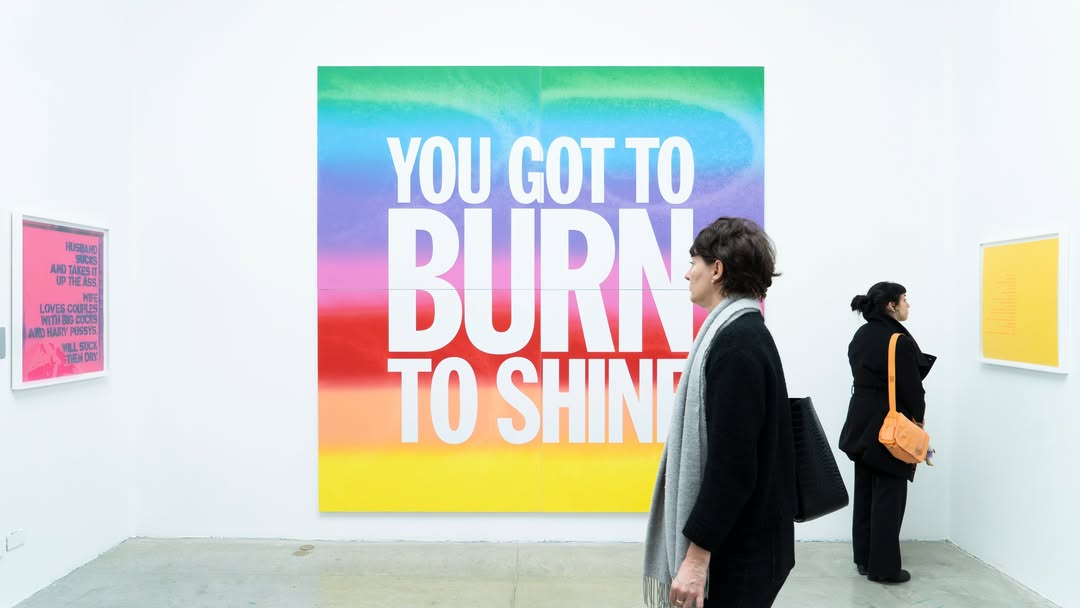
John Giorno, The Performative Word, exhibition views. Courtesy MAMbo – Museo d’Arte Moderna di Bologna | Settore Musei Civici | Comune di Bologna, ph Ornella De Carlo
Poetry as physical presence, as a plastic body, as matter that saturates space. John Giorno understood that poetry was everywhere, that it filled distances, voids, waiting rooms. Not a place of solitude, but of relation; a form of withdrawal that does not coincide with isolation, but with sharing.
The first Italian retrospective of the American artist—a central figure of the New York avant-garde—traces his life and career through several thematic groupings of works and archival documents. From Perfect Flowers, lapidary poetic verses that dominate the canvas with a pop/punk aesthetic, to Dial-A-Poem, the pioneering project-work from 1969 that eventually gathered the voices of 132 writers and poets and made them accessible to the public through a telephone receiver: each call a different, random voice, a private performance.
In a secluded room, Thanx 4 Nothing, a video work by Ugo Rondinone, the artist’s husband, is screened on a loop. One must take the time to listen to the words of the poem Giorno wrote on the occasion of his seventieth birthday—a kind of testament addressed to life itself—which Rondinone, after his husband’s death, recited barefoot, wearing first a black and then a white tuxedo, filming himself twice.
“Thank you for nothing” is not a disillusioned outlook, but an indiscriminate final farewell to what has been gained and what has been lost, without distinction between joy and pain, friends and enemies, fortune and misfortune. It is a powerful goodbye, clothed in irony and lightness, delivered with measured gestures and a bright voice that conceals a broken heart, mourning, extinguished love. Time is required—24 minutes and 14 seconds—to retrace a life looking back without settling accounts, without slipping into moral judgment, but instead telling and revealing itself for what it was, with gratitude and an open heart.
“I want to give my thanks to everyone for everything,
and as a token of my appreciation,
I want to offer back to you all my good and bad habits
as magnificent priceless jewels
[…]
thanks for being mean and rude
and smiling at my face,
I am happy that you robbed me,
I am happy that you lied
I am happy that you helped me
thanks, grazie, merci beaucoup”.
Permanent Loss of Signal - Galleria Pietro (until 15 March) Curated by Niccolò Giacomazzi
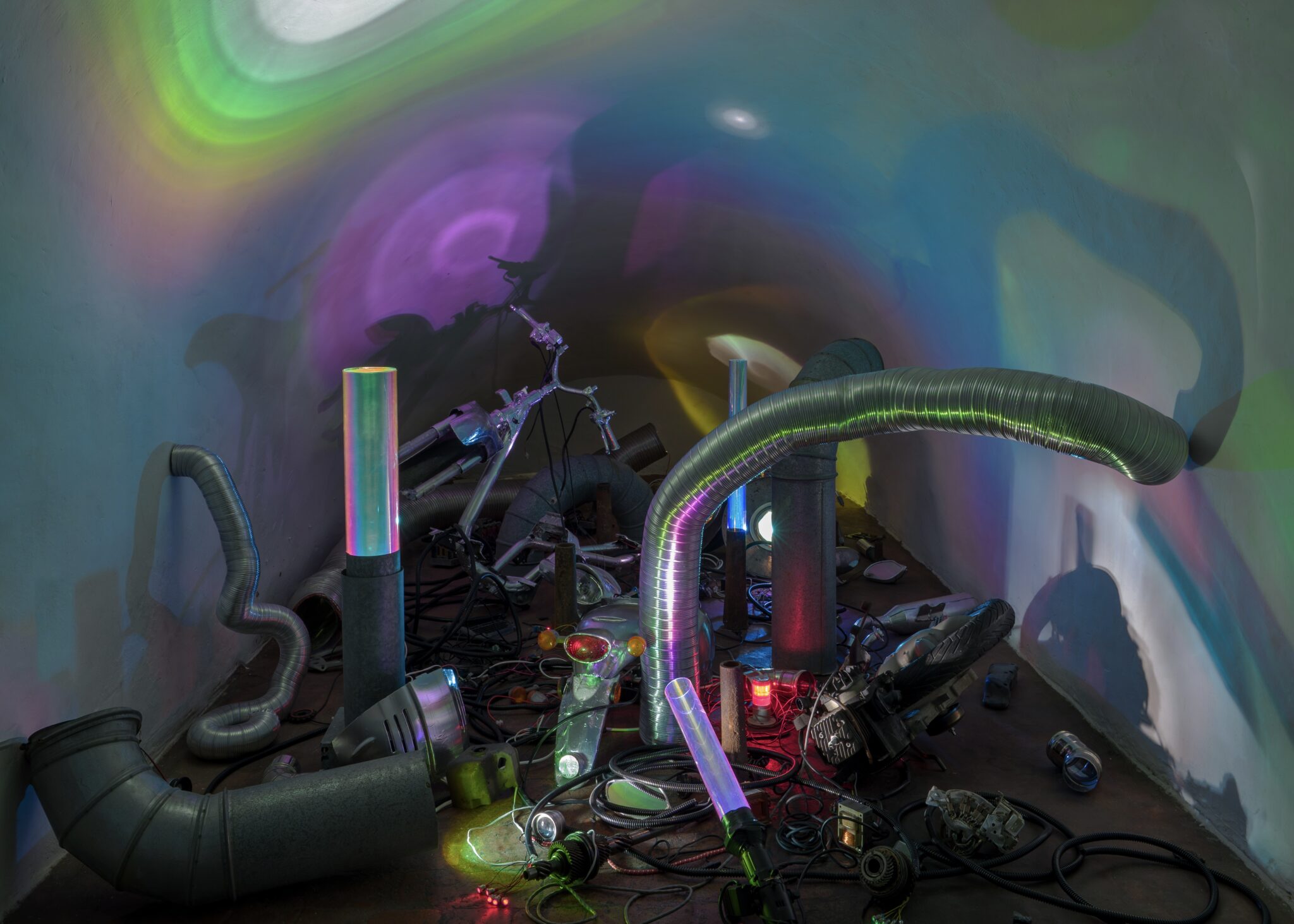
Valerio D’Angelo, Permanent Loss Of Signal (Spaceship), 2026, materiali vari, luci led, arduino, dimensioni varie, ph. Manuel Montesano
“One day, perhaps, I will understand your restlessness and your wandering in search of an answer. I hope you will find it, and that it won’t remain just a latent hope. At that point, there will be no need for long speeches. A signal will be enough. Any kind.”1
It could be a small love story, a space mission, a final farewell between NASA colleagues after years of honorable service together. Knowing which one it is doesn’t matter, because whatever it was, it ended badly. A narrative divided into three acts, three spaces contained within the small deconsecrated chapel on Galliera street—once a place of worship and prayer, now the stage for a space journey that has failed and remains frozen in the site-specific installation by Valerio D’Angelo (Rome, 1993). A parabolic antenna, a carpet of wires and metal, an astronaut resting on the chapel’s altar while reflecting on his failure. In a claustrophobic, timeless dimension, between silence and suspension, we ask ourselves how difficult it is today to be heard: we perceive the echo resonating in the cold space, the steady, mechanical movement of the antenna rotating on itself, the intermittent lights reflected in the metal.
Where is the other? If I were to scream, would anyone hear me? Would someone come to save me?
As we search for empathy in a world so unwilling to grant it, are we really that different from those who leave for space knowing they might never return?
Mattia Moreni. L'antologica di Bologna, 1965 - Mambo, project room (until 31 March) Curated by Pasquale Fameli and Claudio Spadoni
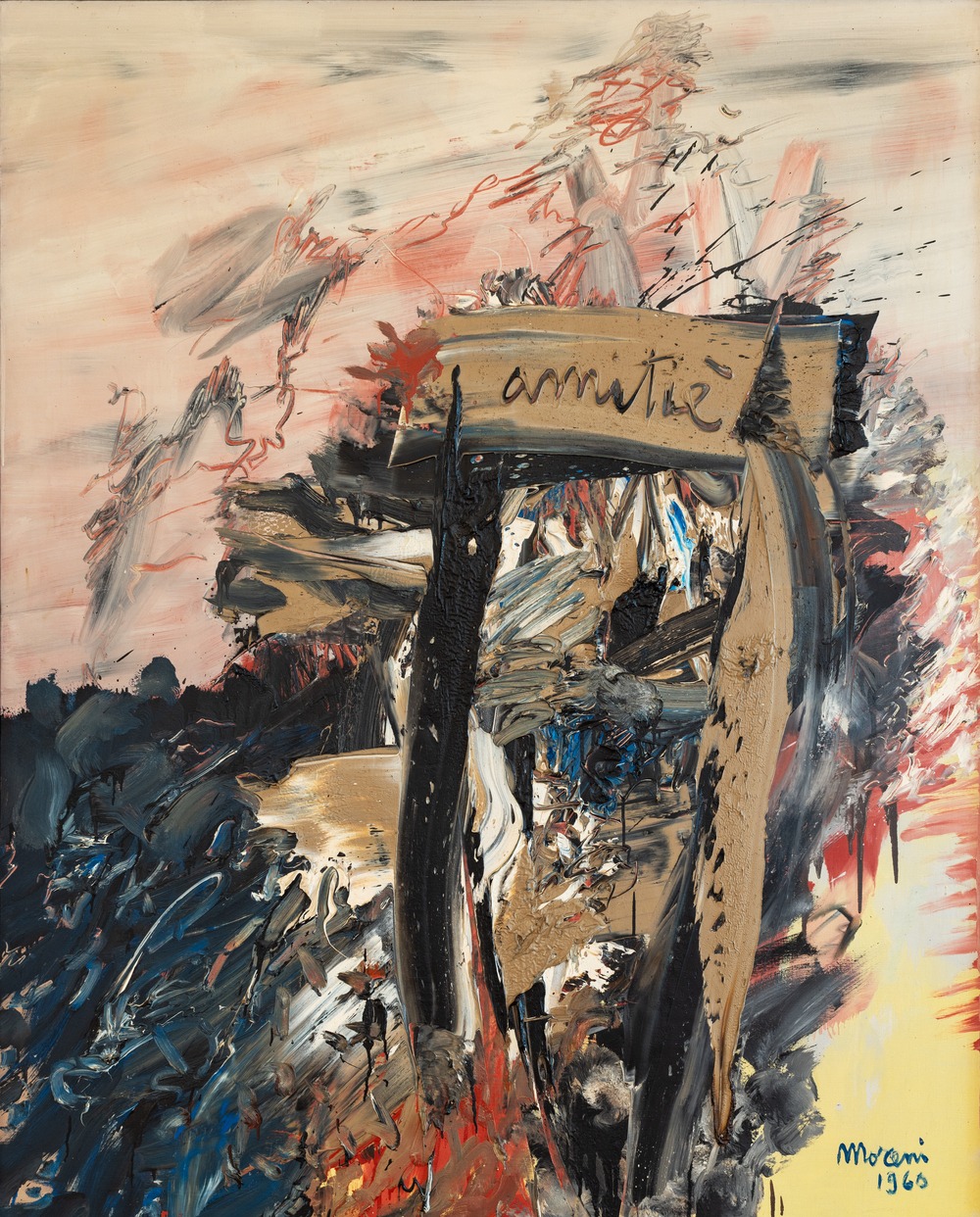
Mattia Moreni, A tutti i maldestri del mondo: amitiè, 1960, olio su tela, 162 × 130 cm, Modena, collezione privata.
He was born in Pavia but chose Emilia as his adopted land, and it is precisely here that Mattia Moreni is being remembered today in five acts. After the exhibitions in Bagnacavallo, Forlì, and Santa Sofia, the MAMbo project room hosts the fourth chapter of the project MATTIA MORENI. From Training to “The Last Thrust Before the Great Mutation.”
In 1965, in the spaces of what was then the Galleria d’Arte Moderna of Bologna—today, in fact, MAMbo—Francesco Arcangeli curated Moreni’s first solo exhibition in a public institution, consecrating his personal, independent, and autonomous poetics. It is precisely that historic exhibition that is taken up and reinterpreted here, sixty years later, through a selection of works that retrace the complexity of an unclassifiable figure who moved with ease and passion between figurative language and Art Informel.
Material, intense, at times expressionist, Moreni grappled with all the great themes of modernity—war, industrialization, psychological crisis—an intensely human prophet and advocate of an art that can still be read today as an inner cry, a plea for help, an expression of the disturbances born of the post–World War II era.
Yet the anxieties of the century did not undermine the strong vital drive of his canvases: angry paintings in which color hurls itself forward, seeking no softness at all.
Délio Jasse. Angolan file - AF Gallery (until 18 April) Curated by Marco Scotini
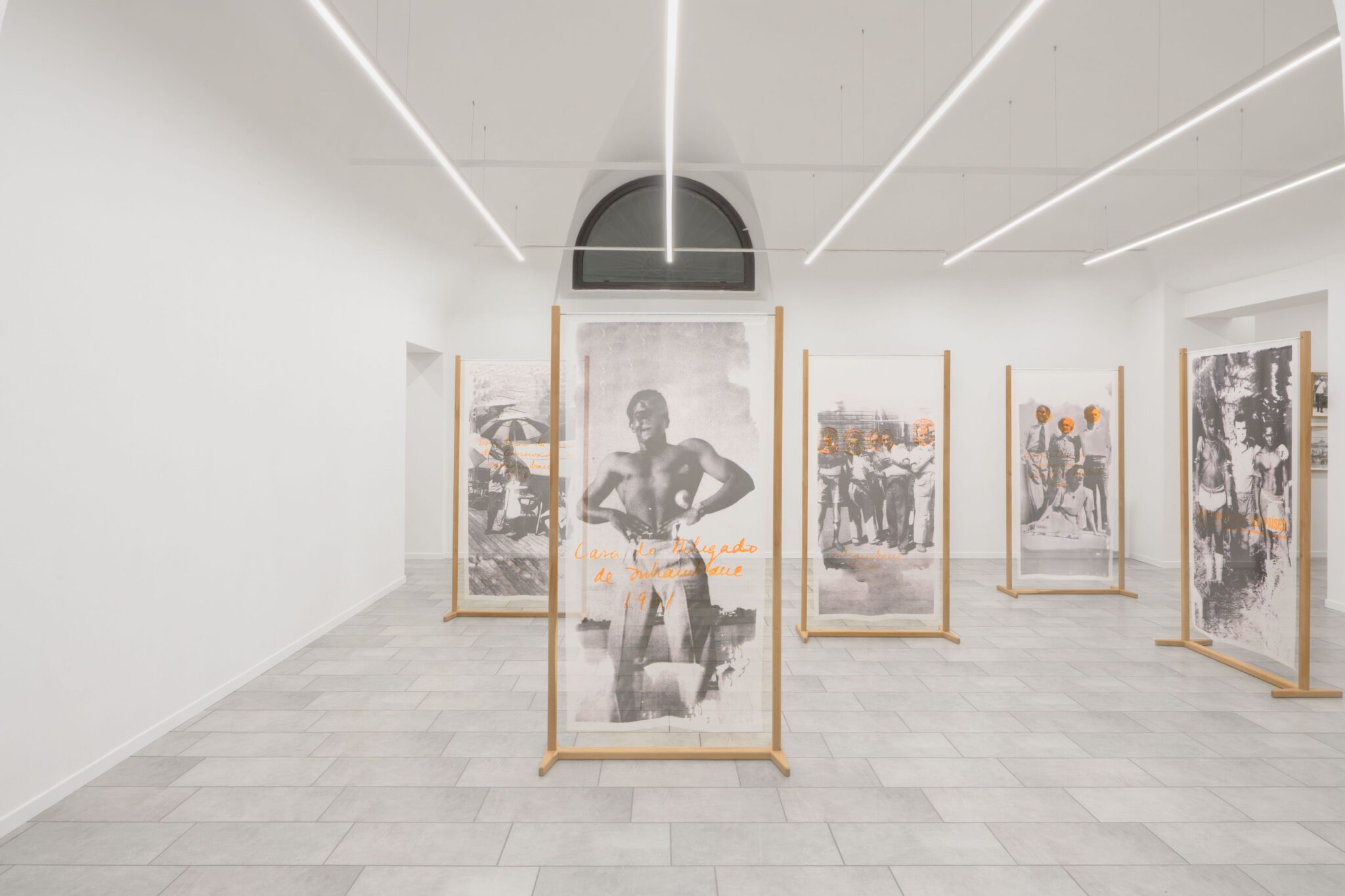
Delio Jasse, The Angolan File, exhibition view. Courtesy AF Gallery
If a photographic archive is synonymous with objective memory and preservation, Délio Jasse breaks this axiom to retrace the stages of an “unresolved history.”2.
Portuguese colonial occupation in Angola dates back to 1476 and ends with the achievement of independence in 1975. Jasse rereads his country’s history through a reflection on the very concept of the archive: a device that saves or condemns to oblivion according to criteria that are anything but objective, dictated by violent, supremacist ideological constructs.
The artist tampers with, alters, and personalizes photographs sourced from family albums and second-hand markets—precious testimonies sold off at low prices.
Measured traces of gold leaf seep into the photographic paper, erasing faces and signaling “a redemption never recorded.”3
In Jasse’s hands, photography—an ostensibly mute and objective medium—becomes contested ground, a site of negotiation, the settling of a long-outstanding account.
Placed at the center of the space rather than merely hung on the walls, the works invite the public to take part in a historical reconstruction: to bear witness against centuries-old power dynamics, to validate and acknowledge systemic subjugation and the lived experience of a people.
The archive—the new archive—thus corrects the errors of history, heals the voids, fills the cracks, and speaks the unsaid.
CC. Michael E. Smith - Palazzo Bentivoglio (until 26 April) Curated by Simone Menegoi and Tommaso Pasquali
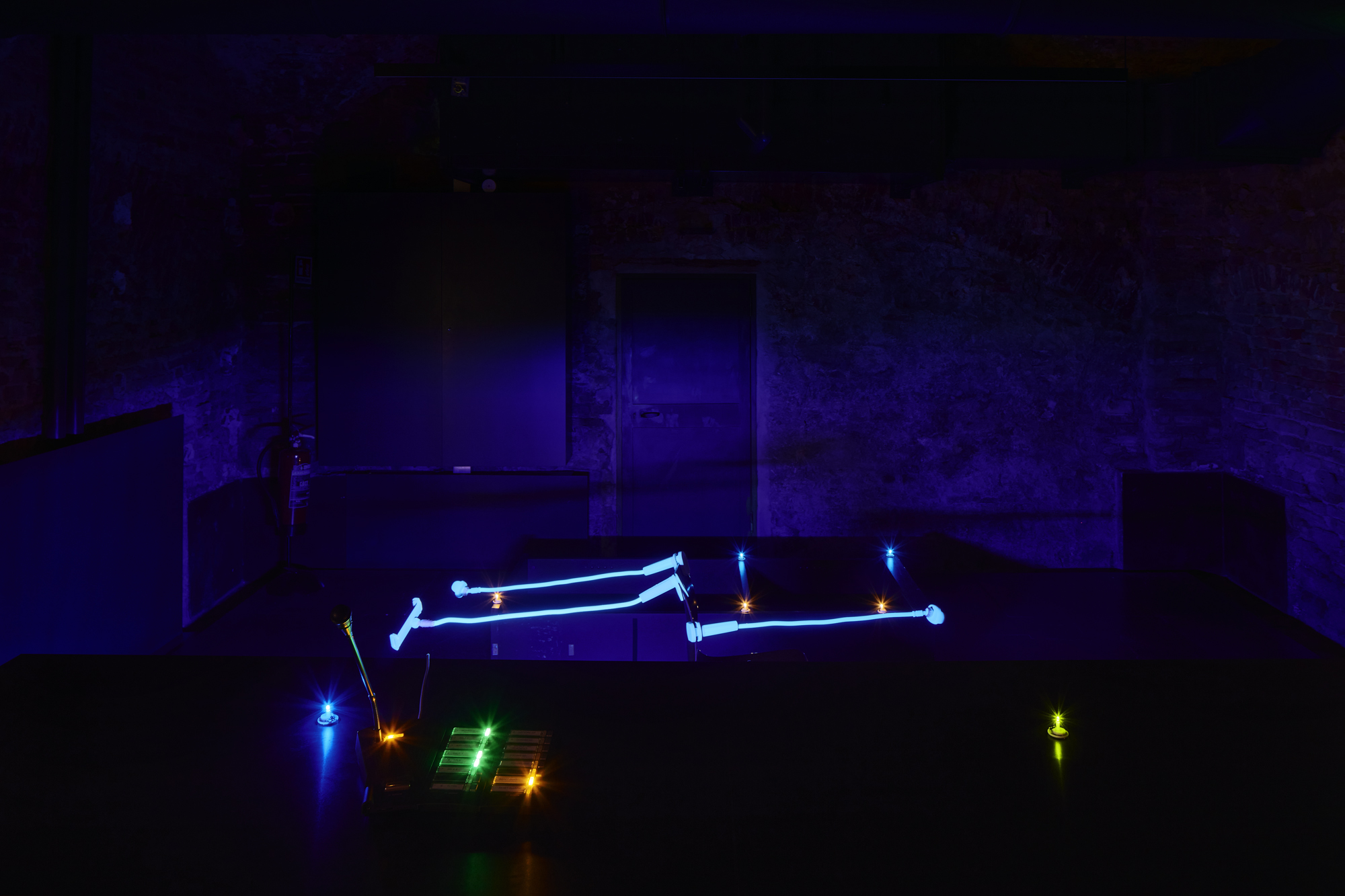
Michael E. Smith, CC, Palazzo Bentivoglio, Bologna, 2025, ph. Carlo Favero
Michael E. Smith works with the waste produced by consumer society. Therefore, Michael E. Smith speaks about us. And yet he never mentions us. In our place, he addresses Nike shoeboxes, tennis balls and basketballs, expensive padded jackets—objects once worn and carefully preserved, now remnants of lives lived too fast. They are inanimate bodies that the artist transforms into anthropomorphic visions or presences from the animal world, creatures in which unease and irony merge and coexist.
At the same time, Smith plays with light, a foundational aspect of his artistic practice: the lighting is pushed to its limits, undermining the sense of security of those who walk through the spaces of Palazzo Bentivoglio, at times completely dark. The environment becomes ambiguous, restless, at moments even dangerous (the writer felt the need to hold on to the handrail while descending the stairs because of a mirrored surface that, given the low lighting, appeared as a void in the floor).
The exhibition title—his second institutional show in Italy—CC (“see see” / “look, look”) asks us to do something that is literally impossible, inviting us instead to adopt a different kind of gaze.
Having lived in Detroit until 2014, Michael E. Smith observed the effects of deindustrialization, urban decline, and the resulting depopulation. The speed with which these empires of mass production are born and die conveys a sense of instability that underpins contemporary life: an uncertain, slow walk, always close to the handrail in case of emergency.
________
1 From the critical essay by Niccolò Giacomazzi
2 From the critical essay by Marco Scotini
3 From the critical essay by Marco Scotini
English translation by Dobroslawa Nowak