

3 Exhibitions to See in April
Our Guide to the Exhibitions in Italy
07.04.2026
There is no place where contemporary art cannot be found: in disorder, in mistakes, in the ugliness of the world. It inhabits the everyday, doesn’t wait for the right moment, and has much to teach perfectionists—the very concept of perfection constantly called into question.
It lives in the brevity of the moment, in instinct, in a passionate reading of the world. It sprouts even where the sun doesn’t shine, because at times it needs shadow far more than light—especially when that light is artificial, from a spotlight, rather than the natural, however slanted, light of the sun.
The three selected exhibitions remind us that there are other places beyond the major circuits of contemporary art—less polished, more porous, and penetrable. Places where marginality is a starting point, not a condition to be endured.
Romane de Watteville. I’ll miss you when you scroll away - Istituto Svizzero, Milan (until 4 July)
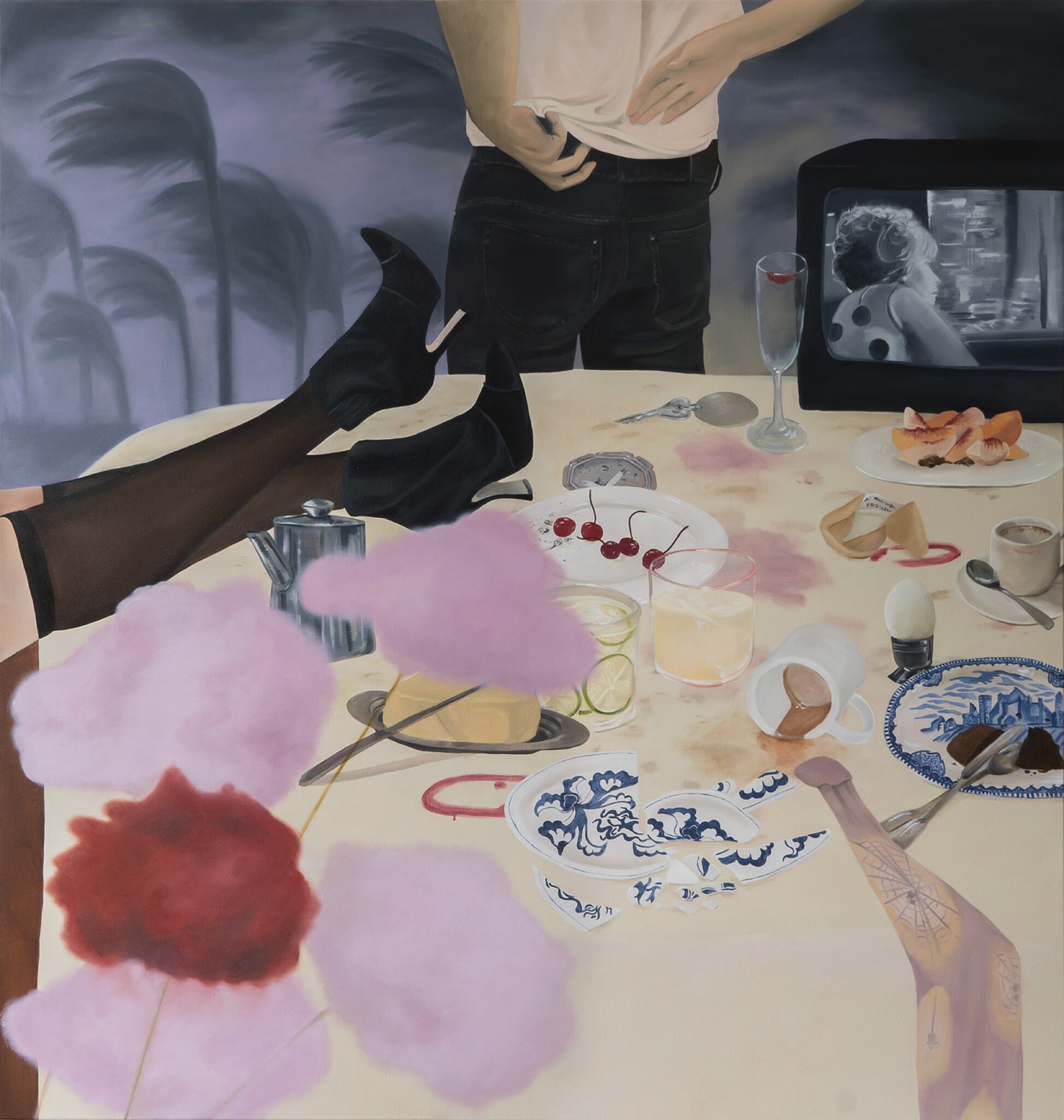
Romane de Watteville, Menacing paradise, 2025, Oil on canvas, 190 × 180 cm (74 3/4″ × 70 7/8″), Courtesy the Artist and Ciaccia Levi, Paris – Milan, Photo: Mina Albespy;
The party is over, the music fades, and the lights come on. What remains, in the paintings of Romane de Watteville, are tables buried under the traces of the night before—leftover cold food and cigarette ashes. The abundance of details makes noise: you can almost hear the chatter, the loud laughter of those who stayed out very late. The scenes speak of an intimacy that burns out as quickly as it is forgotten, an intensity that cools with the first light of dawn, a kind of romance crumpled by a hangover.
The space on the canvas is saturated; the tight rhythm creates a sense of overwhelm, a progression by almost obsessive accumulation. The result is an account of the night that spares nothing. Like the screens of our phones, the vertical canvases present the lives of others without distinguishing between intimate detail and staged display, with an aesthetic that carries within it pop and Surrealism, the glossy sheen of the contemporary and a collective hallucination.
In her first solo exhibition in Italy, the artist, born in 1993, explores what happens when the social performance ends and life returns to what it was before. What lingers are the aftereffects: the headache, the mess to be cleaned up, the sense of emptiness after a night so full it leaves nothing behind to remember. What remains are objects—clothes on the floor, dirty dishes, spilled bottles—telling our story, while we are in the bathroom, bent over with the aftereffects of the night.
PINKING UP - Kunstverein, Bolzano (until 9 May)
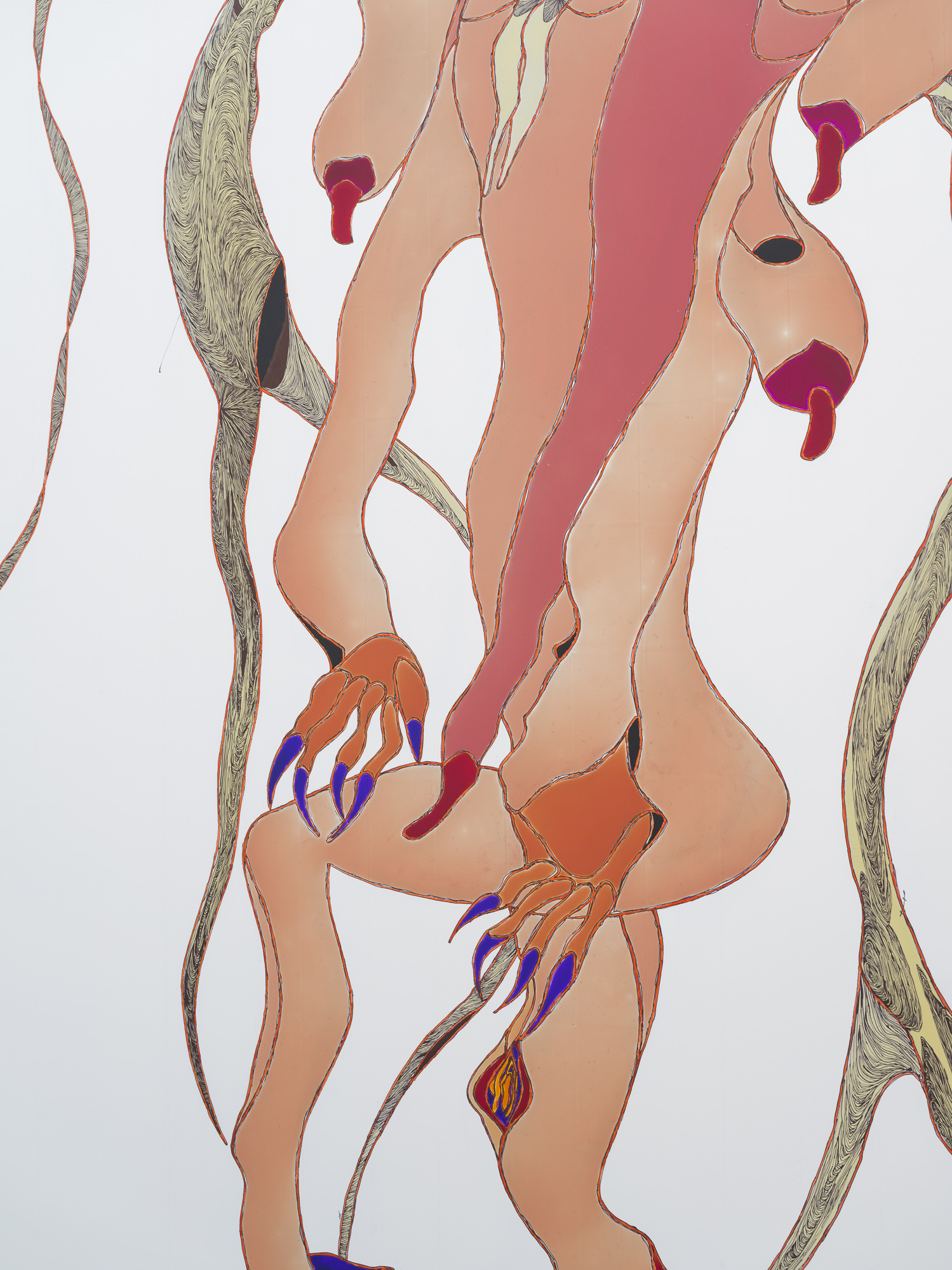
Atelier dell’Errore, Pinking up, exhibition at Ar/Ge Kunst, Bolzano. Photo Tiberio Sorvillo, 2026
The history of Atelier dell’Errore began as an art workshop for neurodivergent children. Today, the autonomous collective—made up of twelve artists—looks back on more than twenty years of activity and presents itself at the Kunstverein in Bolzano through its latest body of work: Unknown Pleasures.
What is desire? Where does it come from? Is it a feeling, or an instinct of the body?
In the works created on mirrored surfaces, desire appears as a shared energy—something that brings bodies closer, that moves through them, that transforms and belongs to no one. A free force, without constraints or fixed trajectories, desire invests the very form of things: organisms in constant evolution. Like a simple equation, as long as desire exists, the organism transforms—and in the collective’s canvases, this equation takes the shape of the animal. An ambiguous creature—brightly colored and primordial in form, made of flesh, membranes, claws, antennae, and yet formless—shifts and mutates across each canvas.
Atelier dell’Errore conceives desire as something that goes beyond erotic tension and sexual instinct: it is soul, vital breath, the very essence of the body. When bodies no longer desire, evolution comes to a halt; the animal settles into a fixed form—until it dies.
E tuttavia crediamo che la vita sia piena di fortunate possibilità - Fondazione Made in Cloister, Naples (until 21 June)
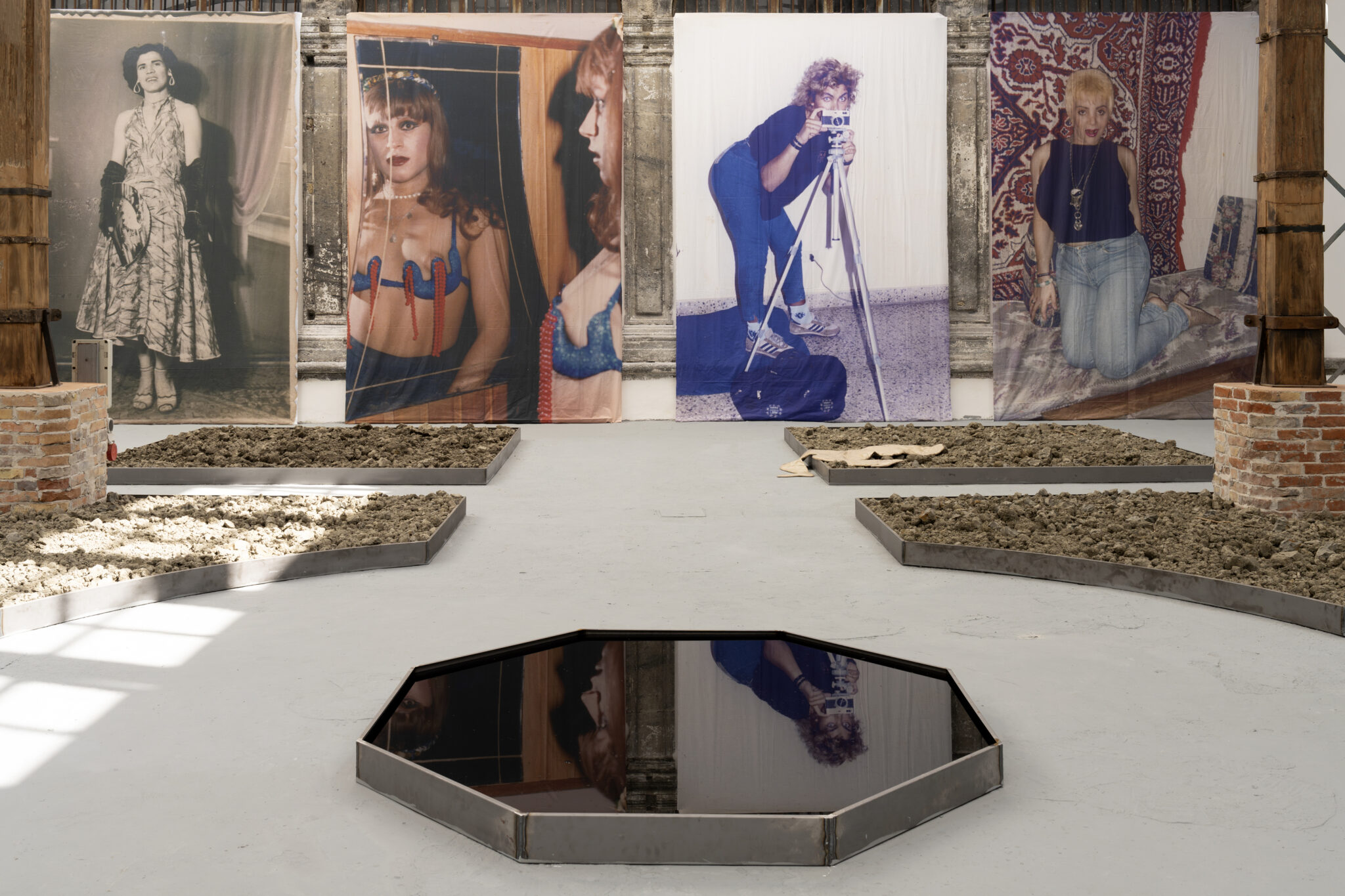
Exhibition view E tuttavia crediamo che la vita sia piena di fortunate possibilità, Fondazione Made in Cloister, exhibition design: Mariano Cuofano, © Francesco Squeglia
With a title that already reads as a manifesto—and that cites the autobiographical poem My Life by the American poet Lyn Hejinian—the exhibition staged in the cloister of the Church of Santa Caterina a Formiello reflects on the possibilities of understanding contemporary art as a practice of active resistance.
Conceived by the independent curatorial collective nonlineare, the project follows curvilinear trajectories that unfold through shadow zones and border spaces. It is from these sites that the five voices of the artists featured in the exhibition emerge, narrating their personal stories within a collective framework addressed to the community.
From the Archivo de la Memoria Trans—one of the most important archives in the world dedicated to the memory of the Latin American trans community—to Gabrielle Goliath—an international voice and emblematic victim of the arrogance of the dominant system—the artists in the exhibition draw strength from their interconnections in order to reclaim a space, both physical and cultural, long denied by the major circuits of the art system.
Across photography, installations, painting, and archival materials, the works form a single collective testimony: a historical testament, an assertion of selfhood, and of their own specificity.
Translated to English by Dobroslawa Nowak