


The Cultural Project Tramandars: What Must Continue
19.05.2026
What might appear to many as an irrelevant connection — between the knowledge of the folk practices of those living on the slopes of Vesuvius and the artist residency Tramandars, founded in 2017 in Borgo Casamale, the historic center of Somma Vesuviana (Naples) — in fact reveals a profound relationship, or rather a fortunate bond. In this land especially, a complex set of popular traditions merges with contemporary art and the local community, giving back a heritage that is anything but static, instead dynamic and rich with propulsive energy. Thus, this territorial space succeeds in transforming itself into a place, understood as a lived dimension continually nourished by new artistic contaminations, where anthropology and cultural geography converge in a process of “gentle” anthropization, far removed from abrupt and invasive transformations. From this union emerges an unprecedented museography of local reality, constructed both by the artists in residence and by the curators invited to accompany their projects, all united by a vital impulse toward research.
The vitality that characterizes the land stretching around the slopes of Vesuvius is deeply syncretic, combining Marian cults, rituals tied to the volcanic landscape, and popular devotional practices, while gathering the echoes of the many customs that have traversed it over time. It is a context in perpetual transformation, subject to continuous “sprouting,” so that every transmitted tradition may generate new interpretations, narratives, and symbolic variants. Each year, Tramandars invites creatives to participate in the residency program. For 2026, the artists are the collective damp, Django Burdeau, and Margherita Muriti (Resident artists), joined by Veronica Bisesti, Raimondo Coppola, Niccolò De Napoli, Caterina Di Gaetano, Gabriel Orlowski, Marta Perroni, Anna Irina Russell, and Noemi Sparago (Fellow artists). Alongside them work the resident curators Dario Benvenuto and Massimiliano Maglione, together with external curators accompanying the various project developments, who for this edition are Vasco Forconi, Marta Ferrara, and Giulia Pollicita.
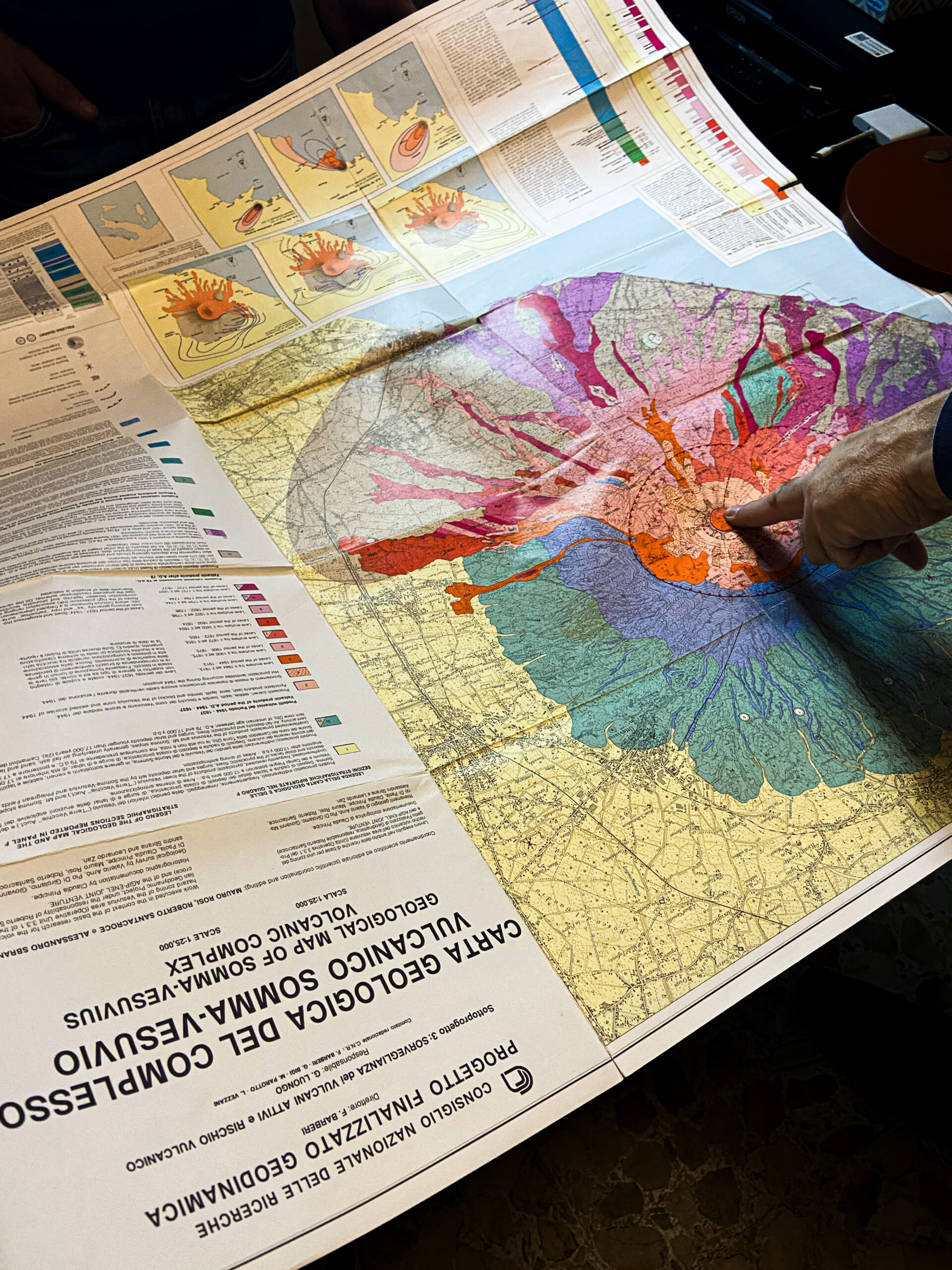
A geological map of Mount Vesuvius at Archivio Russo Somma, as part of the Art Summit 2026 promoted by Tramandars, Photo by Pepa Ricciardi, Courtesy of Tramandars
The residency reveals the importance of experiencing things live and in real time, of participating directly in the festive rituals of the Borgo, bringing together different personalities who work harmoniously within a shared and relationship-based dimension. Connections and encounters, tied to the concept of “transmission,” become central during the residency period, emerging with particular clarity whenever a condition of shared hypersensitivity arises among the participants. Thus, Monte Somma — part of the mountain complex embracing Vesuvius in a semicircle, at whose foothills Borgo Casamale stands — during the period between May and August, on the occasion of the Festa della Montagna and the Festa delle Lucerne, shines with vitality, evoking a profound intangible heritage of musical practices, oral traditions, and collective rituals in which past and present, sacred and profane, nature and art converge. In this way, what is geographically classified as a volcanic mountain formation becomes a catalyst of energies from which artworks may emerge.
For both curators and artists, participating in and sharing such moments does not simply mean acquiring new tools through which to read and inhabit the territory; rather, it becomes an intimate and communal gesture, endowed with an almost cosmic value aimed at the sincere understanding of what in reality belongs collectively. The experience of the stay opens itself to places through a sensitive and entirely non-preordained gaze, and it becomes evident how art, in its various forms — performative, installation-based, photographic, pictorial, and sculptural — reveals that past traditions, in relation to the landscape morphology upon which artistic practices are grafted, do not merely represent a backdrop, but rather horizons for new critical challenges.
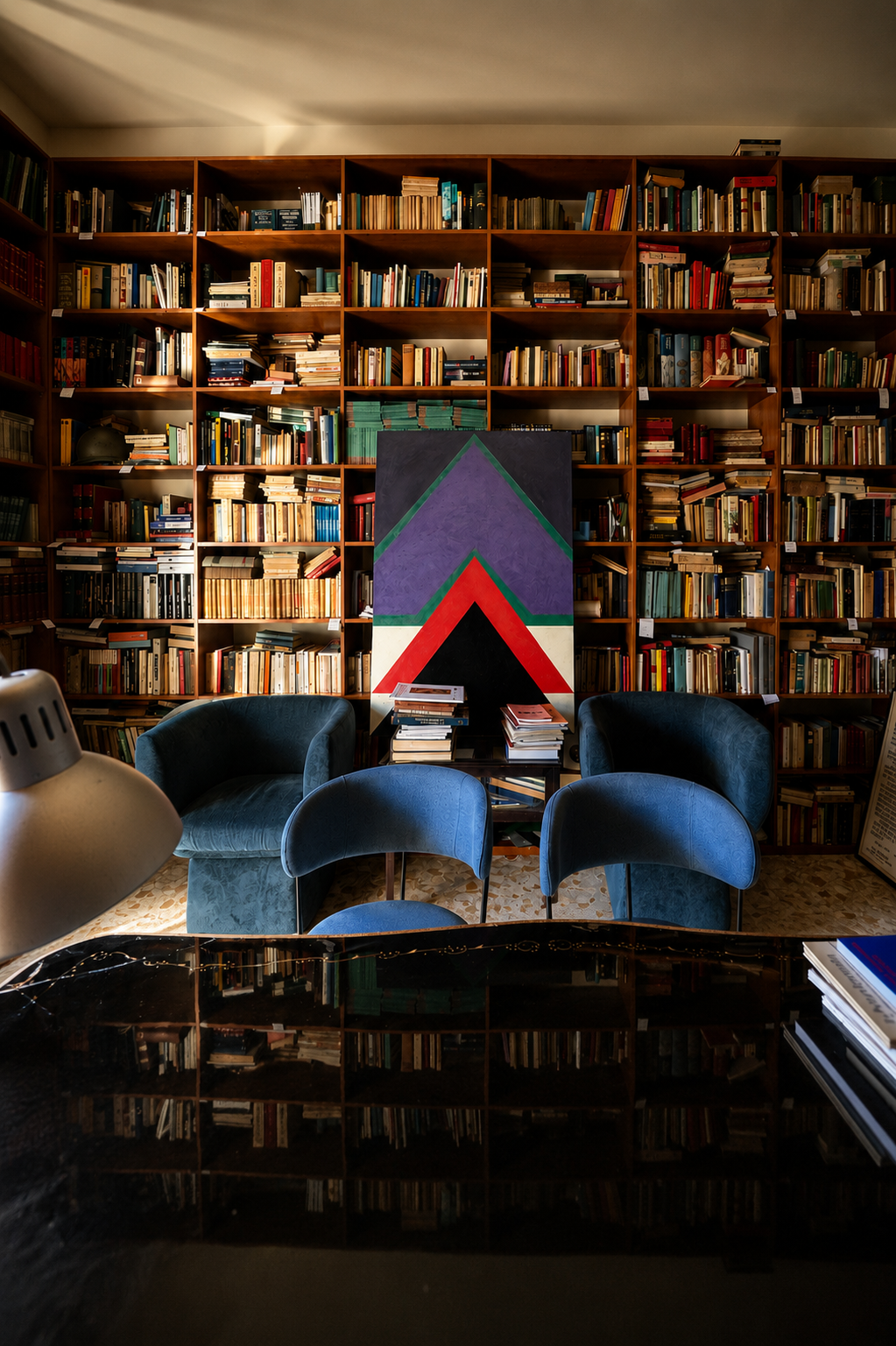
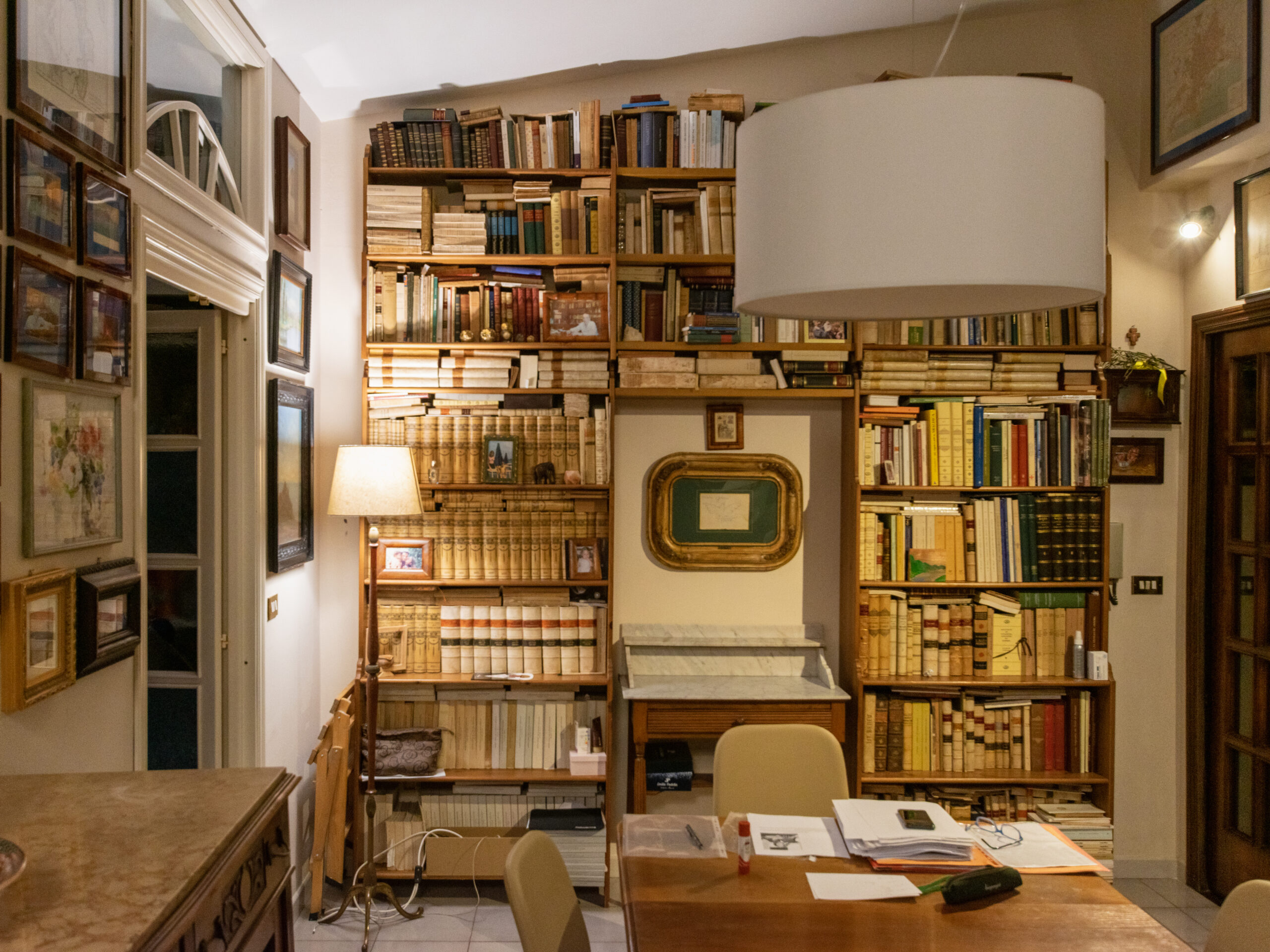
Views of the interiors of Archivio Russo Somma, Borgo Casamale, Somma Vesuviana, Courtesy and Ph. Credit Archivio Russo Somma
Among these, the relationship between historical memory and contemporaneity assumes a central role. Direct engagement with the site, together with the study and consultation of archival materials, therefore becomes a fundamental instrument for restoring investigative depth to the stratifications that characterize it. In particular, all artists are given access to the Archivio Russo Somma, founded in 1973 by Domenico Russo and coordinated by Gaetano Maria Russo, comprising approximately 30,000 volumes, including unpublished materials concerning the history of Naples and Vesuvius. To this are added around 300 maps and views of Naples and the Vesuvian area, together with 1,000 slides documenting monuments and artworks from Somma Vesuviana.
From an in-depth study of these materials originated the work of Rebecca Moccia (Naples, 1992), participant in the third edition with Ancestors Syndrome (2025), a project born during the residency that continues today to develop autonomously at Temple Bar Gallery + Studios in Dublin, on view until June 28, 2026, within the multidisciplinary project Nostalgism.
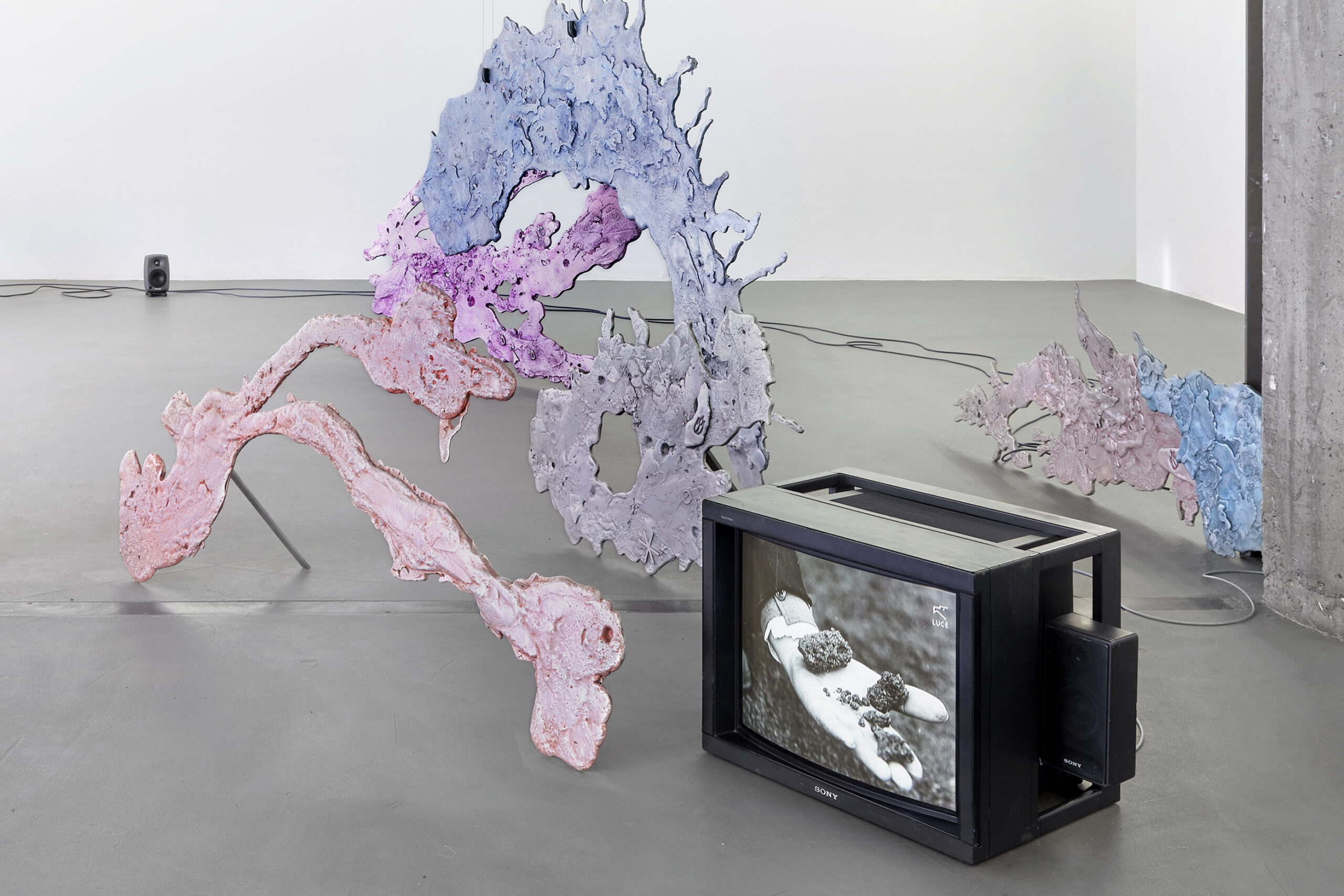
Rebecca Moccia, Ancestors Syndrome, Installation view at Temple Bar Gallery + Studios, Dublin, 2026, Ph. Credit Ros Kavanagh, Courtesy of the Artist and Mazzoleni
The work conceived during the residency stems from research conducted at the Archivio Russo Somma on several geological maps of Vesuvius, intertwined with family memories related to the 1944 eruption. What emerges are true “aerosculptures,” abstract forms suspended in air and space like a lattice in pastel tones, alluding to the colorations of the reference maps from which the shapes are extracted. Although this may initially appear didactic, what instead surfaces is an intimate relationship with matter that retraces the varying depths of the artist’s fascination and attachment to the archival research undertaken. Each component of the work becomes a slippery tactile pulsation of cast aluminum, culminating in the joining of the elements through the careful exercise of a particular manual skill.
What stands out is how each site of the residency is characterized by a multidisciplinary nature from which different levels of analysis emerge, capable of unifying issues while preserving the specificity of individual case studies. However, the aim is neither to rewrite history nor to formulate definitive judgments or univocal interpretations, but rather to construct a plural paradigm in which folklore studies meets geography, while ethnography and art are oriented toward investigating the physical, cognitive, and sensory dimensions of places.
With Tramandars — a name born from the union of “tramandare” (to transmit or pass down) and ars, understood as a profound creative practice — the artwork is never bent to a specific interest nor flattened by a melancholic past-ism or a dominant present. Rather, research emerges that is characterized by the joyful discovery of otherness, establishing a deep relationship with the territory and its history.
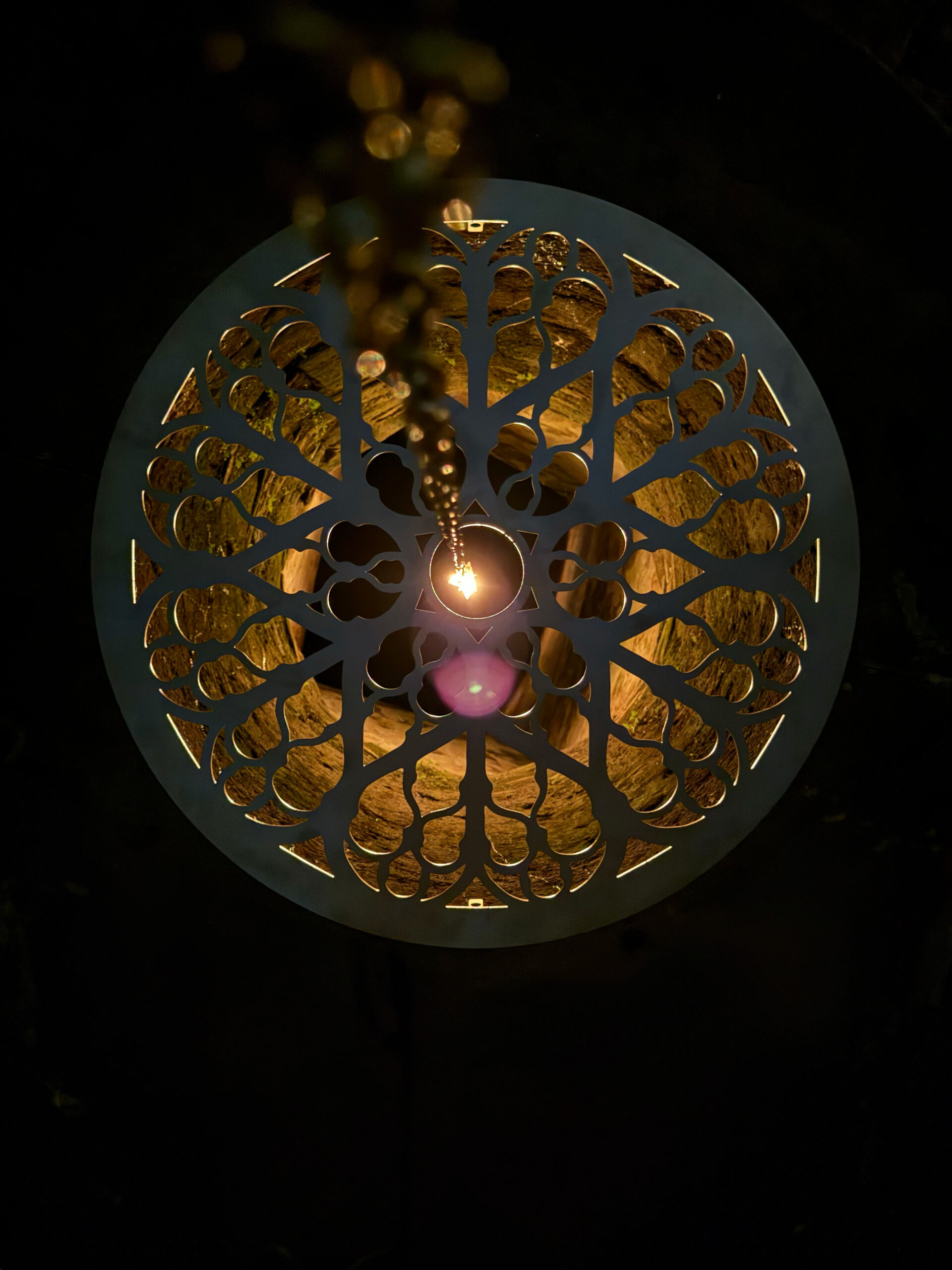
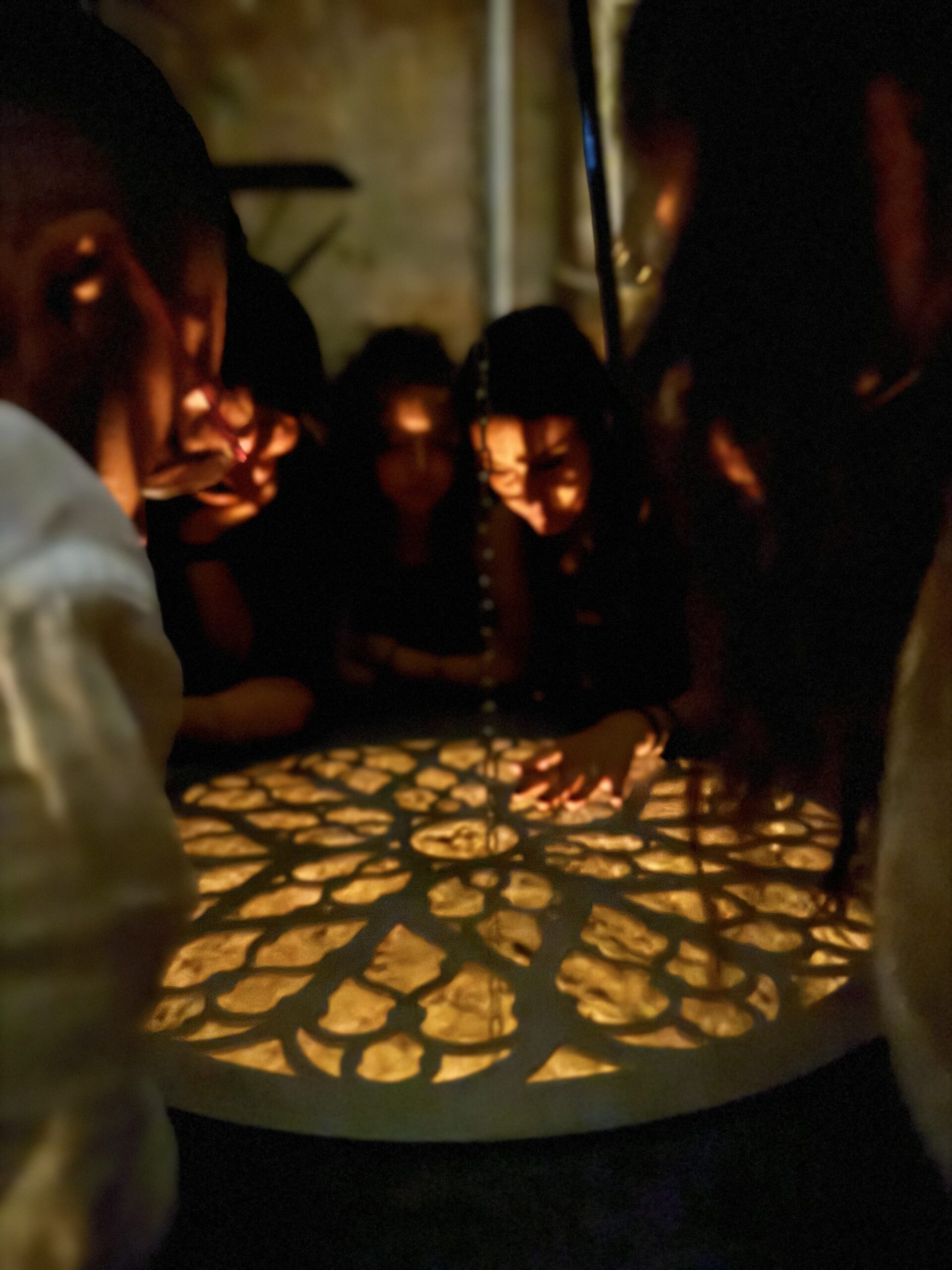
Lucas Memmola, A Wind Coming from Within (Un vento che viene da dentro), 2025, Borgo Casamale, Somma Vesuviana, Courtesy of the Artist
Some of these works are permanently installed and still visible in the Borgo, as in the case of Un vento che viene da dentro (A Wind Coming from Within, 2024) by Lucas Memmola (Bari, 1994), already present during the first edition. In this work, a rose window—its design recalling that of the French cathedral of Saint-Pierre de Beauvais—is placed at the opening of a well, filtering a light projected from within. Here Memmola works on the concept of the visual device as an imaginary boundary to be crossed, and the “wind” evoked in the title may refer both to the airflow inside the occluded well and to the currents brushing the morphology of Monte Somma. It is a metaphor that also alludes to breath as a generator of language, referring to the flow of words passed from mouth to mouth across generations, as well as to the songs performed during the Borgo’s festivities.
In this sense, it is clear that written, sung, and spoken words are sediments that tell of who we have been, the geographies we have inhabited, the foods we have consumed, and the rituals that have united us, as bearers of traditions still alive today.
For others, the residency experience during the Borgo’s festivities represents a valuable opportunity to rediscover oneself as both alive and actively participating at the same time.
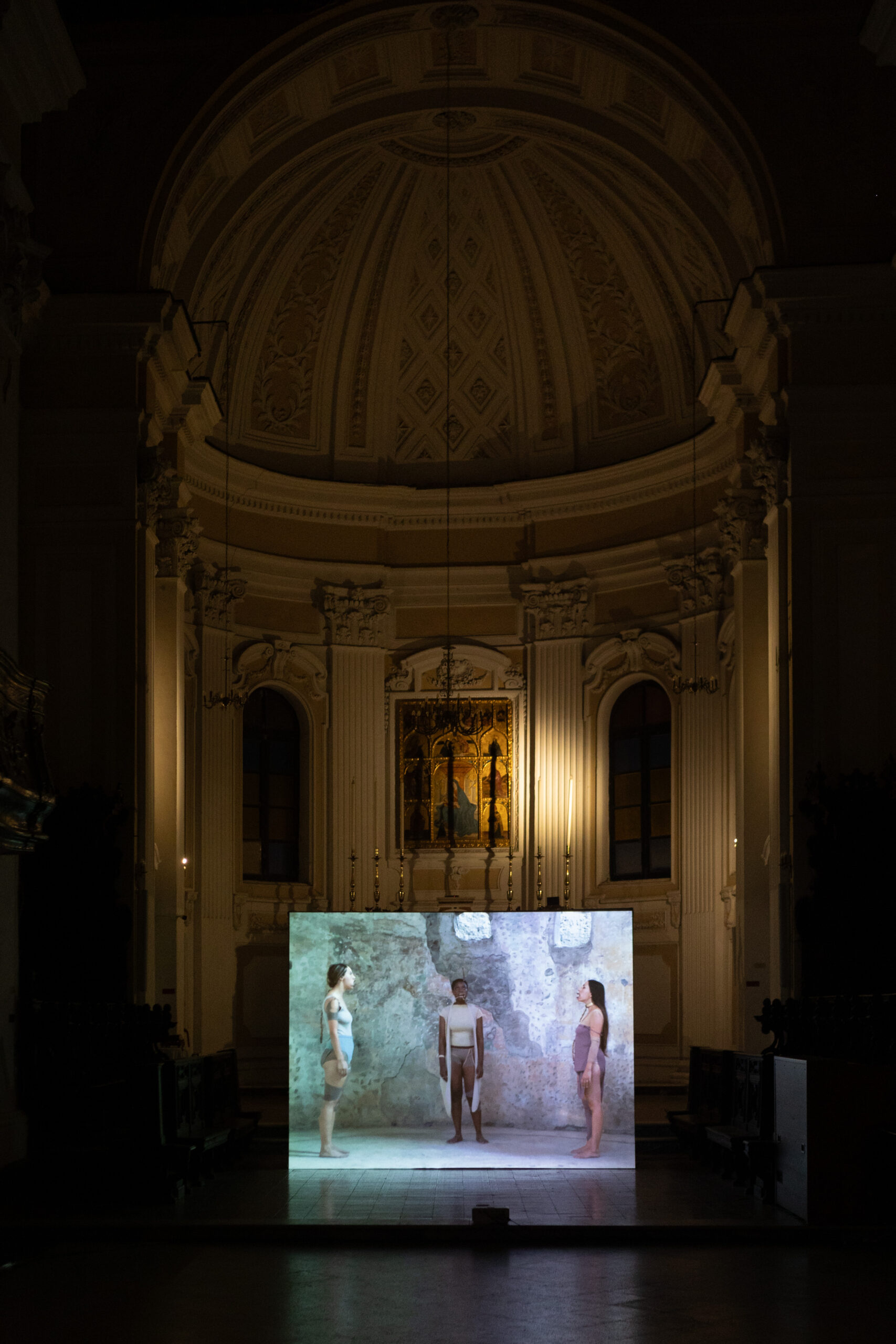
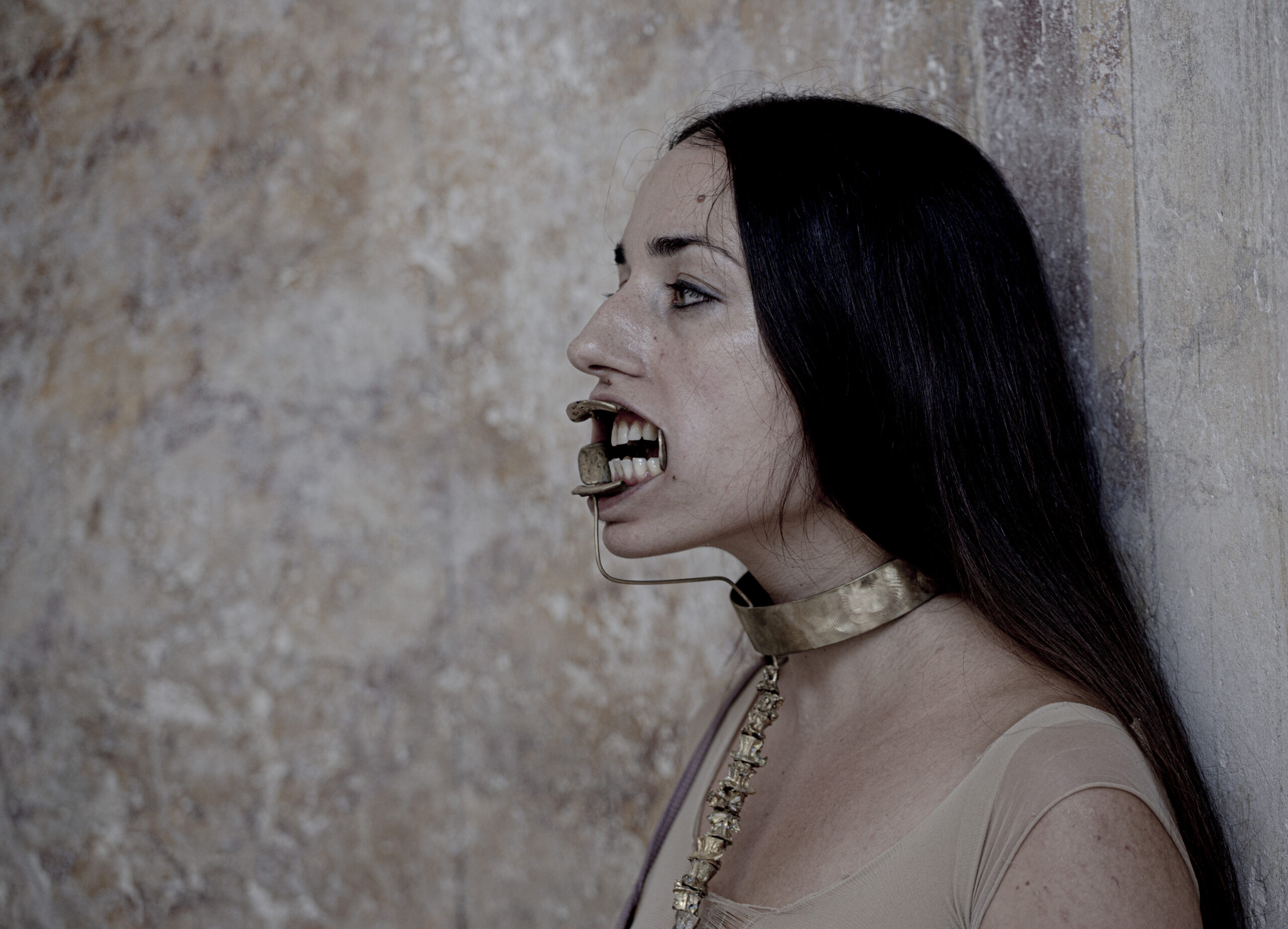
Maria Giovanna Abbate, Everything Must Be Sung to Exist (Tutto per esistere deve essere cantato), video performance, Chiesa Collegiata, 2025, Borgo Casamale, Somma Vesuviana, Ph. Credit Alessandro Lanciato (left) / Maria Giovanna Abbate, Everything Must Be Sung to Exist (Tutto per esistere deve essere cantato), 2025, Performer Shushan Hyusnunts, Ph. Credit Francesco Capasso (right)
Proximity to and direct involvement in all the celebrations make it possible to discover how memory is not merely recollection, but becomes participation, as a necessity for rereading the multiple roots that define it. Nothing, indeed, seems to impact the emotional sphere more than performative practice, which is capable of producing sensitivity, unease, and even disturbance.
From this perspective, during the second edition, Maria Giovanna Abbate (Caserta, 1991) presents the work Tutto per resistere deve essere cantato (Everything That Is to Resist Must Be Sung, 2025), composed of a video-performance shown at the Collegiate Church of the Borgo, of which bodily extensions used by the performers remain. Through practice and immersion in mountain rituals, as well as knowledge of local traditional foods, the artist generates sculptures conceived as bodily expansions and subsequent performative actions, in which food, body, and sound operate within a circular system of semiotic interchangeability.
This work can be interpreted as a profound reflection on physicality understood as a space of utopia, where the works worn by performers act as bodily prostheses, approaching the figure of the mutant being and thus opening new possibilities for transformation and liberation of the subject through what is worn. In this dynamic, song and food become instruments of emotional externalization and symbolic expiation, through a land understood as a metaphor for existence itself, both for the inhabitants of the Borgo and for the artists in residence.
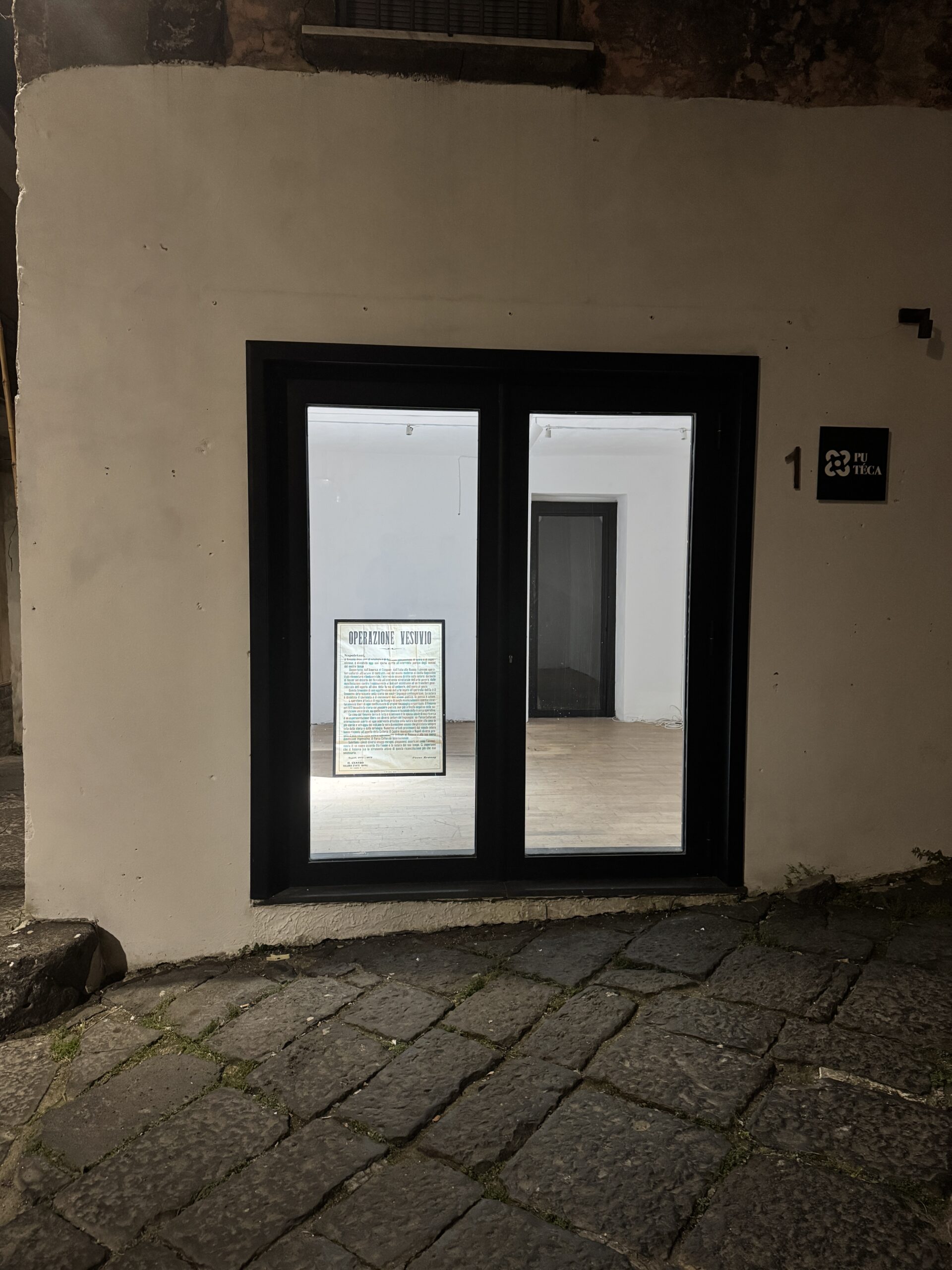
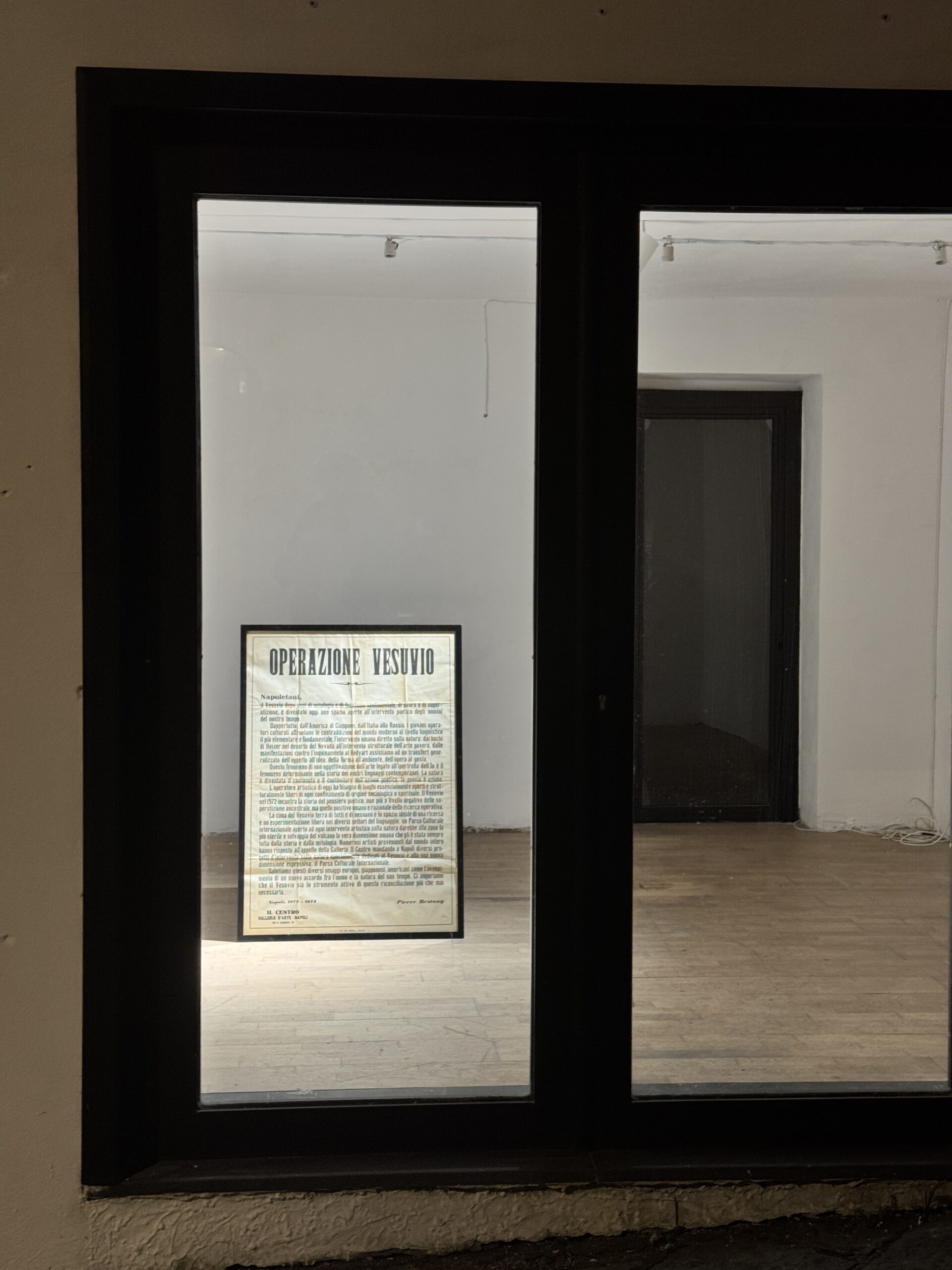
Pu-TÈCA Tramandars, Operation Vesuvius, (Operazione Vesuvio), Borgo Casamale, Somma Vesuviana, 2026
It happens that the intangible and landscape heritage studied by each artist becomes a tool of inquiry and exploration of a broader scenario, where Naples and Borgo Casamale reveal themselves as welcoming, profound, and vital, open to an attitude of analysis and cultural research of the contemporary.
Within this auspicious horizon, in the exhibition space Pu-TÈCA Tramandars — approximately fifteen square meters in size — one can currently view the manifesto by French art theorist and critic Pierre Restany concerning Operazione Vesuvio, dating from 1972–1973. In the text, it is stated with unequivocal clarity that “the summit of Vesuvius is land of everyone and no one, an ideal space for research and experimentation open to every artistic intervention”: a striking image that invites reflection on how the past, together with the territory that hosts it, allows us to narrate the present and even to imagine the future.
Translated to English by Dobroslawa Nowak