


INDICATRIX
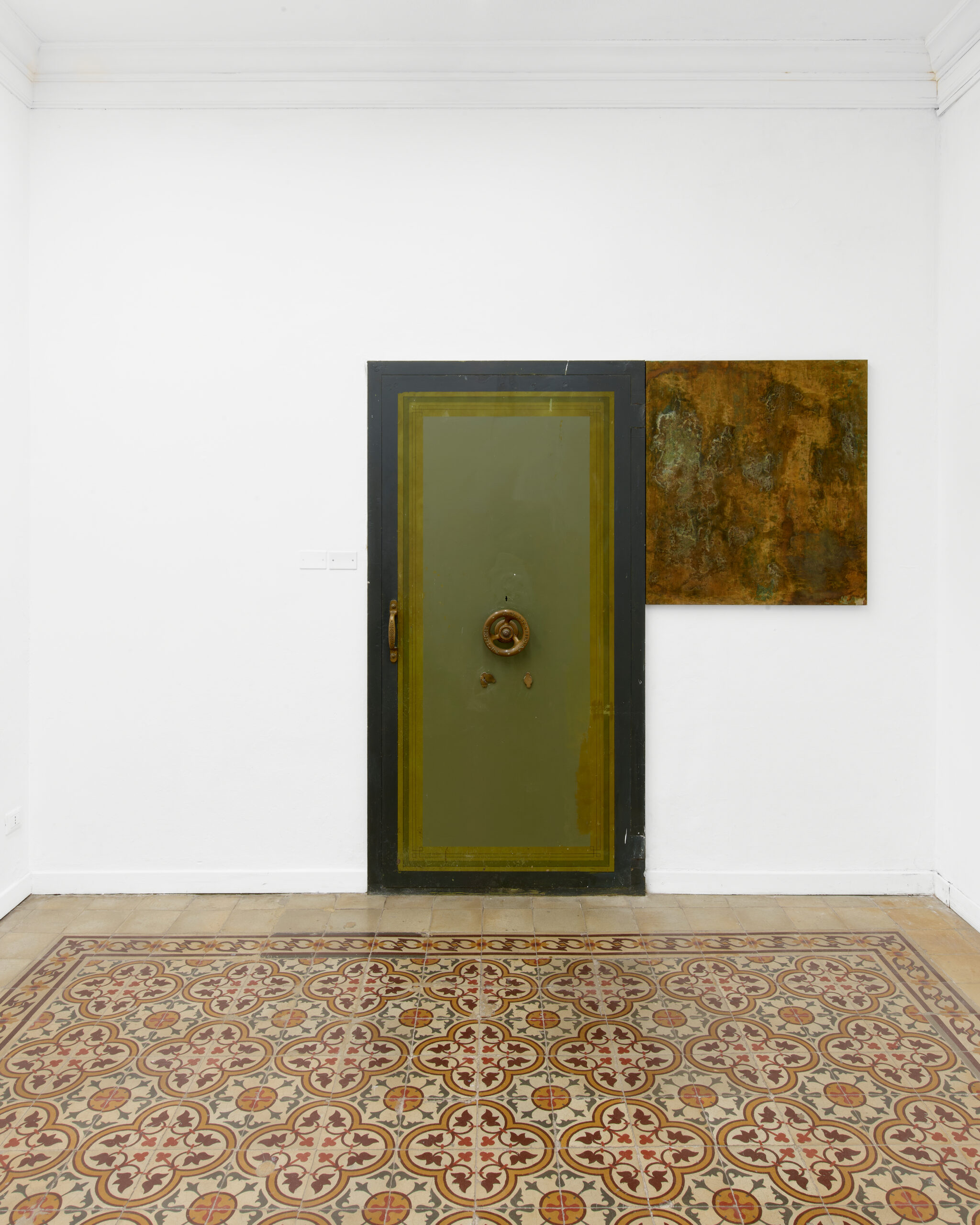
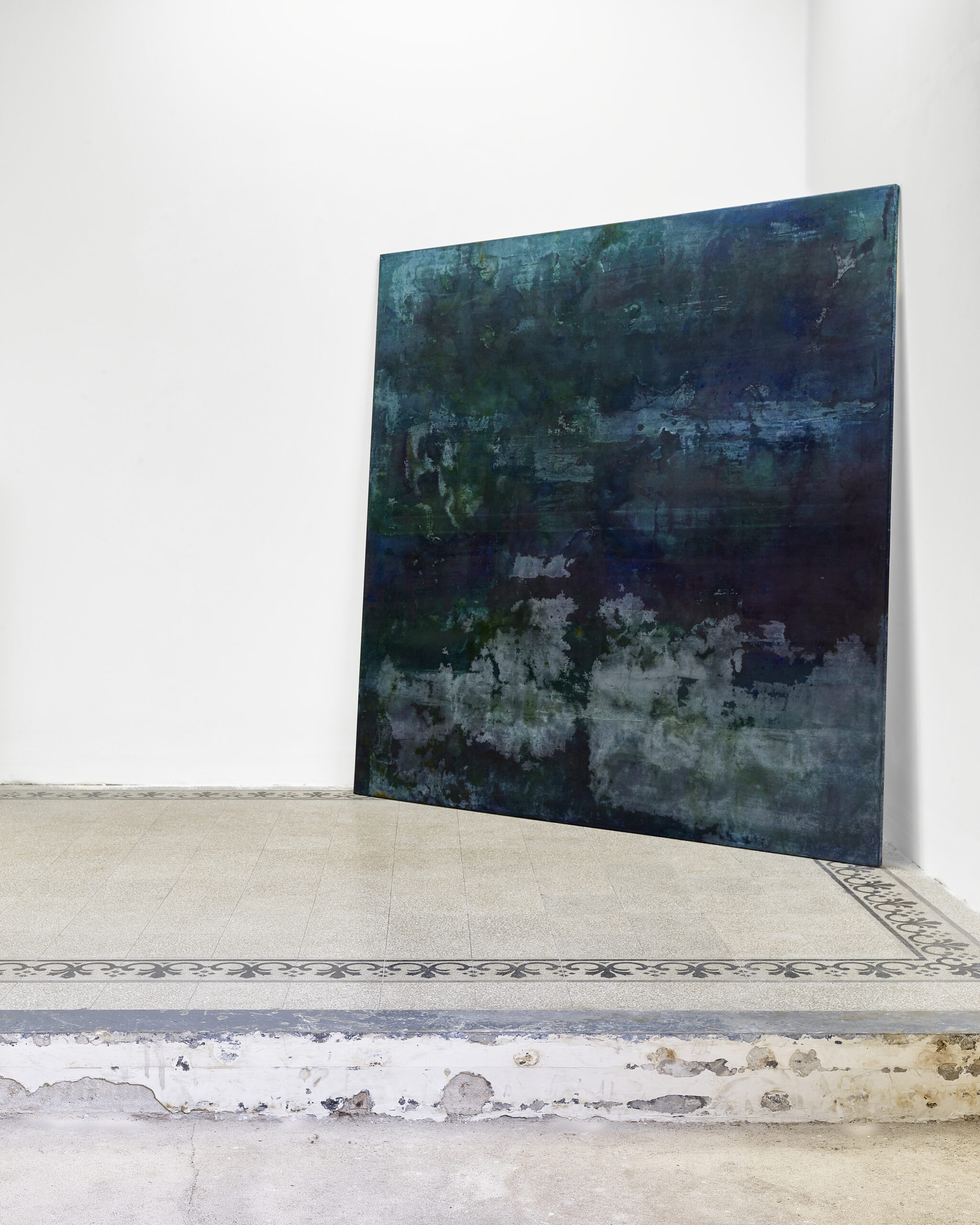
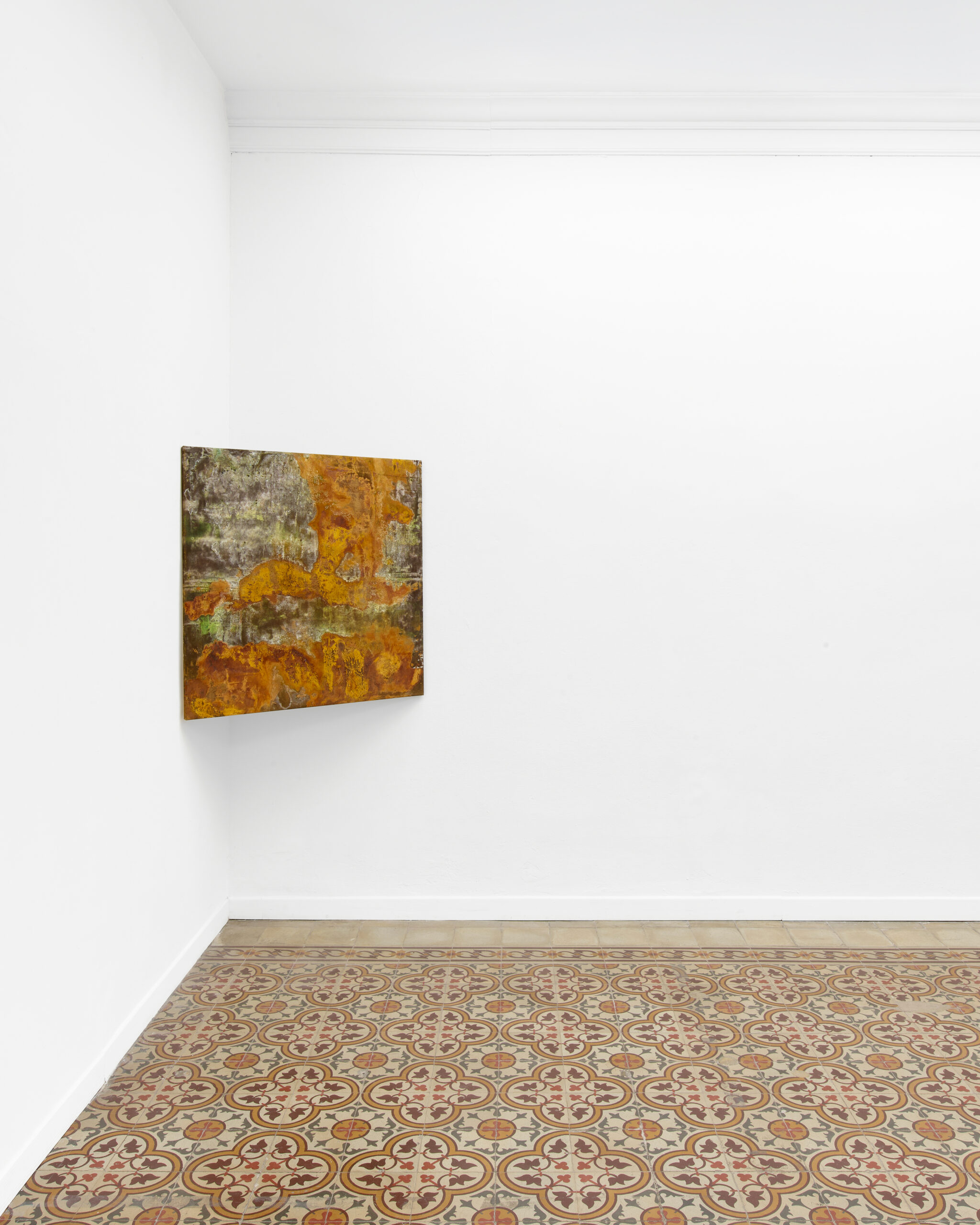
In Jorge Luis Borges’s stories, the labyrinth resists the idea of rigid symmetries; it is a perceptual and interior condition, a space in which every passage alters the shape of the path, and where the exit coincides with the transformation of the one who crosses it.
A similar labyrinthine quality runs through Taylah Hasaballah’s surfaces. Born in Australia with Coptic-Egyptian origins, Hasaballah works against the idea of linear development and resists any notion of an intention belonging exclusively to the artist. Her works emerge within a regime of uncertainty, a sustained questioning of the self as “creator/producer” of form. From this conceptual stance, she unfolds a practice that replaces the willfulness of the gesture with the logic of processes: surfaces generated through chemical reactions, accumulations, drifts, and successive erasures produce forms that remain in flux. In her own way, Hasaballah retrieves the idea of the labyrinth found in Borges —a condition in which every deviation becomes generative.
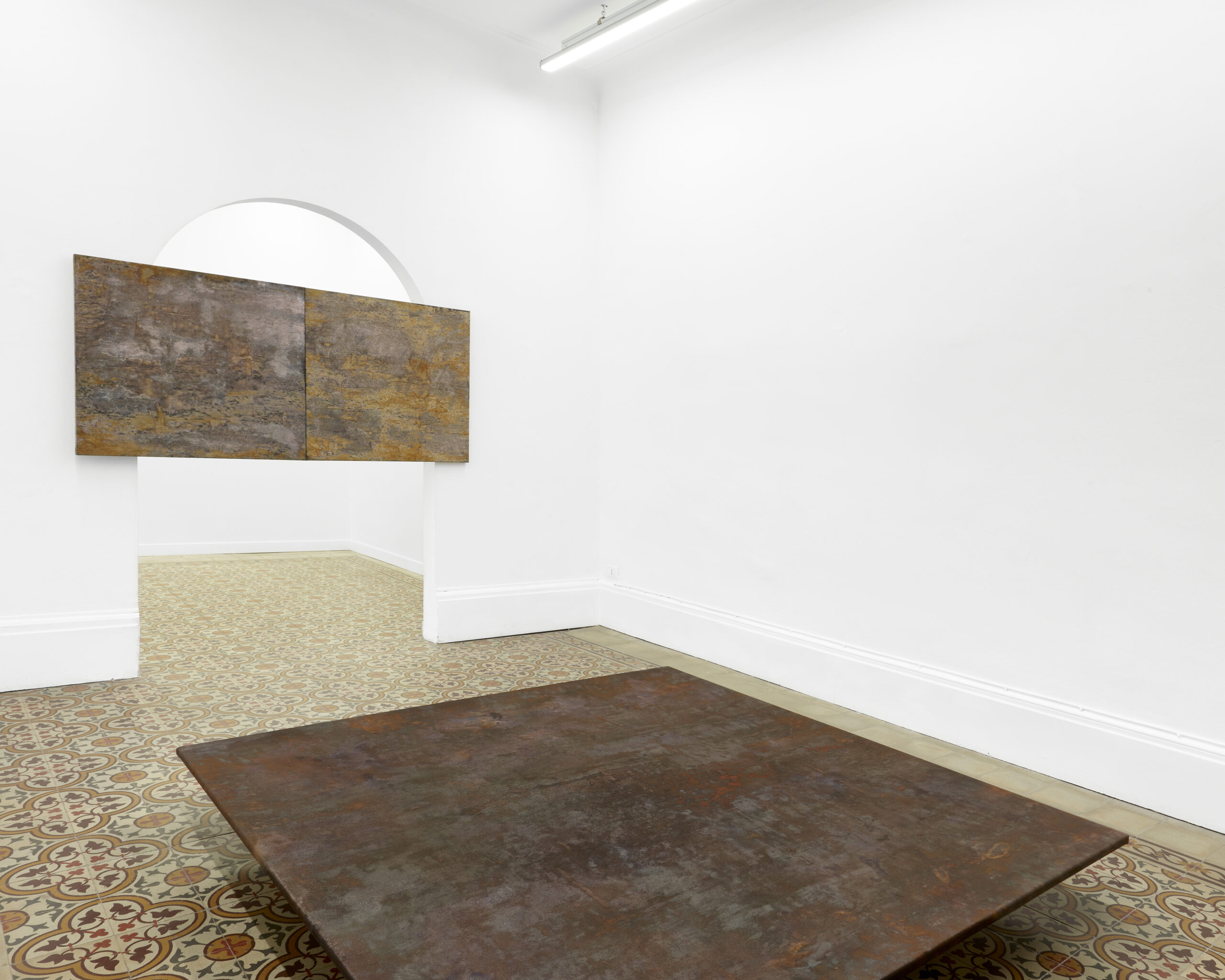
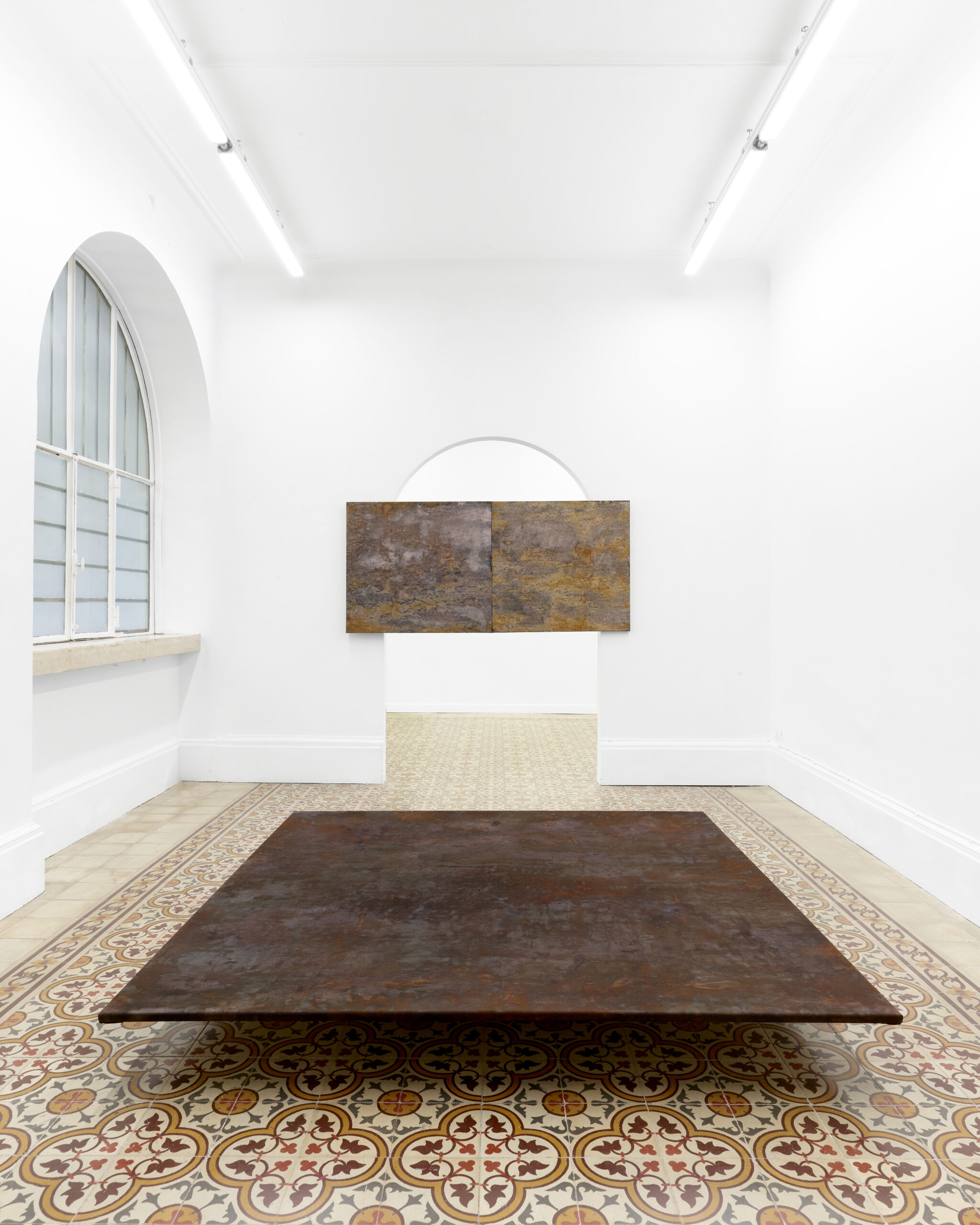
Within this framework, INDICATRIX: Time Leaks / Causes of Extinction Unknown, Hasaballah’s first solo exhibition in Europe, unfolds as a material labyrinth. Her sensitivity to stratification, to minimal marks and shifts within matter, has gradually pushed her practice away from the rigidity of oil painting. The transience of her surfaces exceeds the intentionality of the gesture and results from processes in which matter is no longer guided but acts on its own; the surface becomes an organism to be observed.
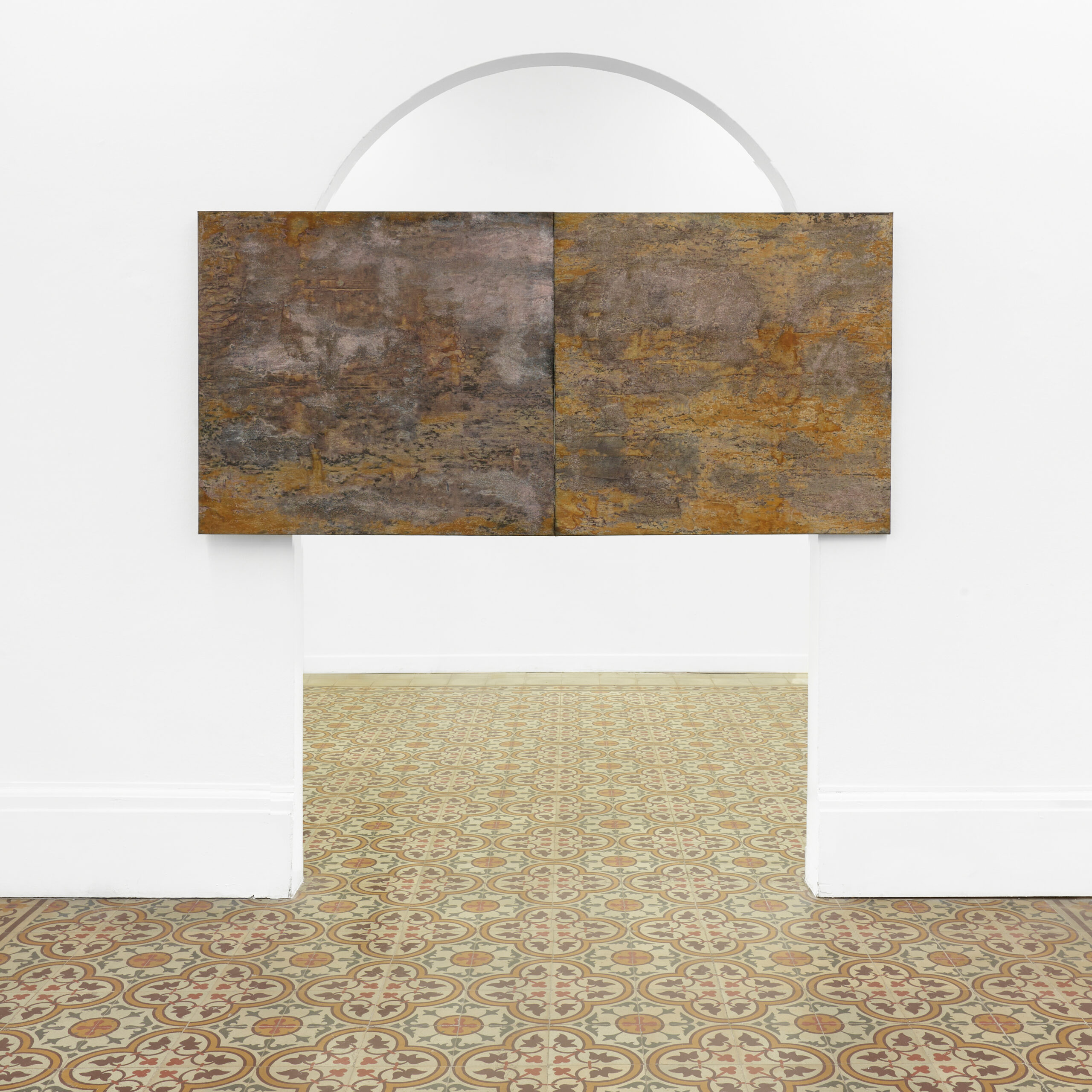
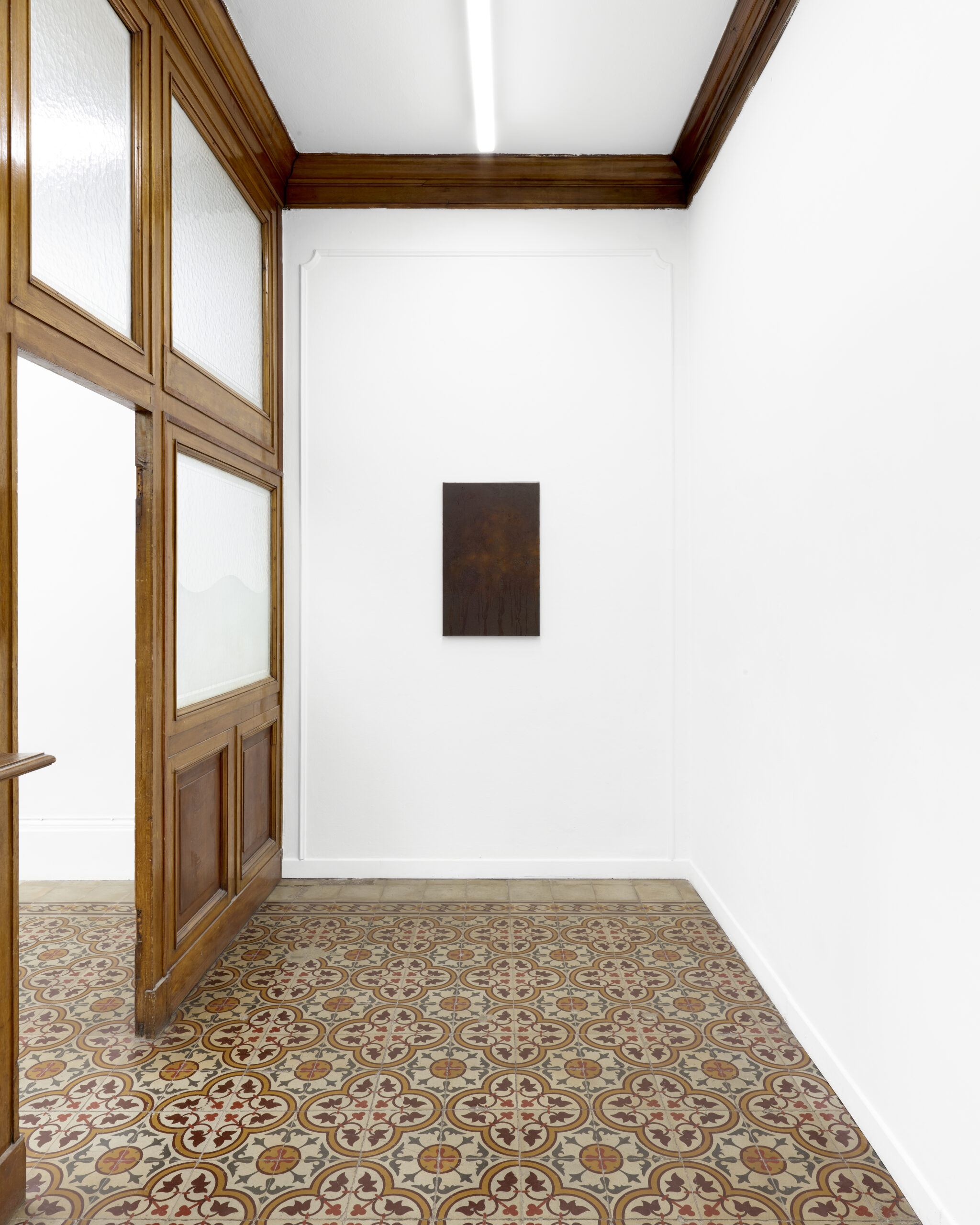
Abandoning oil was not merely a change of medium—it marked an ontological shift, a decision to entrust form to the mutations and drifts of matter. Hasaballah’s practice begins with this principle of subtraction. She allows the surface to register whatever occurs above or beneath it—traction, falling objects, wind, accidental contact—without letting the gesture determine its form. I think of them as “entropic surfaces,” structures that react, deform, and stratify. Chemistry becomes a generative system: the morphology of the works arises from the behavior of linen, from accumulations of salts and metals, ionic acetates, pigments, and substances that react unpredictably with one another. If her oil painting still belonged to an ancestral idea of the artist as the original producer of form, her recent work embraces a processuality that escapes the auratic question of the artwork and yields to the transience of matter. In giving way to matter, her practice meets entropy. Beyond its physical definition—measuring disorder and the dispersion of energy within a system—entropy in art theory destabilizes and reconfigures our visual and temporal perception: an ineluctable drift toward transformation. Robert Smithson described it as an irreversible process, an “evolution in reverse” that dissolves form and reshapes it over time. These surfaces owe something to Land Art, to Smithson’s entropy, and to the labyrinthine imagination of Borges and J.G. Ballard, which Hasaballah sees as a manifestation of entropy itself.
Within this entropic landscape, INDICATRIX becomes a lens through which to observe what distort when a surface is translated elsewhere—when matter becomes organism and when the artist serves only as the initial catalyst. The title refers to Tissot’s Indicatrix, a cartographic device that visualizes distortions produced when one surface is projected onto another: infinitesimal circles that, once displaced, become ellipses, revealing tension, stretching, compression. It is a tool of perception that makes visible the inevitable bias that comes from any attempt at containing or transposing nature into a man-made system. This logic structures the exhibition’s two chapters:
Time Leaks (Milan) and Causes of Extinction Unknown (Brescia), two temporal conditions of porous matter. Their formulation emerged from an analysis of the temporal and entropic architecture running through Hasaballah’s work, where the axis is the instability of time itself: a time that crystallizes or collapses, as in Ballard’s anti-time; a time that stratifies into images in which past, present, and future coexist, echoing Deleuze’s time-image.
Time Leaks stages an accelerated, precarious temporality—surfaces reacting to light, showing slippages, distortions, metamorphoses in progress (all works from 2026). It marks the threshold of temporal escape where time manifests as loss. Causes of Extinction Unknown, by contrast, reveals a geological temporality: surfaces that have reached an osmotic poise with their environment, showing sedimentations, crystallizations, and forms emerging under the pressure of time (2023–2026).
The works take shape as geologic formations. Each layer alters what precedes it, producing swellings, collapses, micro-fractures. The morphology generated by the linen—an Italian linen, soft and easily deformed—recalls rivers and valleys. In some works, the imprint of the studio floor folds into the form; others, made on refractive polyester, react to light; in others still, the fall of a liquid determines direction, or the reaction between metals and salts produces an unpredictable chain of reactions.
They have no before and after: they register as material phases held within spans of time.
Sound extends this temporality.
INDICATRIX is permeated by a soundscape composed by Blu Aloé—a sound artist shaped by Cologne’s experimental techno scene—built from granular synthesis, distorted drones, dense modular textures, and contact-microphone recordings made in producer Boris Wilsdorf’s studio. The old oil tank in the studio—once used by Einstürzende Neubauten to capture reverberations and textures—becomes a medium that translates entropy, oxidation, and the precarious relation between matter and its environment into sound. Blu Aloé worked with samples of materials found in the works—metals, surfaces, droplets, rusted tanks—and with modular synthesizers generating feedback loops and recursive systems. In Time Leaks and Causes of Extinction Unknown, sound reverberates the metamorphoses and stages of matter, becoming the audible trace of Ballard’s anti-time, where worlds crystallize or collapse, making temporal slippages and sedimentations perceptible. In this way, the two chapters of INDICATRIX inhabit a shared entropic dynamic, with sound extending the internal logic of the works and revealing fractures in time as vibration, residue, and persistence.