


Letter to an Institution: The Present History of the Venice Art Biennale
By Kamil Sanders
23.06.2026
Among the authors selected through the open call for critical essays on the 61st Venice Biennale.
1
The historical moment from which this visual assemblage takes shape is the 34th Biennale. The moment captured is June 1968, during the opening days. The backdrop of the scene: the calli of Venice swell with student demonstrations demanding, among many other things, an exhibition without prizes—prizes understood as particular inflections of the language of Power, whether governmental or commercial.
Inside the Biennale, beyond the police cordon that separates the protest movement from what passed for reality, many of the exhibiting artists express their solidarity with the demonstrators and, in a gesture that would become emblematic, turn their works around and face them to the wall.
Gastone Novelli, an exceptional painter and a formidable thinker, who would die later that same year, inscribes on the reverse of a canvas a political testament that speaks for more than himself alone: THE BIENNALE IS FASCIST.
What followed this heroic image is less widely known.
On 22 June, just before the exhibition opened to the general public, while one final demonstration made its way to the U.S. Pavilion under the chant of “Free Vietnam,” the prize jury moved through the exhibition and selected the award recipients. As it passed, every artist, without exception, uncovered their work.
Thus were the flowers of ’68 domesticated: no longer by pruning shears, but by beauty contests.
Because what does the artist do? They tend to arrive at the Biennale and feel satisfied by it, or at least that is the attempt on the part of Power: to construct a framework within which all artistic efforts are directed and subsequently channelled, thereby preventing them from scattering into directions that Power cannot control and that could become dangerous to Power itself.
Enrico Castellani, as included in Carla Lonzi’s Autoritratto
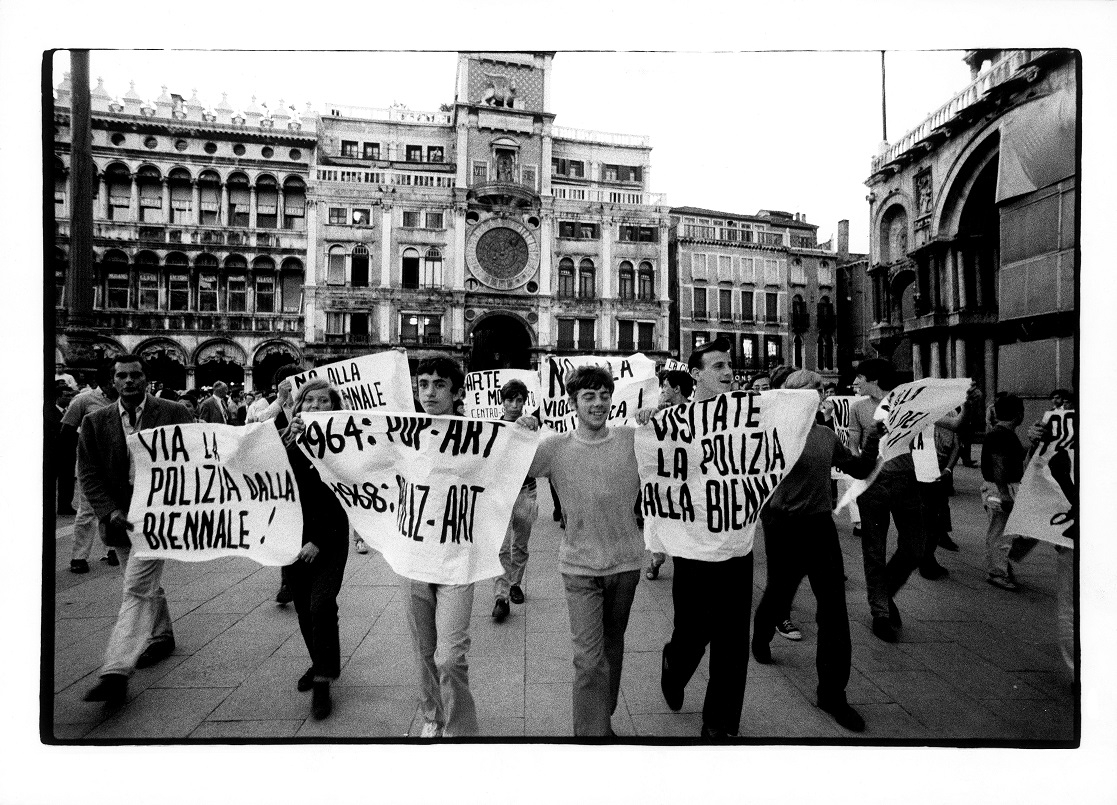
Demonstration against the 1968 Biennale in Piazza San Marco in a photograph by Ugo Mulas @ Eredi Ugo Mulas
The intentions of Power had already revealed themselves, to the more attentive, four years earlier in the very same venue, during the so-called “Pop Biennale.”
Amid the 1964 edition of the exhibition, the American Pavilion’s governing committee, through its curator Alan Solomon, actively and diligently promoted an art that was “as cheerful as a city’s shop windows, as exciting as cinema posters; as seductive as advertising” (Plinio De Martiis, italics mine). At the height of the Cold War, a piece of the broader American hegemonic strategy came into view, immediately crowned by the awarding of the International Painting Prize to a leading figure of U.S. Pop Art, such as Robert Rauschenberg. 1
The outcomes of the specific conjuncture of 1964, however, became sealed in the body of the exhibition far more deeply than the mere American primacy: the assertion, across every level, of a tendency that aligned the language of the avant-garde with the grammar of the mass media marked a point of no return in the art system, with which many innocent artists would no longer be able to avoid confronting themselves, caught in the trap between critical discourse and prime-time television.
The Art Biennale was born in 1895, after five years of gestation, on the initiative of the Municipality of Venice under its mayor Riccardo Selvatico.
In 1930, it was made an autonomous institution, placed under the close control of the Mussolini regime. The new statute provided, among various measures, for the government’s appointment of its board, and it would continue to apply well beyond the fall of the dictatorship, until 1973. Novelli’s statement thus resonates with full justification: in 1968 and beyond, the Biennale is fascist.
From the postwar period onward, the Biennale—like any respectable cultural institution—found itself increasingly struggling to secure the funds necessary for its survival. This urgency was followed by Legislative Decree of 29 January 1998, which redefined the Biennale as a private entity, renamed it as a cultural company (“Società di Cultura la Biennale di Venezia”), finally opening up to the injection of “possible contributions and allocations, including in the form of sponsorship, from other public or private bodies or institutions” (Legislative Decree no. 19 of 29 January 1998). On 8 January 2004, in an effort to streamline financial flows, the Biennale was transformed into a Foundation.
The first brand to enter the organism was illycaffè in 2003. It was followed, among others, by Swatch and Valentino, culminating in an exclusive agreement with Bulgari from 2026 onwards and for the two subsequent editions.
The Biennale was not the only contemporary art institution to open its ears to capital. In 2017, a giant such as Tate Britain was confronted with the most unpleasant consequences of this kind of infiltration, when BP, one of the world’s major oil and gas multinationals, did not renew its almost thirty-year contract following protests by numerous activists.
That such a controversial company could have sought to refurbish its image through the painting of such a respected institution might be seen as the most disastrous outcome of a fatal misunderstanding. However, it seems to me that this line of reasoning can be pushed a little further, to the point of arguing that the critical issue in this seepage lies in the very alignment of artistic languages with advertising codes, to which brands remain eternally hostage. On the other hand, this was not a one-sided affair: seduction is a reciprocal process, and 1964 testifies that art had long been under the spell of the sparkling allure of consumer society.
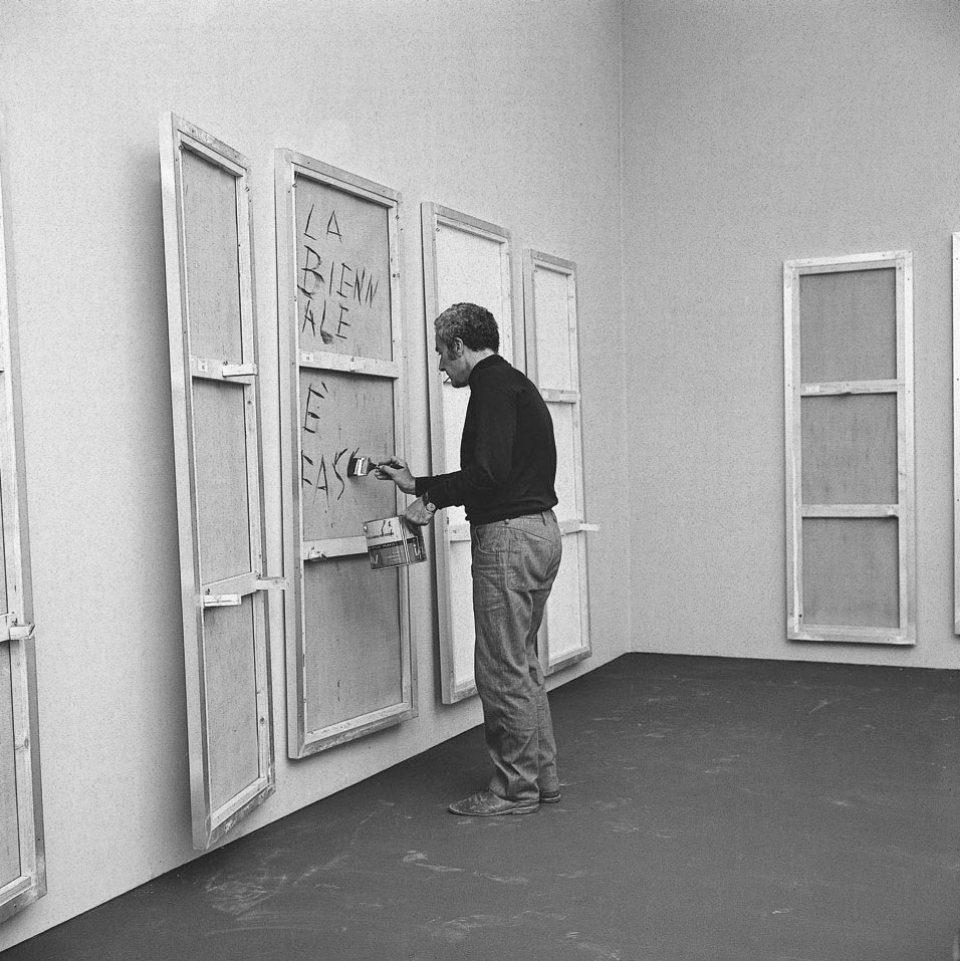
Gastone Novelli at the 1968 Biennale @ Agenzia Dufoto
In a foundational text of his early philosophy, Instincts and Institutions2, Gilles Deleuze advanced an idea that I take as a turning point in these pages: institutions conceived as the creative and affirmative dimension of law, ideally opposed to the coercive force of legislation.
If one were to juxtapose this notion with the excerpts discussed in the preceding paragraphs, one might venture the idea that the Biennale—so swiftly ferried from the cave of fascism to the glittering allure of capital—never truly had the time to dream itself into being as an institution.
According to Deleuze, the institution imagines. In doing so, it seeks to serve the needs of a community in good faith. When that claim is betrayed, whether through an excess or a lack of zeal, the institution lays bare its limits. Beyond those limits, in the spaces left unattended, dissent begins to germinate. At times, it is cultivated until it flowers into revolution, the complementary act of imagination.
In 2026, the lagoon delivers to the shores of the present the remains of a schizophrenic creature. Stranded in the day, it displays the queer and mixed-race torso of a foreigner everywhere, crowned by a reassuring smile, in minor keys: one that calls to mind, more than the Third-Worldist movements of the past, those multinational corporations that drape themselves in rainbow colours each June, intent on reaching new pots of gold.
Below, far beneath the waterline, this creature has its ankles firmly bolted to the ballast of its own colonial foundations. The traces of this legacy seep out from every side of a spatial arrangement designed in the Fascist era and carried through to the present without any significant re-semantisation.3
This particular dissociation that afflicts the Biennale—a creature simultaneously nationalist and decolonial, capitalist and inclusive—brings with it a singular capacity to slip through objections unscathed.4 The alienation of its parts corrodes its form. Stripped of any defining features, the organism deforms, melts, and finally shifts into a gaseous state. In this condition, it could be anything: it spreads across the entire horizon, leaving not a breath of air for contradiction.
Thus, at the very moment when the Biennale reveals its own inadequacy, instead of accepting its finitude and withdrawing to dream behind its sacrosanct boundaries—and making room for others—it deforms itself to excess in order to occupy all available surface: and in doing so it takes the path of Power, which, whether in the form of empire or market, through prizes or sponsorships, always tends to occupy everything that lies below the level of air.5
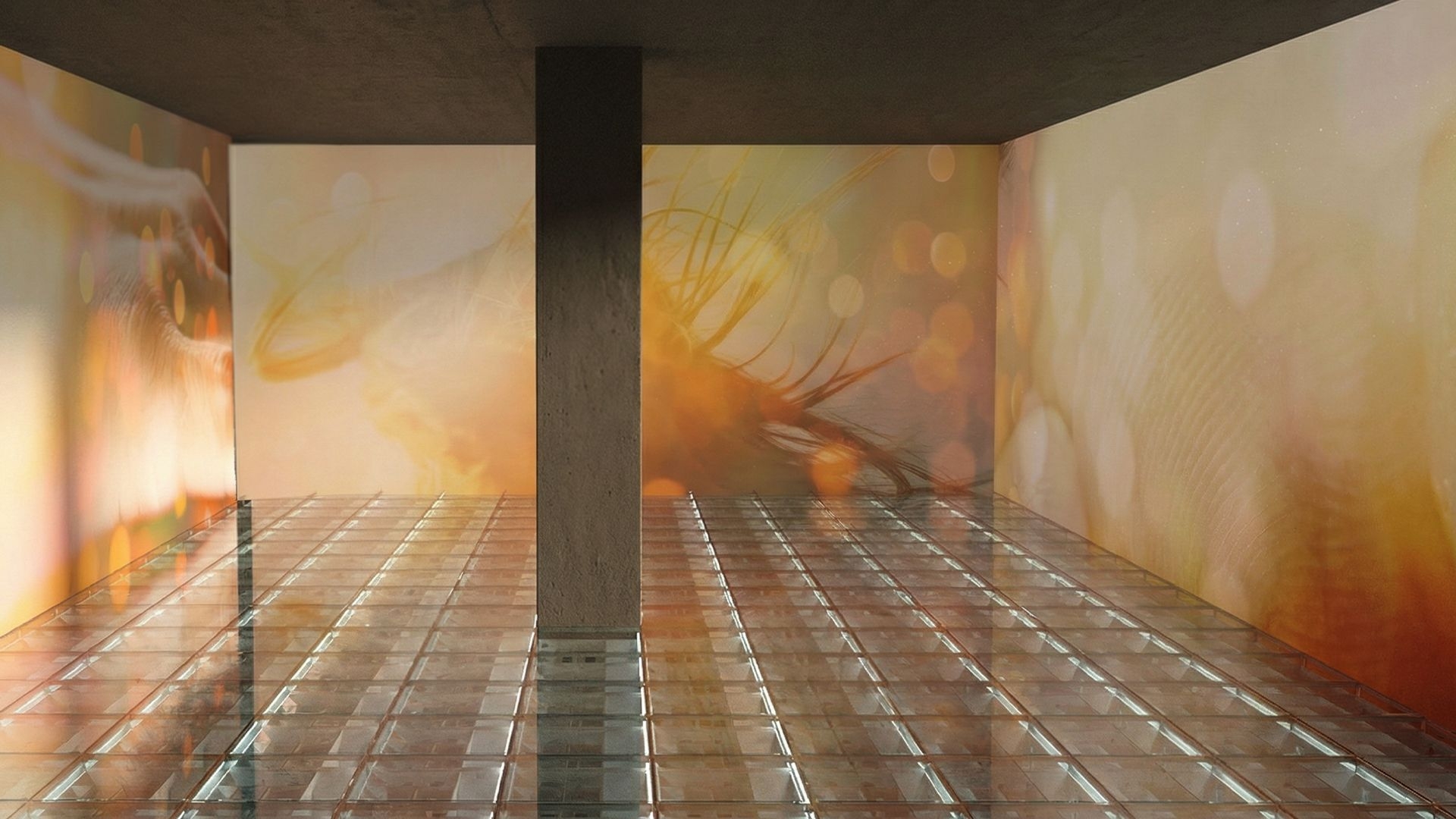
View of the exhibition Siniša Radulović, Out of the Blue, I’m Swept Away, curated by Svetlana Racanović @ Siniša Radulović
The following is a brief description of a particular case from the 2026 Art Biennale, which diverges from this score.
It is an installation that stages many of these bodies situated below the level of air, described in a dual form of glass floor and ceiling. These figures inhabit a dense, walkable ecosystem of 164 identical cells, connected by identical doors. At the periphery, the bodies are sparse and variegated; out of nostalgia or mirage, they safeguard their intimate desires from the prison that contains them. As one moves centripetally inward, the figures fade. Translated into increasingly absurd poses, they continue to pile up until forming a compact wall edging the center.
There is nothing at the center. No possibility of an elsewhere, only an inaccessible black pillar: the horizontality of this dystopian scenario has categorically excluded any possibility of an above.
Above, above the glass ceiling, where no one looks, projections tint the walls with dream and skin. Wonder flickers in simple form, the only opening onto the possible, halfway between touch and clouds, like the pure white flight that escorts the tightening of an embrace.
Out of the Blue, I’m Swept Away is the project presented by Montenegro at the 61st Art Biennale, conceived by Siniša Radulović and curated by Svetlana Racanović. Nestled like a misstep within the Castello district, it constitutes a rare episode of lucid self-critique in the exhibition, where self-critique assumes the contours of finitude.
Within the walls of the Montenegro Pavilion, the limits of the Biennale are precisely summarized: they coincide with the walls of identical rooms, repeatedly arranged according to identical curatorial texts, inhabited by docile spectators, straining toward a center which, for some time now, as surgically set out in the exhibition’s elegant catalogue, has been “absorbed by consumerist and digital perspectives, or by populist and totalitarian structures.” Advertising, awards, which ultimately lead only back to themselves6.
The guests of the Montenegro Pavilion are granted the privilege of an aerial framing, which coincides with emancipation. The human greenhouse is imprisoned below. The two environments exclude one another, whereas in the upper part of the installation, the sky opens like a lap, as if offering the possibility of returning to life, turning one’s back on the dystopia we have become, and acting as though nothing had ever happened.
Not yet revolution, of course, but a decent escape; and that is already a great deal.
There is little left to add, except to note how encouraging it is that this opportunity has taken the form of an artwork rather than theoretical speculation. If beauty will never save the world, it may at least have the capacity to save itself.
I realize that, over the course of this writing, the polemical tone has gained far more ground than the constructive one. This is due to the fact that, within that hypothetical dialectical process opposing institutions and forms of contestation, my heart leans decisively toward the latter, thereby excluding the possibility of keeping one foot in both camps. This is also the reason why I chose, as an example of art in good health, the subversive proposal of Montenegro, rather than a more properly institutional exhibition such as the excellent Vatican Pavilion, a worthy successor to the papacy’s tradition of patronage.

View of the exhibition Siniša Radulović, Out of the Blue, I’m Swept Away, curated by Svetlana Racanović @ Siniša Radulović
Before yielding the floor to the authors of the essays that will be published in the coming months, I would like to take space for a final reflection, one that attempts to reconnect certain unresolved passages and, in doing so, bites its own tail and wounds itself.
In 1968, Biennale prizes were a useful tool for defusing artists’ protests. In 2026, the Biennale emerges half-broken from a series of unfortunate and ferocious confrontations, in which the institution yielded on virtually all fronts: particularly regarding the opening of the Russian and Israeli pavilions, it proved unable to resolve itself between the double standards of the authorities and the need to avoid any divisive position that might unsettle investors. It is notable that the casus belli appears to have been the irritation of the Israeli exhibiting artist, Belu-Simion Făinaru, at the possibility—given his position as a representative of a genocidal state—of not receiving awards.
Following these events, which culminated in the jury’s resignation, the decision was made to delegate the awarding of prizes to the spectators. Ultimately, even the public becomes entangled in beauty contests, albeit from the reverse side of the artists, according to a narrative that claims to be democratic but, having already invested its entire pedagogical apparatus in advertising, turns out to be merely consumerist.
Finally
Illness is the means by which an organism rids itself of the foreign body.
Rainer Maria Rilke, Letters to a Young Poet
In this way, the suffering body withdraws, making room for contradiction.
It is only in an auspicious spirit that I note the minimal terms to which the highest aspirations of the world’s most important exhibition have been reduced. The wish is twofold: it concerns both a return to institutional character and the emergence of ever more ruthless forms of contestation. Thus, at the bottom of this brief journey into the long night of the Biennale, we may allow ourselves to hope that these extreme and almost psychotic tugs-of-war—having moved from the exhibition into the text—have served to suggest the importance of the parts.
That is: if the institution performs its function, art may be the avant-garde, it may be anything. But if the institution seeks to become everything, to saturate the entire horizon, then art is left with nothing but servility. And this, for art, is the most terrible outcome.
English translation by Dobroslawa Nowak
1 The Biennale would have other occasions to place its heart on this side of the Iron Curtain, among them the anti-Soviet Biennale of 1977. ↩
2 In truth, it is a collage of others’ reflections, framed by a brief introduction. ↩
3 At this point, it is worth bearing in mind that of the twenty-nine national pavilions in the Giardini—privately owned by the participating states—only one belongs to an African country, Egypt; all the others are scattered across the city, at considerable cost, housed in palaces and deconsecrated churches, alongside other “minor” pavilions. It should also be noted that, as will become clear later, many of the most interesting contributions to the exhibition come from these peripheral spaces. ↩
4 It is no coincidence that the most significant protests to have taken the Venetian stage—though they concerned the noblest of causes (the Vietnam War in 1968, the genocide of the Palestinian people in 2026)—ultimately followed a centrifugal trajectory, leaving the fundamental arteries of the complex untouched. ↩
5 From this perspective, it is interesting to note the meticulous attention paid by recent editions of the Art Biennale to the specific geographic origins of the artists. ↩
6 The text’s subsequent precise references to a “botany of bodies,” in an explicit nod to Peter Sloterdijk, appear to echo certain passages of the ecological rhetoric that orchestrates the displays at the Arsenale, while at the same time revealing the curatorial intention—whether conscious or not—to domesticate such impulses within a broader program aimed at justifying its own existence. It should be noted that the premature passing of artistic director Koyo Kouoh deprived the exhibition of its last remaining stabilizing force, exacerbating these critical tensions to the point of exhaustion. ↩
Bibliography
Gilles Deleuze, Istinti e istituzioni (1955), Mimesis, 2014
Chiara Di Stefano, Una pagina dimenticata. Analisi delle tensioni storiche e sociali alla Biennale veneziana del 1968 (2006), Università degli Studi Roma Tre, 2006
Carla Lonzi, Autoritratto (1969), Abscondita, 2017
Svetlana Racanović, Siniša Radulović, Catalogue of Pavilion of Montenegro 2026 61. Venice Biennale. Out of the Blue, I’m Swept Away (2026), DPC Podgorica, 2026
Rainer Maria Rilke, Franz Xaver Kappus, Lettere a un giovane poeta (1929), Il saggiatore, 2021
Carlo Ripa di Meana, Gabriella Mencucci, L’ordine di Mosca. Fermate la Biennale del Dissenso. Una storia mai raccontata (2007), Fondazione Liberal, 2007
Web references
https://che-fare.com/articoli/al-centro-del-dissenso-la-biennale-1977
https://legislature.camera.it/_bicamerali/schemidl/971215.htm
https://liberatetate.wordpress.com/tate-and-bp/
https://thepasswordunito.com/2021/09/22/1964-la-biennale-della-rivoluzione-pop/
https://www.arte.it/notizie/roma/quando-l-america-propagandava-rauschenberg-e-il-mondo-libero-20865 https://www.artribune.com/mostre-evento-arte/biennale-di-venezia-1964-e-la-pop-divenne-fenomeno-di-massa/
https://www.britannica.com/art/Venice-Biennale
https://www.campaignlive.co.uk/article/bp-calls-time-three-decade-long-often-controversial-tate-sponsorship/1387023
https://www.espoarte.net/arte/stranieri-ovunque-secondo-illy-art-collection/
https://iris.unive.it/retrieve/e4239ddd-f5bf-7180-e053-3705fe0a3322/1968.pdf
https://www.labiennale.org/en/news/biennale-arte-2024-stranieri-ovunque-foreigners-everywhere
https://www.labiennale.org/it/storia/i-primi-cinquant%E2%80%99anni-della-biennale
https://www.luigicarluccio.it/images/carluccio/mostre/pdf/biennale/bien_1964_1.pdf
https://www.swatchgroup.com/en/services/archive/2022/swatch-la-biennale-di-venezia-2022
https://www.tgcom24.mediaset.it/scheda/biennale-di-venezia-storia-e-origini_85714467-202402k.shtml
https://www.theartnewspaper.com/2015/05/07/whos-bankrolling-the-venice-biennale