



Martina Zanin: Every Caress, a Blow. Between Terror and Care
Di Dobroslawa Nowak
24.03.2026
At the exhibition Every Caress, a Blow, on view at the Fondazione Pastificio Cerere in Rome through April 18, 2026, and curated by Antonio Grulli, Martina Zanin explores the complexity of relational dynamics.
The artist observes, from a position of distance, the fragile material of psychological processes, refining her gaze until it becomes cold and analytical—an act of self-protection, a way of not being overwhelmed by the intensity of absences, memories, traumas, tensions, and power relations that traverse her.
At the same time, this analytical dimension—manifested in a metal sculpture depicting a raptor’s claw, repeated and resonating in space as the sole presence on the wall, or in a photograph of a rabbit’s frozen, terrified gaze, concealed behind tall grass and placed on the floor in the corner of the room—is so restrained that it becomes clear the emotional detachment is not neutral. It is terror held in suspension.
The exhibition makes use of photography, sculpture, and installation to investigate the ambiguous boundary between protection and control, affection and dominance, inheritance and possession, as well as the forms that relationships take when subjected to such tensions. In Every Caress, a Blow, the focus shifts to the animal and its relationship with the human being.
Having already addressed this issue in a previous critical text (Animality in Contemporary Art and Interspecific Communication, Kabul Magazine, 2022)¹, encountering it here prompts an interesting reflection.
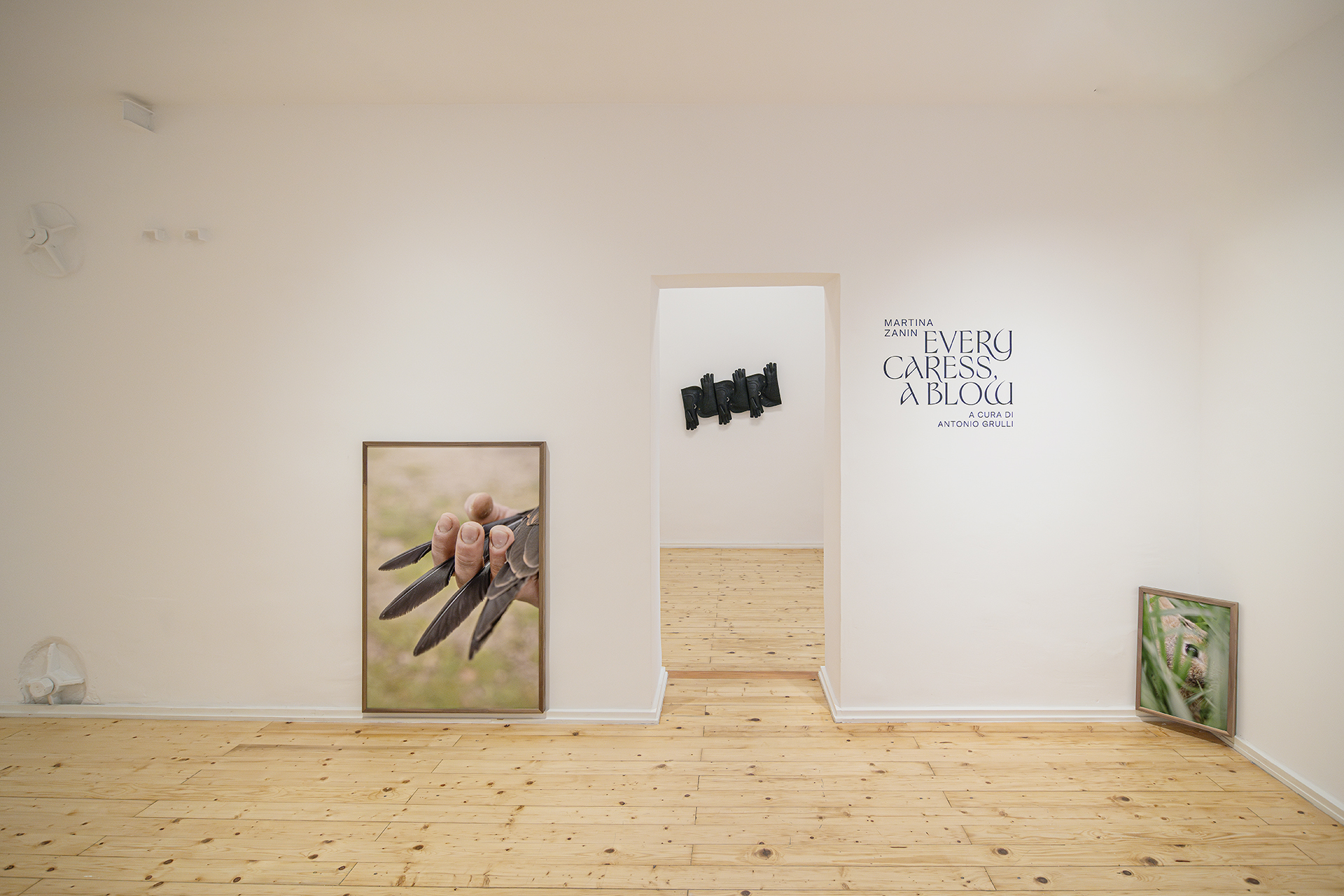
Installation view Martina Zanin, EVERY CARESS, A BLOW, Fondazione Pastificio Cerere 2026. Courtesy Fondazione Pastificio Cerere.
In her photographic book I Made Them Run Away (2021), Martina Zanin recounts a brief domestic story lived by three people: herself, her mother, and a male figure, a generic and inconsistent presence in both their lives. In the intimate memory evoked in the publication, Zanin returns to a childhood episode: as a child, after telling her mother about her day and showing her what she had learned by dancing and singing in front of the television, the man interrupted her performance, saying, “It’s getting late, you’d better go.” This was followed by a look from her mother and a phrase that remained etched in the artist’s memory: “Do you always have to make them run away?”2
Approaching Martina Zanin’s work requires acknowledging the vulnerability of this child, recounted by the artist herself: brief yet powerful stories that resurface in her exhibitions and publications. It is precisely this emotional entanglement—of which she was involuntarily a part, burdened by a weight not entirely her own—that generates an energy later reemerging in an “organized” artistic form: sometimes more objective, a sort of visual and sculptural “laboratory,” where the emotional load is dissected with a scalpel, sterilized, and separated into test tubes; at other times contextualized or concealed, as in her photograph of a mirror fogged by steam or the shot capturing the intense orange light illuminating the forest floor.
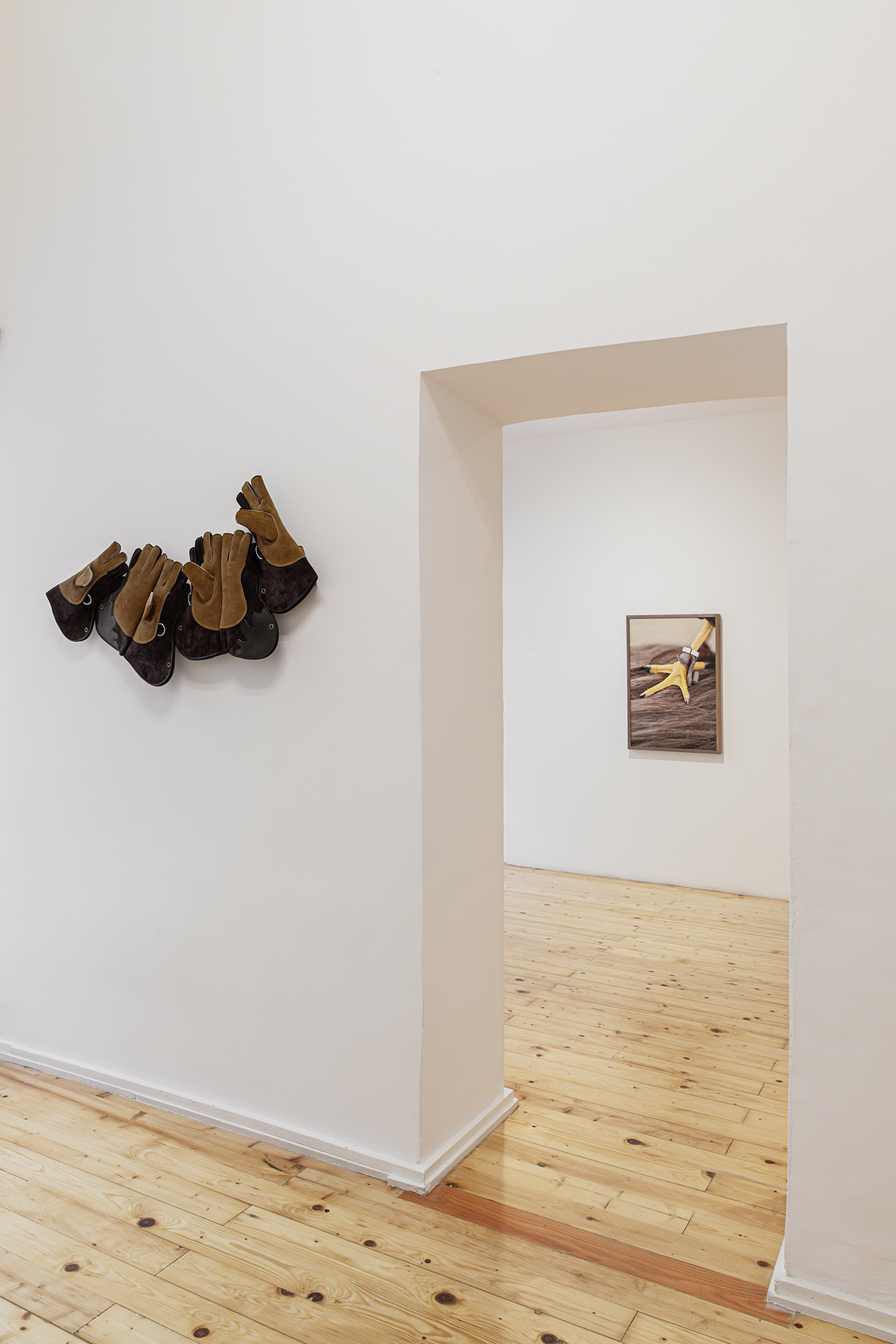
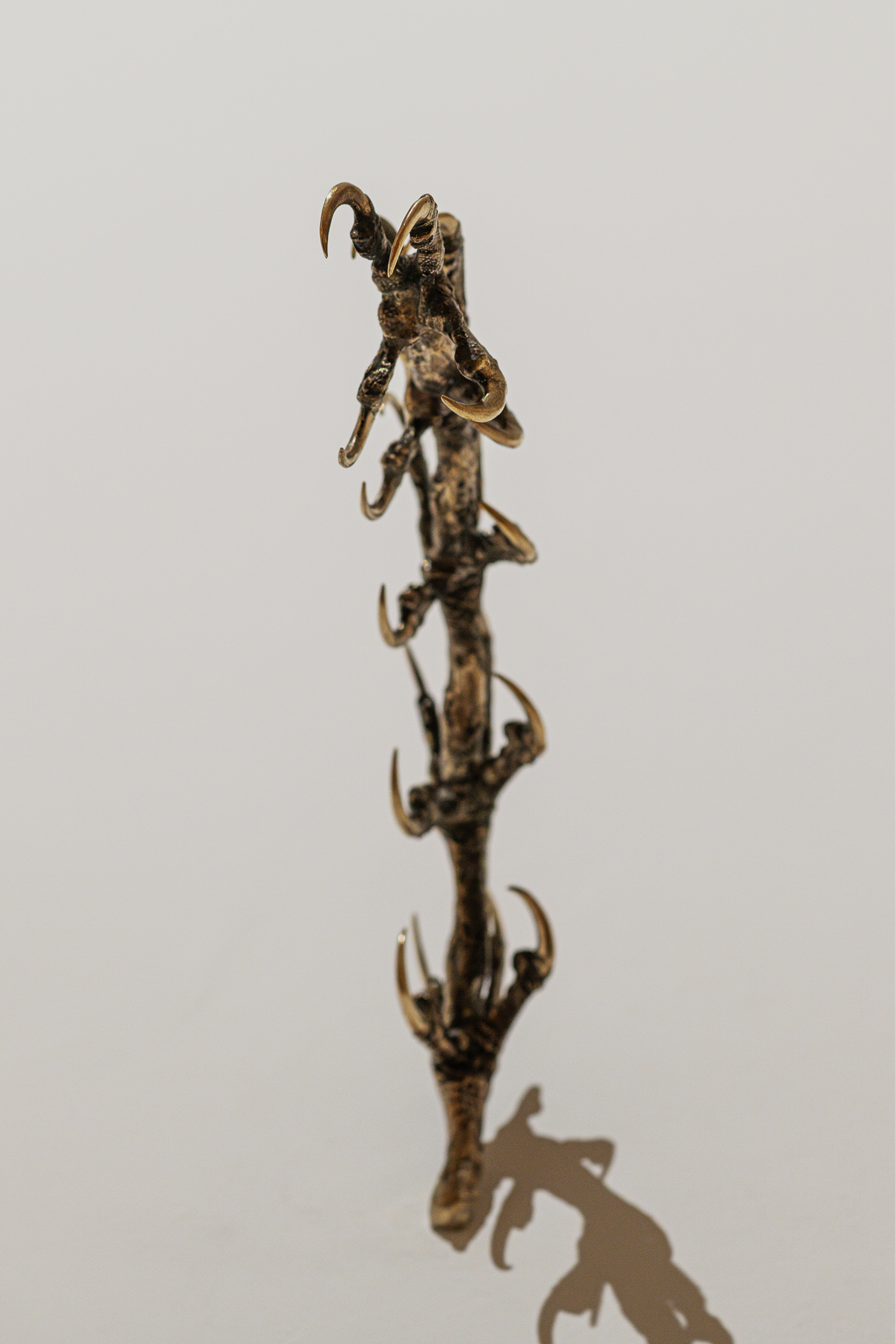
Installation view Martina Zanin, EVERY CARESS, A BLOW, Fondazione Pastificio Cerere 2026. Courtesy Fondazione Pastificio Cerere. / Martina Zanin, A PREDATOR, IS A PREDATOR, IS A PREDATOR…, 2026. Bronzo, 65x5x8 cm. Courtesy l’Artista e Nashira Gallery. Installation view EVERY CARESS, A BLOW, Fondazione Pastificio Cerere 2026. Courtesy Fondazione Pastificio Cerere.
Through sculptures, photographs, and installations, Every Caress, a Blow stages the inner tension arising from personal experience, situated at the intersection of psychology, ethology, and spirituality. The exhibition investigates how body and identity are shaped through affective dynamics of power and protection, which bind the subject indissolubly to those who care for them. Antonio Grulli, the curator of the exhibition, refers to the different dimensions of the skin—material, aesthetic, and even philosophical: “Our epidermis is probably the first sensory organ through which we adhere to the world. We experience our skin as the surface upon which our history is deposited, a surface on which only pain leaves visible traces. […] It is the space of the intimate that remains, paradoxically, the most exposed organ.”³
Skin is the protagonist in all four rooms, gaining ever more presence with each step, until it envelops us completely.
The experience does not strike immediately. In the first room, a series of photographs of birds of prey, human bodies, and a rabbit: intersecting gazes, a hand merging with a bird’s wing, details of the body, and captured moments clearly convey an attempt to give form to emotional conflict, suspended in space with calm and clarity. This tension becomes almost physical, an invisible line drawn with precision from one point to another.
The artist does not yet introduce a sensory experience: she holds us back until we are ready.
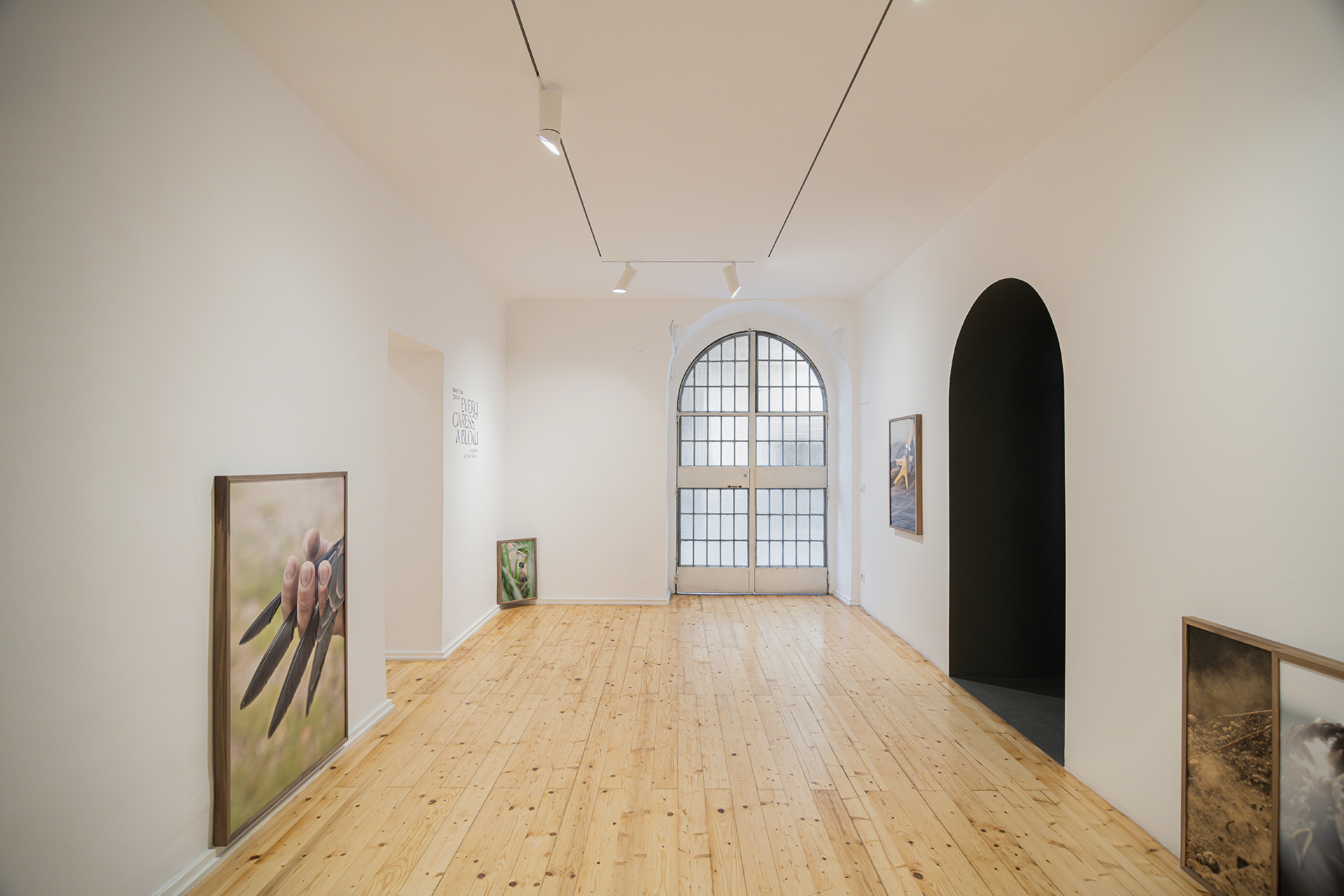
Installation view Martina Zanin, EVERY CARESS, A BLOW, Fondazione Pastificio Cerere 2026. Courtesy Fondazione Pastificio Cerere. Credits: Carlo Romano
The freedom to remain mere observers is upended in the second room. The dark leather sculptures hanging on the wall are made by assembling falconry gloves. On one hand, we are still spectators; on the other, the gloves evoke a series of desires: to touch them, wear them, smell them, deciphering the seriality and decorative purpose of these originally functional objects. Much of this experience occurs on an unconscious level; we, too, are made of skin.
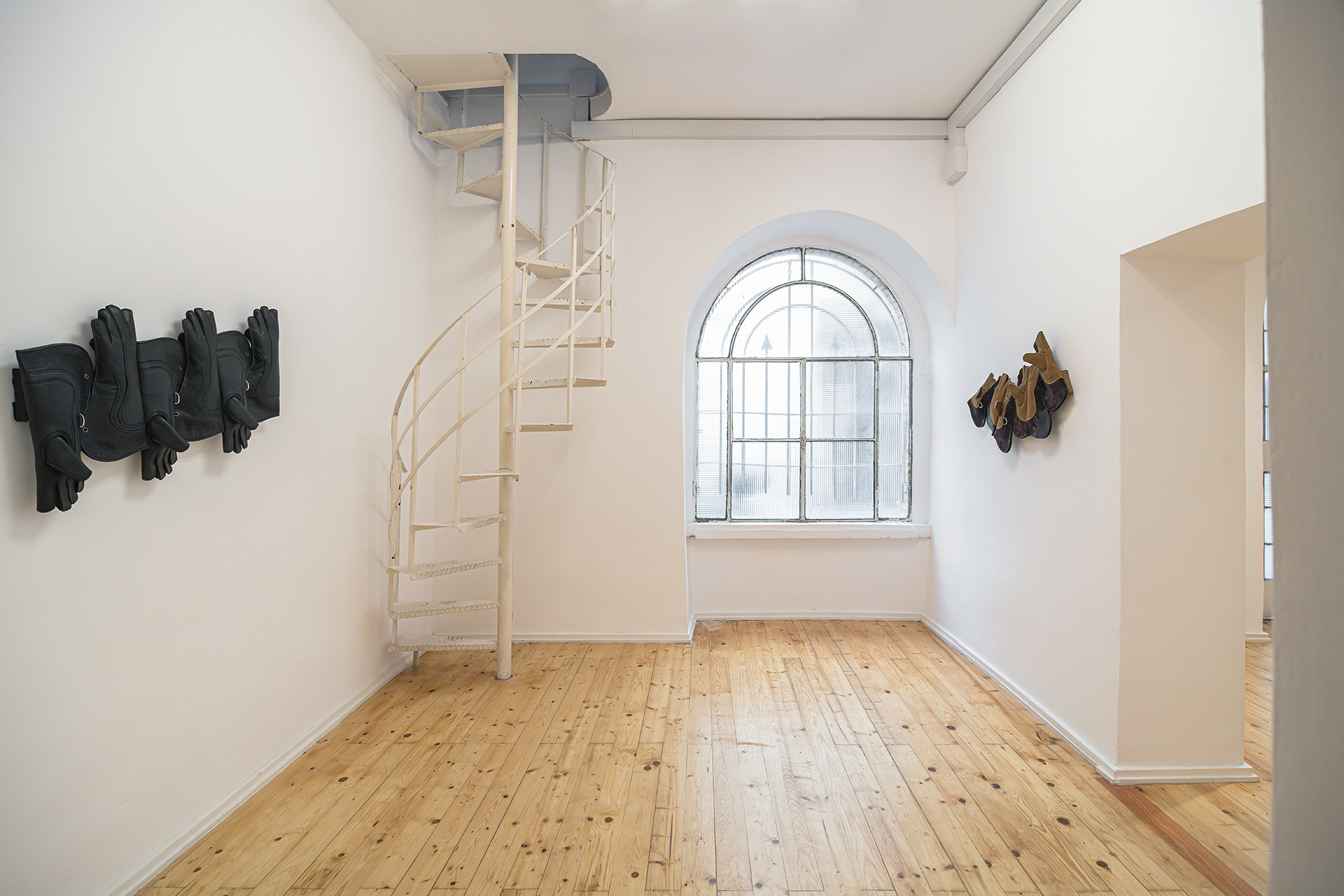
Installation view Martina Zanin, EVERY CARESS, A BLOW, Fondazione Pastificio Cerere 2026. Courtesy Fondazione Pastificio Cerere. Credits: Carlo Romano
Further on, skin—a material so familiar to us—begins to sting. At mid-wall, at eye level, there is a single metal sculpture, composed of a raptor’s claw repeated, “captured in the act of seizing its prey”3. As the curator notes: “The coldness of the sequence brings out the ruthlessness of power and violence, often centered on precise and relentless rituals”4. One cannot help but perceive the suffering, almost automatically intertwined with the act of repetition. Just think of the anticipation of receiving a punishment, imagining the pain it entails simply because it has already been experienced before. It is a method similar to that used in the course of traditional school education, based not on understanding but on the mechanical reiteration of knowledge. Repetition is also inherent in the cruelty of certain family or social rituals, which, although they could die out within a generation, continue to exist precisely because their power lies in being repeated.
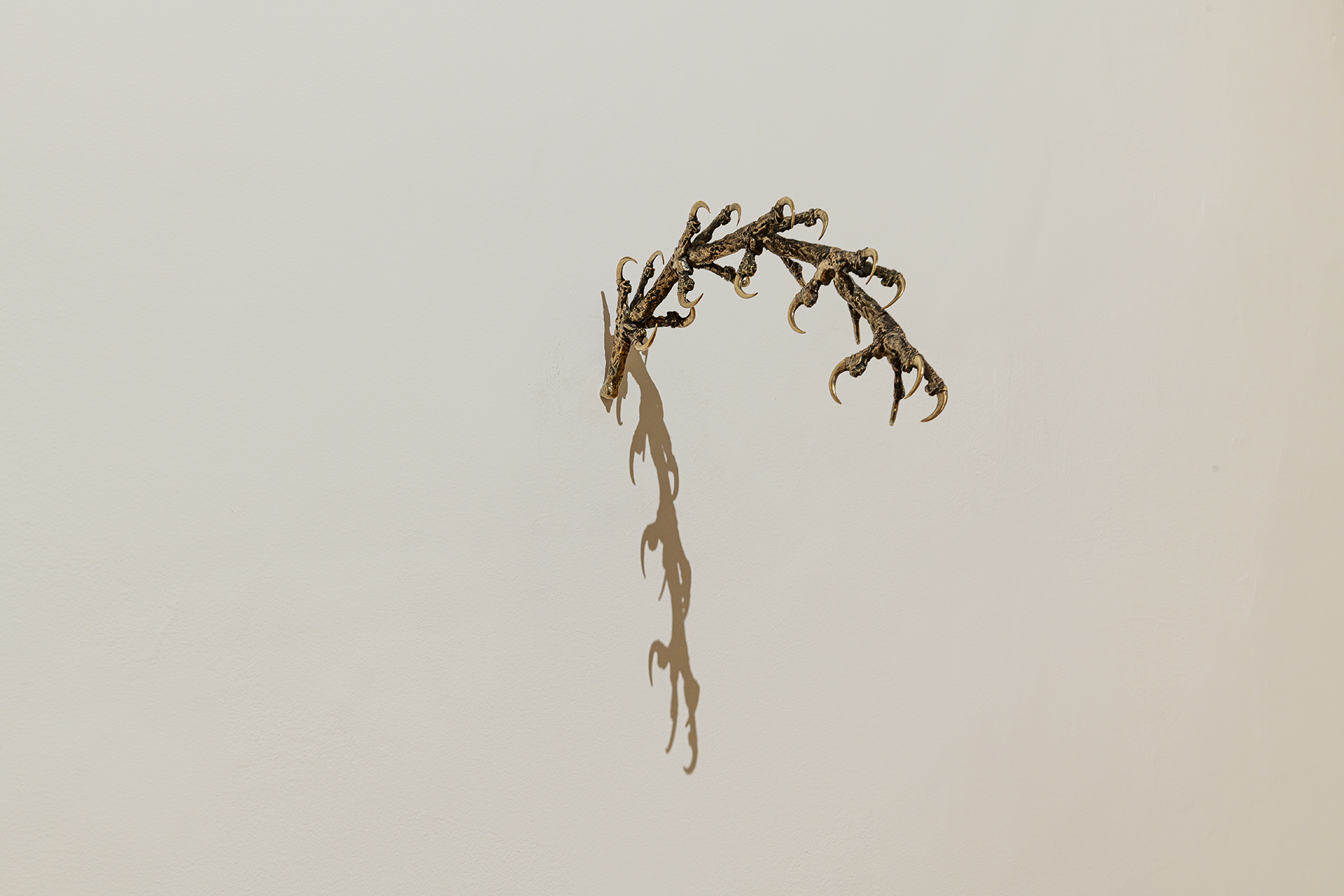
Martina Zanin, A PREDATOR, IS A PREDATOR, IS A PREDATOR…, 2026. Bronzo, 65x5x8 cm. Courtesy l’Artista e Nashira Gallery. Installation view EVERY CARESS, A BLOW, Fondazione Pastificio Cerere 2026. Courtesy Fondazione Pastificio Cerere.
In the final room of the exhibition, where the installation on display is now larger than us, we finally feel embraced. We experience a kind of relief, even if the reason is not entirely clear. We encounter a rigid metal structure with an enclosed leather space inside: theoretically nothing pleasant, yet soft and secure compared to what we have encountered so far. We could call it a den, with space for a single person. Its leather conveys the same presence as that animal which, along the journey, frightened us, impressed us, and reminded us of our own vulnerabilities, eliciting a sense of pity. The skin that envelops us still carries its scent; inside, there is no light. It is a safe beginning and end.
It is neither common nor simple to involve the presence of animals in a work of art while maintaining a distance from identification. Already in 1986, Bill Viola, speaking about his video I Do Not Know What It Is I Am Like, referred to “a personal investigation into inner states and the connections with animal consciousness that we all carry within us.”5 From this perspective, Zanin comes to embody, through the animal, both poles of the spectrum, ultimately causing them to collapse: the prey becomes predator, and the predator reveals itself as fragile.
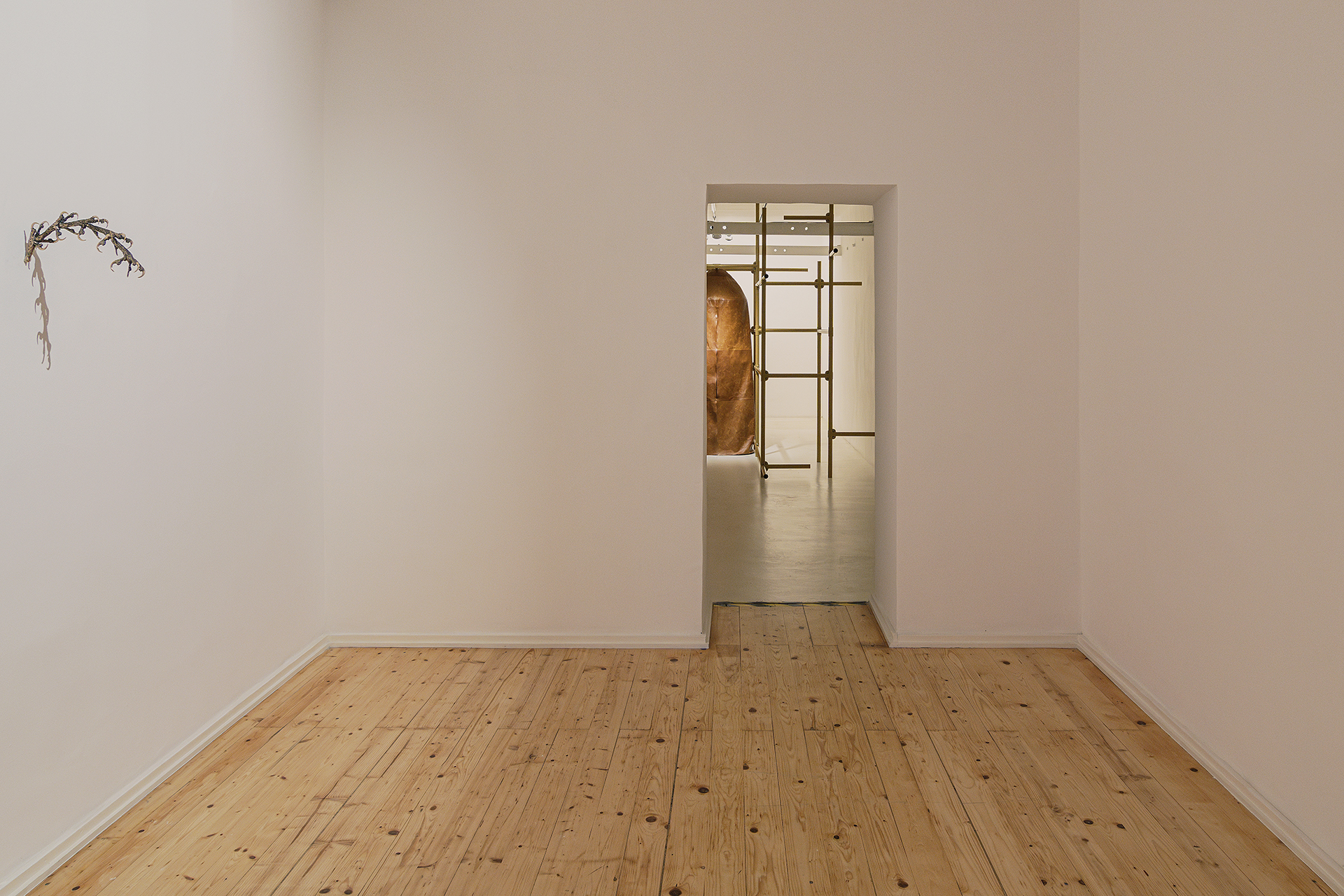
Martina Zanin, AMBIENTI. TANE – Rabbit Hole, 2026. Cuoio, tubi, giunti, 330x380x450 cm (dimensioni variabili). Courtesy l’Artista e Nashira Gallery. Installation view EVERY CARESS, A BLOW, Fondazione Pastificio Cerere 2026. Courtesy Fondazione Pastificio Cerere.
¹,5 Animalità nell’arte contemporanea e comunicazione interspecifica, Dobroslawa Nowak https://www.kabulmagazine.com/animalita-nellarte-contemporanea-e-comunicazione-interspecifica
² I Made Them Run Away, Martina Zanin https://www.skinnerboox.com/books/imadethemrunaway
3,4 Every Caress, a Blow, Martina Zanin https://www.pastificiocerere.it/mostre-attivita/martina-zanin-every-caress-a-blow
Exhibition details:
Title: Martina Zanin: Every Caress, a Blow
Artist: Martina Zanin
Curator: Antonio Grulli
Place: Fondazione Pastificio Cerere, Rome
Date: 19 February – 18 April 2026