



The Dimension of Research at The Real Academia de España en Roma
Studio Visits With Federico Clavarino and Miguel Fructuoso
21.04.2026
Which foreign art institutions are able to actively and meaningfully shape the cultural environment of a historic metropolis such as Rome? An unruly and visionary city, Rome manages to reconcile, in multiple ways, contemporary research with an extraordinary plurality of experiences. In particular, there are seventy academies and foreign institutes distributed heterogeneously across the urban fabric. With few exceptions, they operate as isolated or self-referential entities, while still maintaining an ongoing dialogue with the public, thereby contributing to the expansion of cultural offerings. As residency spaces for creatives engaged in specific fields of research and study, their primary contribution lies in providing an alternative point of view. Within this context, the city witnesses a reconfiguration of the traditional exhibition system, which—together with the growing autonomy of artists and the increasingly incisive role of communication channels—helps define a more articulated cultural landscape.
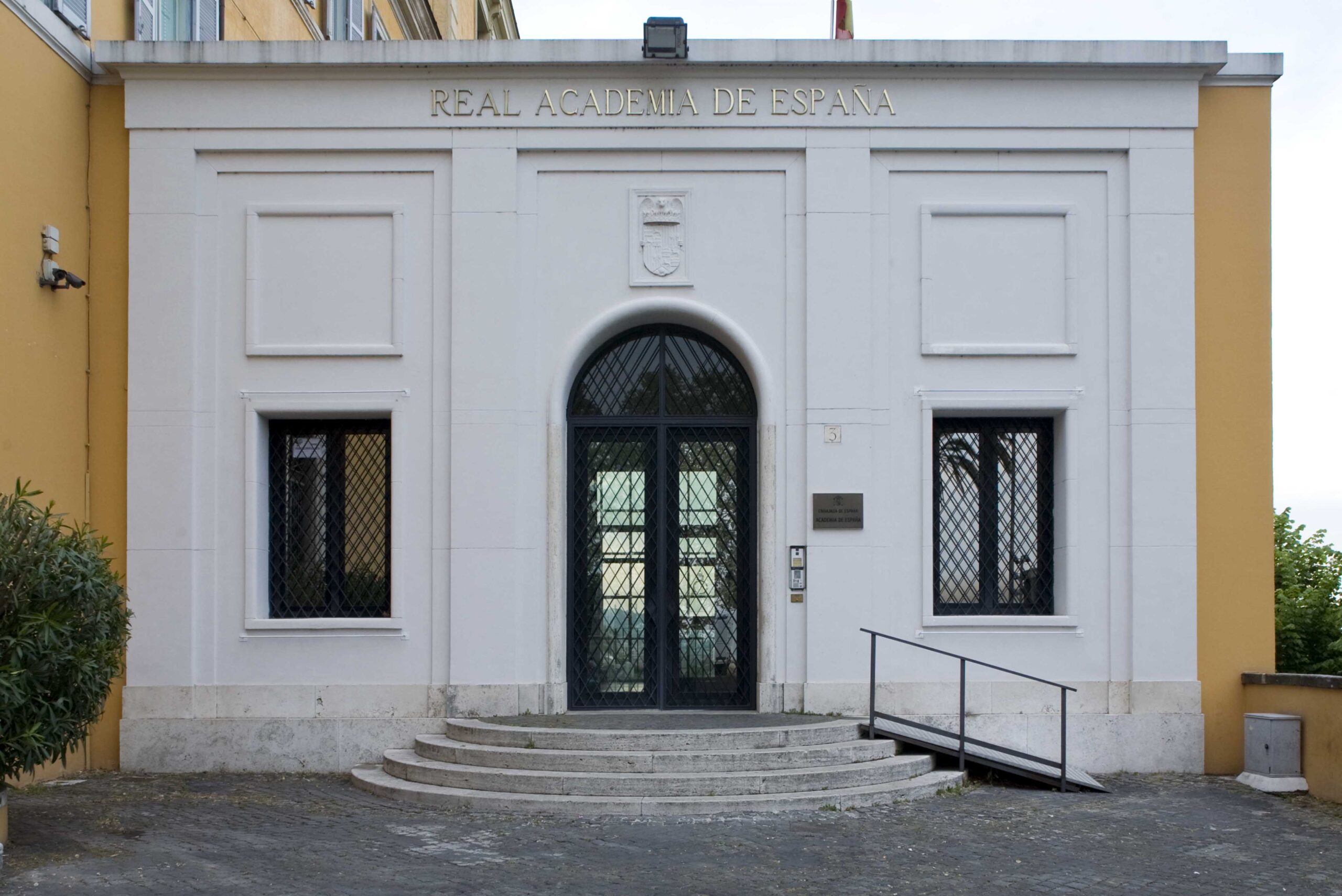
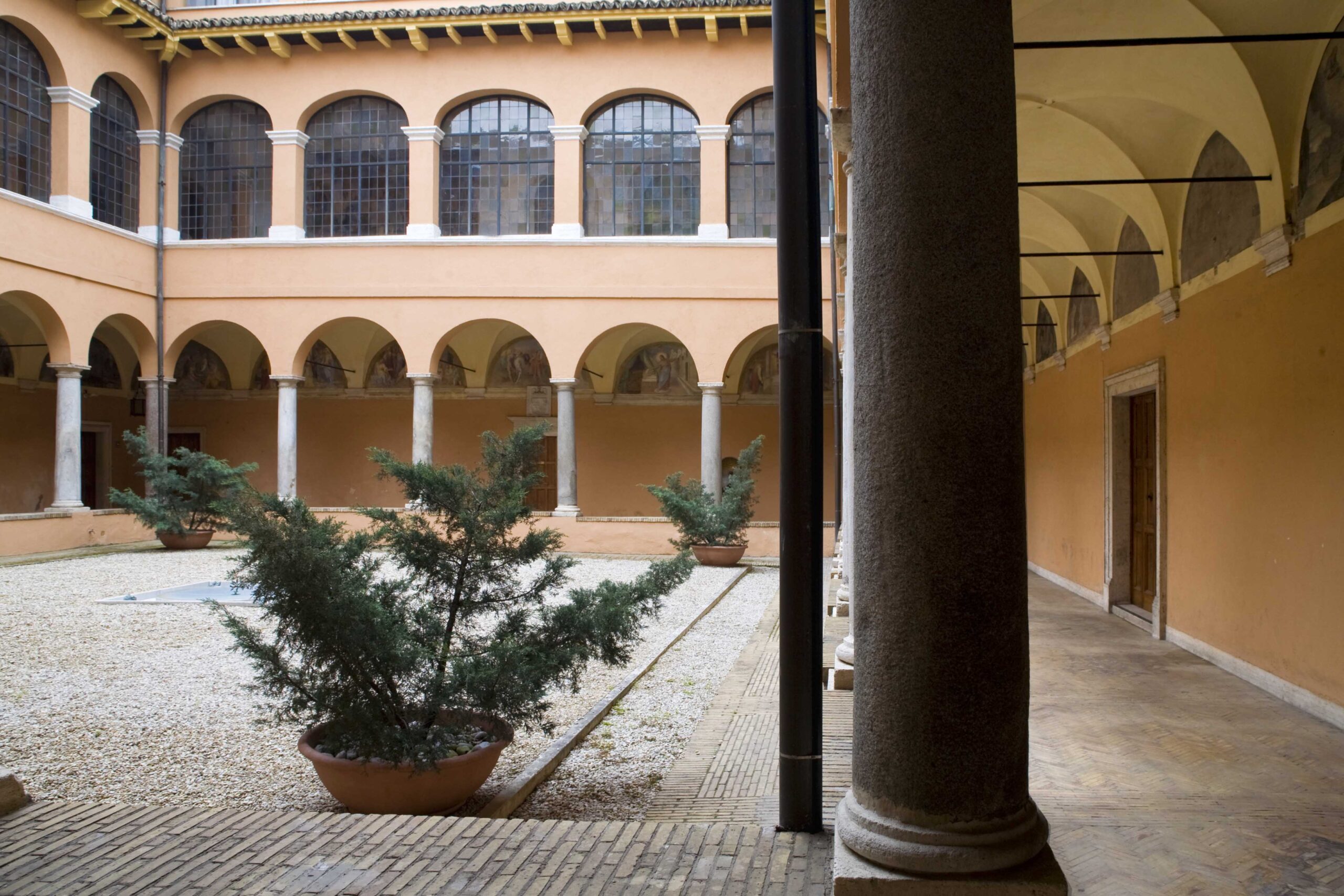
© Entrance, Real Academia España Roma. Photo credit: Julio Galeote / © Cloister, Real Academia España Roma. Photo credit: Julio Galeote
In this regard, a particularly significant role is played by the Real Academia de España en Roma—founded in 1873 and active since 1881—which this year has offered nineteen fellowships across various disciplines. It also provides the opportunity to share studio spaces and fosters connections between fellows and all that the city has to offer, especially the morphology of the territory on which it stands. Each year, the Academy organizes Open Studios and a final exhibition of the researchers. These initiatives are complemented by additional occasional events, such as talks and seminars, aimed at supporting study and the independence of research

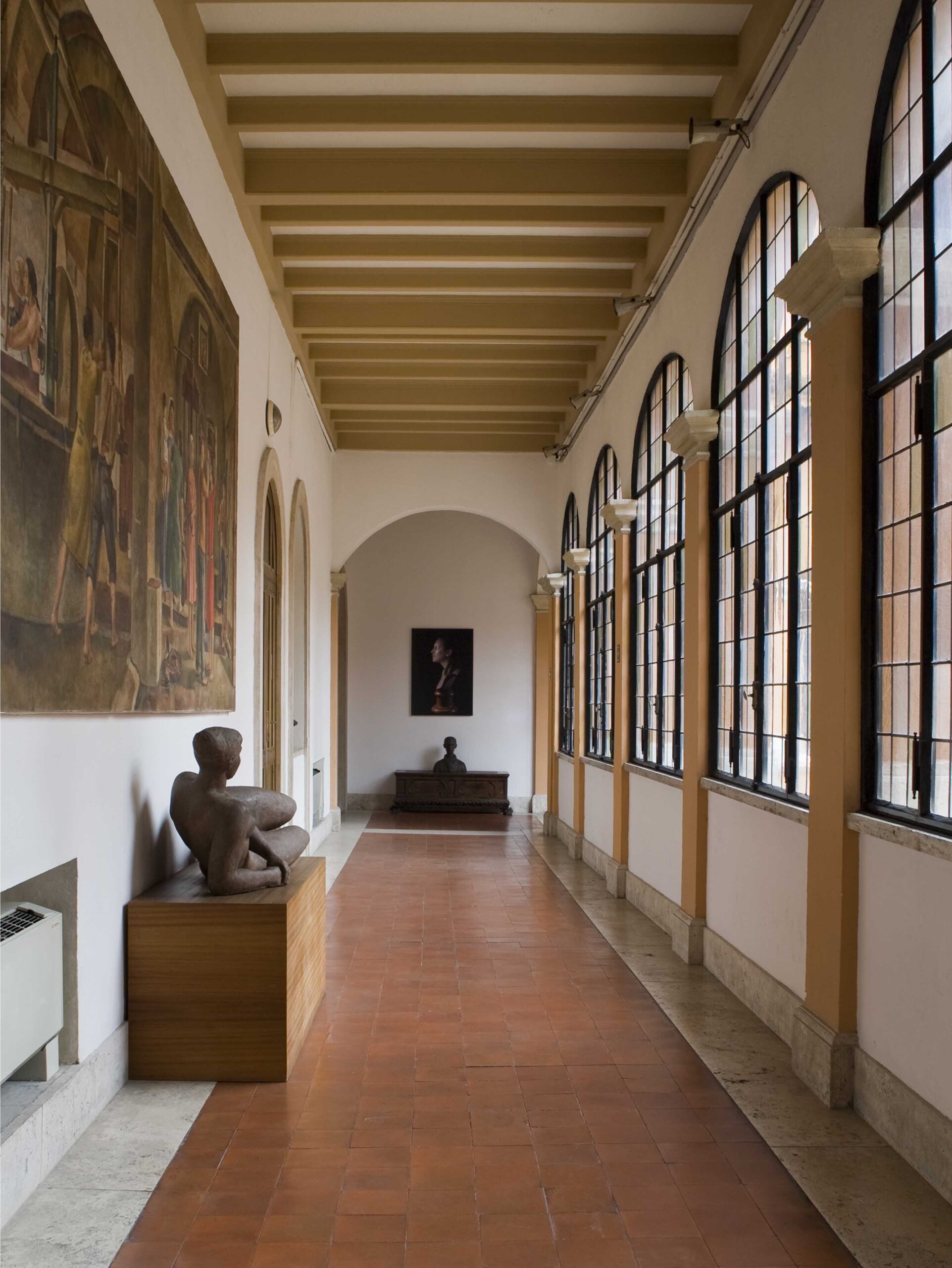
© ATELIER XYZ, Tempietto di San Pietro in Montorio, Real Academia España Roma / © Cloister, Real Academia España Roma. Photo credit: Julio Galeote
Visiting the studios of the Real Academia de España en Roma means overlooking one of the city’s most significant panoramic points, immersed in a context so sublime as to seem almost unreal. This opens onto a far more complex issue concerning the ways in which the city can be known and the methods each fellow adopts—not only to engage with what appears complete and harmonious, like the environment hosting them, but to problematize and critically investigate it. From this perspective, a further consideration arises: how can one generate a positive impact on one’s research without limiting its effectiveness to the duration of the residency alone? The answer lies in the training and tenacity of each participant. Thus, city and inquiry must share a common tension capable of brushing against empirical data while embracing the utopian, transforming all physical and immaterial urban resources into a vital stimulus for investigation. In the case of the Real Academia de España en Roma, this translates into the transformation of a private value into a collective heritage, capable of welcoming the sedimentation of knowledge as a shared legacy. The contemporary era, with its emphasis on immediacy, is marked by complexity, where transformations intertwine multiple forms of knowledge—as many as the disciplines offered by the Academy itself.
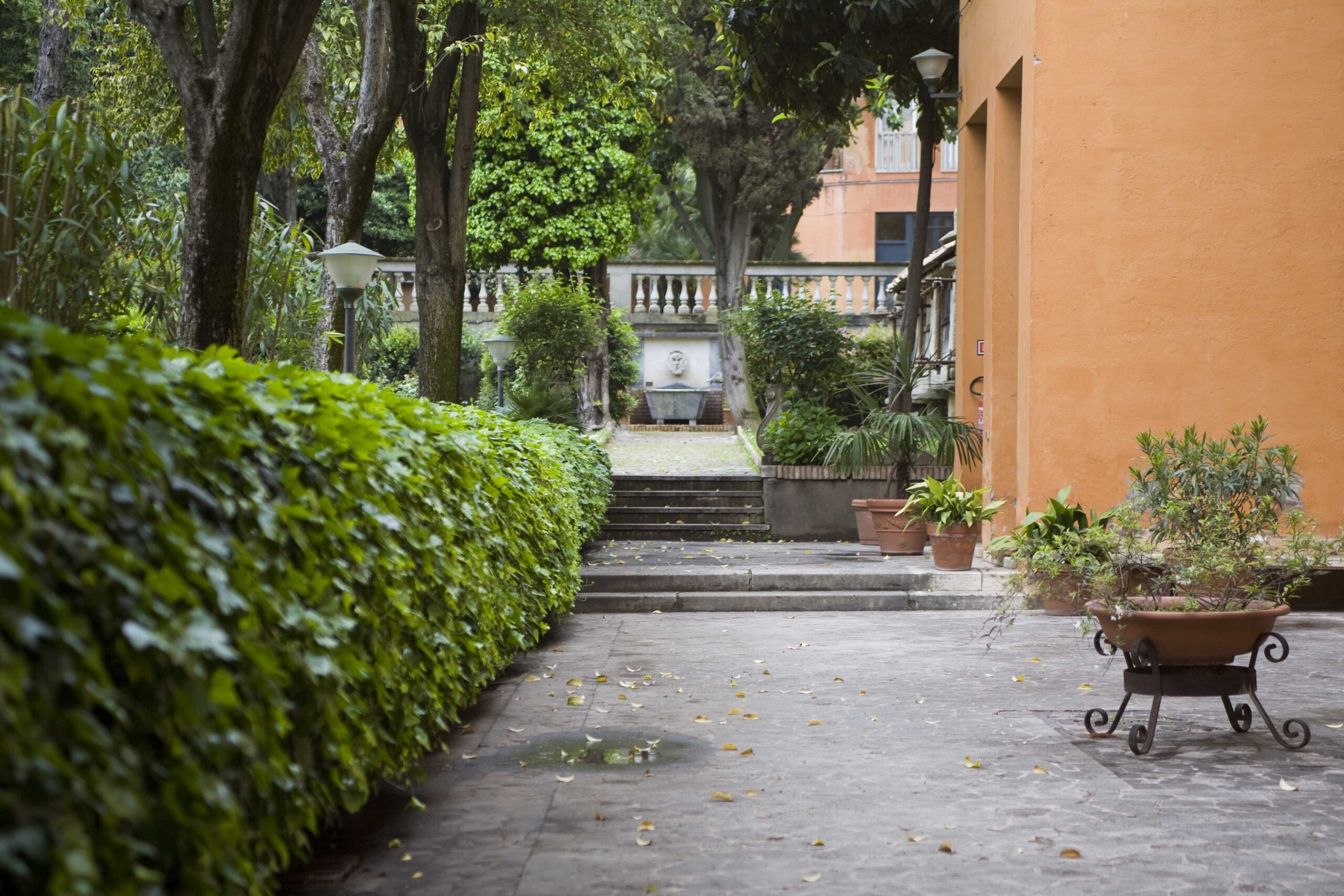
© Garden, Real Academia España Roma. Photo credit: Julio Galeote
The choice to conduct studio visits with fellows Federico Clavarino and Miguel Fructuoso, respectively in Visual Arts and Plastic Arts, is not accidental. Despite their radical differences, both have addressed their fields of inquiry by updating and contextualizing them in relation to certain identity-related questions rooted in Rome’s past and present history. Although the meetings took place in the final days of March, some time was needed for reflection to emerge—especially given the sense that both research practices have captured characteristic aspects of the city, yielding an even more articulated reality.
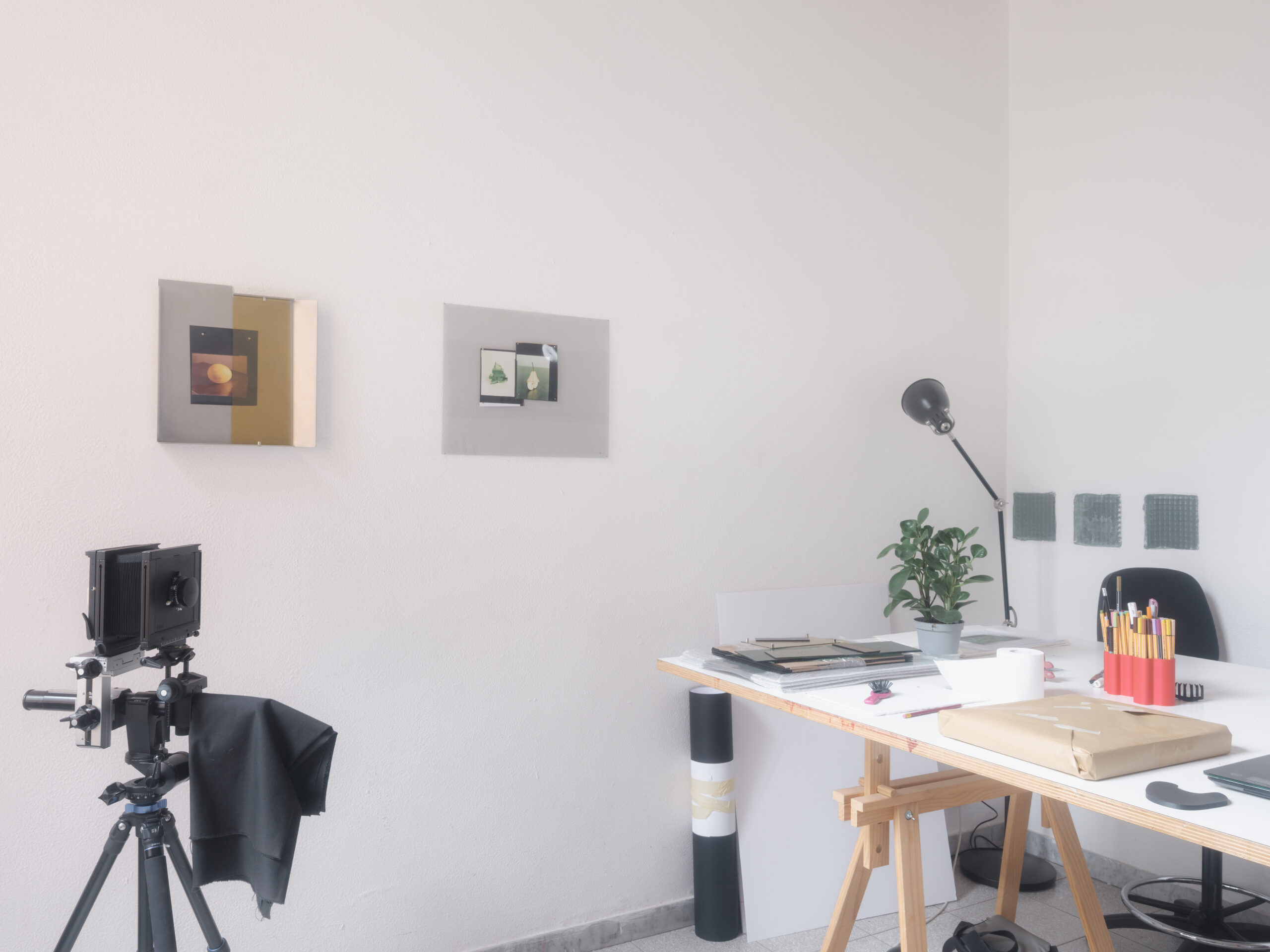
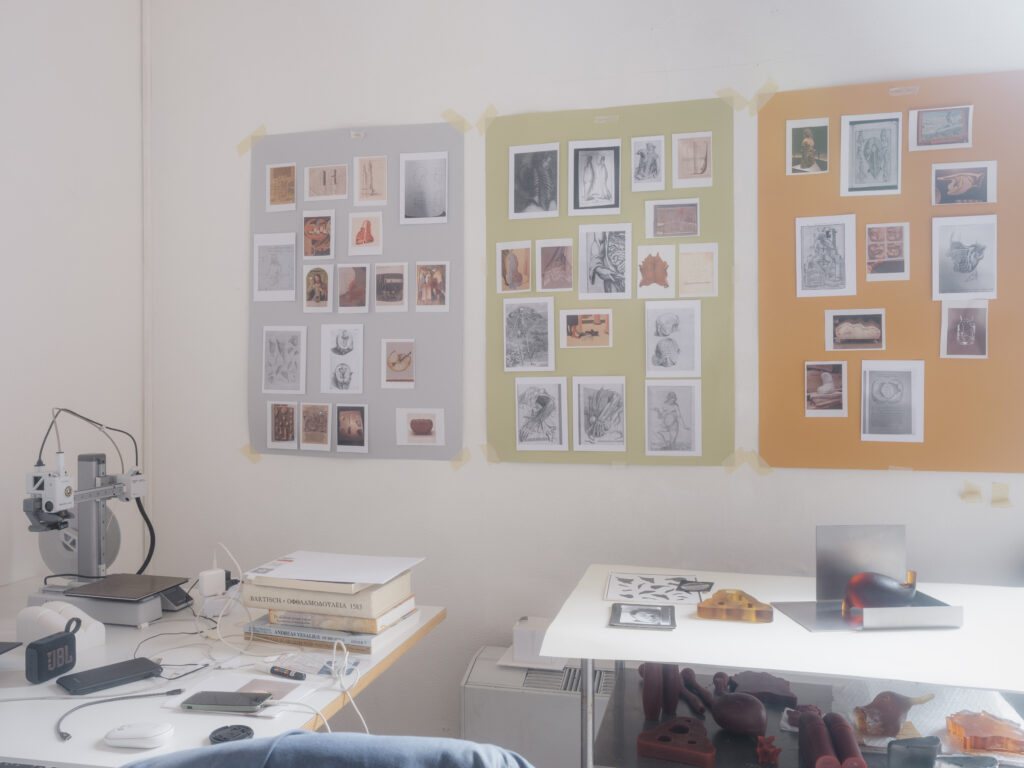
Federico Clavarino’s studio at the Real Academia España, Rome, Courtesy of the artis
Federico Clavarino’s studio (Turin, 1984) is located on the ground floor of the Academy and overlooks a portion of the gardens. In the lower area, the artist carries out analytical work using cameras and light-orientation tools. Two desks hold books and a small 3D printer, while photographs and image fragments to be processed are pinned to the walls. With his characteristic calm demeanor, the artist describes the project he is developing during the residency, centered on the concept of the cut as a concrete necessity for discovery—a phase of selection and reconstruction of a personal imaginary that evolves and radically transforms from the initial data collected. This theme offers compelling lines of inquiry into anatomical study practices and architectural drawing in art history, subjects he has explored in depth in the libraries of the American Academy as well as at the Bibliotheca Hertziana, Max Planck Institute for Art History in Rome.
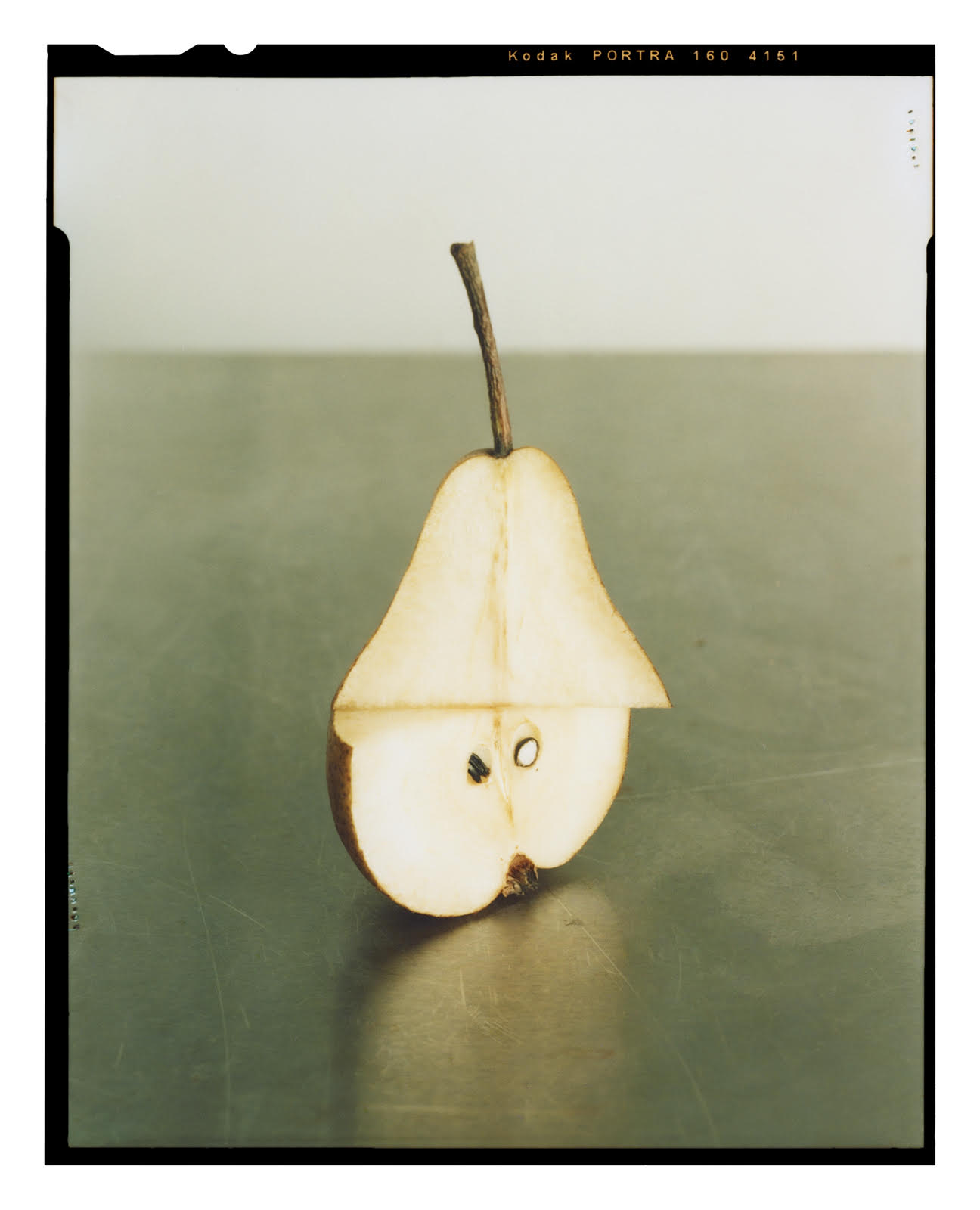
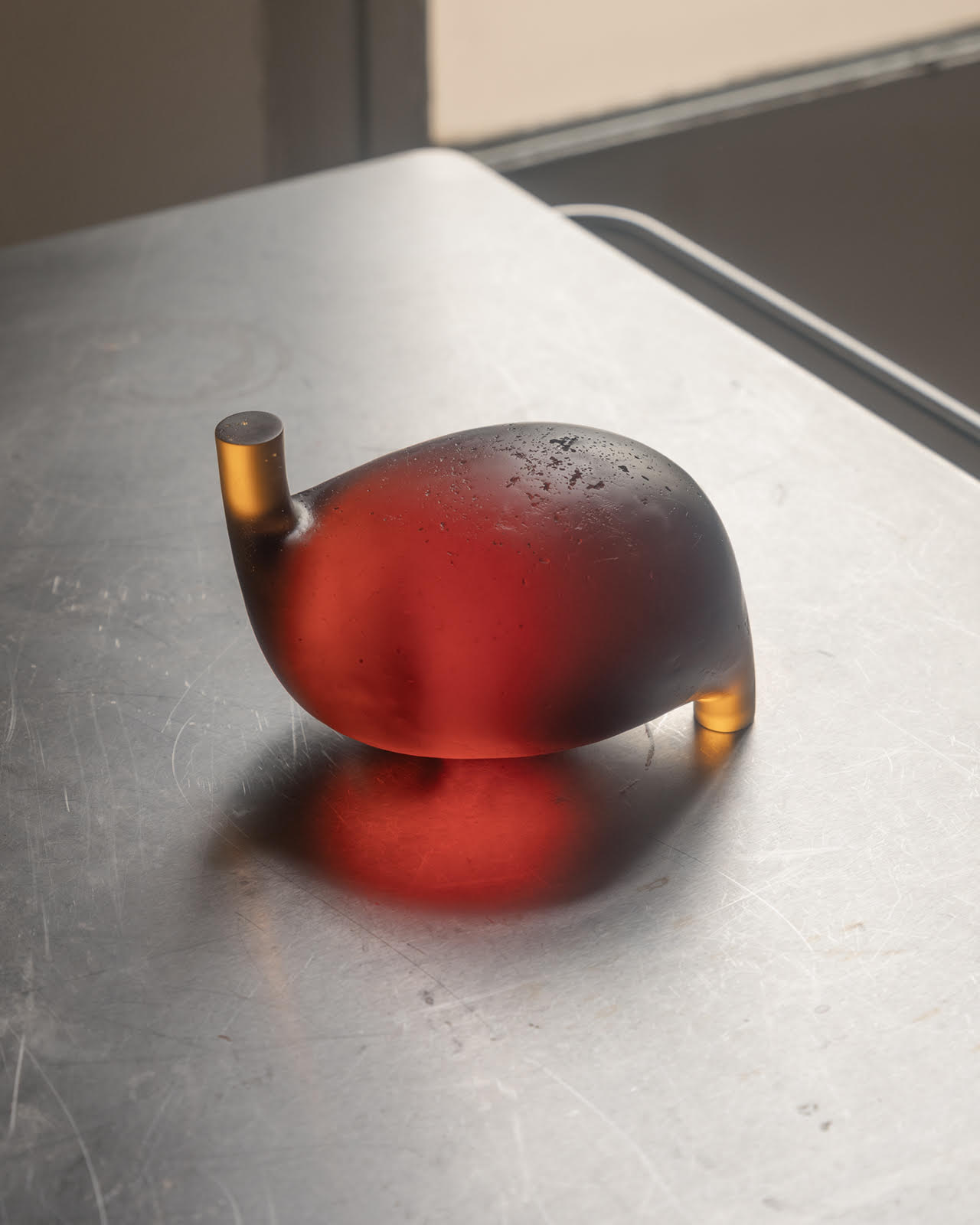
Federico Clavarino’s photographic work at the Real Academia España, Rome, Courtesy of the artist / Glass sculpture by Federico Clavarino at the Real Academia España, Rome, Courtesy of the artist
In the analytical phase, photography is used experimentally, revealing the object in a disturbing and surreal manner. This initiates a true investigative process based on the dialectic between the form emerging from the photographic shot and its three-dimensional translation into glass sculpture. What emerges is a constant tension between the initial and final data, revealing how the nature of the photographic device is altered as it transforms into sculpture, thereby allowing access to different levels of understanding of the object, regardless of its visual integrity.
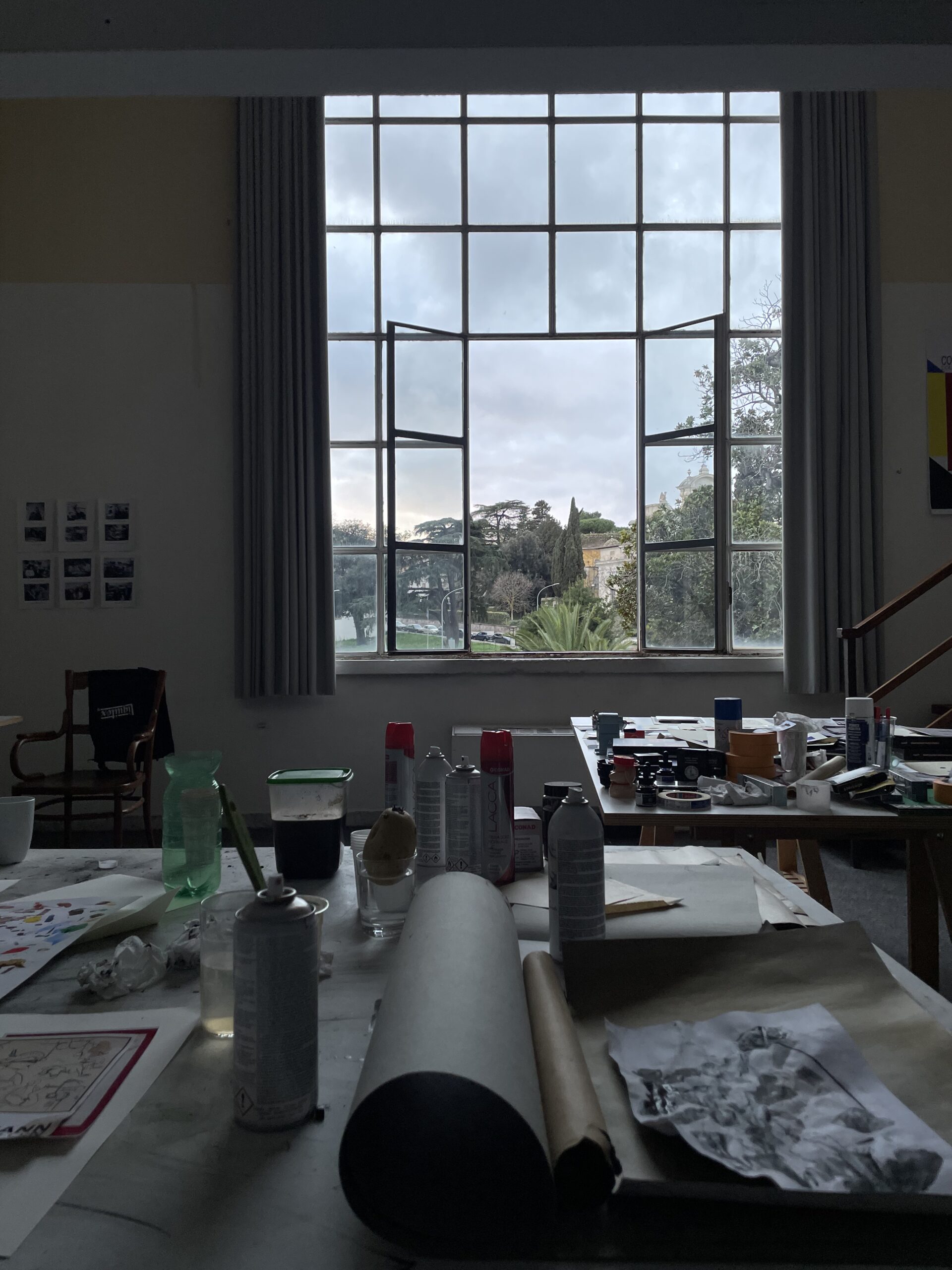
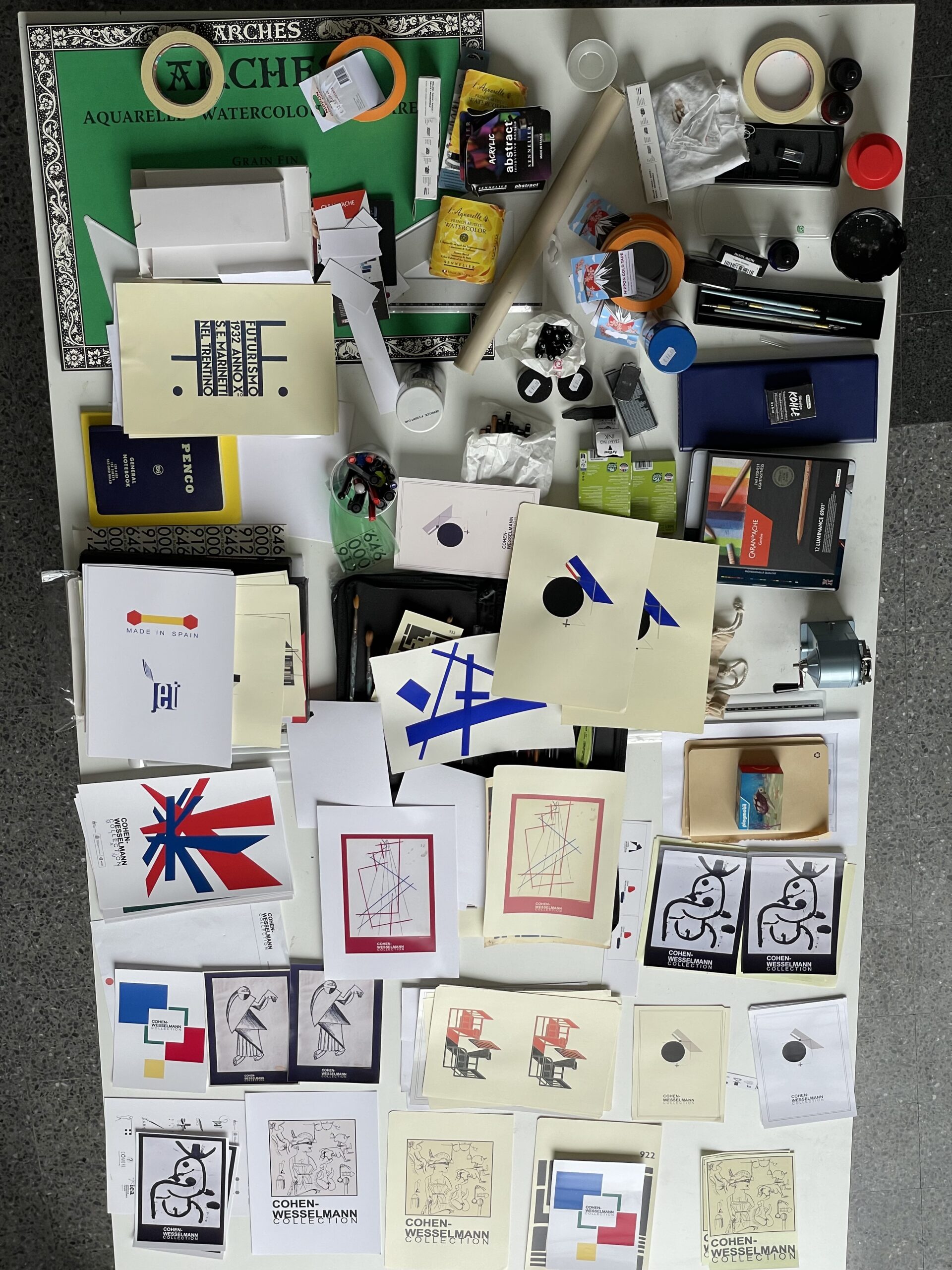
Miguel Fructuoso’s studio at the Real Academia España, Rome, Courtesy of the artist
In contrast, Miguel Fructuoso (Murcia, Spain, 1971) presents a highly effective survey of issues surrounding reproducibility and authorship. His investigation is based on a complex storytelling structure and the value of the “fake”: the artist constructs a narrative around a fictitious Cohen-Wesselmann Collection, reconstructing its origins, the histories of its collectors, and the museum venues where it has allegedly been exhibited. The narrative becomes compelling, as it includes reproductions of museum merchandising, informational brochures, entire communication campaigns, and historical photographs of the two founders. Notably, the direct—equally fictitious—connection to the city of Rome dates back to 1935, when a suitcase filled with drawings from the Collection was left by the two founders in the home of Mario Mafai and Antonietta Raphael, before being entrusted to the then director of the Real Academia de España. Entering Fructuoso’s studio thus produces a distinct sense of disorientation, both due to the linearity of the project’s development and the diversity of the collected material. Considering that the displayed works exhibit specific visual stylistic features drawing on references from art history—such as Russian Constructivism in the work of El Lissitzky and Sophie Taeuber-Arp, and especially the linear draftsmanship of Pablo Picasso during the period of Les Demoiselles d’Avignon—the artist offers an imaginary journey through artistic historiography. Fructuoso skillfully manipulates the workings of memory, the processes of narrative construction, and contemporary media tools.
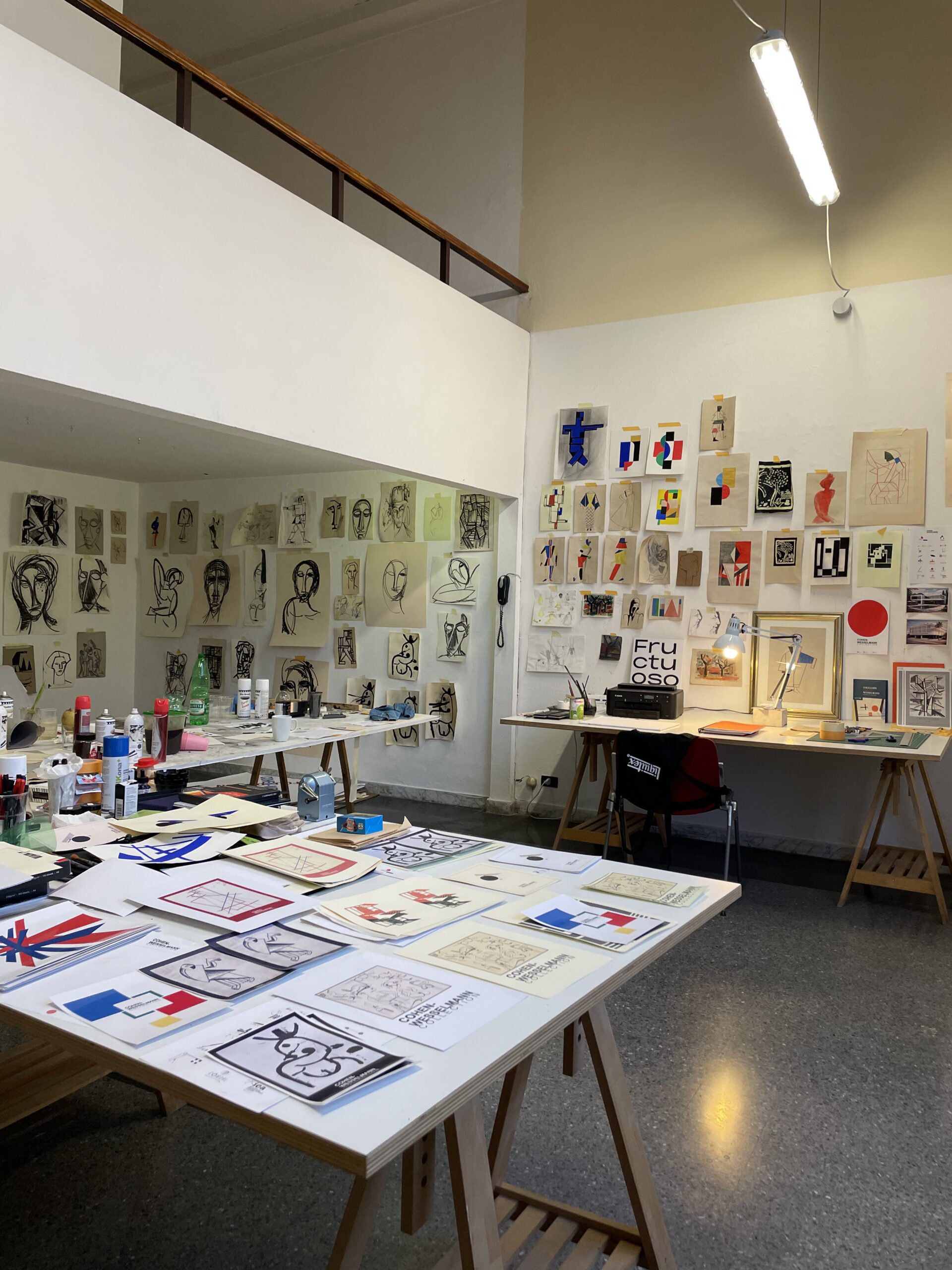
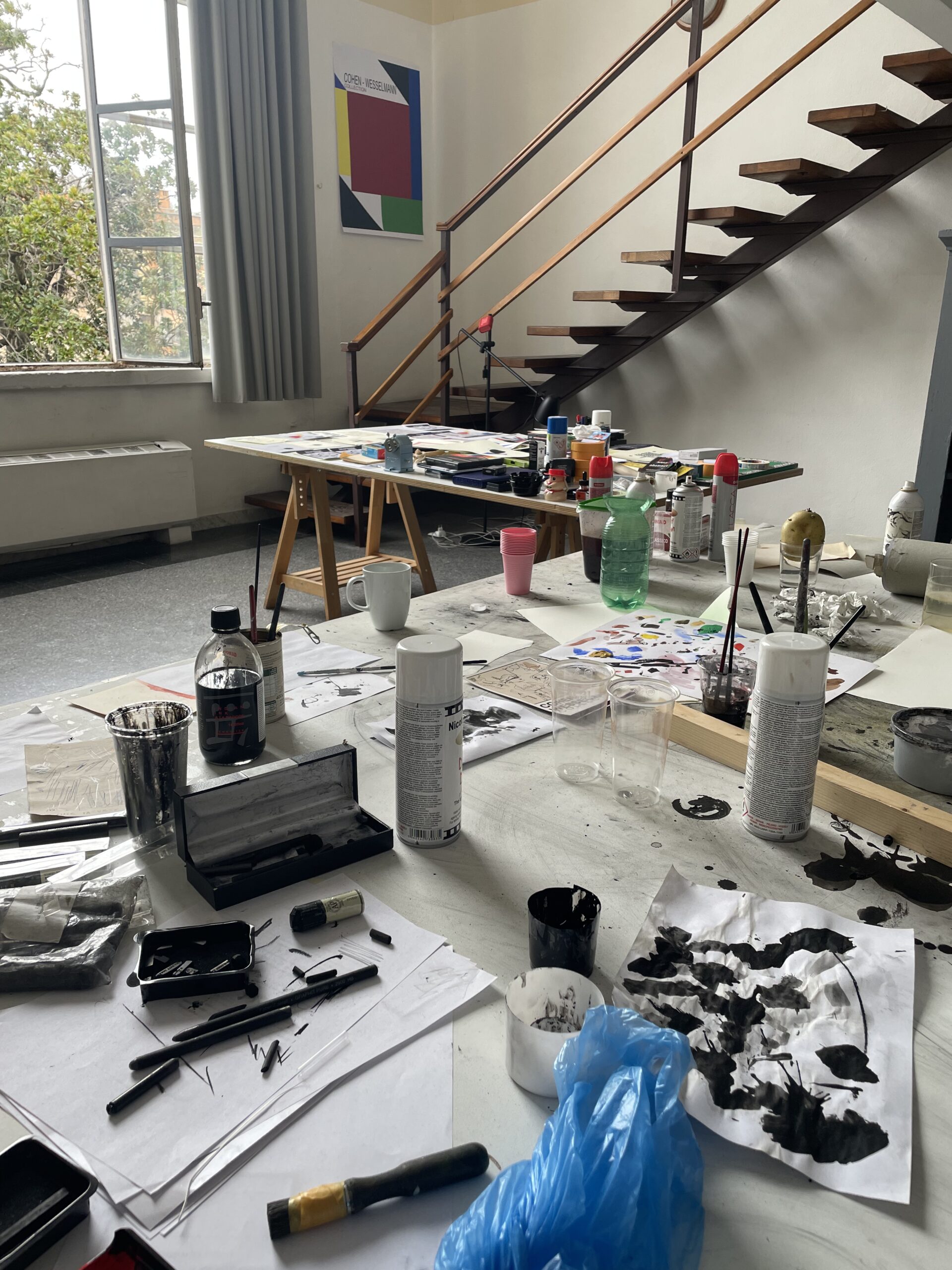
Miguel Fructuoso’s studio at the Real Academia España, Rome, Courtesy of the artist
Thus, for both Clavarino and Fructuoso, imagination and experimentation expand reality, grounded in the shared awareness that every element can become meaningful and potentially transformable. Their work questions the value of the imprinted or written form—always distilled and transmitted through further passages—recognizing that even in a city like Rome, such distinctions are never clear-cut but may, at times, prove to be, to some extent, malleable.
Translated to English by Dobroslawa Nowak