


The Sabotage of the Major Key: Tension Between the Refusal of Spectacle and the Risk of Aesthetic Neutralization
By Giulia Nestola
14.07.2026
Among the authors selected through the open call for critical essays on the 61st Venice Biennale.
“How could I pretend that everything is fine in the world while I am curating the Biennale? At the same time, I believe that one of the best ways to address difficult issues is not to begin the conversation with them directly. You have to guide people gradually toward a difficult or controversial position, or toward an idea that confronts them with something capable of unsettling their comfortable view of the world. You do this through humour or through beauty. You can also do it through something that resonates—something that is intellectually resonant (…).” Shubigi Rao (b. 1975, Mumbai), on the Singapore Pavilion at the 59th Venice Biennale (2022), quoted in Setting the Tone of the Exhibition – The Anatomy of Exhibition Openings, Jacob Fabricius, DISTANZ, 2024.
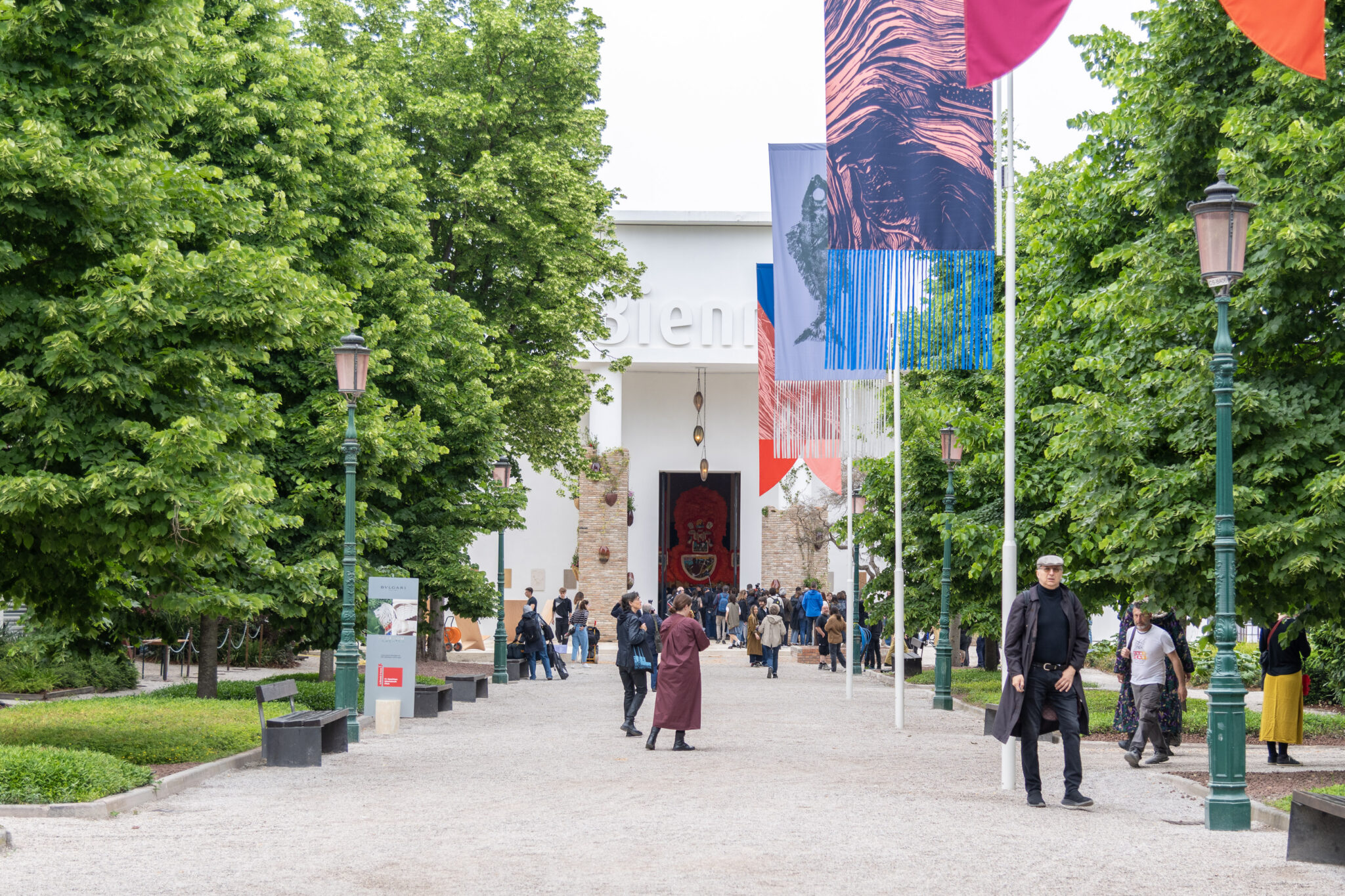
In Minor Keys, Central Pavilion, Giardini della Biennale, Venice 2026. Photo Irene Fanizza
Koyo Kouoh’s curatorial proposal, In Minor Keys, does not present itself as a simple exhibition, but rather as a critical device and a means of perceptual deviation that interrogates the very conditions of contemporary vision. The title functions as a theoretical statement1: “minor keys” belong to a grammar of listening, fracture, vulnerability, and ambiguity, in opposition to the dominant “major keys” of contemporary public communication—a rhetoric built on permanent urgency, excessive exposure, and the spectacularization of trauma. The radical significance of Kouoh’s curatorial gesture lies precisely in this move. In an era that, following Fredric Jameson, could be described as dominated by the cultural logic of late capitalism2—by superficiality, simultaneity, and the accelerated consumption of images—In Minor Keys attempts to sabotage the extractive logic of the contemporary gaze. It refuses to feed the present-day viewer’s bulimic appetite for images of explicit trauma, withdrawing the artwork from the extractive economy of emotional consumption. Yet withdrawal is never an innocent gesture: it always opens up the possibility of neutralization. It is precisely this ambivalence that provides a key to reading the Biennale as a whole, which can be understood through a series of recurring tensions.
In this sense, the Biennale can be understood through three fundamental coordinates that provide a way of navigating the geopolitical and symbolic chaos that runs through it. The first concerns the betrayal of the principle of “minor keys”: what was meant to foster the listening of whispers, of marginalized subjectivities within the central systems of power, has progressively been stifled by an overwhelming noise. In place of withdrawal and delicacy, a media clamour has emerged, fuelled by predatory visual apparatuses, necropolitical aesthetics, and a militarized rhetoric of the image. Rather than slowing down the rhythm of perception, the Biennale often appears to fully embrace the hysterical speed of global information flows. The second coordinate concerns institutional failure: a political and curatorial system that sabotages itself, unable to articulate a genuine culture of dissent. Contemporary power disperses, centrifuges, and implodes from within, revealing the absence of an ethical compass and of any authentic sense of cultural institutions. Recent tensions, the resignations of scientific committees, controversies surrounding funding, and geopolitical pressures demonstrate how fragile artistic autonomy becomes when absorbed into diplomatic and economic logics. The third coordinate concerns the persistence of national pavilions which, in a world marked by renewed nationalisms, walls, and politics of exclusion, are perceived by many as remnants of colonial and twentieth-century imaginaries. Yet these institutional tensions do not concern only the functioning of the Biennale itself. They also affect the very way in which images and artworks today claim to produce knowledge.
The central theoretical premise of In Minor Keys is an awareness of the crisis of visual evidence, a crisis of the gaze itself. For a long time, politically engaged and documentary art practices assumed that making horror visible was sufficient to produce critical awareness.
The exhibition embraces the ineffable and magical realism, recognizing that if the media image claims to be a transparent window onto reality—a claim that Susan Sontag exposes as an illusion—then every frame is also an act of exclusion3. This is not a matter of escaping reality, but of acknowledging that the truth of trauma often resides in what cannot be said or shown; that trauma, therefore, always exceeds its representation. Through the use of sound, texture, and atmosphere, the exhibition challenges what Walter Hopps described as the “curatorial tendency”: the impulse to overwhelm the viewer4 with information and slogans. Instead, it creates a space in which the viewer is invited to complete the work through their own perceptual and emotional experience, transforming viewing into an act of ethical co-creation. Within this framework, In Minor Keys operates within what Rosalind Krauss defines as the “post-medium condition”: the medium is no longer a stable support, but a diffuse field of experiences in which the artwork dissolves into a constellation of sensory, spatial, and discursive stimuli5.
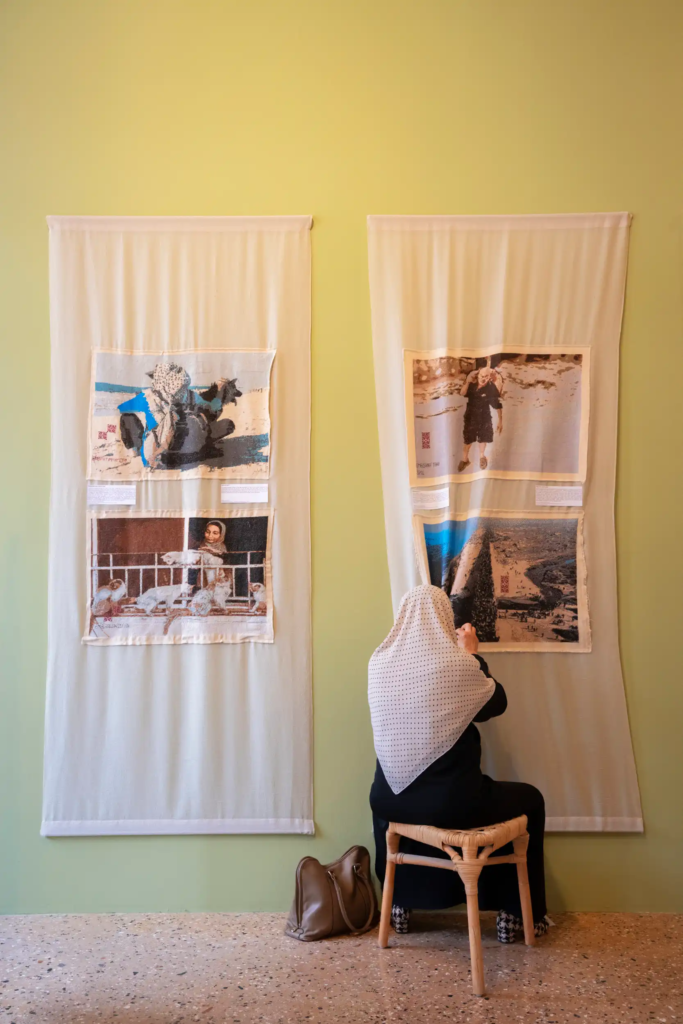
61st International Art Exhibition of La Biennale di Venezia, In Minor Keys by Koyo Kouoh
Yet it is precisely within this atmospheric fluidity that the most elusive paradox takes shape. It is from this very paradox that the exhibition’s decisive question emerges. The core of the critique of In Minor Keys lies in a burning question: can the rejection of spectacularization constitute a form of genuine political responsibility, or does it risk becoming an aesthetic neutralization that domesticates conflict? Within this tension, the Biennale is not merely the broader context, but its very condition of possibility and friction. Every curatorial gesture is measured against an infrastructure that is economic, diplomatic, historical, and above all perceptual. In Minor Keys attempts to work within this contradiction without resolving it.
On the one hand, presenting trauma within a major global institution can easily transform suffering into cultural commodity, into symbolic consumption for international elites. Pain is not removed, but made inhabitable; trauma is not denied, but suspended within a controlled aesthetic form. Abstraction, sensory evocation, and silence therefore become gestures of radical ethics precisely because they prevent the commodification of suffering and compel the viewer to confront the void left by violence. It is a politics of “resonance,” in which the viewer’s body becomes the sounding board for a truth that cannot be reduced to a pixel. On the other hand, the risk of aesthetic neutralization comes into view. As Fredric Jameson warns, within the logic of late capitalism, every form of resistance risks being reabsorbed as an emotional intensity detached from any concrete referent6. A war transformed into an immersive installation risks losing its political specificity and becoming a refined aesthetic experience. The danger is that the ineffable becomes a veil of Maya, obscuring the concrete responsibilities of political and economic actors. When suffering becomes “beautiful” or “sublime,” it ceases to be intolerable. As Susan Sontag has shown, the repetition of images of horror does not necessarily produce critical consciousness, but rather habituation, saturation, and emotional distance7. At that point, aesthetic distance can become a form of moral protection.
This is where the most profound tension of the contemporary Biennale emerges: how can beauty remain connected to real conflict? How can we prevent the sensory from becoming a form of consolation? The challenge of In Minor Keys lies precisely in keeping open the wound that constantly points back to the brutality of the world beyond the pavilion, ensuring that beauty and poetry never become a form of pacification. In Minor Keys continually oscillates between two poles: deviation and domestication, openness and neutralization. It is precisely this oscillation that constitutes its central stake. Yet this friction does not unfold in the abstract space of curatorial theory; it reverberates within the exhibition walls, against the backdrop of a world in flames.
The Geopolitics of Subtraction and the Institutional Trap
At a time when states are fortifying their borders and pushing migrant bodies back toward those who persecute them, the deeply contradictory structure of the Biennale makes any discussion of In Minor Keys inseparable from the very structure that contains it. The Biennale is not merely a container, but a global apparatus of representation: national pavilions, sponsors, cultural diplomacy, symbolic economies. National pavilions are not simply exhibition spaces, but remnants of a state-based modernity that continues to organize the contemporary through territorial logics. In a world shaped by migration, hybrid wars, and transnational identities, this structure appears increasingly misaligned. Yet already in 1993, Achille Bonito Oliva attempted to transform these pavilions into sites where political borders could be disrupted, opening a reflection on the possibility of a transnational contemporary8.
Looking closely, each edition of the Venice Biennale seems to cyclically reactivate the same unresolved contradictions. Time and again, the impression emerges that current geopolitical events inevitably overshadow the artworks, shifting the Biennale from artistic inquiry toward the terrain of current affairs. The Biennale is repeatedly accused of being a profoundly ambiguous machine, in which dissent risks being reintegrated into the spectacular circuit of cultural capitalism: a place where political rhetoric risks prevailing over art’s actual transformative capacity, and a space still largely shaped by aesthetic codes, languages, and criteria of legitimacy developed within Western cultural institutions. And yet, precisely within this network, the Biennale continues to exert an extraordinary power of attraction. Despite being one of the most contested cultural apparatuses of the contemporary world, it remains one of the few places capable of continually reopening, before an increasingly broad and global audience, the fundamental questions of what art can be, what political function it might still serve, and what forms of collectivity it can still produce. To understand this remarkable and almost magmatic force of attraction, one must look back to the history of the institution itself.
The Biennale is, by its very nature, a process through which conflict and its forms of resistance become institutionalized. Looking at the genealogy of its crises — from the historic protests of 19689, which challenged the structure of the art exhibition as a marketplace, to the threshold of the 1990s — it becomes clear that the event has never been a neutral territory, and that the autonomy of art within it has always been subject to negotiation. An emblematic case occurred in 1990, when the collective Gran Fury presented the now-iconic Pope Piece: an installation juxtaposing the image of Pope John Paul II with slogans criticizing the Catholic Church’s position on AIDS prevention10. The Biennale’s administration initially attempted to prevent the work from being exhibited, considering it blasphemous, while the Vatican even considered an official intervention to demand its removal. The controversy exposed the Biennale as a space of permanent conflict between artistic freedom, institutional power, and public morality. The work was controversial not only because of its explicit content, but because it disrupted the presumed neutrality of the exhibition space, transforming the pavilion into an openly political arena — an ideological battleground. Every attempt to transform art into a space of genuine dissent inevitably encounters the limits imposed by the very structures that sustain the event itself. It is within this tension that In Minor Keys is situated: an exhibition that attempts to withdraw from the spectacular noise of politics while remaining deeply traversed by its conflicts.
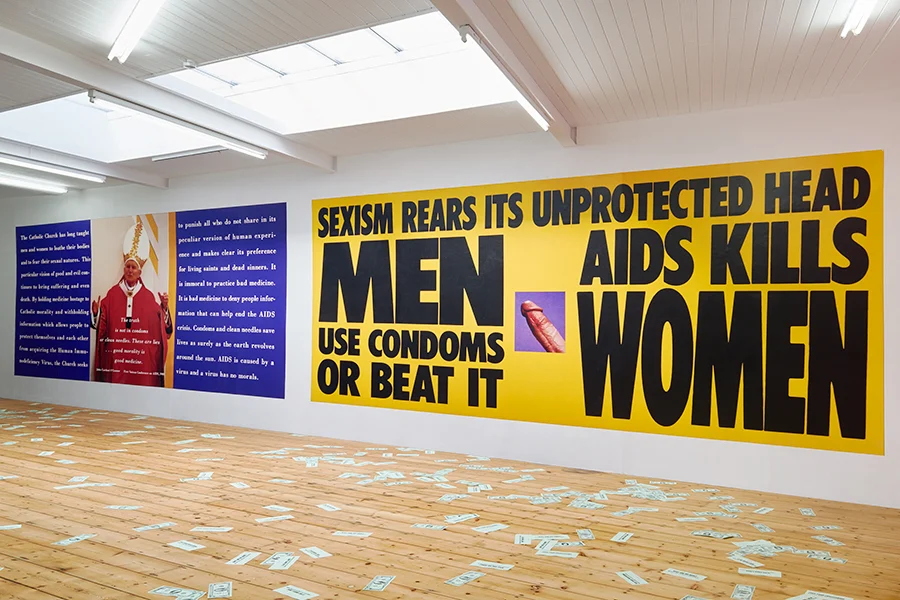
Gran Fury, The Pope and the Penis, 1990, vinyl wall poster (left); Gran Fury, Sexism Rears Its Unprotected Head, 1988, vinyl wall poster (right). Ph. Original&theCopy
A fundamental rupture in recent institutional dynamics is represented by the mass resignations of juries and scientific committees in response to political censorship or sponsor pressure. These events demonstrate that the “minor key” of curatorial practice cannot exist when the underlying infrastructure is compromised. When a jury resigns, it denounces the fact that the “major key” of power has made attentive listening impossible. It is the moment when the ineffable dimension of an exhibition must be translated into the resounding silence of institutional protest. Seth Siegelaub consistently argued that curators must take responsibility for the structures they uphold11. Resignation is the acknowledgment that, at times, the only way to act with “political responsibility” is to stop decorating the machinery of power. The Biennale appears today as a space almost hollowed out by the arrogance of international relations. Political conflict violently enters the exhibition space, transforming the art system into a field of permanent tensions that reveal the fragility of the boundary between artistic autonomy and institutional control.
Among the contemporary manifestations of this conflict, the issue of boycott is arguably the most significant. The debate surrounding boycotts—particularly in relation to the Israeli Pavilion and the protests against sponsors linked to the arms industry—tests the boundary between aesthetics and politics. If In Minor Keys advocates silence and withdrawal, how can this be distinguished from the complicit silence of an institution that refuses to take a stand? Kouoh’s silence is a poietic silence: it creates space for the Other. Boycott, by contrast, is a political silence: it serves to deny legitimacy to an oppressive system. The challenge for contemporary curatorial practice is to ensure that the exhibition’s “minor key” does not become an excuse for ignoring calls for boycott, but instead provides the emotional coordinates through which to understand why such a boycott is necessary. Geopolitical responsibility demands that art be unsettled by what lies outside it—that the voices of those protesting beyond the Biennale’s gates reverberate within its silent installations.
The need to make external urgencies resonate within the walls of the institution finds one of its most radical practical expressions in the strategies through which the African continent is represented. This issue exposes the deep contradictions that have long shaped the Biennale’s model of cultural internationalism, as its recent history clearly demonstrates. At the 52nd International Art Exhibition (2007), curated by the American Robert Storr, the inauguration of the first official African Pavilion ultimately relied on the private collection of the businessman Sindika Dokolo, revealing a profound ambiguity. The legitimate urgency of giving space to the continent’s narratives was, in practice, outsourced to opaque financial interests tied to regime-linked elites, turning decolonization into little more than an institutional façade. This stands as historical evidence that the Biennale’s internationalism, when deprived of methodological radicalism, risks systematically absorbing emancipatory demands and reducing them to diplomatic and exotic cultural capital. By contrast, this year’s South African Pavilion is emblematic of Kouoh’s curatorial methodology, one capable of breaking this cycle of institutional appropriation. The renewed discussion of a unified African Pavilion reflects broader debates about the representation of the continent at the Biennale. While Western institutions have often expected African art to perform its own suffering for an international audience, In Minor Keys refuses such spectacle. Choosing not to represent the historical traumas of apartheid through a didactic realism, but to evoke resilience through abstraction and the sensory, is an act of self-determination. This curatorial practice, grounded in an anti-extractive form of care, seeks to transform the exhibition space into an archive of the commons, where African history is not presented as the story of a victim to be observed, but as a vital force from which to learn.
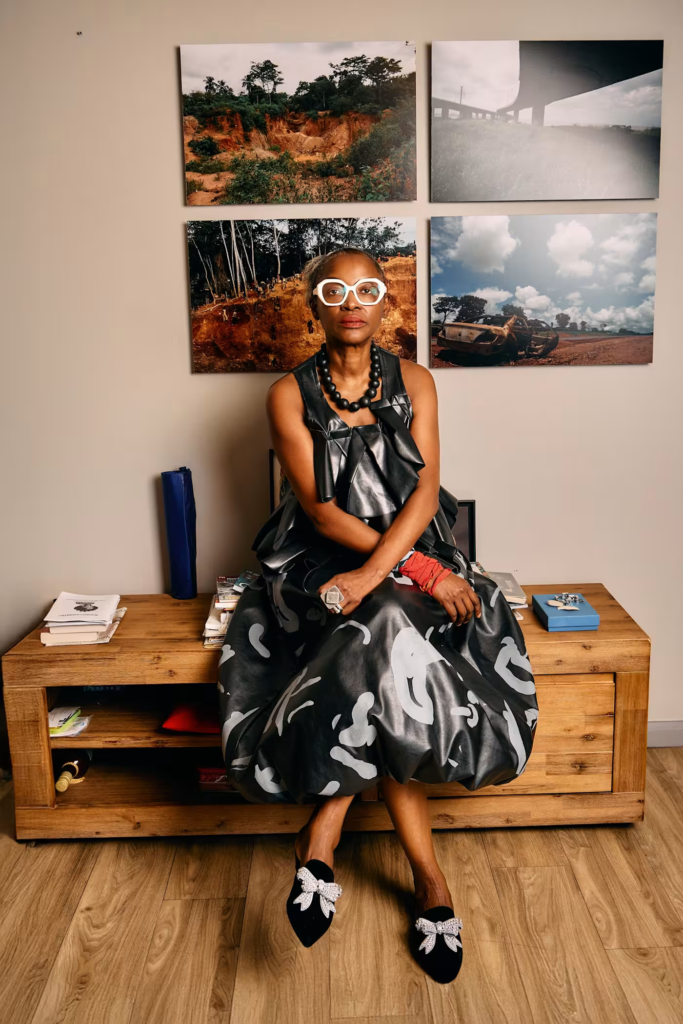
Kouoh in front of a photographic series by George Osodi © Trevor Stuurman (left); Palestine Museum, Palazzo Mora, Venezia, 2026. © Federico Vespignani, Celestia Studio (right)
Dialectical Temporalities and the Emancipation of the Sensitive Gaze
Kouoh’s reflection, however, concerns not only questions of geographical or postcolonial representation; it also engages with the way an exhibition organizes the temporality of experience. As Claire Bishop argues in Radical Museology: Or What’s Contemporary in Museums of Contemporary Art?, some contemporary art institutions attempt to resist the neoliberal homogenization of time through exhibition practices capable of reactivating historical memory, discontinuity, and conflict12.
Bishop has extensively criticized the “presentism” of contemporary art: an obsession with immediate relevance that mirrors the cycles of financial capital and social media. Kouoh, by contrast, attempts to construct a dialectical contemporaneity—a slow, layered temporality. The exhibition does not respond to the urgency of the clock, but to that of deep memory. Through an almost ancestral sense of time, it operates as a device for sabotaging neoliberal acceleration. This minor time, in which the viewer lingers, listens, and becomes lost, allows narratives that colonialism has attempted to erase to emerge, transforming the visitor from a consumer into a temporary custodian. Ultimately, the effectiveness of In Minor Keys rests almost entirely on the shoulders of the visitor. To call upon the viewer means, inevitably, to redefine the very concept of reception.
Following Jacques Rancière’s theory, the politics of art aims to produce an emancipated spectator—not a passive viewer who receives a moral message, but an active subject engaged in a redistribution of the sensible, capable of redefining what can be seen and what can be thought13. The spectator envisioned by Kouoh is not someone to whom a lesson is delivered, but someone who must exercise what Anaïs Varo Barranco calls a sensitive gaze.14. This gaze does not seek evidence of the crime; rather, it seeks relationships and listens to vulnerability. It is an exercise in radical empathy that is not based on similarity, but on co-implication. The political responsibility of the exhibition is fulfilled only if the visitor accepts not being reassured—if they accept leaving with more questions than answers, carrying with them that “minor key” that continues to resonate even after the lights of the Biennale have gone out. Yet this emancipation remains unstable, because the space that enables it is already an institutional apparatus. And every institution contains its own limits.
In Minor Keys demonstrates that withdrawing from spectacle does not mean abandoning politics. On the contrary, in a world that demands we shout ever louder in order to be heard, Kouoh reminds us of the subversive power of the whisper. Aestheticization becomes dangerous only when it is separated from real struggles. But when it remains traversed by the tensions of the present, beauty ceases to be mere decoration and becomes a form of resistance. In Kouoh’s own words, the 61st International Art Exhibition of the Venice Biennale is defined as a contest between those who seek to fill “the void of alienation that allows one human group to deny the humanity of another human group” and those who seek to widen it.15. The effectiveness of In Minor Keys does not lie in its ability to withdraw from dominant logics, but in exposing them, making visible the very difficulty of this process. Kouoh’s true curatorial wager consists in transforming the sensible into a space of responsibility, where art neither consoles nor absolves, but continues to resonate like a minor key capable of disrupting the deafening noise of the present. Perhaps, then, the point is not to choose between spectacle and withdrawal, but to inhabit their friction; to keep the contradiction open without transforming it into synthesis.
Because a minor key never resolves. It interrupts, diverts, insists. And in this persistent discordance —fragile, unstable, reversible—the political possibility of the sensible is still at stake.
English translation: Dobrosława Nowak
Bibliography
1. La Biennale di Venezia, Biennale Arte 2026, official website, 2026, available at: https://www.labiennale.org/en/art/2026
↩
2. F. Jameson, Postmodernism, or, The Cultural Logic of Late Capitalism, London-New York, Verso Books, 1991.
↩
3. S. Sontag, Davanti al dolore degli altri (Regarding the Pain of Others), edited by P. Dilonardo, Milano, Nottetempo, 2006.
↩
4. H. U. Obrist, A Brief History of Curating, Zurich-Dijon, JRP|Ringier – Les Presses du Réel, 2008.
↩
5. R. Krauss, L’era postmediale. Marcel Broodthaers, ad esempio, Milano, Postmedia Books, 2005.
↩
6. F. Jameson, cited above
↩
7. S. Sontag, cited above
↩
8. A. Bonito Oliva (a cura di), Punti cardinali dell’arte: XLV Esposizione Internazionale d’Arte, Venezia, Marsilio, 1993.
↩
9. Cfr. K. Sanders, Letter to an Institution: The Present History of the Venice Art Biennale, in «The Italian Art Guide», 23 giugno 2026, available at: https://theitalianartguide.com/letter-to-an-institution-the-present-history-of-the-venice-art-biennale/.
↩
10. M. Kimmelman, Review/Art; Venice Biennale Opens With Surprises, in «The New York Times», 28 maggio 1990, available at:
https://www.nytimes.com/1990/05/28/arts/review-art-venice-biennale-opens-with-surprises. html
↩
11. H. U. Obrist, cited above
↩
12. C. Bishop, Radical Museology: Or What’s Contemporary in Museums of Contemporary Art?, with illustrations by D. Perjovschi, London, Walther König, 2013.
↩
13. J. Rancière, The Emancipated Spectator, London-New York, Verso Books, 2009.
↩
14. J. Rancière, La partizione del sensibile. Estetica e politica, edited by I. Bussoni, Roma, DeriveApprodi, 2016.
↩
15. Cfr. La Biennale di Venezia, official website, 2026, cited above
↩