


5,700 Finished Bodies. Miriam Cahn at MACRO
04.08.2026
Miriam Cahn’s immediate and spontaneous smile during the interview Still Leben (2026)1, when she is asked about the four months each year during which the sun never reaches the village of Stampa, Switzerland, where she lives, is almost symptomatic. That smile reveals how a condition that might appear extreme is, for her, a source of wonder. “It’s not that there is no light: there is no sun. And that is a huge difference. The sun is up there, there’s a line, and down there, where I am—because I live in the valley, at the very lowest point—there is a very special light that I like very much.”
She moved there when the town where she had been living became a popular tourist destination. She decided to relocate to the valley, to the very place where Alberto Giacometti had also lived. She continues: “It’s not that there is no light. It’s not dark. It’s a light that is, I would say, a little violet.” That radiant smile returns to her face as she tries to recall the exact shade of that color. Yet, two minutes later, in the same interview, she firmly denies that this light has influenced her work in any way.
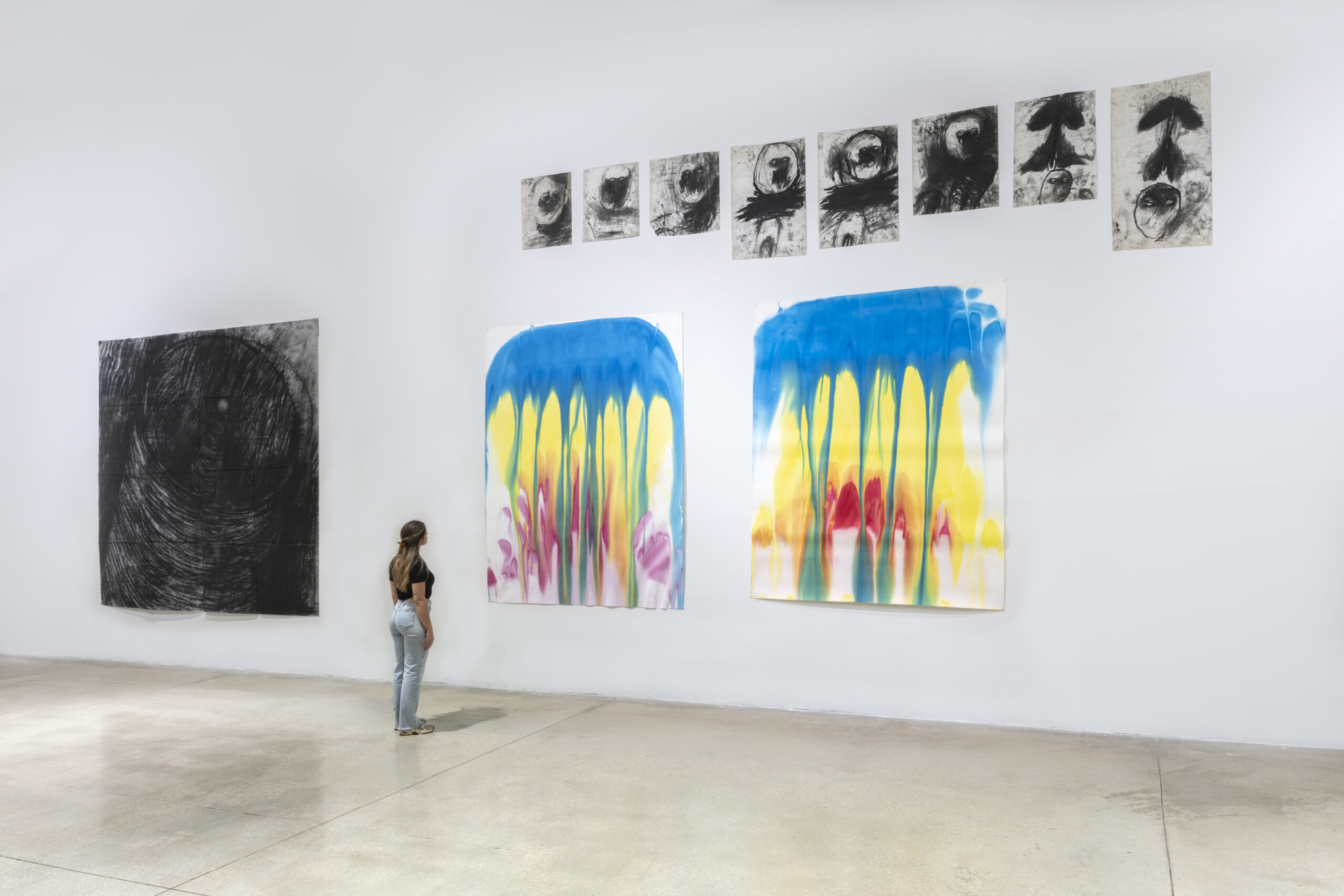
Miriam Cahn. Ciò che mi guarda, installation view, Roma, 2026. Ph. Ela Bialkowska – OKNOstudio. Courtesy MACRO – Museo d’Arte Contemporanea di Roma
Ciò che mi guarda (What Looks at Me), the first major museum retrospective dedicated to Miriam Cahn in Italy, curated by MACRO Artistic Director Cristiana Perrella, brings together more than 130 works created by the artist from the late 1970s to the present.
There is always a certain hesitation in approaching a retrospective, especially when the artist has already become part of one’s own cultural landscape. It is not uncommon for the chronological or thematic order imposed by the exhibition design to disrupt the poetic fabric the artist has developed over the years, rather than enhancing it.
Faced with the difficult challenge of conveying fifty years of artistic research without imposing a single, overarching interpretation, Ciò che mi guarda (What Looks at Me) unfolds through autonomous groups conceived as units of thought—an exhibition strategy that Cahn has developed since the 1980s. These “room installations” translate into space what a single painting could not contain on its own. Among them are Herumliegen (Lying Around) (2022), created in response to Russia’s invasion of Ukraine, and Familienraum (Family Space) (1996–2009), dedicated to memory, affection, and inner geographies.
These spatial solutions are complemented by the exhibition design conceived by artist and architect Didier Fiúza Faustino, structured around modular geometric forms that define open spaces filled with passages and sightlines. This is where the core of What Looks at Me—and, inevitably, of what does not look—reveals itself, through alternating moments of disclosure and concealment along the exhibition path. Faustino’s structures thus become an integral part of the experience of the exhibition.
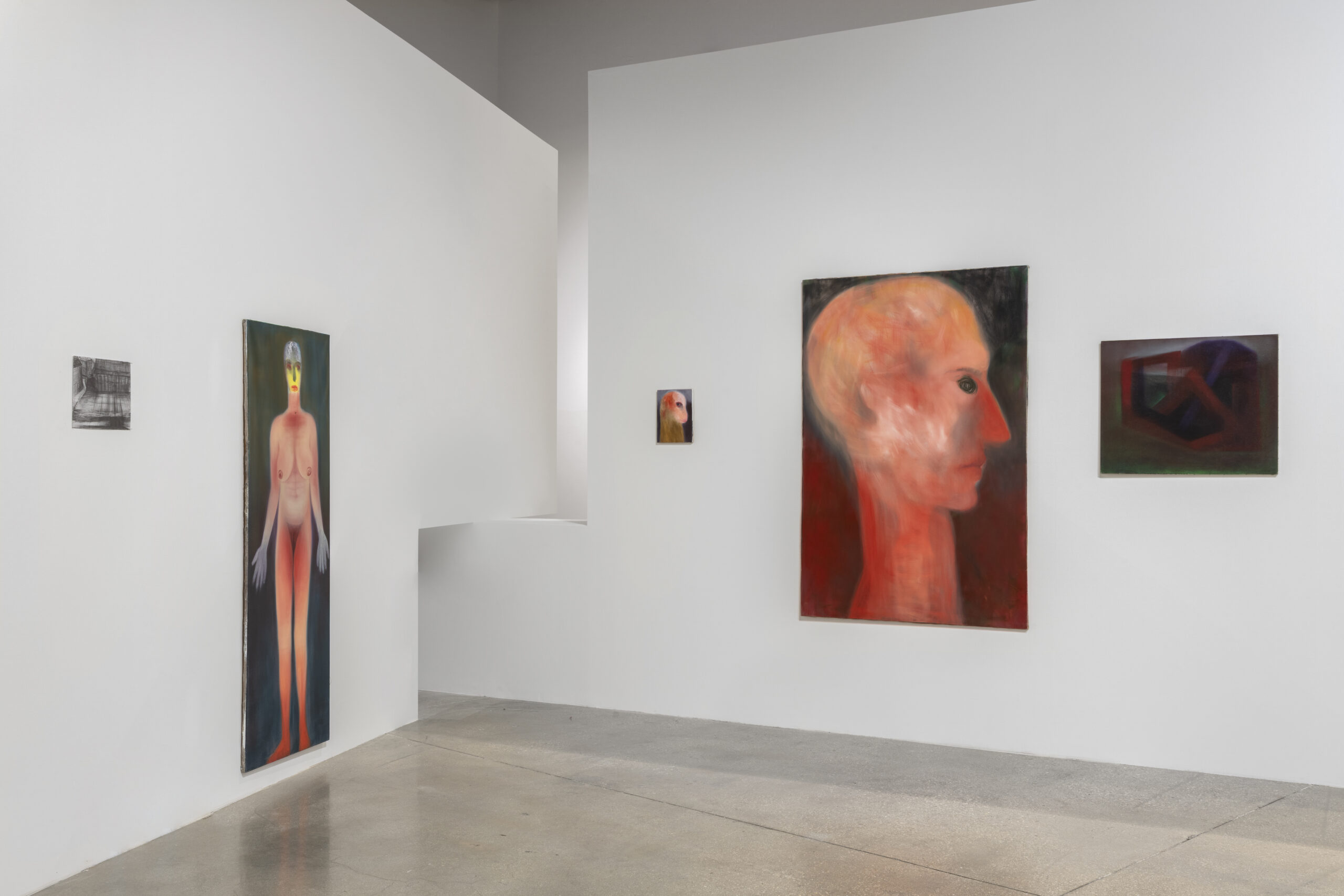
Miriam Cahn. Ciò che mi guarda, installation view, Roma, 2026. Ph. Ela Bialkowska – OKNOstudio. Courtesy MACRO – Museo d’Arte Contemporanea di Roma
Certain themes recur continuously throughout Cahn’s work: the violence of war, the female body and power relations, as well as social and intimate relationships. The force, at times brutal, with which these forms refer to a shared and immediately accessible visual vocabulary—just think of SHOW! (2022), depicting the detail of a childbirth, or könnteichsein (2022), a face struck by a punch—makes it all the more surprising that, under prolonged observation, the figurative image can easily dissolve, allowing the qualities intrinsic to painting itself to emerge: color, line, matter, and painterly gesture. As the artist herself explains, she no longer needs to think about technique; over the years, she has completely internalized it.
The exhibition conveys the variety of techniques and materials employed by the artist, ranging from the monumental charcoal and black chalk drawings she began making in the 1980s to photographic prints, from watercolors on paper to oil paintings on canvas and wood, and finally to mixed-media works combining glue, chalk, pastel, pigment, and pencil.
“Female artists have a lot to do to rewrite the history of art,” Miriam Cahn recalls in another interview, Female artists have a lot to do! (2021)2 —“because most art throughout history has been created by men. It is therefore their vision, often eroticized, that represents women as passive figures, preferably without faces.” She continues: “We have a great deal to do, and that is why my females look back.” From this perspective, sustaining the gaze becomes an affirmation of one’s own presence; consequently, the title What Looks at Me acquires yet another level of interpretation.
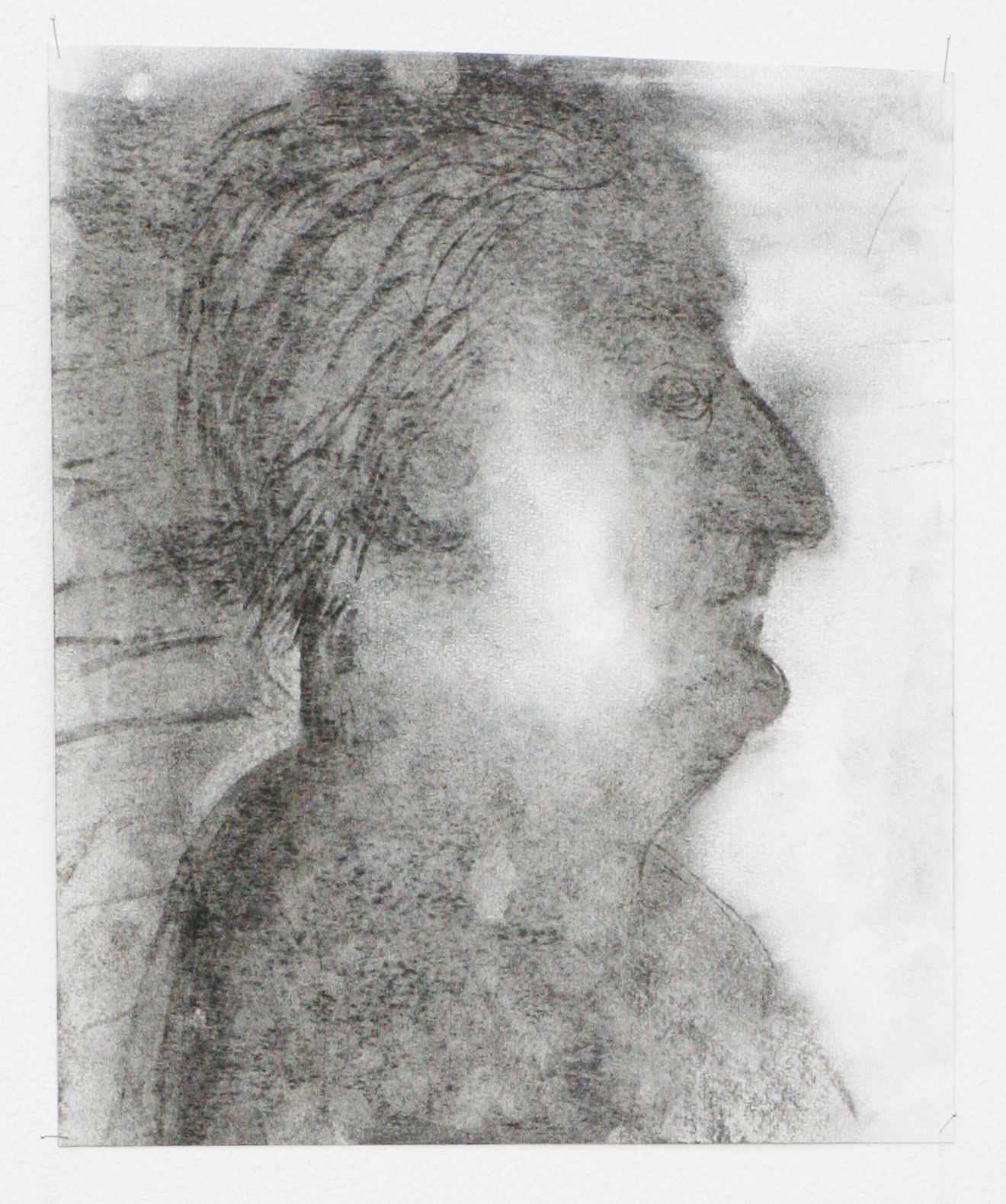
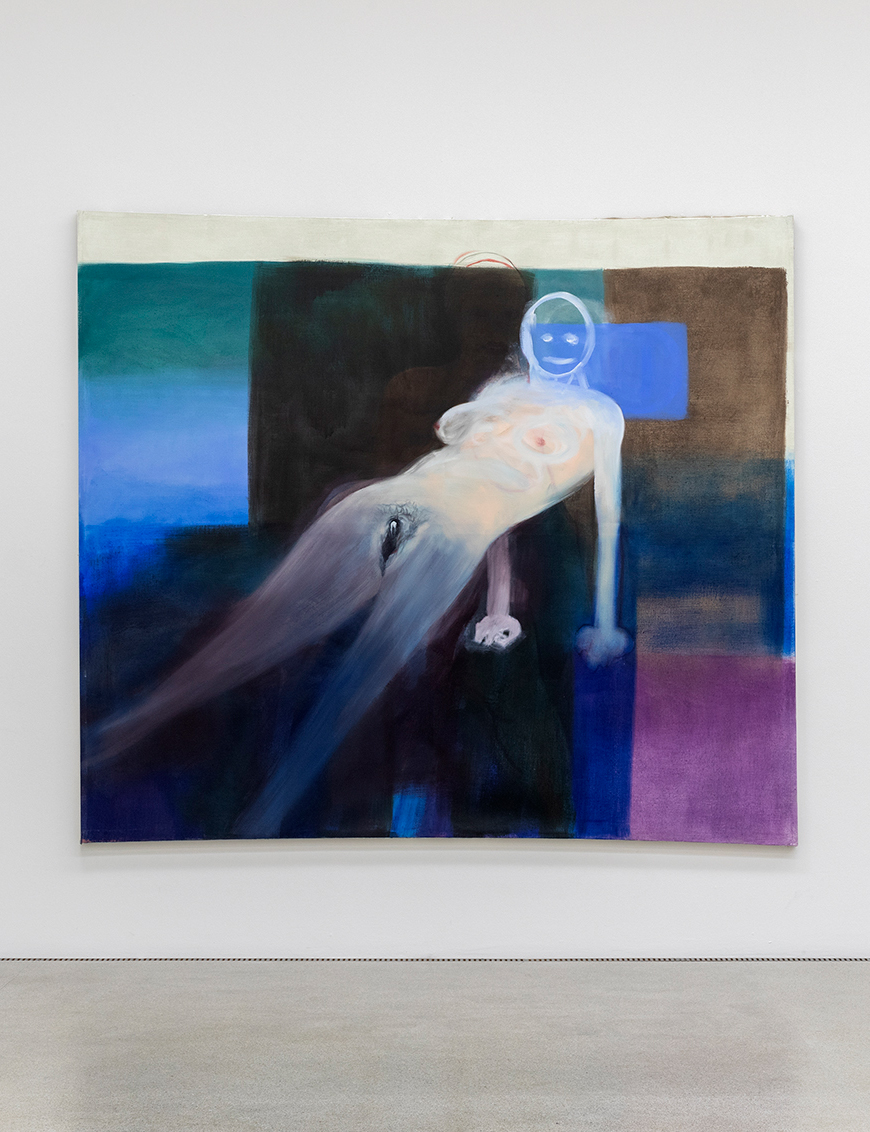
Miriam Cahn, (seltenes) portrait / (rare) portrait, 14.11.2005 charcoal on paper 30 x 24 cm/ FAMILIENRAUM, Ph. Meyer Riegger (left) / Miriam Cahn, zeige! / show!, 18. / 19.04. + 24.08. + 01.09.2020, oil on canvas, 275 x 305 cm Courtesy the artist Meyer Riegger and Galerie Jocelyn Wolff, Paris, Ph. Meyer Riegger (right)
When it is pointed out to her that her work is often associated with issues such as injustice in the world, violence against women, and women’s condition, Cahn responds: “It’s not that I illustrate what happens, but what happens, happens to me.” In 1995, she stopped painting performatively on the floor because her body no longer allowed her to work in that way. Nevertheless, she continued to use her body as a tool, emphasizing that the content of her work has remained unchanged.
Her painting heroes are all men—Francisco Goya, Philip Guston, and Pablo Picasso—because throughout the history of art there has been a lack of representations of women created by women themselves. Certain subjects were rarely addressed: experiences such as rape, menstruation, pregnancy, or childbirth remained at the margins of the painterly tradition or were filtered through a male gaze. Cahn rejects being identified through her work as the spokesperson for a political cause. She considers it a limiting definition. In the video interview I Would Rather Be Painting Flowers (2017)3, she says she finds the label “political art” misplaced: “You should be able to look at a painting without knowing what it is about,” she says. “The work should be accessible to everyone in a non-literal way.”
Since 1995, she has been painting bodies. She says she has lost count both of the years she has spent painting—“A thousand!” she jokes—and of the finished paintings of bodies in her archive, which she estimates now number around 5,700.
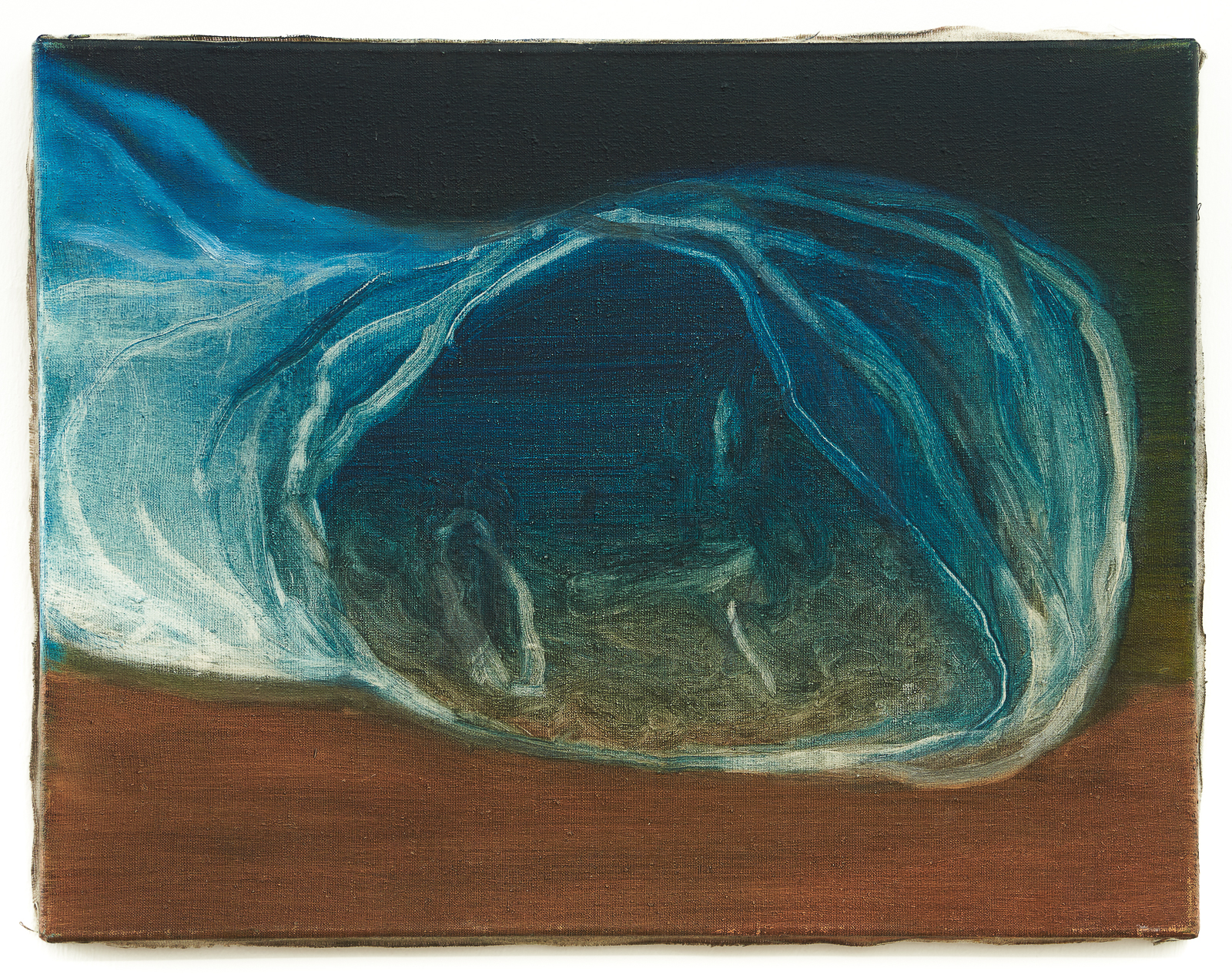
Miriam Cahn, am strand / on the beach, 2006 + 13.08.2019 + 01.08.2020, oil on canvas, 40 x 52 cm, Private collection, Berlin, Karlsruhe, Ph. OliverRoura
English translation: Dobroslawa Nowak
1 “Still Leben,” 2026 https://www.youtube.com/watch?v=c0xk9zFXM8w
↩
2 “Female Artists Have a Lot to Do!,” 2021 https://www.youtube.com/watch?v=SHJLuRa1zLA
↩
3 “I Would Rather Be Painting Flowers,” 2017 https://www.youtube.com/watch?v=a-ZJ-3ql5tA
↩