

Noah Beyene: Studio Visit as a Storytelling Practice
Maria Vittoria Pinotti | 17/11/2026
The studio visit has long been considered an essential step in gaining a deeper understanding of an artist’s practice, as it provides an opportunity to engage with the raw material of their work, gather insights that can inform critical judgement, and develop exhibition projects. Although this practice is now widespread, it often takes place in the lead-up to an exhibition or in connection with market strategies and talent scouting. In the case of painter Noah Beyene (Stockholm, 1993), however, the experience opened up the possibility of approaching the questions that follow as a deeply introspective form of storytelling, capable of conveying his personal understanding of the space in which he works, as well as certain aspects of his creative process.
Following our first remote meeting, which took place around two months ago, we began to consider how to convey the essential aspects of his practice despite the physical distance between us, using the different areas of his London studio as starting points for reflection. What is particularly striking is how the studio, situated somewhere between a living space and a workplace, rather than being a source of limitation, gives rise to a form of painting understood as a diary of moods, feelings, experiences, and both individual and shared values.
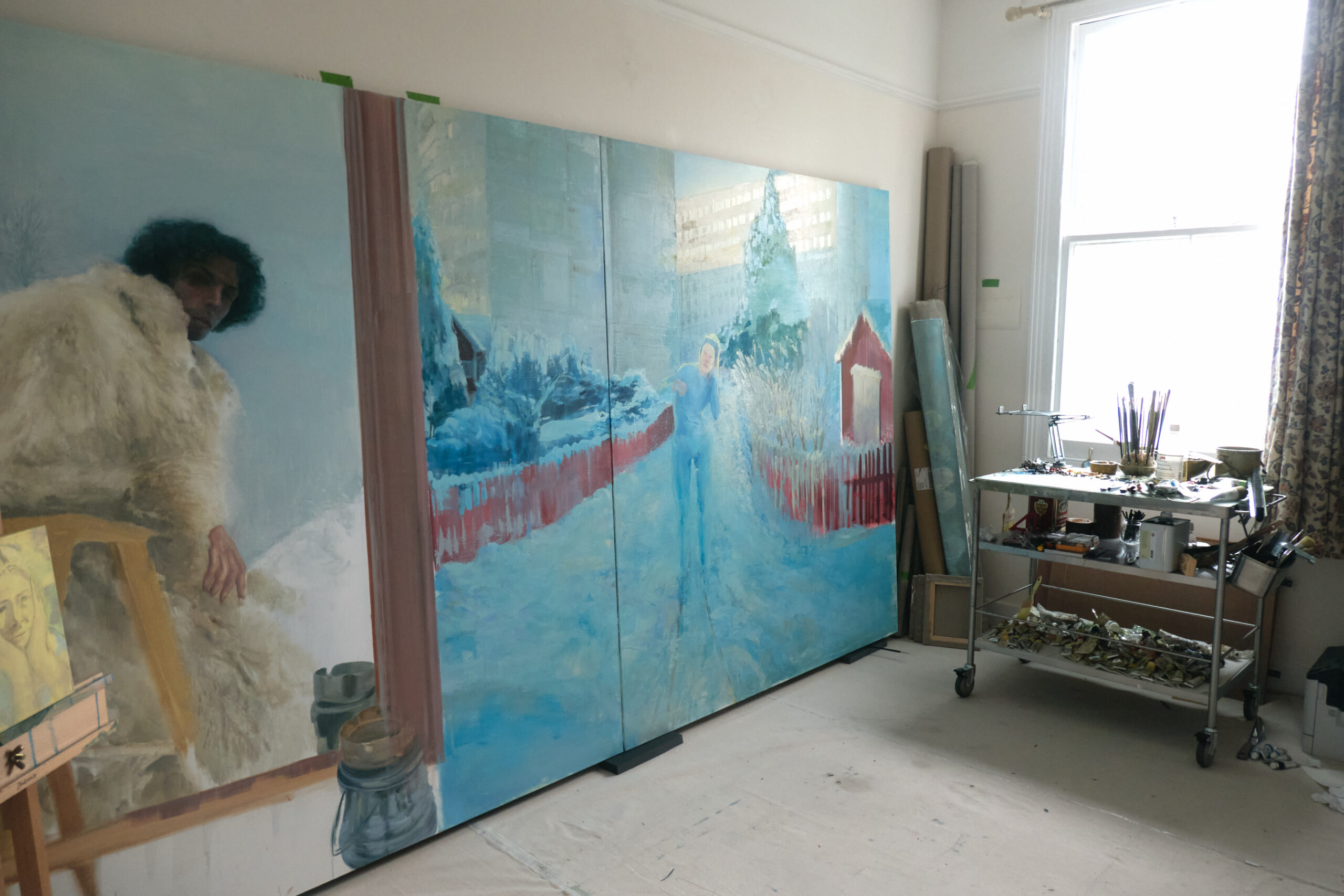
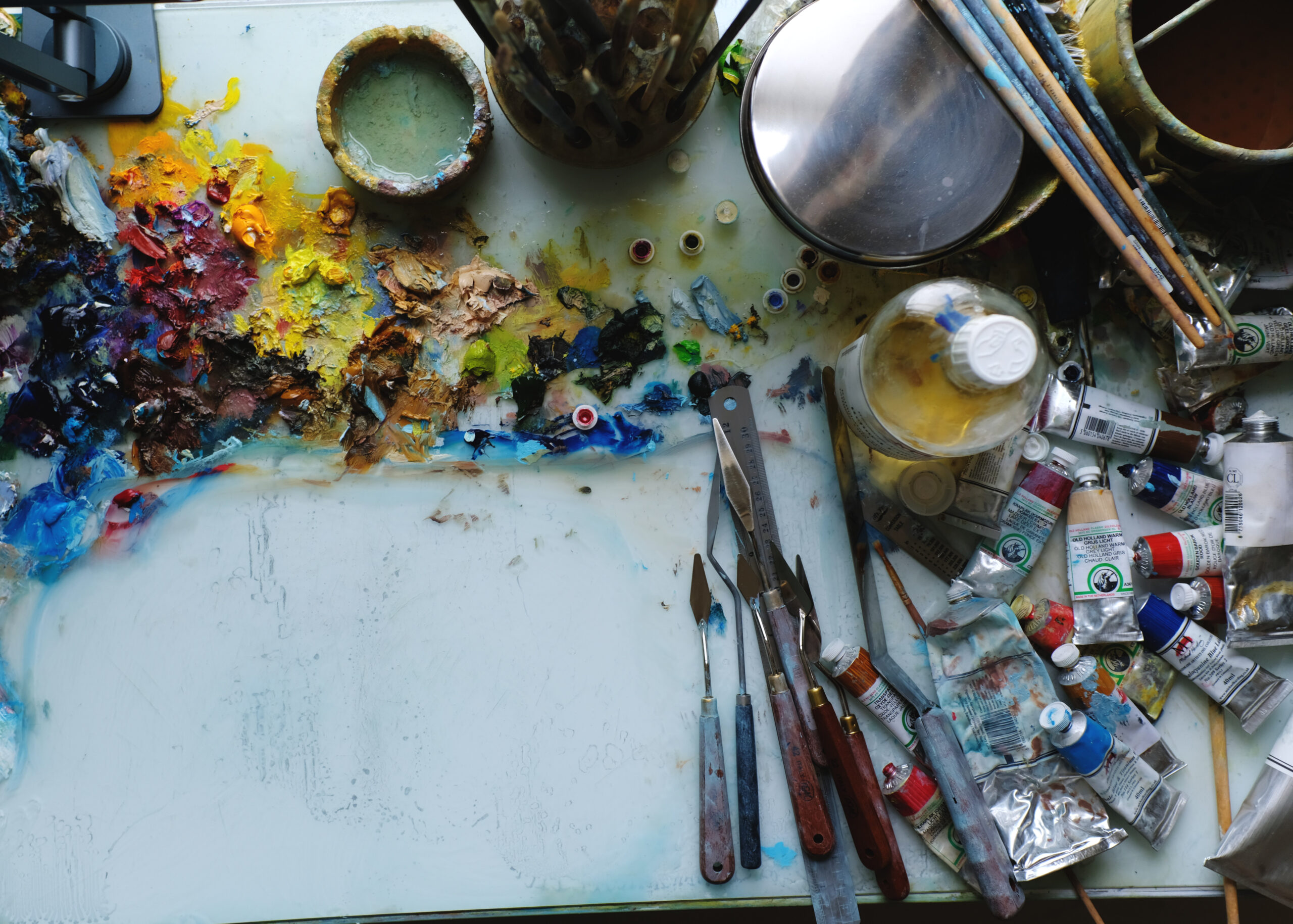
Noah Beyene’s studio, London, November 2026, courtesy the artist
Having gone through several formative stages, Noah Beyene has developed, in works exhibited at Solito Gallery in Naples, The Bridge Gallery in Paris, and CFHILL in Stockholm, a painterly sensibility that is attentive both to narrative and to the pursuit of tonal balance. Each work becomes a process of testing what one seeks to depict, in a constant oscillation between the object and its evocation, without ever fully rendering it. For the artist, fixing a subject and assigning it a chromatic weight thus means not only telling its story but, above all, transforming it. Seen in this light, the studio environment helps us understand how this painting comes into being through a dynamic process of exploration, moving between the translation of sculptural volume and the modulation of colour and light.
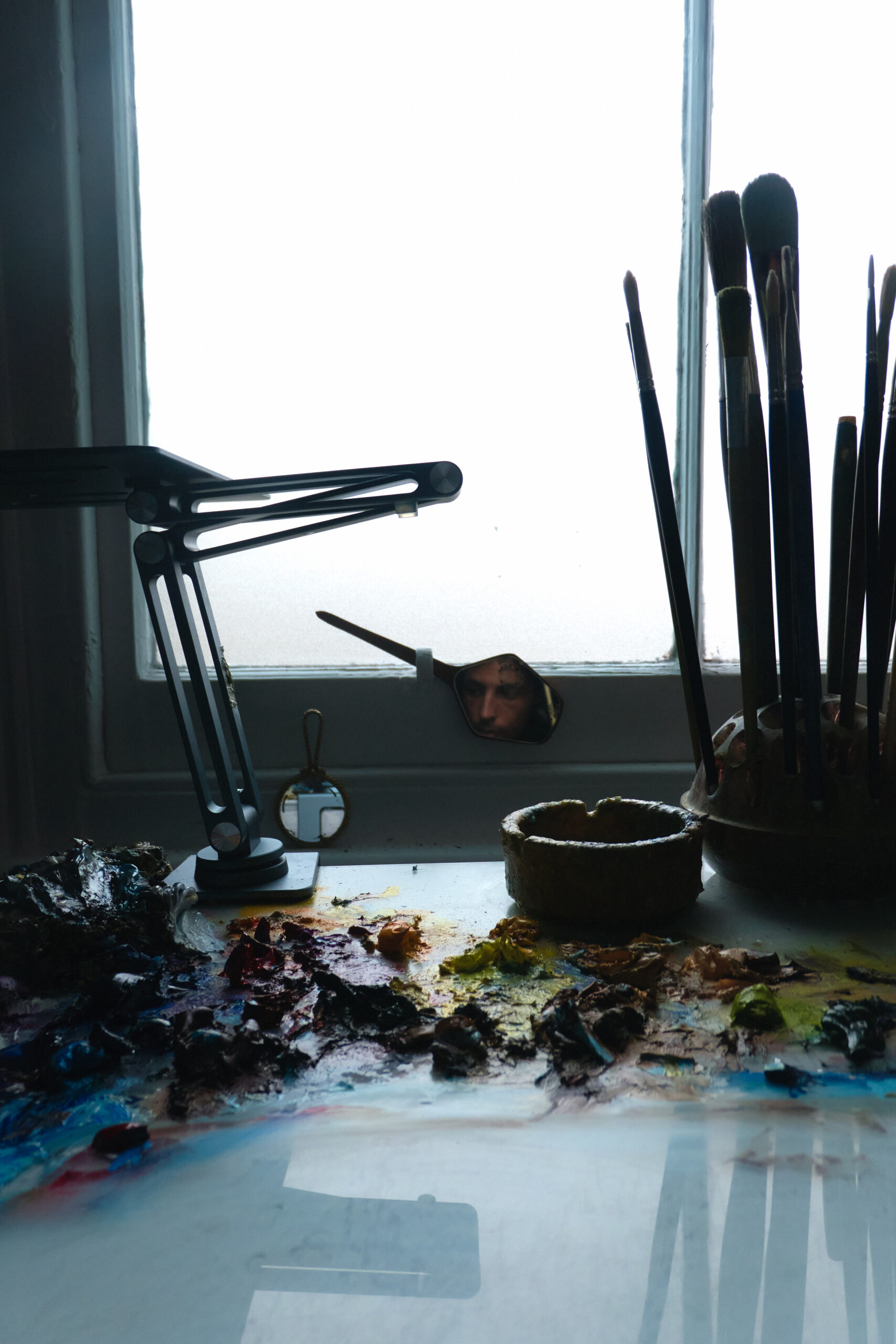
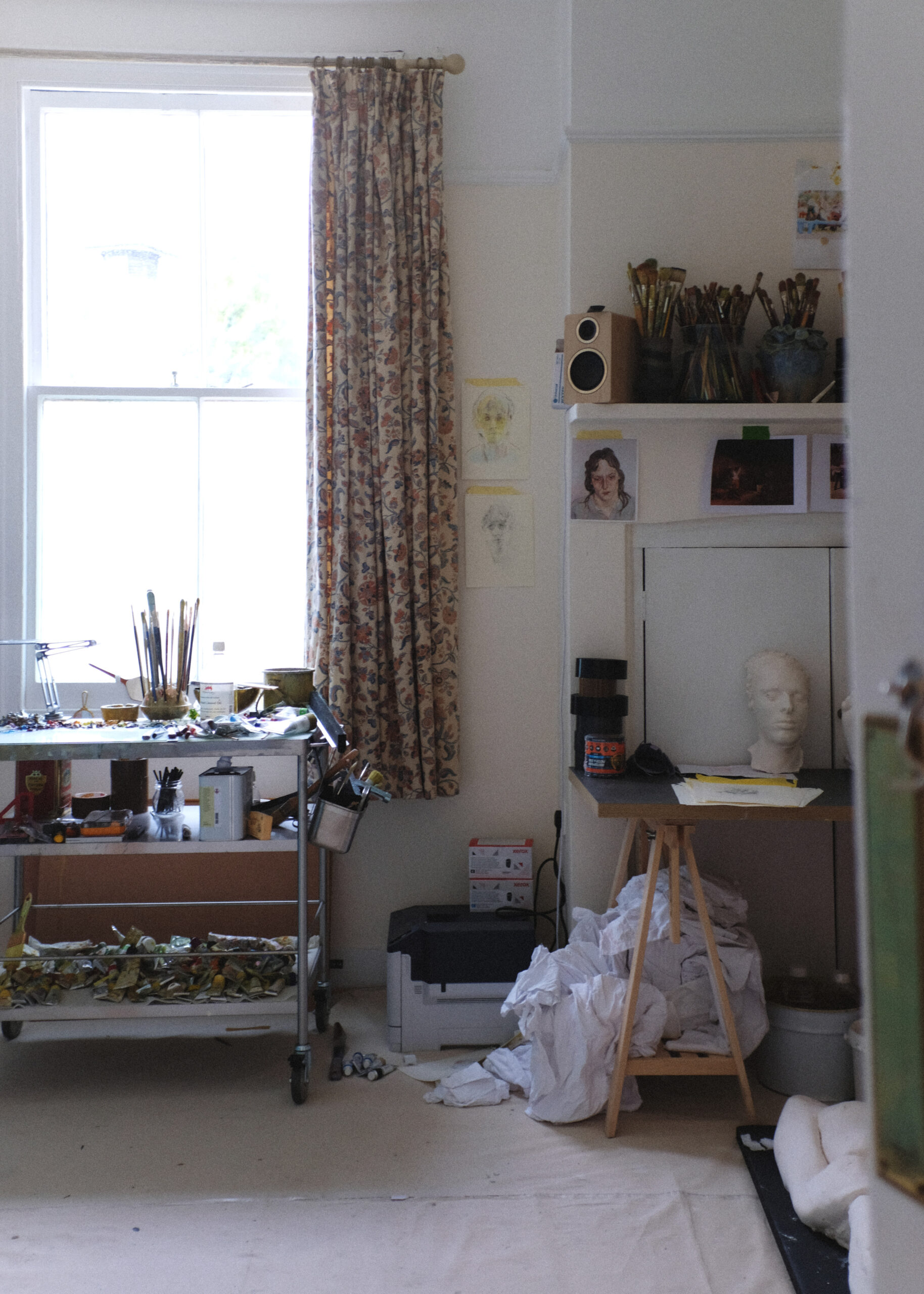
Noah Beyene’s studio, London, November 2026, courtesy the artist
Maria Vittoria Pinotti in conversation with the artist
Maria Vittoria Pinotti: Could you tell us about your studio, how you have organised the space, and how long you have been working here?
Noah Beyene: I started working in this space in January this year. It’s fairly small, but it has a beautiful north-facing window that gives me a soft, consistent light throughout the day. I’m not sure I organise it in any particular way, the space tends to organise itself around whatever I’m working on. It’s so small, and I try hard not to let the studio spill into the rest of my home, so everything revolves around the project I’m working on at the time. There are limitations to a home studio, but I find that living with my work allows for prolonged looking, and a more passive relationship to it. I can enter the studio without feeling the need to work on something and just sit with the work.
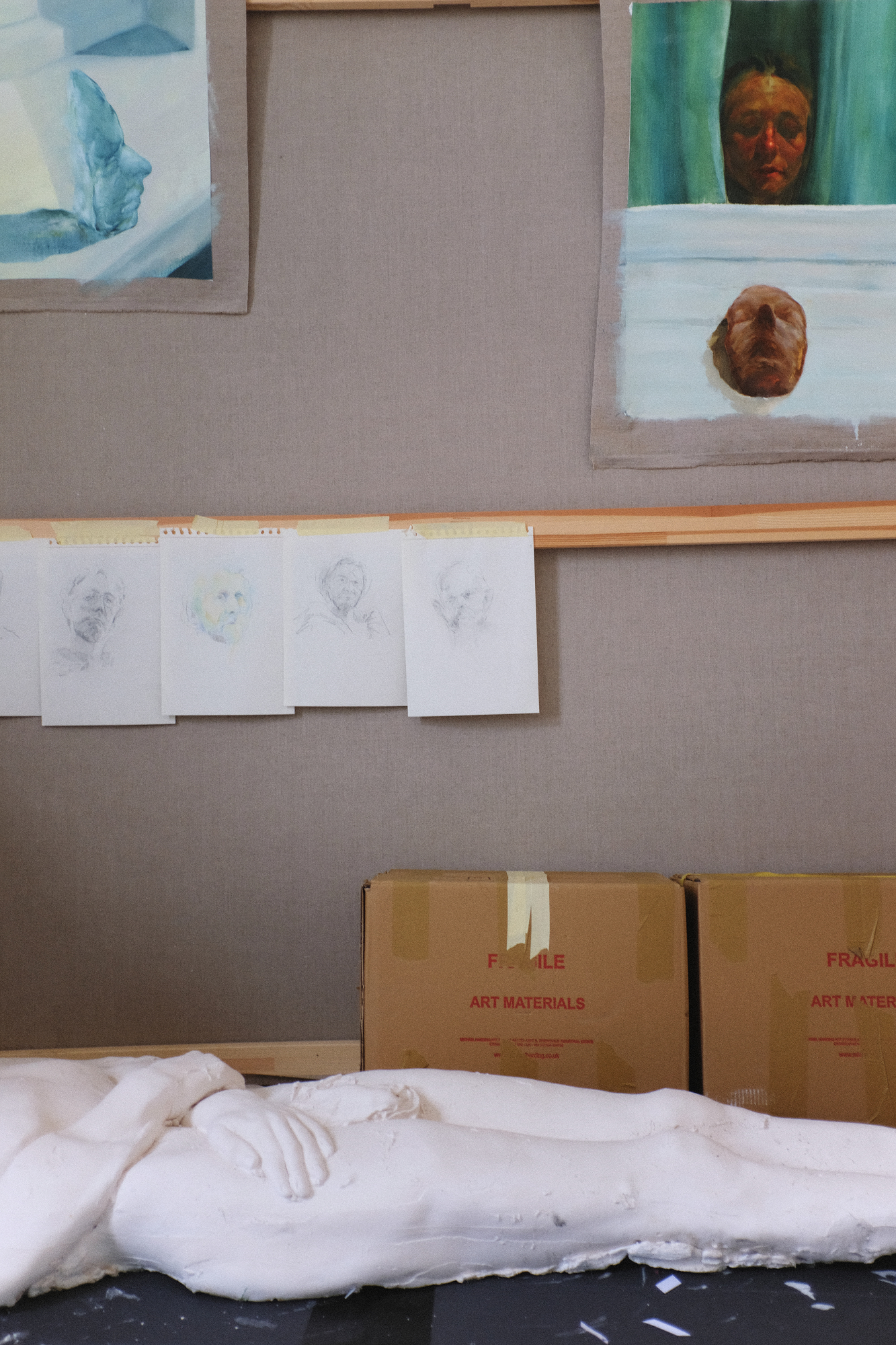
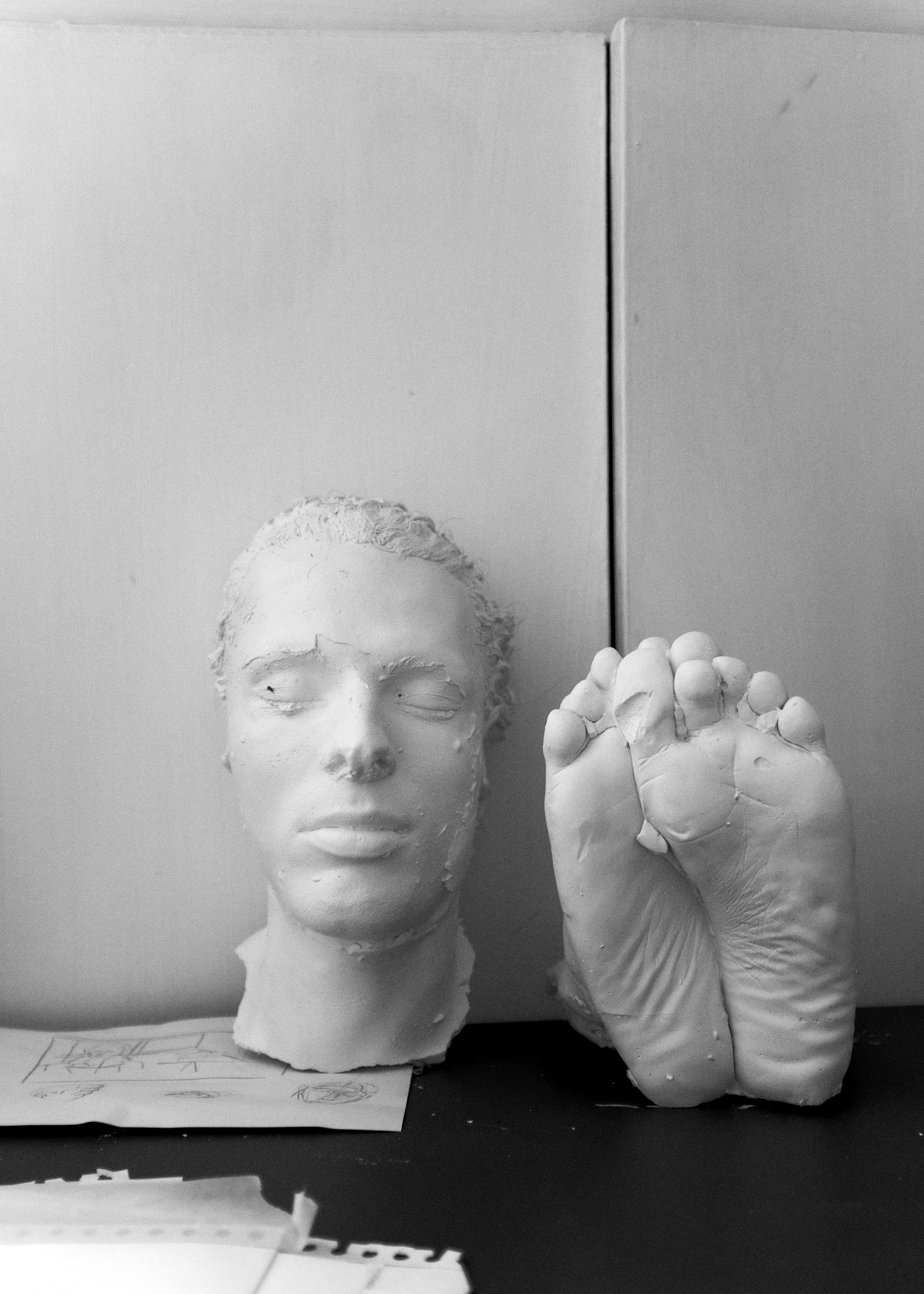
Noah Beyene’s studio, London, November 2026, courtesy the artist
MVP: There are plaster casts in your studio. What role do they play in your practice, and how do they relate to your painting process?
NB: I became interested in casts while working on my show Making an Impression (The Bridge Gallery, Paris, 2025). I was painting impressions I’d made by pressing my face into snow and then making plaster casts from those impressions. The paintings and casts were, in many ways, trying to capture impermanence. I have a background in photography, and there’s something about the process that feels very akin to it, that seemingly unbiased capturing of someone’s likeness. I’ve kept thinking about the process since. My first plaster casts tried to make the impermanent permanent, but I became interested in the reverse, so now I’m experimenting with moulds made from casts to create detailed ice casts. There’s something so enticing about an impermanent object, and about the very human desire to make the impermanent permanent. I’ll show the first iteration of this idea next year, inside a freezer with glass walls. The freezer becomes an interesting piece of infrastructure for me, a symbol of our desire to master nature. I don’t have an exact date for when I will show the work but it will most likely be shown in London.
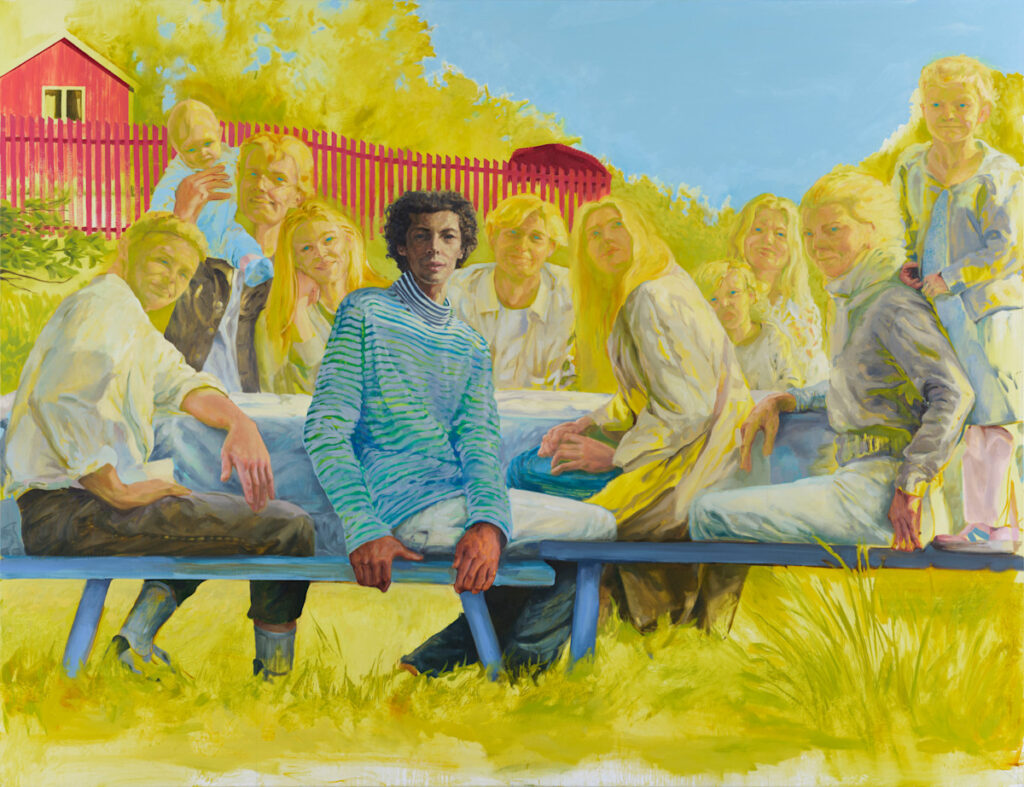
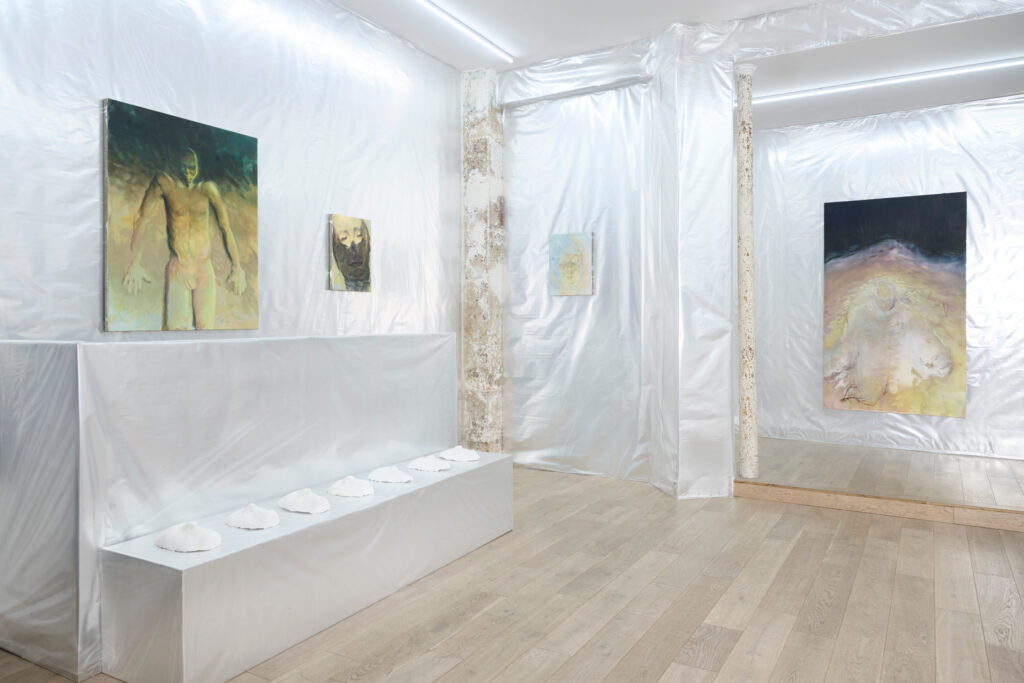
Noah Beyene, Preservation of Fishy Traditions (Surströmmingsskiva), oil on linen, 200 × 260 cm, 2024–2025, courtesy CFHILL, Stoccolma and the artist / Noah Beyene, Making an Impression, The Bridge Gallery, Paris, 10 December 2025 – 23 January 2026, courtesy The Bridge Gallery and the artist, ph Rémi Pujol
MVP: You were born in Stockholm, have Ethiopian roots, and your studio is in London. How have these different cultural geographies contributed to shaping your painting practice?
NB: Hugely, I think. It’s almost ironic when I think about it: the places and themes I make work about are always the places I’m not in. Perhaps the absence of a place sharpens it, or perhaps it’s the contrast that helps me see it in a new light. Much of my recent work, such as Sweetish (CFHill, Stockholm, 2026), reflects on the birth of the nation-state, specifically the Swedish nation-state, and how central art and culture were to making that project viable. But those ideas came to me while I was studying in London, far removed from Swedish culture. My work with ice feels deeply related to Sweden too, to how a cold environment shapes a society. And as you mention, while I think of myself as Swedish, I carry some Ethiopian culture and heritage with me as well, something that feels increasingly difficult to do in Sweden today, not that it’s ever been super easy. Going back to ice, certain sensations are so visceral that they become part of our everyday vocabulary. If someone is cold or frosty, we instantly know what that means, and we can almost feel the burn of ice just by looking at it. I want to use it as a medium because I grew up in a country that was ice cold, but also because ice is transparent, and being mixed race I have at times felt too visible against Sweden as a backdrop, and equally invisible.
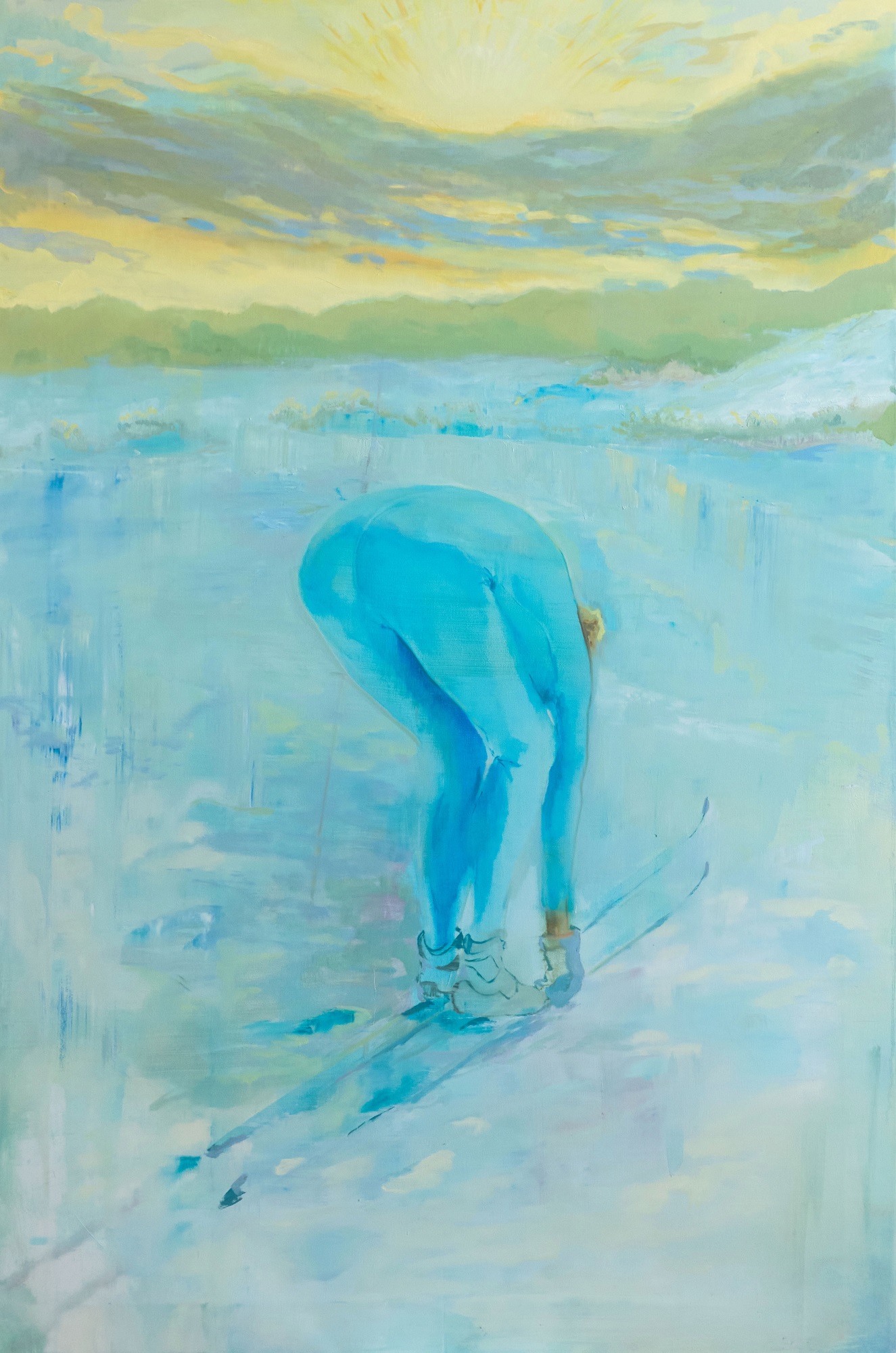
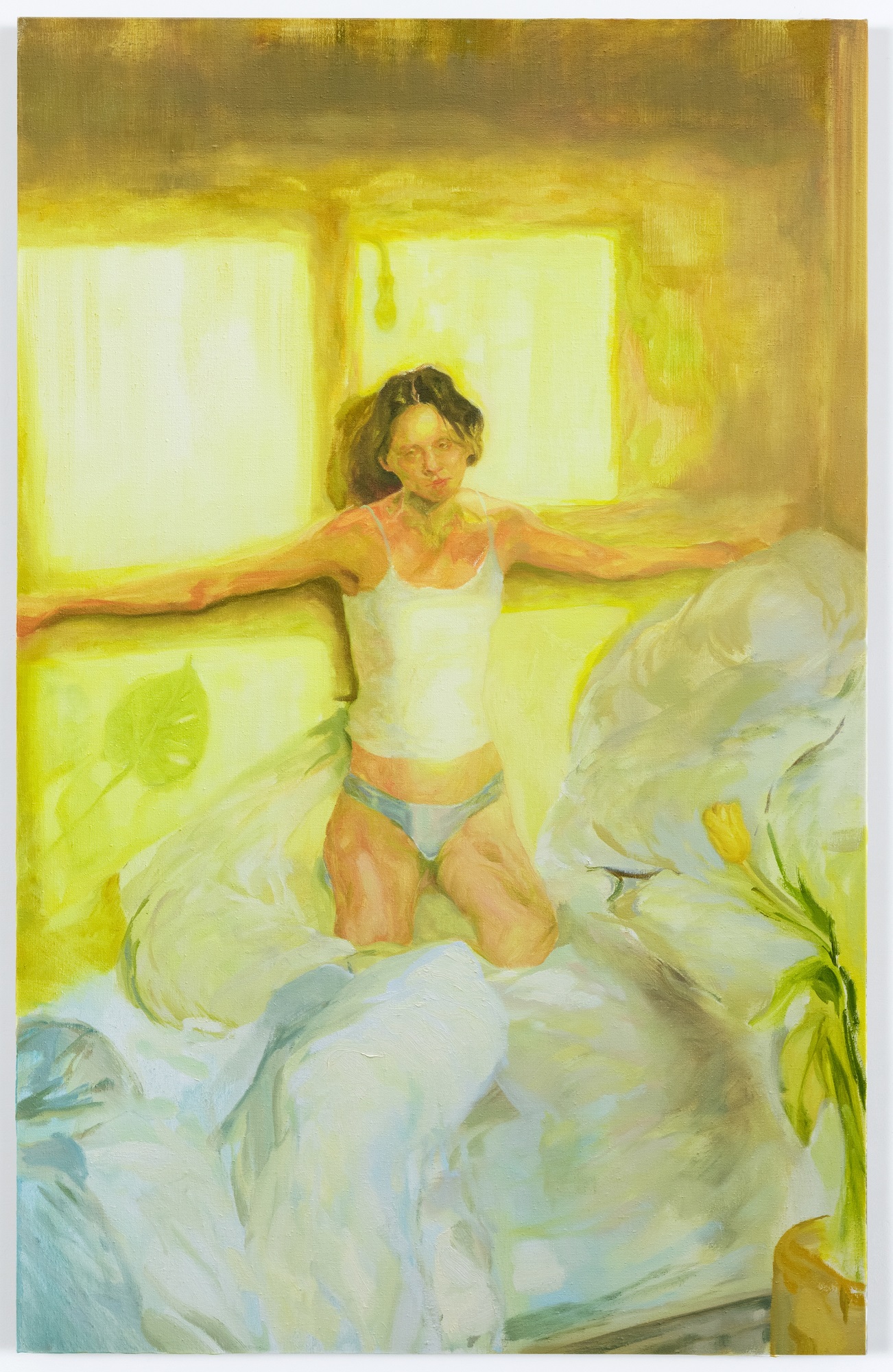
Noah Beyene, Renward, oil on linen, 2026, 150×100 cm, courtesy the artist / Noah Beyene, Mourning Light, Bedscape, oil on linen, 110×70 cm, courtesy the artist
MVP: In your paintings, you establish a particular relationship with tonal values, with each work developing around a single colour range, as in the case of blue and yellow. How do you choose your colour combinations, and what role do tonal values play in the construction of the image?
NB: I think of my paintings as occupying a space similar to how my memory functions. Images arise and feel clear as day until I probe further, some things stay very clear, while others lose their edges. But that place or situation always has a feeling attached to it, and that’s often where colour comes in. My near-monochromatic way of working is closely linked to a sense of overstimulation, of being overwhelmed by a feeling. I try to get the colour as true as I can by asking myself what colour something feels like it has, in an almost childlike way: what colour is the sun? What colour is the water? This is the first hurdle a figurative painter grapples with, the world feels very different from how it objectively looks. Having figured that out, I’m now more interested in why it feels the way it does.
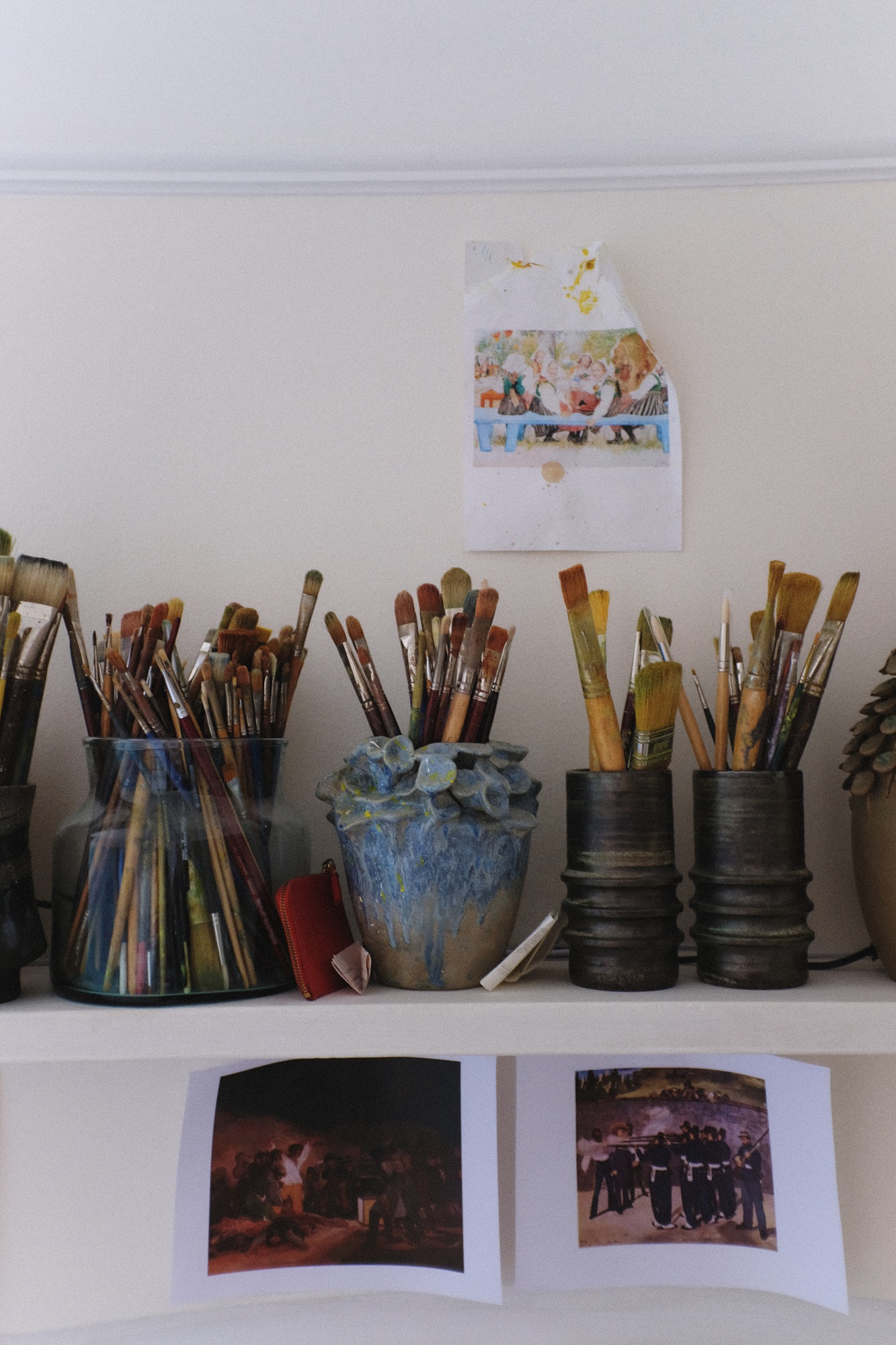
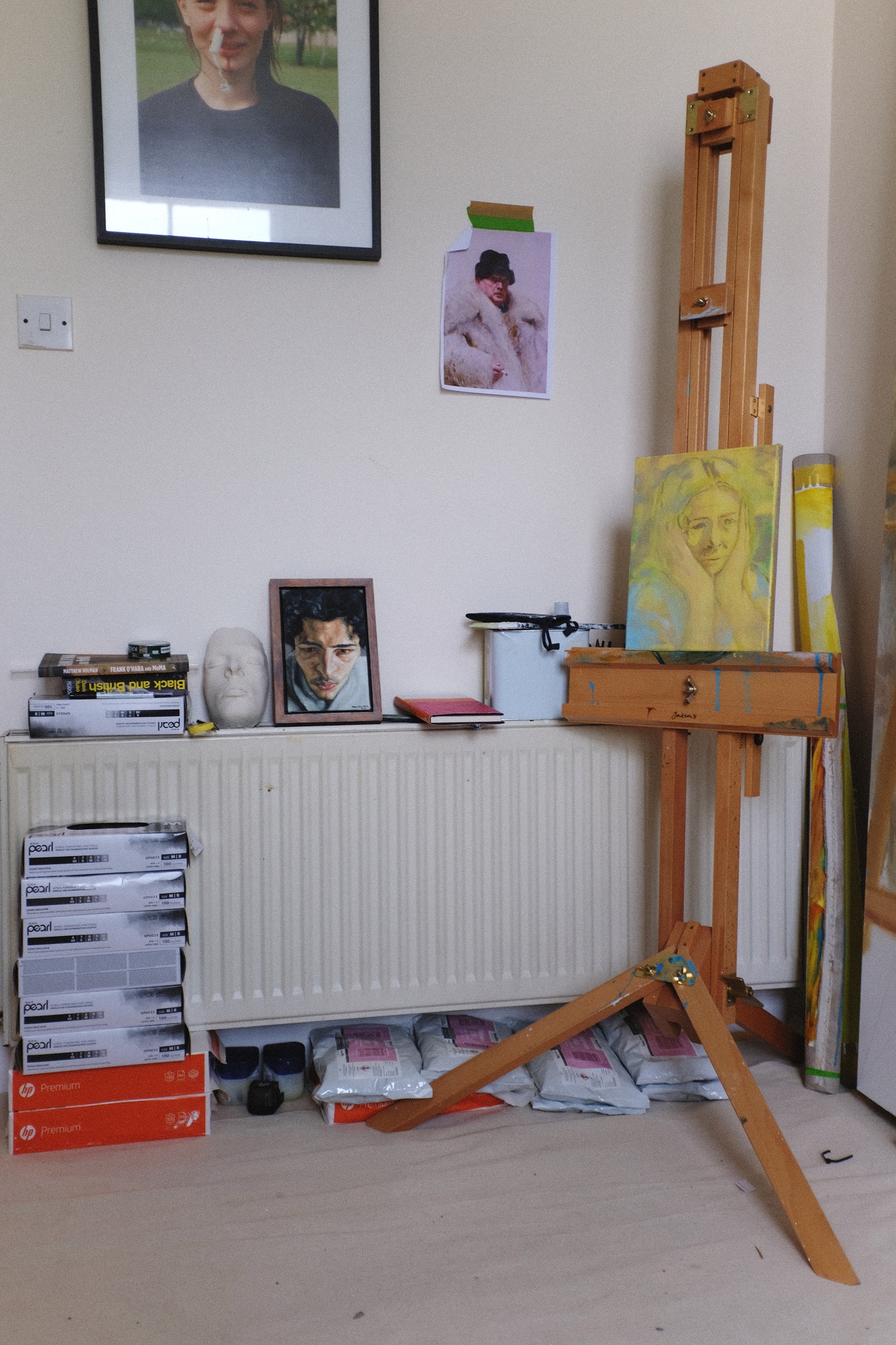
Noah Beyene’s studio, London, November 2026, courtesy the artist
MVP: What is your relationship with art history? There are images of Francisco Goya and Édouard Manet pinned up in your studio. Which artists or movements in art history do you feel are close to your practice or find inspiring?
NB: Art history is very central to my practice. It started because I’m obsessed with art, and it’s now become a tool for understanding the world. The term “art history” sounds like it contains a neat history of just art, but for me it’s increasingly just history. Art has influenced politics and politics has influenced art, and the artist’s ability to distil and make sense of what’s going on is a huge driving force for me. I pinned the Manet and Goya to my wall a few months ago, as once more we find ourselves in political unrest and uncertainty in many parts of the world. They became even more poignant when Pete Hegseth’s wish to livestream the firing squad execution of the Fort Hood shooter was approved by Donald Trump. It was shocking to think that the world’s most powerful nation state would want to make such a public show of strength. Goya’s The Third of May 1808 (1814) and Manet’s The Execution of Emperor Maximilian (1868–1869) both show a state placing people in front of a firing squad, and Manet borrowed his composition from Goya. Seeing an execution planned as a broadcast made them feel less like history and more like a warning. I don’t think there are specific movements I’m more drawn to. The artists and movements that speak loudest to me are the ones who have dealt with issues central to my thinking at any given time, as I imagine Manet was when he looked to Goya’s composition. I do have to admit, though, that Goya and Manet both hold a very special place in my heart. Goya went from court painter to making some of the most radically honest images denouncing the atrocities of war, and Manet’s ability to break with the expectations of painting, and so upset French polite society, fascinates me. What I take from them is a kind of permission: to use the skills I’ve been trained in to look directly at what power is doing.
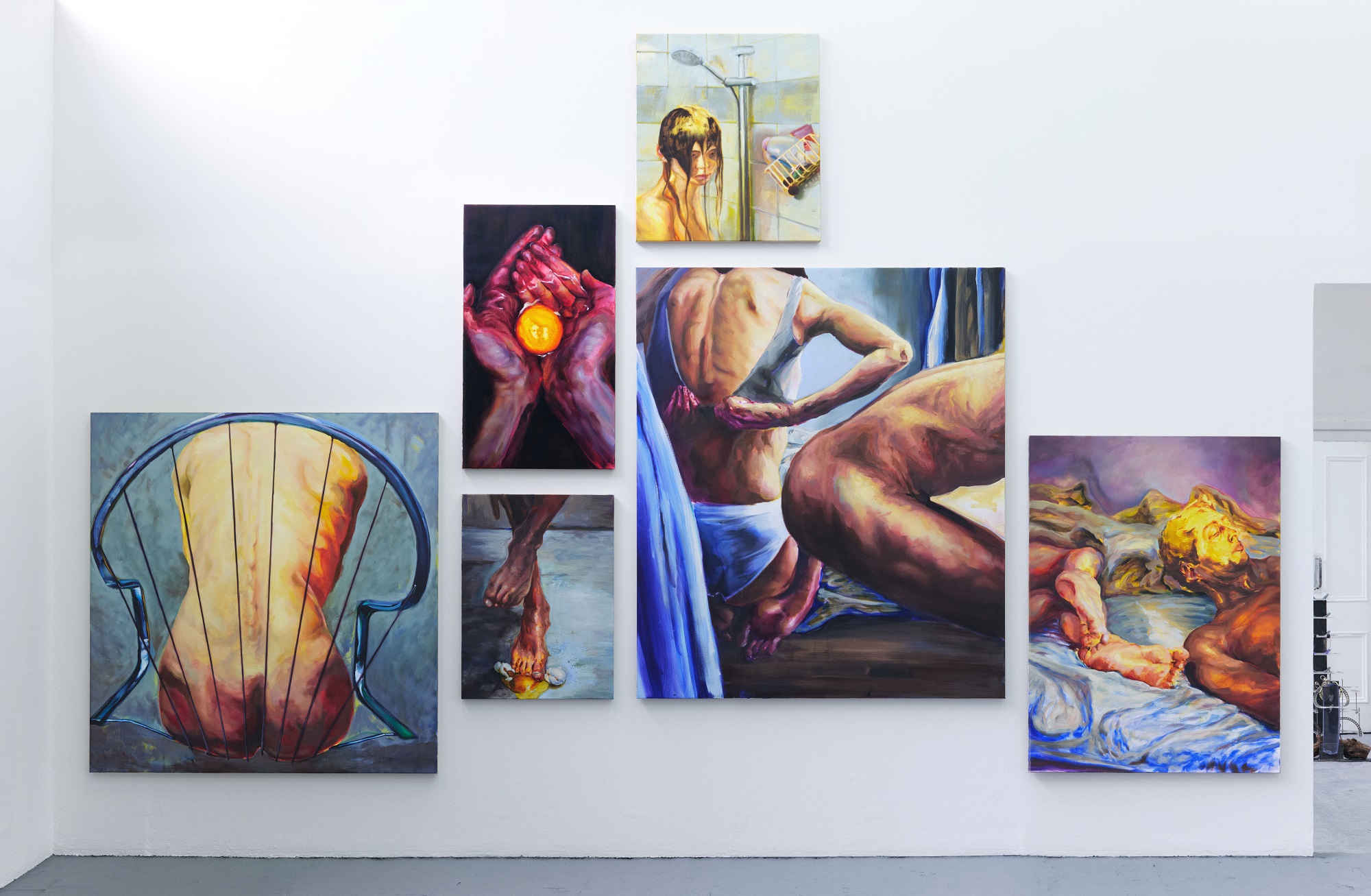
Noah Beyene, Slade Degree Show 2023, Slade School of Fine Art, University College London, London, June 2023, courtesy the artist
MVP: What does the physical space of painting represent to you? On several occasions, you have placed multiple canvases together, creating compositions resembling diptychs. How does this choice come about, and what kind of relationship do you seek to establish between the individual surfaces?
NB: Painting, and art-making more broadly, is a very natural way for me to communicate, more so than writing or speaking. I feel more able to get where I want to go. I can contain elements that might not seem connected to anyone else, but that are connected to me, by showing rather than telling. I like approaching my work as projects or shows, as it allows for prolonged thinking about subject matter, and about how to create dialogue between the works and the viewer.
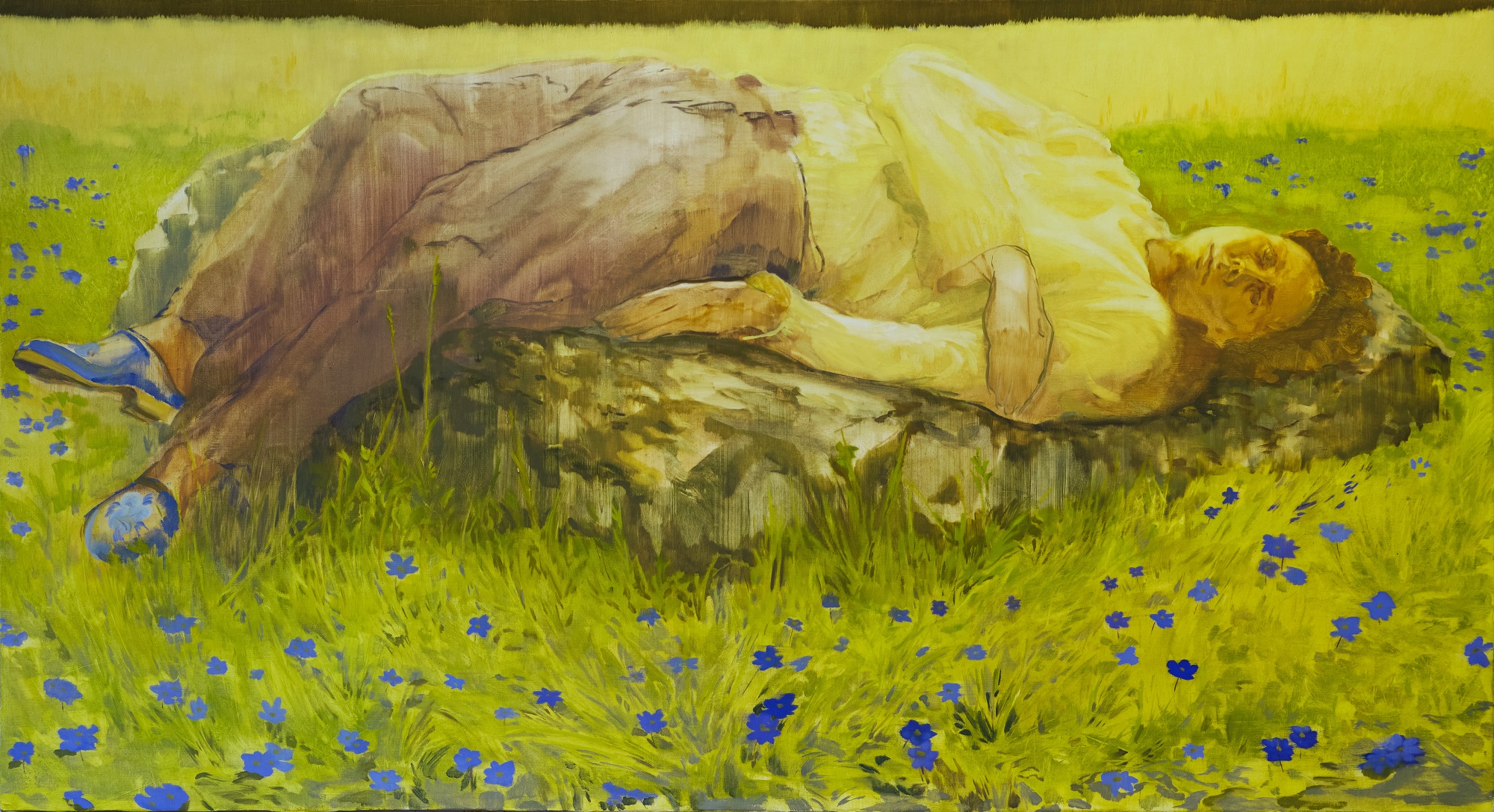
Noah Beyene, Sacrosanct Flowers, oil on linen, 2026, 98×180 cm, courtesy the artist
MVP: Looking back at your exhibitions and artistic research so far, what does painting mean to you today?
NB: It’s becoming clear that painting is a space to distill and interact with the world in a very meaningful way. I have high ambitions for my practice, but they relate to how I look at history and contemporary society, not to any superficial goals. It feels like a high-stakes arena where thoughts are weighed carefully. It remains a sacred space where things don’t have to be fully resolved, and that contradicts much of the speed and efficiency we’ve become so used to.
The interview was conducted in English; The introduction was translated to English by Dobrosława Nowak