


A Garden in Minor Keys
The Holy See Pavilion and a Few Lessons in Silence
Rachel Cecília de Oliveira and Flávia Virgínia from pó de crítica | 13/10/2026 | Originally published in Portuguese on 26 August 2026 at pó de crítica
Imagine a beautiful summer day, with a sky so blue it almost looks artificial and light so perfect it seems like a photo filter. Now add to that serene image an oppressive heat: heavy, humid, the kind that makes your clothes cling to your body within minutes of stepping outside. Sweat follows you everywhere, especially as you make your way on foot through the narrow streets, bridges, and passageways of a Venice overrun with tourists at the height of the European summer. Everything around you happens at once: people laugh, talk, stop abruptly to take pictures, drag children along behind them. Somewhere along the way is a train station. Looking for a few minutes of relief from the punishing sun, you decide to step inside and walk through it. The air is cooler; everything else intensifies. People arrive and leave, wheeling suitcases across the floor. Voices overlap in different languages, mixing with station announcements, the rattle of wheels, hurried footsteps, and the constant movement of trains pulling in and out of the platforms. After all, “the train that arrives is the same train that departs.”1 When you finally emerge from the station and meet the sun and heat again, you see an orange stone wall to your left. At the end of it, a gate. You walk through, and, as if by magic, everything changes scale, rhythm, and volume. It feels like entering a parallel world. A world imagined by Saint Teresa of Ávila.
That parallel world is one part of The Ear Is the Eye of the Soul, the Holy See Pavilion at the 2026 Venice Biennale, curated by Hans Ulrich Obrist and Ben Vickers. The exhibition unfolds across two sites.
At the Complesso di Santa Maria Ausiliatrice in Castello, it takes the form of a contemporary scriptorium, bringing together an archive, a library, and Alexander Kluge’s final work, from which the exhibition takes its title. Kluge died in March 2026, before seeing the exhibition installed. Like Koyo Kouoh, curator of the Biennale’s International Exhibition, he did not live to see the project completed.
The Giardino Mistico dei Carmelitani Scalzi (the Mystical Garden), by contrast, is the site where the exhibition unfolds primarily through sound. If the exhibition at Santa Maria Ausiliatrice is structured around reading, research, and memory, the Mystical Garden is built primarily through the body, movement, affect, and listening. It is this second experience that we want to pursue here.
Anyone entering the garden receives a pair of wireless headphones, a map, and the instruction that they have 50 minutes to make their way through it. Across the map are the names of artists whose practices and trajectories could hardly be more different. Their contributions are distributed throughout the garden in sound zones and spatial interventions that repeatedly overlap and bleed into one another. The visitor is therefore invited to move. This emphasis on movement is already embedded in the garden’s own conception. The Giardino Mistico is organized in dialogue with The Interior Castle, a book in which Saint Teresa of Ávila imagines the soul as a diamond-like castle composed of seven dwelling places, each corresponding to a stage in the journey toward union with God. The garden translates this spiritual architecture into a physical itinerary: its seven sections invite the body to move, step by step, through successive states of contemplation. The Ear Is the Eye of the Soul thus introduces a second itinerary into one that was already there. The spiritual journey imagined by Teresa and the sonic journey devised by Obrist, Vickers, and the participating artists begin to occupy the same paths.
The garden provides exactly the conditions Koyo Kouoh sought to create with In Minor Keys: slowness, attentiveness, inwardness, and a readiness to notice what is usually lost amid excess. It is no coincidence that Hans Ulrich Obrist and Ben Vickers conceived the Holy See Pavilion as a direct response to Kouoh’s proposition. But there is an important difference between aspiring to such states and actually producing them. Within In Minor Keys, with its 110 participants dispersed across an incomparably larger area, multiplicity often tips into accumulation. In the Mystical Garden, by contrast, 22 artists coexist within a relatively small space without generating the same sense of saturation. That is where the question guiding this text begins to emerge: why does something that remains a curatorial utopia in Kouoh’s exhibition here seem to become a concrete experience? Our hypothesis is that the difference lies less in the amount of stimulation than in how multiplicity is organized and made available to our attention. The number of voices may remain high, while the relations between them, and the demands they place on us as viewers or listeners, change entirely.
That difference, however, cannot simply be attributed to the fact that the exhibition takes place in a garden. Replacing a conventional exhibition space with a quiet environment does not automatically slow us down. How many gardens, churches, or other ostensibly peaceful places have we entered without experiencing any change in the rhythm of our attention? Our phones continue to demand our attention; our minds continue operating across several channels at once; our bodies may be present in a space while some part of us remains caught in the profusion outside. In The Ear Is the Eye of the Soul, tranquility comes from how the experience rearranges our relationship to time, movement, and the stimuli encountered along the way. The garden, then, works with the artists to create an experience of pause, deceleration, and release.
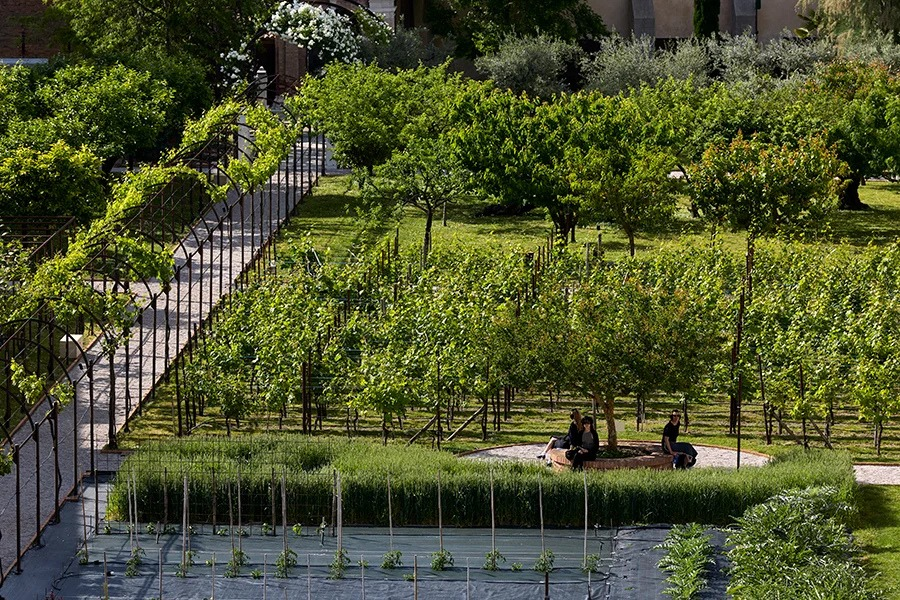
The Ear Is the Eye of the Soul, Mystical Garden, 2026. Courtesy of the Holy See Pavilion. Photograph: David Levene
That rearrangement becomes clearer once we begin to move through the garden. The map may tell us where each contribution is located, but it cannot tell us what we are about to experience. Neither can the garden itself. From the entrance, we can see much of it: the paths, flowerbeds, trees, and other visitors moving through the space. Almost nothing in that tranquil landscape, however, allows us to anticipate what will happen once we begin walking with the headphones on. The garden we see and the garden we experience through the exhibition are strangely different places. Without the headphones, there is gravel crunching underfoot, cicadas sounding almost furiously in the summer heat, voices occasionally crossing the paths, and the muted presence of other bodies wandering through the same space. All of this continues to exist once the exhibition begins, yet much of it recedes from attention. The headphones introduce another acoustic layer, one that changes as we move and gradually reorganizes what reaches us. The Giardino Mistico is already beautiful, modest, calming, and reassuring in its simplicity. But those qualities account for only part of what happens in The Ear Is the Eye of the Soul. The exhibition alters the terms through which the garden is perceived, making it feel like an entirely different place.
That is because, despite being in a visually seductive and comforting environment, sight does not organize the experience. The sensory faculty so disproportionately privileged by the Western tradition is, for the duration of the visit., pushed into the background. The map may tell you that a contribution by Brian Eno lies somewhere ahead. It may even tell you which part of the garden it occupies. But you cannot experience it in advance. Until you physically cross into the sound zone that activates the work, it remains only a name on the map, a possibility rather than an experience. Unlike a painting or sculpture that gradually enters your field of vision as you approach it, the sound in this exhibition does not announce itself from a distance. It comes into being for you only when your body reaches the place from which it can be heard. So, you must walk. And it is precisely the movement that organizes everything sight alone cannot anticipate. It determines the succession of sounds, creates encounters between different contributions, and ensures that no two routes are quite the same. This relationship between body and sound is sustained by a sophisticated technological infrastructure in which the audio responds in real time to your position in space, allowing different sonic worlds to emerge, disappear, and merge as you move.
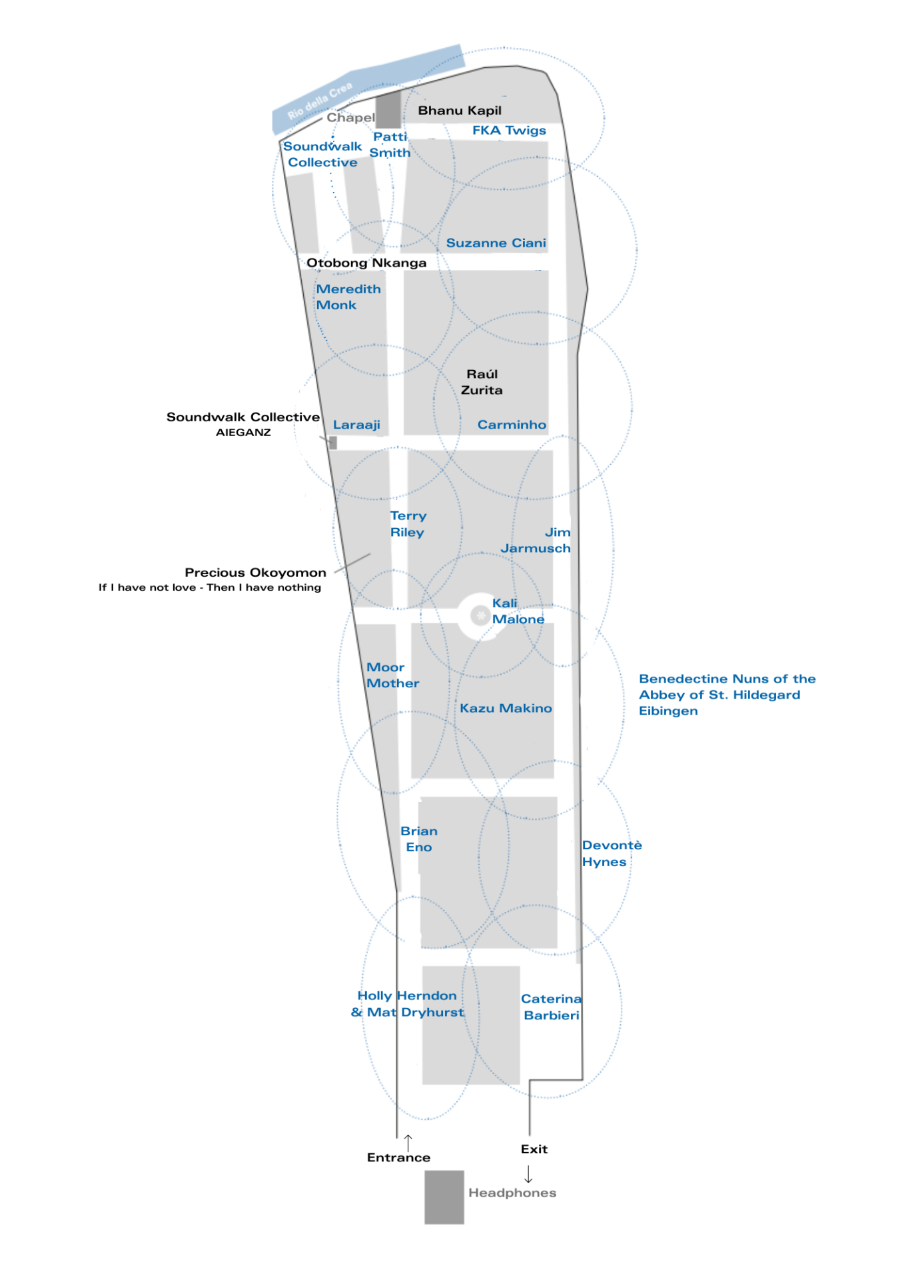
Map of the soundzones in the Mystical Garden
The installation uses an interactive 3D spatial-audio system combined with short-range wireless communication technology operating at high frequencies and across a wide bandwidth, along with a form of spatial audio that tracks both the rotation of the listener’s head (3DoF) and their physical position in space. Roughly sixty antennas are distributed throughout the garden. Almost all of this engineering remains invisible. What we perceive are its effects. A few steps may bring a voice closer, make a piece of music disappear, or let two artists occupy the same sonic space without competing for the few moments it takes you to cross a transition zone. Sometimes you retrace your steps because you sense that you have left something behind. Sometimes you change direction, drawn by an unexpected sound that seems to compose itself almost perfectly with the scene before you. At other times, you stop because you do not want to interrupt or alter what you are hearing. And sometimes you move precisely in order to encounter other visual and sonic compositions. Visual, because the garden itself embeds the works of visual artists. And then there are the garden’s smells and the atmosphere of the place, which also pass through the experience.
The exhibition therefore has no fixed internal sequence, no predetermined duration, and no fixed internal logic like the one established when we press play on a piece of music. Each person makes their own way through it, spending more or less time in each zone and encountering the garden and the works within it in different proportions. The exhibition map renders this with remarkable precision: circles overlap along the route, creating areas in which one composition begins before another has ended. There are no frames, no exact divisions between one work and the next, or, for that matter, between the work and the world.
At this point, the exhibition becomes more complicated because this interpenetration is far from producing consensus. Writing in Frieze, Vanessa Peterson emphasizes the way different contributions blend into one another as we walk, describing the result as deeply atmospheric and moving.2 At the opposite extreme, the essay “Death in Venice,” published in The Manhattan Art Review, recounts an experience that is hardly immersive and at times almost irritating, in which moving from one sound zone to another produces a kind of disjointed spatial playlist. The spiritual tones become generic, while the technological sophistication begins to overwhelm the relationship between music and garden.
It’s interesting that both critics are responding to the same formal decision. What Peterson reads as one contribution dissolving into another, the author at The Manhattan Art Review3 experiences as a loss of differentiation. The question, then, is what happens to authorship and to the distinctions between such different practices when Soundwalk Collective, responsible for composing the sound zones and immersive experience, draws them into a shared spatial composition. The procedure can certainly be understood as a dilution of singularities. But it is also worth asking whether continuing to demand that each contribution present itself as clearly bounded and immediately recognizable would not amount to imposing on the exhibition precisely the logic it seems intent on suspending.
This question becomes even more complicated because these zones of interpenetration are more than spaces between works: they become part of the work itself. Soundwalk Collective has also built an instrument that “listens” to the garden in real time, transforming the micro-acoustics of wind, water, insects, and soil, alongside other signals captured on site, into a composition in a constant state of change. We, the visitors, and the garden itself therefore also participate in what we hear.
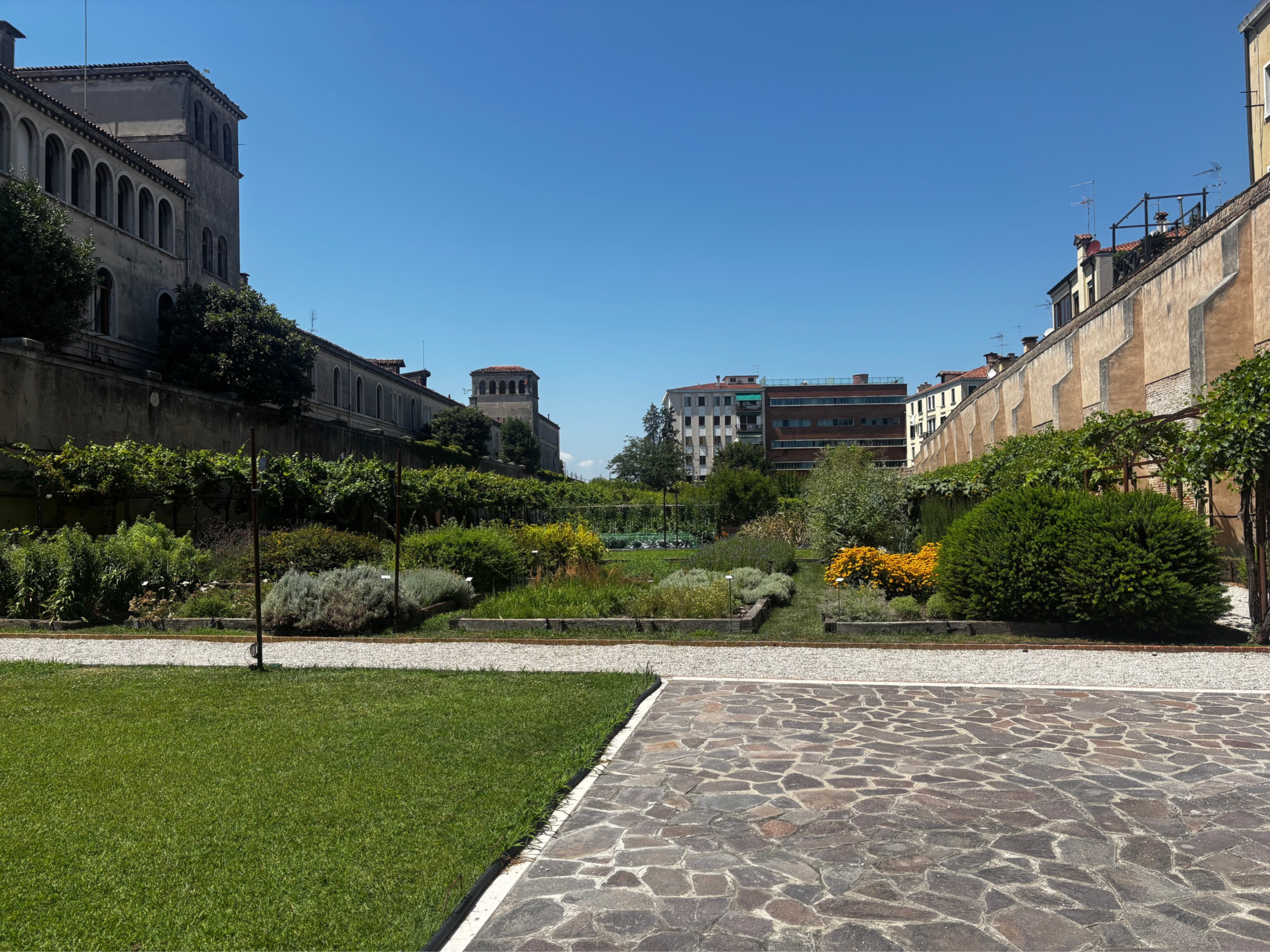
Photograph of the garden taken by the authors
Sounds coexist and pass through one another without requiring one to cancel out the next, spatially reorganizing our expectations. The experience becomes relational: it happens between the garden, the other people moving through it, what reaches us through the headphones, and what each of us produces inwardly in response to what we hear. The Ear Is the Eye of the Soul seems to be structured precisely around passages between different states of attention, which shift as we move through the Mystical Garden. In this sense, its relationship with Saint Teresa of Ávila extends beyond the correspondence between the garden’s seven rooms and the seven dwelling places of The Interior Castle. Teresa turns to the image of the castle to make a journey that cannot be seen imaginable. Through imagination, the soul becomes capable of conceiving its own spaces, passing through them, and orienting itself toward something that remains invisible.
Something similar happens in the garden. We cannot see the next work. We cannot entirely anticipate what we will hear, nor can we see the relationships about to form between sounds. Imagination fills the interval between what reaches the ears and what is absent from the eyes. Little by little, it occupies the space previously taken up by the noise of the world and, together with the sound entering through the headphones, gathers our attention, gives form to what we cannot see, and directs our movement through the garden. As in Teresa’s castle, moving forward through the garden is also moving through an experience constructed within the person who walks it. That is what The Ear Is the Eye of the Soul manages to do. The exhibition does not create silence, nor does it necessarily reduce the number of events taking place. It changes what can reach us, and the way each thing competes for our attention. If Koyo Kouoh imagined a Biennale capable of existing in minor keys, then in the Mystical Garden Obrist, Vickers, and Soundwalk Collective seem to have understood that what was needed was a way for different voices to coexist without all of them having to shout to be heard.
When we stepped back through the same gate by which we had entered, Venice was exactly where we had left it. The heat was still oppressive, the station still crowded, suitcases still rolling across the floor, trains still arriving and departing, people still talking, crossing paths, filling every available space. Nothing around us had become quieter, and yet we had experienced a calm that was difficult to explain. Perhaps because, after almost an hour of learning to walk differently, to listen to what appeared and disappeared, and to sustain our attention without trying to master everything at once, noise itself reached us differently.
This is where The Ear Is the Eye of the Soul seems most fully to realize what In Minor Keys set out to do. Silence was never present in the garden as an absence of sound. It lay instead in a transformation of our capacity to receive sound. When we crossed the station again, amid the voices, the wheels of suitcases, and the movement of trains, the exhibition was already behind us and, at the same time, still taking place. Perhaps a genuinely transformative experience is precisely one that ends within the exhibition space and yet continues, for a while, to rearrange the way the world reaches us.
Edited in English by Dobroslawa Nowak
Bibliography:
1 Reference to Encontros e Despedidas (1985), by Milton Nascimento and Fernando Brant, a widely known Brazilian song.
2 Vanessa Peterson, “Off-Site Exhibitions Review: The Politics of Listening,” Frieze, 8 May 2026. https://www.frieze.com/article/venice-biennale-2026-off-site-exhibitions-review.
3 “Death in Venice,” The Manhattan Art Review, 7 July 2026. https://manhattanartreview.substack.com/p/death-in-venice