


Chimera
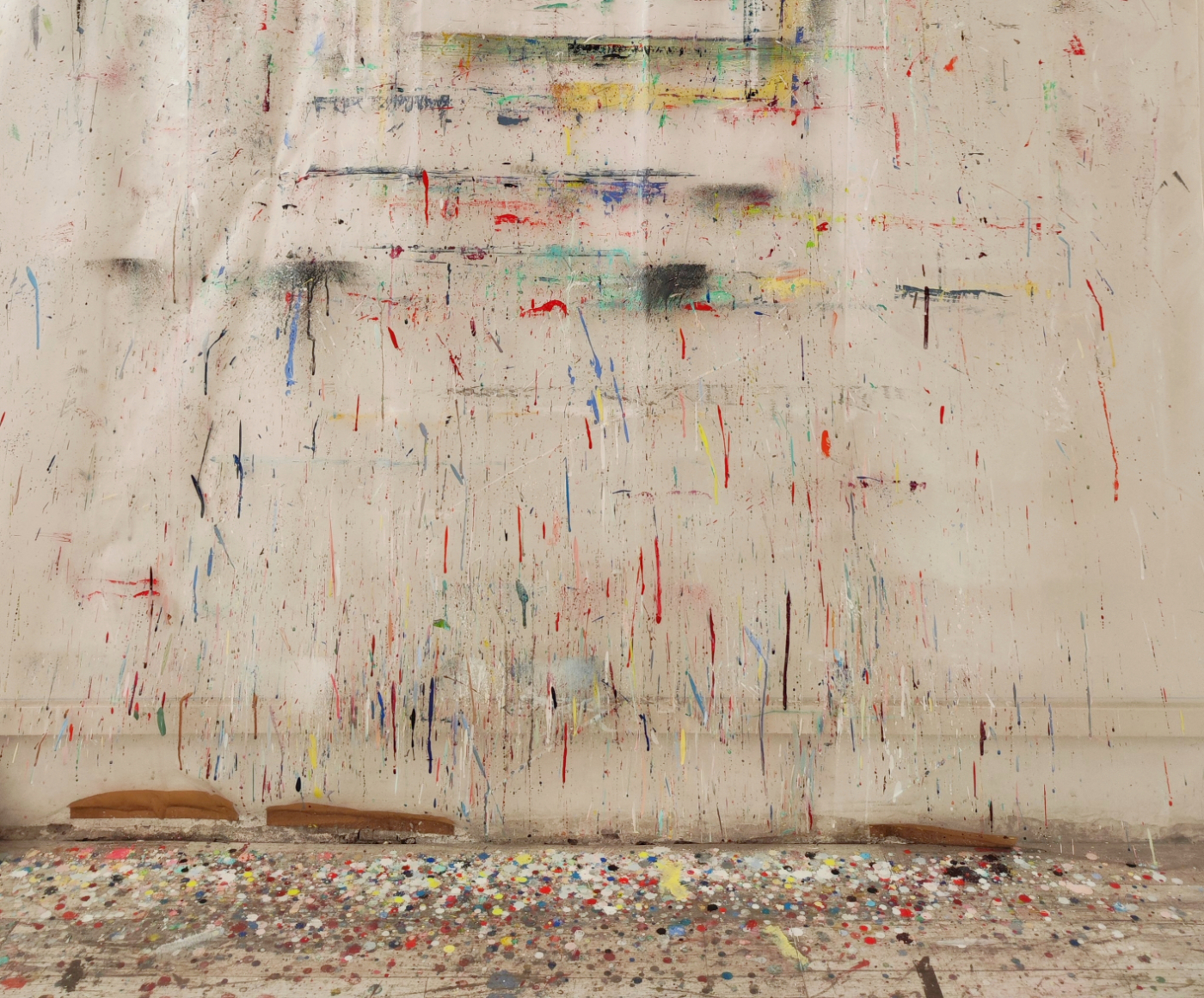
Galleria Tiziana Di Caro is glad to present Chimera, Stanislao Di Giugno’s third solo exhibition at its venue in Piazzetta Nilo 7, Naples.
Figuratively speaking, a chimera indicates an illusionary idea, wish, or project that is extremely difficult to realize. This figurative usage derives from the chimera of mythology, a mythical monster made of parts from different animals, symbolizing something imaginary and unreal.
At first glance, many might think of an “illusion” or an “impossible dream.” The exhibition, however, aims to highlight the chimera’s nature as being composed of heterogeneous elements: different pictorial languages that, rather than repelling one another, find a balance. Here, the chimera is not a symbol of the unattainable, but of coexistence. Fragments of different pictorial languages meet, clash, and ultimately find a shared form, giving life to coherent visual organisms.
An abstract body of work built on the encounter of stylistically different elements.
The exhibition will also feature bronze sculptures created by joining together small, randomly found and collected car parts—for instance, two wing mirrors from different cars fused together. In this case, the chimera sculptures render the concept almost literal: they are organisms built from the union of parts originating from different “bodies.” It is not a random collage, but the birth of a new identity.
There is a very strong thread connecting the two mediums, paintings and sculptures. Both speak of hybridization, transformation, and coexistence.
The fact that the parts come from automobiles adds an additional layer of interpretation. The viewer recognizes individual elements, but their original function has vanished: they become autonomous forms. It is a process close to the assemblages I created in past years, but the bronze casting makes the object definitive—the parts no longer belong to their original categories, but rather it is as though this new creature had always existed.
The chimera is a form born from the convergence of heterogeneous elements. It is not the sum of its parts, but a new organism whose identity emerges precisely from the coexistence of differences.
Each work is a balance between recognizability and transformation, memory and invention. The exhibition explores the moment when that which belonged to different systems ceases to be a fragment and becomes a unified presence. Here, the chimera is not a symbol of the impossible, but proof that seemingly incompatible elements can generate a new coherence.
Stanislao Di Giugno (Rome, 1969) is an Italian multidisciplinary artist whose practice focuses on the expressive possibilities of abstract painting. Through essential geometric structures and a refined chromatic research, his works investigate the perception of space, light, and formal balance. Far from any narrative intent, his painting builds an autonomous language in which compositional rigor and the sensitive quality of the surface are in constant dialogue, transforming geometry into an open, dynamic perceptual experience.
His research develops through a constant reduction of visual elements. Each painting is conceived as a space for contemplation, in which geometric order is not imposed as a closed system, but rather offered as a possibility for perception and experience. The result is an essential, silent painting capable of combining constructive precision, visual depth, and chromatic intensity. His work has been presented in institutional exhibitions and private galleries, including MACRO Rome, the Galleria Nazionale d’Arte Moderna e Contemporanea in Rome, Triennale Milano, the Italian Cultural Institute and the Hammer Museum in Los Angeles, and the American Academy in Rome. He has also participated in international residencies such as Art Omi in Ghent (New York) and the Sammlung Lenikus residency in Vienna. He is represented by Galleria Tiziana Di Caro, Naples.