


The Venice Biennale and the Banality of Virtue
By Nicola Bigliardi
17.07.2026
Among the authors selected through the open call for critical essays on the 61st Venice Biennale.
The Venice Biennale continues to occupy a singular position within the contemporary art system. While events such as Art Basel are primarily responsible for determining the price of artworks, Venice continues to shape their symbolic value, for it is here that decisions are made about which practices deserve to be regarded as necessary, which artistic languages are authorized to represent their historical moment, and which images may aspire to enter history. Of course, these two functions coincide far more often than the art world prefers to admit: institutional prestige generates economic value, and economic value, in turn, reinforces institutional prestige. It is a perfectly functioning circuit that, like all perfectly functioning circuits, ultimately comes to appear natural.
As will become clear, over the past fifteen years this mechanism has taken on an increasingly recognizable character. The quality of an artwork seems to depend less and less on its ability to invent new visual languages, reshape established ways of seeing, and create images capable of outlasting their own historical moment. In its place, another criterion has gradually emerged as equally decisive: that the work makes its moral position immediately legible. In other words, it is no longer enough for an artwork to be formally and artistically compelling; it must also be ethically transparent. The current edition, titled In Minor Keys, offers clear evidence of this shift.
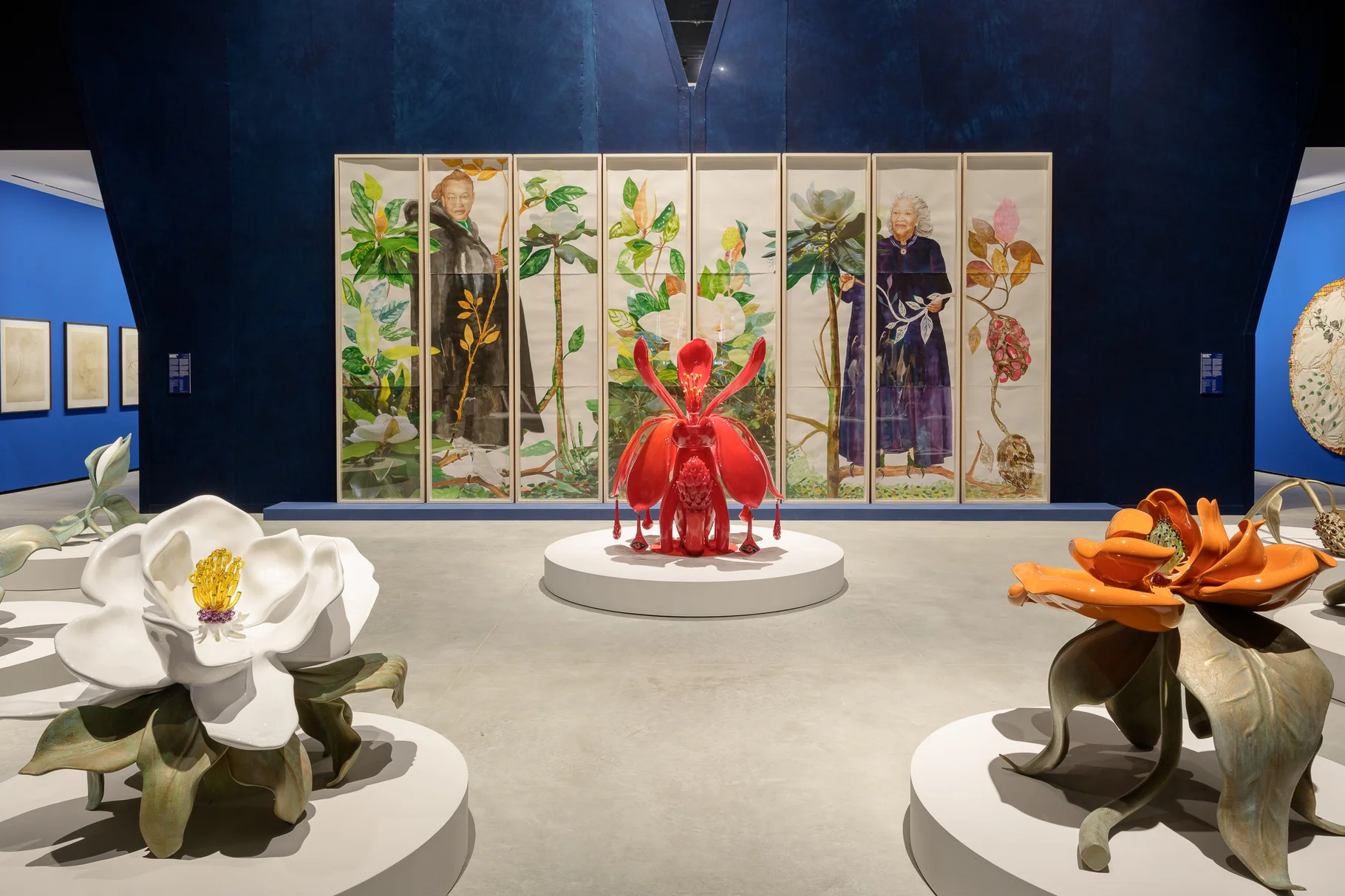
Èric Baudelaire, installation view of Death Passed My Way and Stuck This Flower in My Mouth (2026), at the 61st International Art Exhibition – La Biennale di Venezia, In Minor Keys. Photo: Luca Zambelli Bais. Courtesy of La Biennale di Venezia.
I. A Morally Transparent Biennale
Colonialism, migration, the climate crisis, identity, inclusion, memory, care: these are arguably the defining concerns of our time, and it would be surprising if contemporary art ignored them. The issue, however, is not the subjects themselves but the stance artworks adopt toward them. Increasingly, what the art system recognizes and rewards is not the quality of artistic inquiry but the clarity with which a work makes its moral position visible—responsible, inclusive, democratic, engaged. It is as though an implicit ethical repertoire now exists, one to which every artist is expected, more or less explicitly, to subscribe.
Those who do not identify with it are readily dismissed as reactionary, anachronistic, provincial, or nostalgic; at times even as fascist—or, in ideologically opposed, and sometimes even overlapping, contexts, communist. The labels shift with remarkable flexibility, but the underlying logic remains the same: what matters is that every artwork clearly signals where it stands. The result is the impression that the art system asks artists less and less to produce unexpected, unconventional, independent, or radical images, and increasingly to occupy a recognizable position within a shared ethical horizon.
The artist thus comes to resemble a priestly figure in a religion without transcendence: bearing witness to values, denouncing injustice, and dispensing symbolic responsibilities.
Research into language, medium, visual structure, and the perceptual and cognitive dimensions of the image certainly persists, but when it does, it often survives only as a secondary concern. If these questions may still matter to artists, they are increasingly dismissed by critics and curators alike as relics of twentieth-century modernism—”something out of the 1950s.”
This ethical turn1 now permeates the principal mechanisms through which contemporary art is legitimized, producing similar effects across institutions. Political urgency becomes a curatorial style, trauma is transformed into an international grammar, and critique itself assumes the contours of a readily recognizable code.
Artworks address war, exploitation, racism, inequality, and ecological collapse. Yet the exhibition dispositif subsumes them within a narrative that pre-emptively neutralizes every point of friction, compelling the viewer to take the “right” side.
In this way, radicality becomes an aesthetic convention, while indignation is elevated to a curatorial category.
It is perhaps here that the current Biennale reveals its most interesting contradiction. When every artwork takes a position, every exhibition proclaims its ethical responsibility, and every institution asserts its democratic commitment, critique risks becoming the most sophisticated cultural vehicle of consent.
It is in this sense that Giorgio Agamben’s expression, “the hypocritical mask of the good democratic citizen,”2 becomes relevant: a subjectivity that recognizes itself in the values of democracy, responsibility, and civic engagement, yet through precisely this identification renders acceptable the very dispositifs that orient and govern its experience. Critique is not censored; on the contrary, it is anticipated, encouraged, and ultimately absorbed into the system’s own functioning. As Gilles Lipovetsky and Jean Serroy have argued in relation to the aestheticization of the world, critique itself can be transformed into a culturally desirable experience, perfectly integrated into the mechanisms of symbolic production.
At times, the Biennale seems to offer precisely this: not the experience of conflict but its culturally legitimized representation; not the risk of critique but the opportunity to recognize oneself as an ethically conscious spectator. The question, then, is not what the artworks say, whether this is a successful edition, or even whether it contains compelling works. I believe the Venice Biennale is always worth visiting: it remains an indispensable update on the directions, tendencies, and, ultimately, the fashions shaping contemporary art. The real question is another: what are these works doing here? What function do they serve within the dispositif that renders them visible? This is the question I want to begin with.
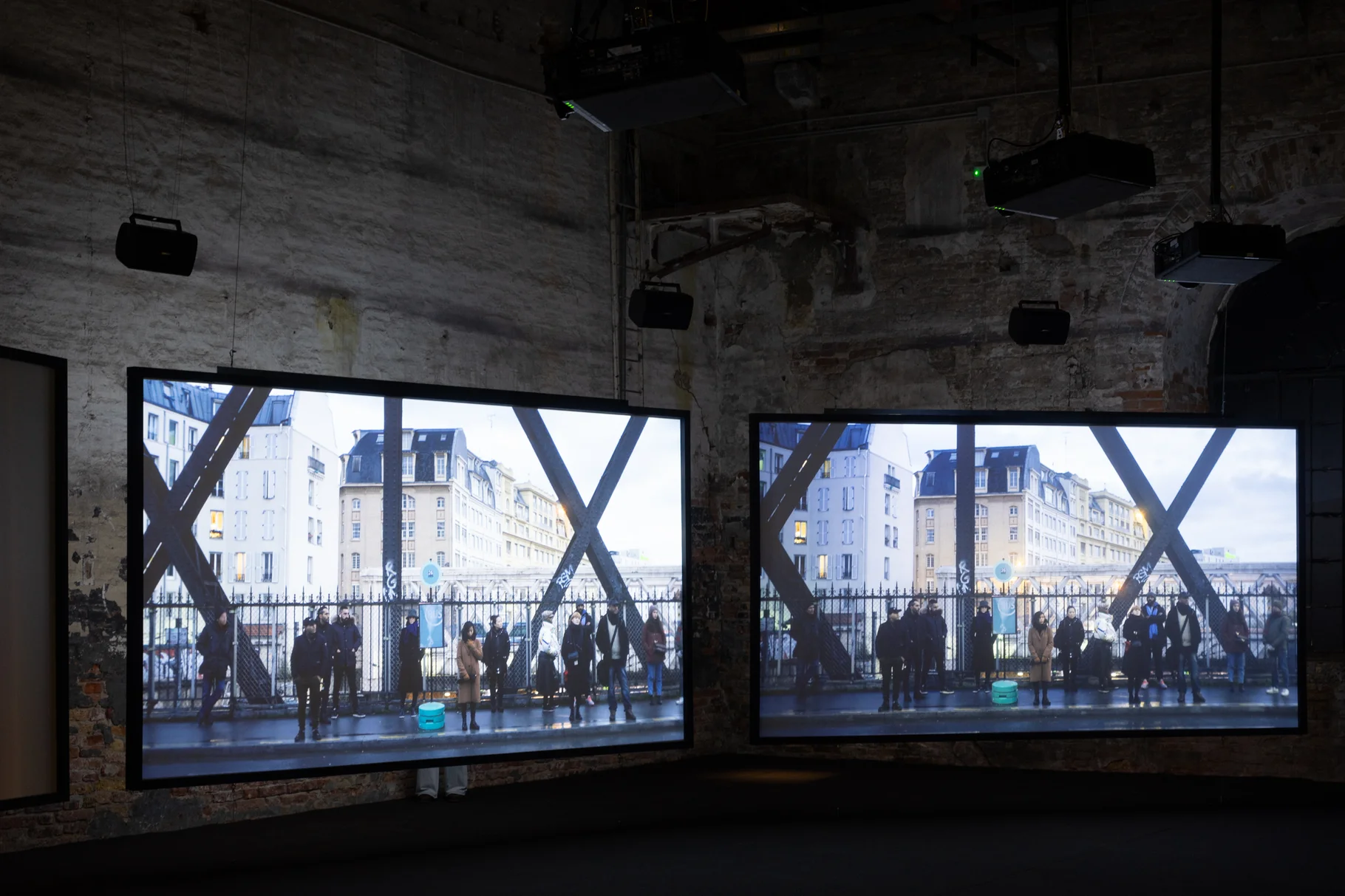
Èric Baudelaire, installation view of Death Passed My Way and Stuck This Flower in My Mouth (2026), at the 61st International Art Exhibition – La Biennale di Venezia, In Minor Keys. Photo: Luca Zambelli Bais. Courtesy of La Biennale di Venezia.
II. In Major Keys
There is something revealing about the fact that the most frenetic international exhibition in the art world has decided, this year, to teach a lesson in slowness.
Slowness has become the fastest-moving cliché in the curatorial lexicon. The priesthood of reflection continues to multiply, officiating over a cult in which the artwork can no longer simply exist: it must arrest us, slow us down, interrogate us, preferably educate us, but above all provoke reflection! As though art’s task were to serve as a spiritual rest stop along the highway of contemporaneity. Yet the more the system accelerates the production of exhibitions, biennials, events, and images, the more insistently it preaches suspension. The contradiction is almost elegant: acceleration produces nostalgia for slowness and, with remarkable efficiency, turns it into yet another commodity to be distributed. Slowing down itself is thus folded into the logic of performance, becoming one more imperative to consume.
In Minor Keys, the 61st International Art Exhibition curated by the late Koyo Kouoh, is built around a vocabulary that has by now become familiar: care, healing, listening, repair, commoning, relation. The catalogue invites visitors to step outside the time of performance, lower the volume of the present, and attune themselves to the quieter frequencies of the “minor keys.” It is striking that this celebration of slowness comes from the most accelerated exhibitionary machine in contemporary art. One enters in order to slow down and instead finds oneself consulting the map like a railway timetable, standing in endless lines for a sandwich, calculating the hours remaining, queueing for performances or for the edition’s most Instagrammable national pavilions, rushing to catch the last one before closing time, then standing in line again for the toilets. In short, standing in line.
Between maps, queues, photographs, and hundreds of artworks compressed into a few hours, every pause becomes a missed opportunity, and every moment of contemplation—assuming contemplation is even possible under such conditions—a delay. The Biennale promises silence, attentiveness, and listening, yet, with its customary efficiency, it organizes an experience founded on frenzy, accumulation, and the hyperexposure of images. It would be more interesting, I think, to reverse the paradigm and reflect on this very specificity of the Biennale itself: to be more realistic and concrete, rather than retreating into an ideal as noble as it is rhetorical.
The overall impression is that of an infinite scroll translated into physical space: instead of scrolling through a feed, one moves from pavilion to pavilion; instead of accumulating content, one accumulates artworks. The medium changes, but not the logic governing the gaze. The much-celebrated contemplative gaze, or the slowness it supposedly requires, is hardly something one can achieve while riding a carousel—let alone while standing in line.
This is where In Minor Keys finds its natural culmination in the previous editions. It does not inaugurate a new phase so much as bring to completion a transformation that has been reshaping major international exhibitions for years. The Biennale has gradually refined a rhetoric of urgency in which the legitimacy of the artwork increasingly depends on its ethical recognizability. Artistic value now tends to arrive already accompanied by its own certificate of moral legitimacy. The major issues of the present occupy centre stage not simply because they are urgent, but because they constitute the language through which the art system legitimizes itself.
Kouoh has stated that she wanted to create an exhibition “more sensory than didactic,” distancing herself from the “litany of commentary on world events.” The intention is difficult to dispute. Yet something curious happens. Even as the exhibition rejects pedagogy, it constructs one of the most pervasive interpretive dispositifs of recent years. Before even encountering the artworks, visitors first come across the vocabulary through which they are expected to read them, followed immediately by wall texts that seem less concerned with describing the works than with guaranteeing their proper moral orientation. The images are interpreted in advance, in the “correct” way. It is precisely through this discreet pedagogy of the gaze that the contemporary Biennale reveals how it operates.
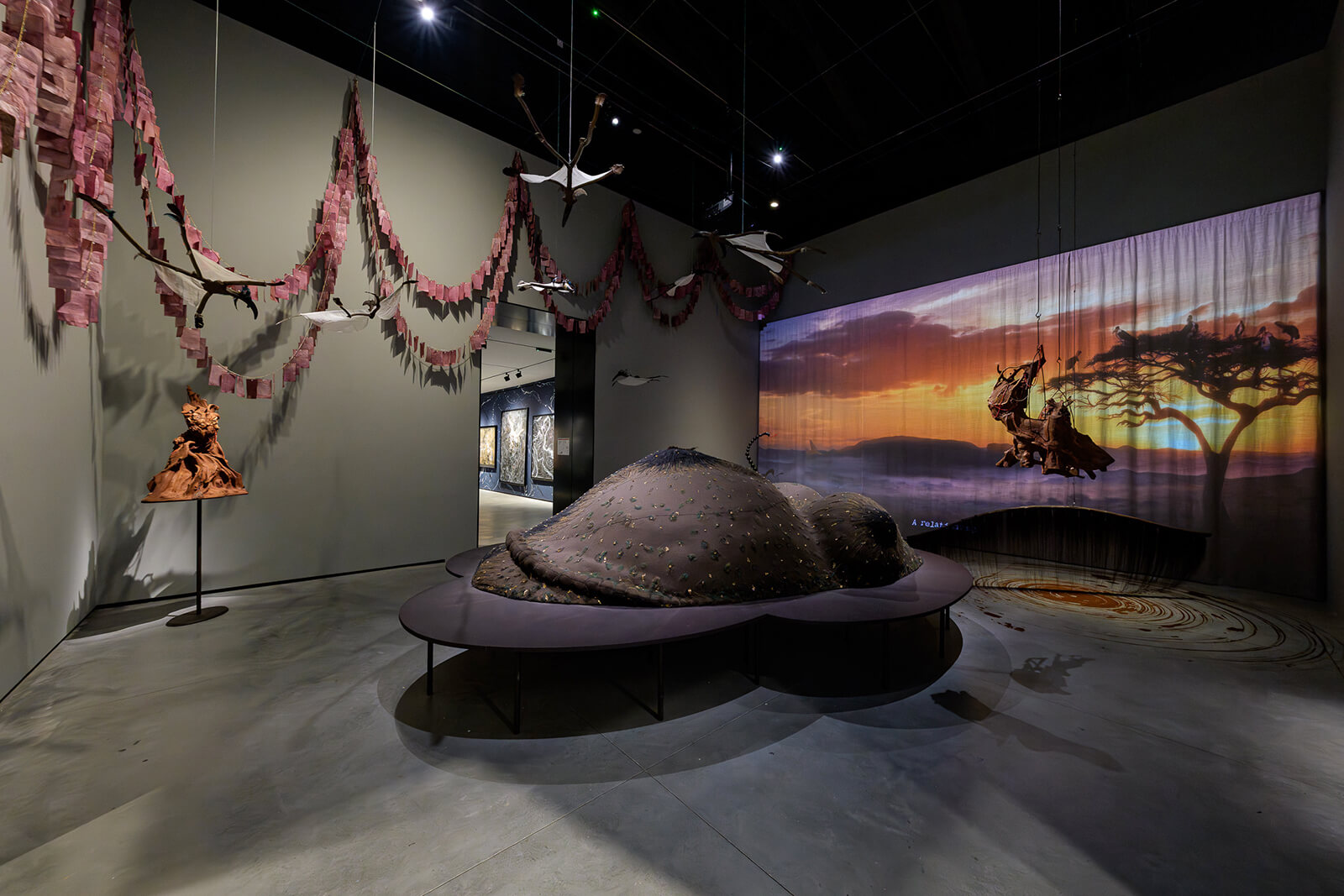
Installation view of Wangechi Mutu’s MothersMound (centre) and the video installation Mumbi, In Minor Keys, Venice Biennale, 2026. Image: Andrea Avezzù. Courtesy of La Biennale di Venezia.
III. Aesth-ethics of Virtue
For well over a century, Venice has been the place where the art world periodically looks itself in the mirror and decides what face it wishes to present to the world. Every Biennale tells us something about art; more importantly, it determines which art is deemed worthy of being told.
Established at the end of the nineteenth century as an exhibition of nations, the Biennale initially reflected the geopolitical balance of its time. The national pavilions that gradually populated the Giardini functioned as embassies without diplomats: they spoke through paintings and sculptures, measuring the prestige of states more than that of artists. Art still served as a banner in the nineteenth-century sense, hoisted alongside the national flag.
The postwar period following the Second World War radically transformed this symbolic geography. The 1948 Biennale reopened Italy to international debate after the years of Fascism and, alongside the retrospective devoted to Picasso, presented Peggy Guggenheim’s collection, offering European audiences their first systematic encounter with the artists who would redefine the language of American art. Pollock, Rothko, de Kooning, and Gorky represented more than the arrival of a new aesthetic season. In the wake of the United States’ victory in the Second World War, their work also heralded the gradual shift of cultural hegemony from Paris to New York.
That transition found its symbolic consecration in 1964, when Robert Rauschenberg became the first American artist to receive the Biennale’s Grand Prize. As Frances Stonor Saunders has shown in The Cultural Cold War, that victory must be understood within the broader framework of American cultural diplomacy during the Cold War, in which contemporary art itself became an instrument of political competition. Venice thus ceased to be merely the place where the balance of power within the art world was observed; it became one of the mechanisms through which that balance was constructed, legitimized, and ultimately made visible.
The upheavals of 1968 interrupted this apparent continuity. For the first time, it was no longer only the artworks that were subject to judgment, but the institution that housed them. The Biennale itself became the object of protest. Its ties to political power, the market, and the structures of cultural representation came under attack. From that moment onward, its task was no longer simply to determine which artists deserved visibility, but also to demonstrate its capacity to respond to the questions that society posed to its institutions.
The next decisive turn came with Harald Szeemann. Beginning in 1999, the International Exhibition ceased merely to coexist with the national pavilions and instead came to symbolically dominate them. The nations remained, but they were no longer the primary narrative. In their place emerged a sweeping curatorial vision capable of traversing continents, identities, and artistic genealogies. The Biennale was no longer a collection of countries; it became a worldview. The pavilions continued to exist, but they came to be read through the lens of the overarching curatorial narrative.
The most recent shift is also, perhaps, the quietest. With Okwui Enwezor’s Biennale in 2015, the exhibition definitively ceased to treat art as its privileged object of inquiry and instead embraced the social world as its true protagonist. Global capitalism, colonialism, migration, the climate crisis, identity politics, systemic violence, and decolonization no longer functioned merely as subjects addressed by artists; they became the very architecture of the exhibition, the conceptual framework within which works of art were expected to situate themselves.
Naturally, there is nothing scandalous about this. It would be difficult to imagine a Biennale that ignored the defining issues of our time. Frankly, the opposite would be cause for concern. The problem is that these themes now seem to arrive at the exhibition with their moral toolkit already included: the artwork is free to say many things, provided it is clear from the outset which side it is on.
The editions that followed the 2015 Biennale have done little more than modulate that same score. Christine Macel restored centrality to the figure of the artist; Ralph Rugoff emphasized the ambiguity of images; Cecilia Alemani expanded the horizon toward the posthuman and the realm of imagination; Adriano Pedrosa rewrote the history of art through a decolonial perspective; finally, Koyo Kouoh replaced the language of denunciation with that of care, listening, and repair. The accents change, but not the music: the repertoire is renewed, while the ethical key remains the same.
This is where the decisive transformation took place. It does not concern artists, nor artworks. It concerns the way they acquire authority. An ethical judgment has gradually come to stand alongside aesthetic judgment, until the two have become indistinguishable. A work is expected to be formally compelling, but also morally legible: it must make injustices visible, assume responsibility, and occupy a position within the political landscape of the present.
One might call this, without any particular malice, an aesthetics of virtue. This does not mean that formal research has disappeared, nor that artists have ceased to experiment. Rather, it means that institutional recognition increasingly passes through a shared moral legibility. A good work remains a good work; but it is also, with increasing frequency, a work that says the right thing at the right moment to the people who consider themselves to be on the right side. The work no longer asks the viewer to question their own position in the world, but rather to inhabit it consciously.
This is where the issue becomes interesting. Not because the causes supported by the Biennale are questionable. On the contrary: precisely because they are difficult to contest, it is worth asking what happens to a work when its critical force perfectly coincides with the cultural consensus that legitimizes it. Because there comes a moment when even dissent, upon entering a museum, ceases to be a problem and is welcomed with a glass of champagne at the VIP opening.
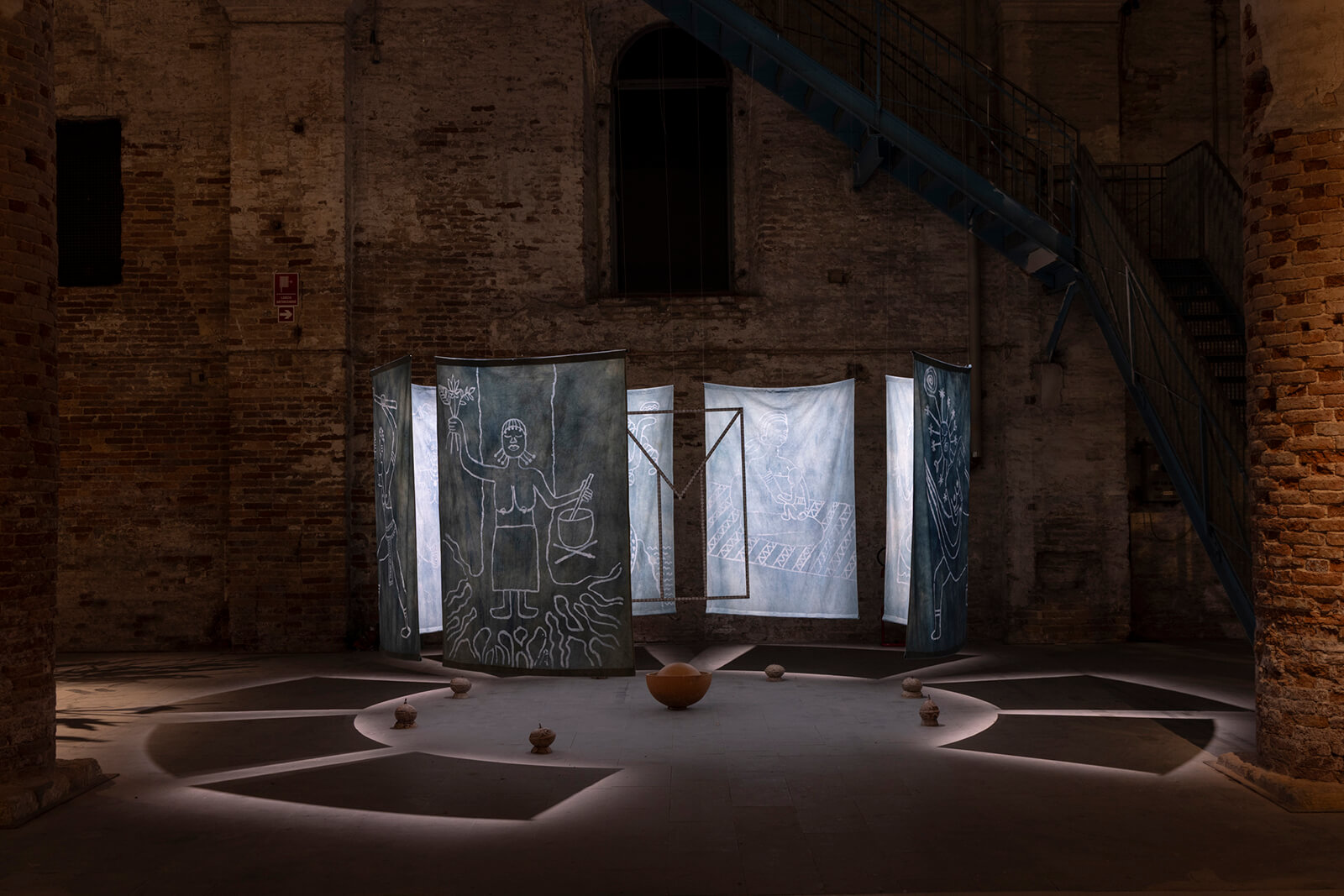
Tabita Rezaire, Omo Elu (2024), installation view, Venice Biennale, 2026. Image: Marco Zorzanello. Courtesy of La Biennale di Venezia.
IV. The Central Peripheries of Art
Another paradox runs through In Minor Keys. In truth, it has run through the Biennale for several years, but here it perhaps reaches its most complete form. It concerns a single word: minor. The title promises lateral voices, low frequencies, stories that have remained out of frame. It promises what still exists at the margins. Yet a mere glance at the catalogue is enough for that word to lose some of its innocence.
Many artists are presented as peripheral figures. And they are, if one looks at the histories they carry with them: colonialism, migration, diasporas, suppressed memories, political violence. But biography is one thing; position within the art system is another.
Around seven out of ten artists live and work permanently within the major international networks of contemporary art (New York, London, Berlin, Paris, Los Angeles). The majority are represented by leading galleries (Goodman Gallery, Mendes Wood DM, Stevenson, Sfeir-Semler, Pace, kurimanzutto, Imane Farès, and others), already present within the major international museum and art-fair circuits. Many regularly participate in the world’s leading exhibitions (Documenta, the São Paulo Biennial, Sharjah Biennial, Gwangju Biennale), occupying a position that is by now firmly established within the art system.
The evidence is difficult to ignore. These are not occasional guests or outsiders, as they might appear to be. They are among the protagonists of the very circuit that today produces prestige, recognition, and symbolic value.
This in no way diminishes the quality of the works, nor the historical importance of expanding the canon. On the contrary, it is evidence of its success. But precisely this success demands a question: does it still make sense to call “minor” that which now occupies a dominant position?
At this point, one is reminded of some memorable episodes of Passepartout devoted to the Venice Biennale, in which Philippe Daverio observed, with his trademark irony, that the African artist imagined as “exotic” often ends up living in New York, exhibiting in Chelsea, and working with the same curators as his or her European or American counterparts. The exotic, ultimately, no longer describes a condition: it describes a gaze—or rather, a cliché. Hans Belting, from another perspective, has also shown how many artists from the so-called global scene are presented as bearers of alterity while being fully integrated into the international circuits that produce value and recognition (The Global Contemporary and the Rise of New Art Worlds, 2013). If the periphery continues to occupy the centre of the discourse, it becomes increasingly difficult to determine where the margin truly lies. And perhaps it is precisely here that the Biennale reveals its deepest paradox.
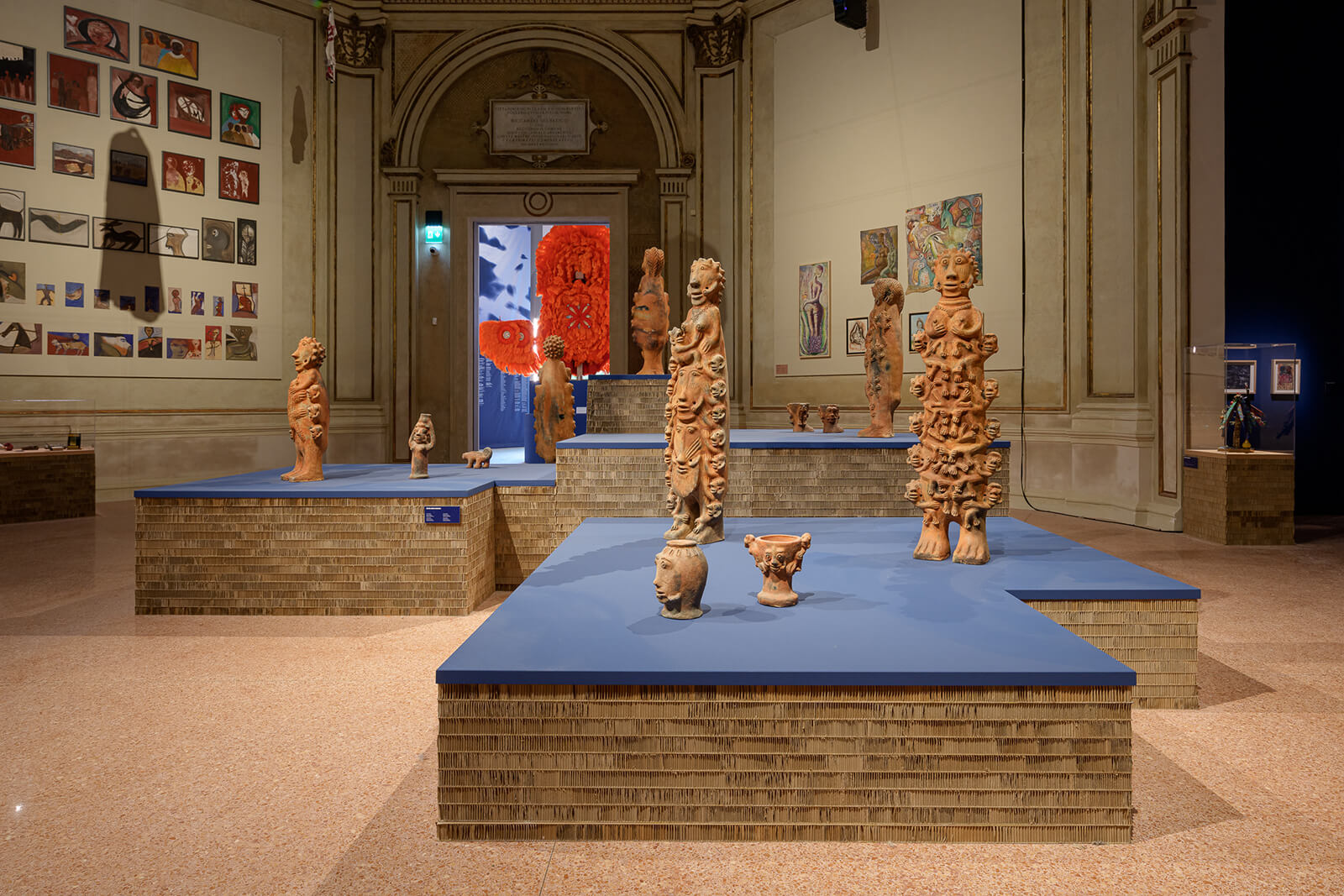
Installation view of terracotta sculptures by Seyni Awa Camara at the Central Pavilion, Giardini, In Minor Keys, Venice Biennale, 2026. Image: Andrea Avezzù. Courtesy of La Biennale di Venezia.
V. The Academy of Virtue, or the Waltz of Good Consciences
The most politically significant moment of the 2026 Biennale did not take place inside the exhibition spaces. It happened outside them. The debate over whether certain national pavilions should open or close, the resignation of the international jury, the refusal of several artists to compete for awards, and the statements issued by delegations suddenly shifted the conflict beyond its usual framework.
What followed was a kind of waltz of good conscience. If the Russian pavilion is closed, why not the Israeli one? And if the Israeli one, why not the American one? And Venezuela? And the European states? And the major collectors and magnates who finance the art system? Each answer generated a new question; each exclusion revealed a new inconsistency to denounce. For a few days, the Biennale seemed to transform into a rather unusual competition: not one for the Golden Lion, but one to determine who could appear the least morally reprehensible.
From this perspective, In Minor Keys completes a transformation that began at least a decade ago. If Okwui Enwezor organized the Biennale around the vocabulary of urgency, trauma, and denunciation, Koyo Kouoh replaces that register with one of care, listening, repair, and relation. The words change, the tone changes, even the emotional temperature of the exhibition changes. What remains surprisingly stable is its function: to construct a community of vision that, before sharing a taste, shares a moral horizon.
This is where the mechanism becomes noteworthy. Aesthetic judgment and ethical judgment increasingly tend to overlap, to the point where the formal quality of a work becomes less and less distinguishable from the moral position it occupies in the present. Images continue to produce complexity, but the framework that receives them tends instead to reduce that complexity within a largely shared interpretive structure.
In this sense, the Biennale does not merely aestheticize conflict. It aestheticizes consent as well. It does not only display wars, colonialism, migration, environmental devastation, and inequality; it displays the way in which the international art community chooses to recognize itself in relation to those issues. The visitor moves through the crises of the contemporary world while simultaneously moving through a representation of their own virtue: open, sensitive, willing to listen, morally positioned on the right side of history.
Perhaps this is the most sophisticated function of the contemporary Biennale. Not to tell visitors what they must think, but to allow them, for a few hours, to experience the reassuring sensation of already thinking what one ought to think. The aesthetic experience thus becomes a form of secular absolution: it does not necessarily change the world, but it confirms to the art world that it inhabits the right one.
English translation: Dobroslawa Nowak