



Alessandro Gioiello. There Is No Painting Without Poetry
19.02.2026
One may wonder whether, in painting as in literature, there exists a form of poetic license that can represent, whenever it is employed, the sensitive expression of a convinced and necessary freedom to change. Just as a writer may transgress linguistic norms, adopting a fragmented syntax enriched with neologisms, so too is the artist free to break the rules of traditional representation, renouncing verisimilitude and perspective in order to undertake a search guided by opposite impulses, marked by uncertainty and an intense inspirational force. In painting, as in poetry, such versatility is certainly capable of arousing deeper involvement, since the artist, having at his disposal broader technical means than the writer, possesses a greater capacity for invention. And it is perhaps precisely on this occasion that a point of contact is created between painting and poetry—the latter understood not as the rhetorical exercise of a declamatory outburst, but rather as the original practice of poiein, a making that coincides with producing and with seeking. Alessandro Gioiello (Savigliano, Cuneo, 1982), trained at the Academy of Fine Arts in Turin, has developed a truly complex relationship with painting, suspended between inspiration and a form of gentle resistance that led him to approach this technique again after ten years of study.
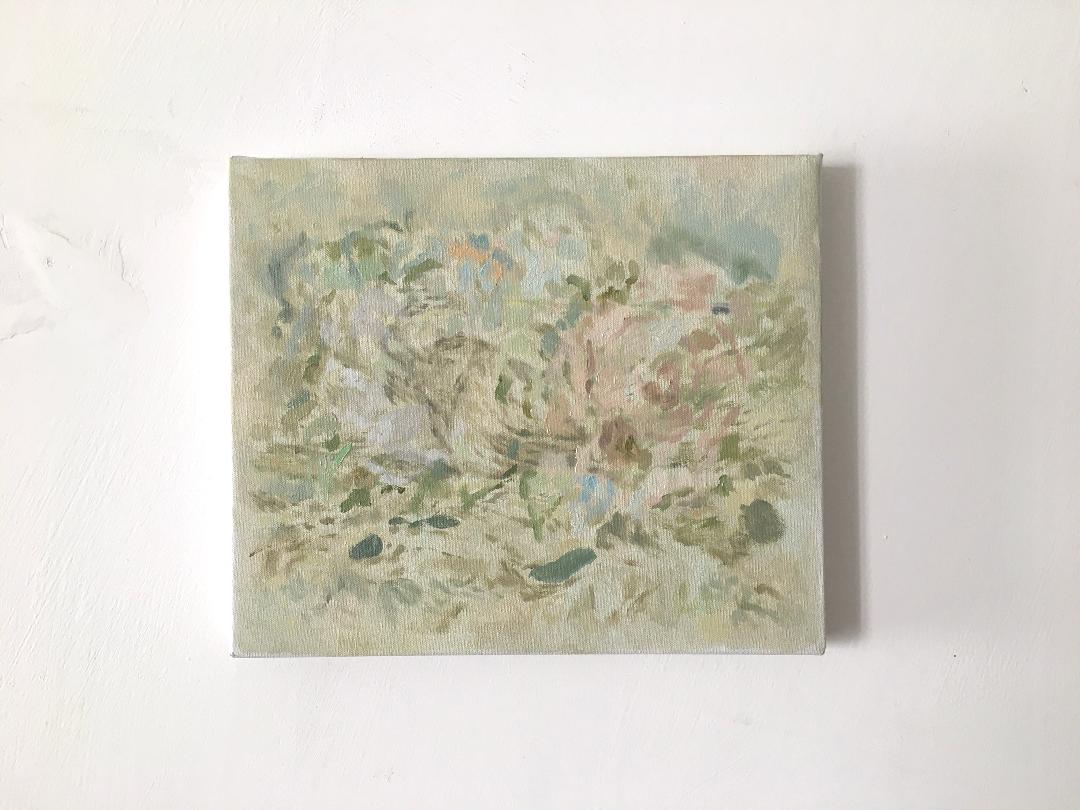
Alessandro Gioiello, Fiori di luna, 2023, oil on linen, 21×25 cm, Courtesy the artist
Before working with oil paints on canvas, the artist went through various phases of study and research, during which—precisely because of the poetic license mentioned earlier—he freely experimented with new techniques that allowed him to explore different materials. Although it is right not to adhere too rigidly to a division of an artist’s work into periods, for Gioiello painting represents a joyful discovery that coincides with the opening of a new phase of research. At first, his technique involved the use of powdered wool applied to Velcro canvases, through which the artist reconstructed details drawn from scenes in fifteenth- and sixteenth-century art history. These preparatory works led him to handle the canvas with acumen and slowness, focusing only on selected visual fragments, thereby giving the works the perception of a suspended, powdery materiality.
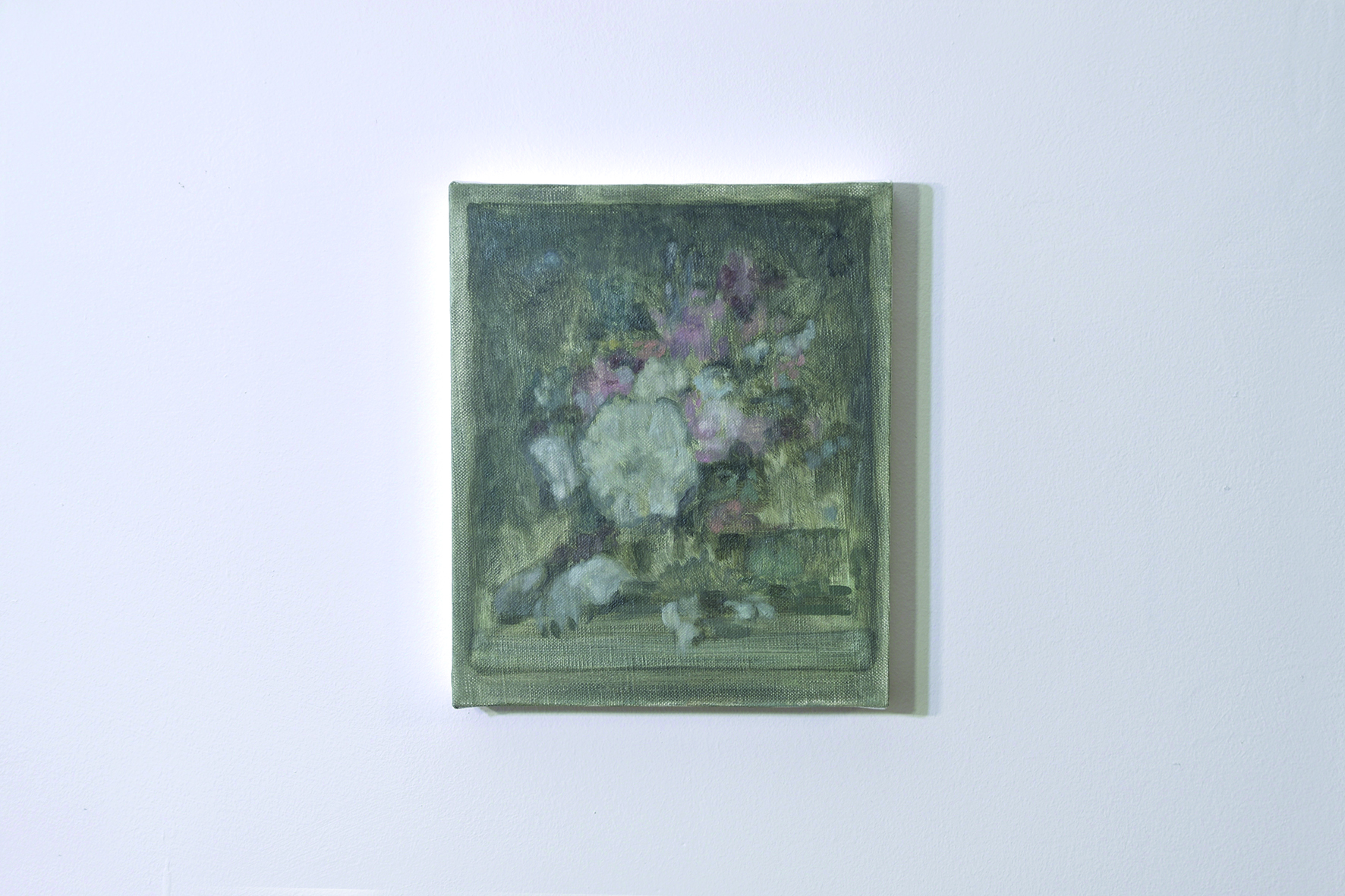
Alessandro Gioiello, Fiori in posa, 2022, oil on linen, 25×21 cm, Courtesy the artist
It is precisely this tactile sensation that led Gioiello to work with oil paint in the form of tiny flames and fine fibrils which, rather than defining the subject, leave it free—without contours—seemingly in motion across modestly sized linen and cotton canvases. With a careful eye on what surrounds him, and through the simplicity of the subjects he depicts—such as a vase of flowers, a window, a lunar landscape, or a grassy place—Gioiello tends to disintegrate outlines, creating a visual and perceptual blurring that reveals a particular sense of intimate familiarity even in the most ordinary things.
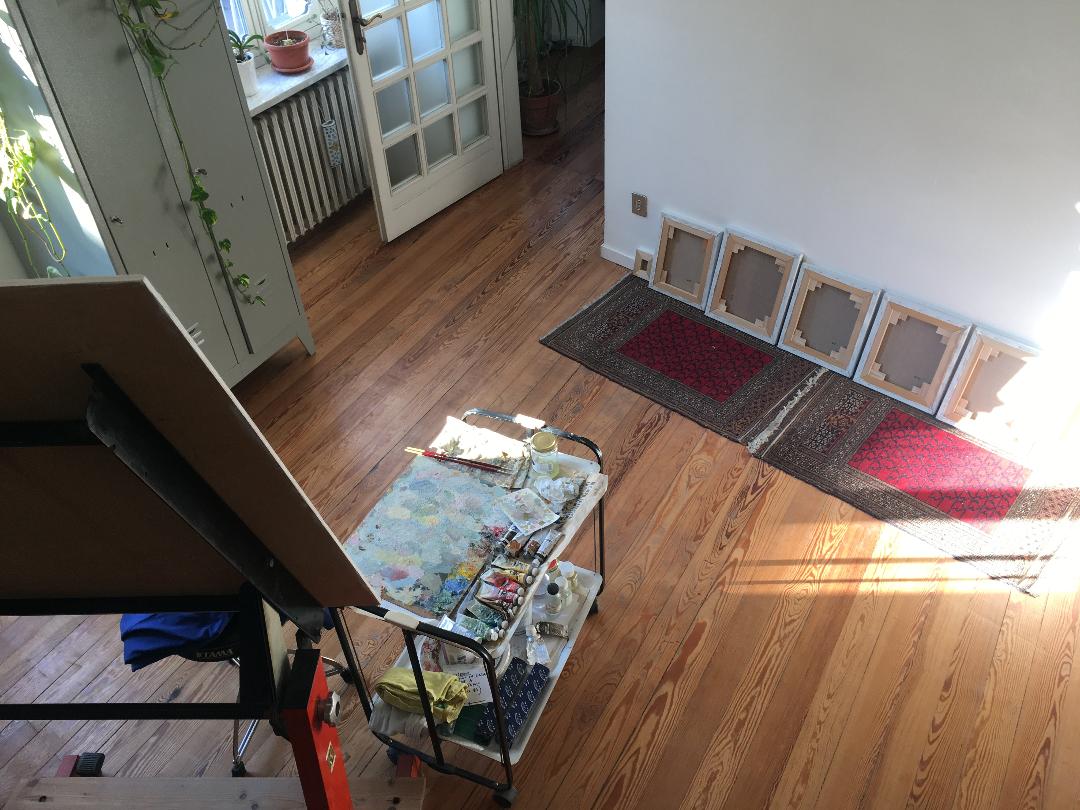
Alessandro Gioiello’s studio in Racconigi, Cuneo, January 2026, Courtesy the artist
The most recent canvases are the result of thoughts and memories connected to the objects that occupy his studio, such as art history volumes or simply tubes of oil paint. These images are conceived with a good measure of reflection; by surrendering to introspection, the artist rediscovers ideas already held in memory—not so much as simple quotations, but rather as a vivid reemergence of recollections. A similar approach also characterizes the English painter Winifred Nicholson (Oxford, England 1893 – Carlisle, Cumbria, England 1981), whose painting, although formally different from Gioiello’s, shares an attachment to a limited number of themes. By painting bouquets of flowers on a windowsill, observed in their slow transformation over time, Nicholson highlights a practice grounded in a lasting relationship with the object, presented through a series of successive variations.
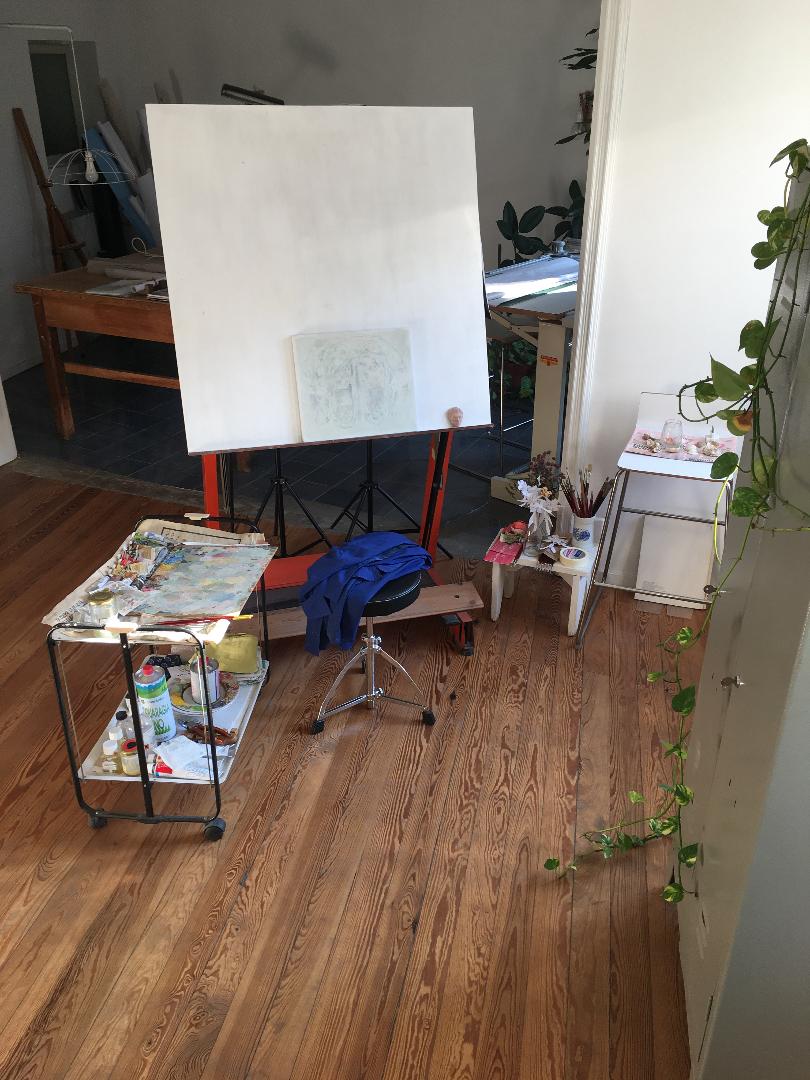
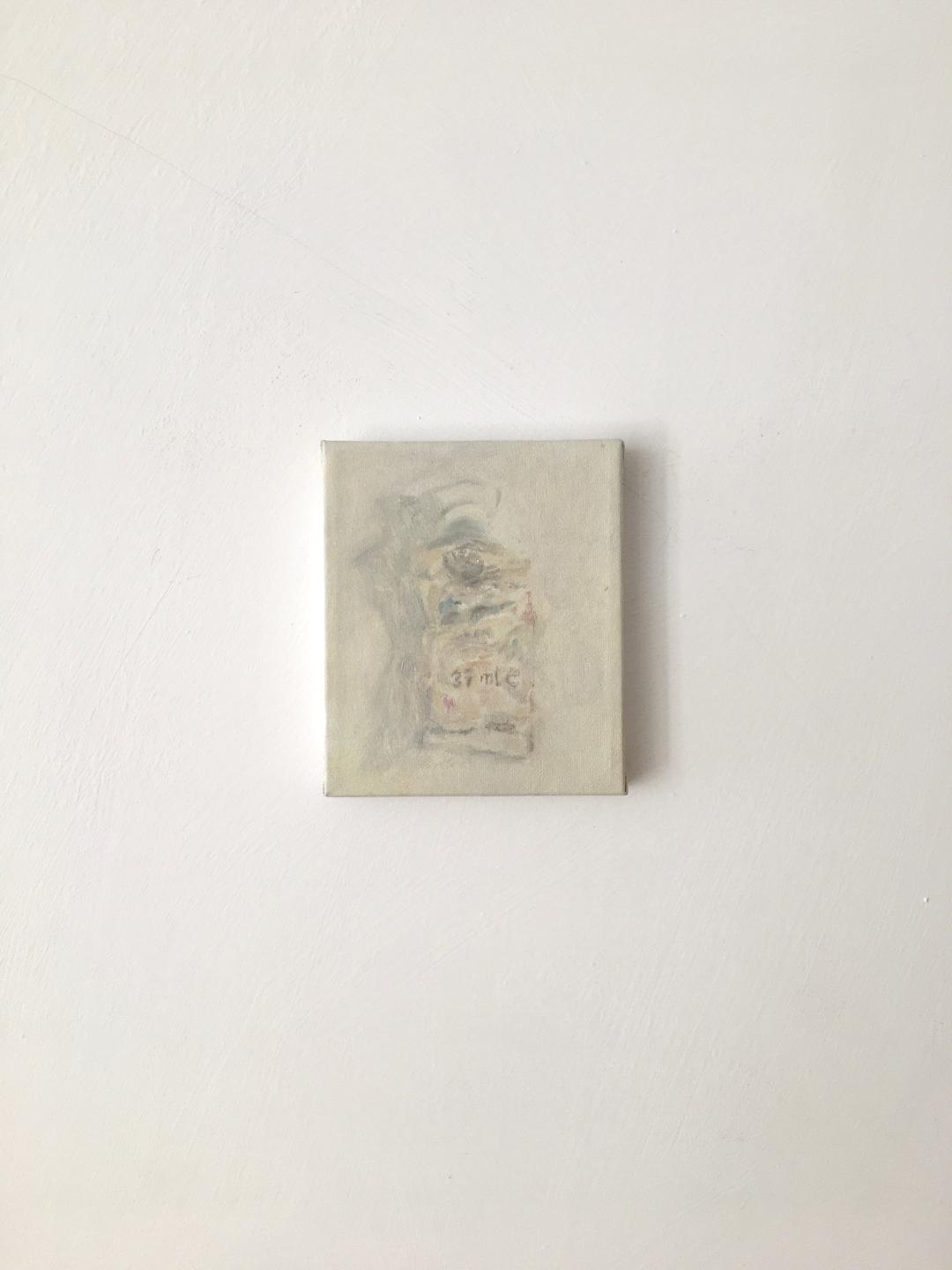
Alessandro Gioiello’s studio in Racconigi, Cuneo, January 2026, Courtesy the artist / Alessandro Gioiello, Dancing with myself, 2025, oil on cotton, 12×10 cm, Courtesy the artist
In the same way, Gioiello approaches the subject with a detached and crystalline calm, preserving a subtle lyricism, as if the work had originated from a reading in the margins of a poem. For these reasons, for the artist the relationship with reality ceases to be a reference of resemblance and, by breaking this bond, an austere simplicity emerges, transforming the real datum into a barely plausible construction through a painterly code based on a few tones ranging among neutral beiges, from warm to cool. This extreme reduction leads us to wonder where this painting originates, as it seems to derive from a dimension that moves according to its own rhythms and, while maintaining a vivid relationship with reality, offers a sense of suspension in relation to the image. Alessandro Gioiello’s studio evokes all these sensations and stands along that line which continuously connects the painting to the place in which it was conceived. The atelier, located in Racconigi in the province of Cuneo, covers an area of approximately 30 square meters and is illuminated by large windows that allow natural light to filter in.
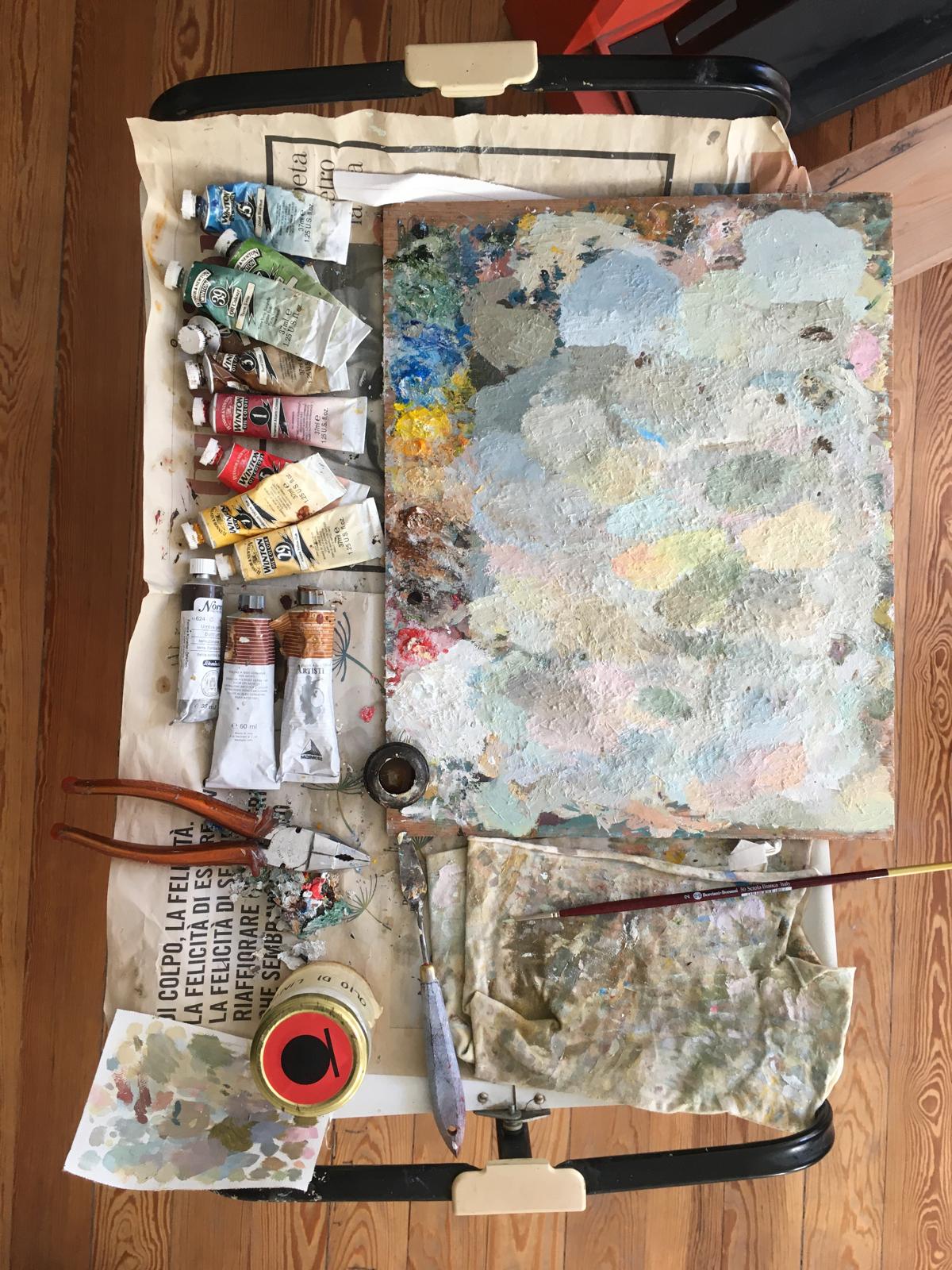
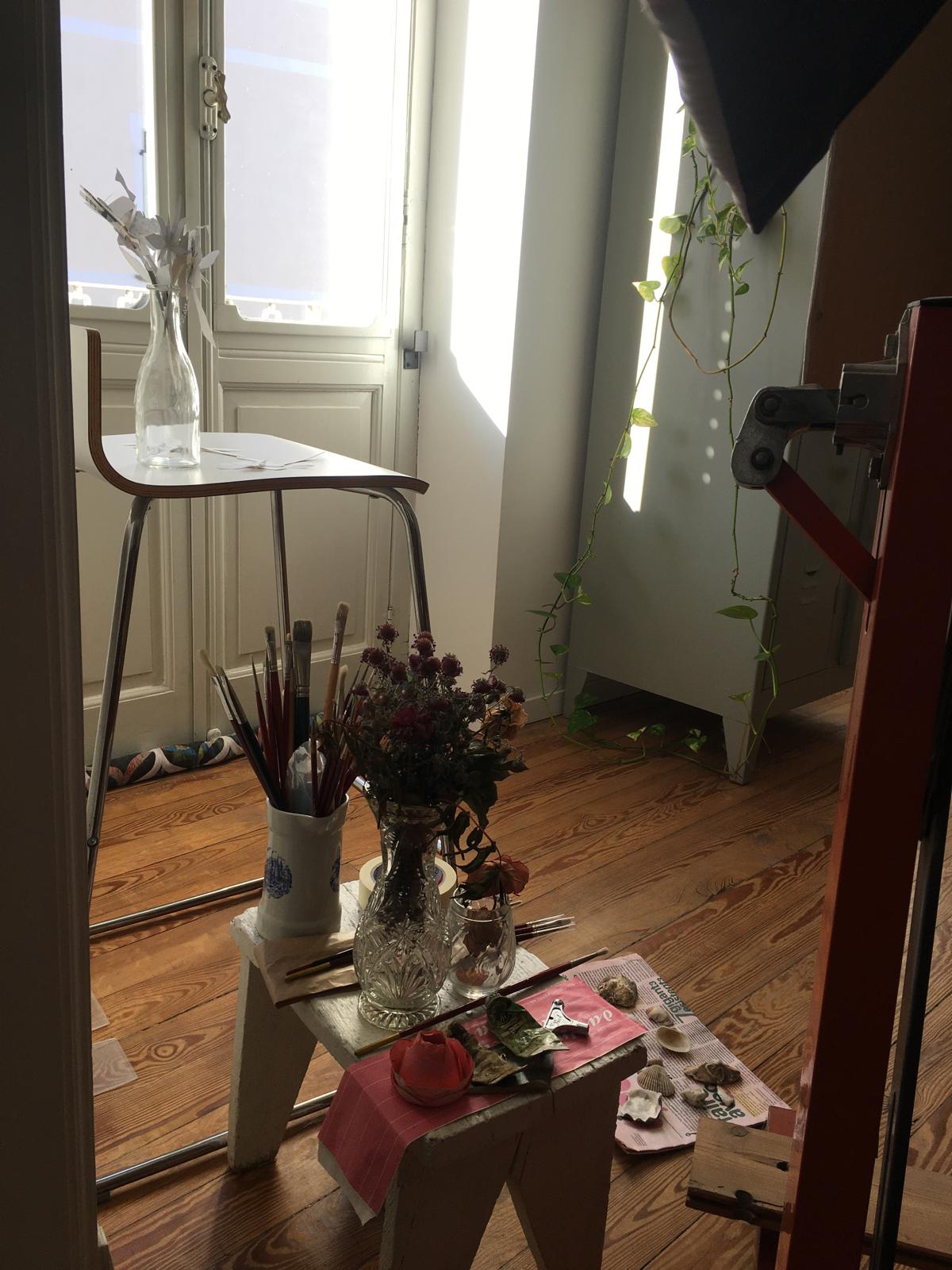
Alessandro Gioiello’s studio in Racconigi, Cuneo, January 2026, Courtesy the artist
The spaces convey a calm stillness, establishing a delicate dialogue between the quiet of the environment and what the paintings depict. Although the spaces are large, Gioiello prefers to work on small canvases, and it is precisely through these that his relationship with painting becomes evident: a dialogue with the serene concentration that characterizes the studio, followed by an intense phase of reflection. Thus, each work prompts one to ask what mental process led him to choose that particular object. Since this research arises from an idea that becomes clear only after long contemplation, the figure hovers on the canvas just as it does in the artist’s imagination, emerging as if it were the sum of countless prior thoughts, smoothed by the passage of time, consolidated by the weight of memories, and fractured by doubts and uncertainties. Yet precisely these elements prove fundamental to Gioiello’s practice, as no work is born instantly, nor without hesitation and reconsideration.
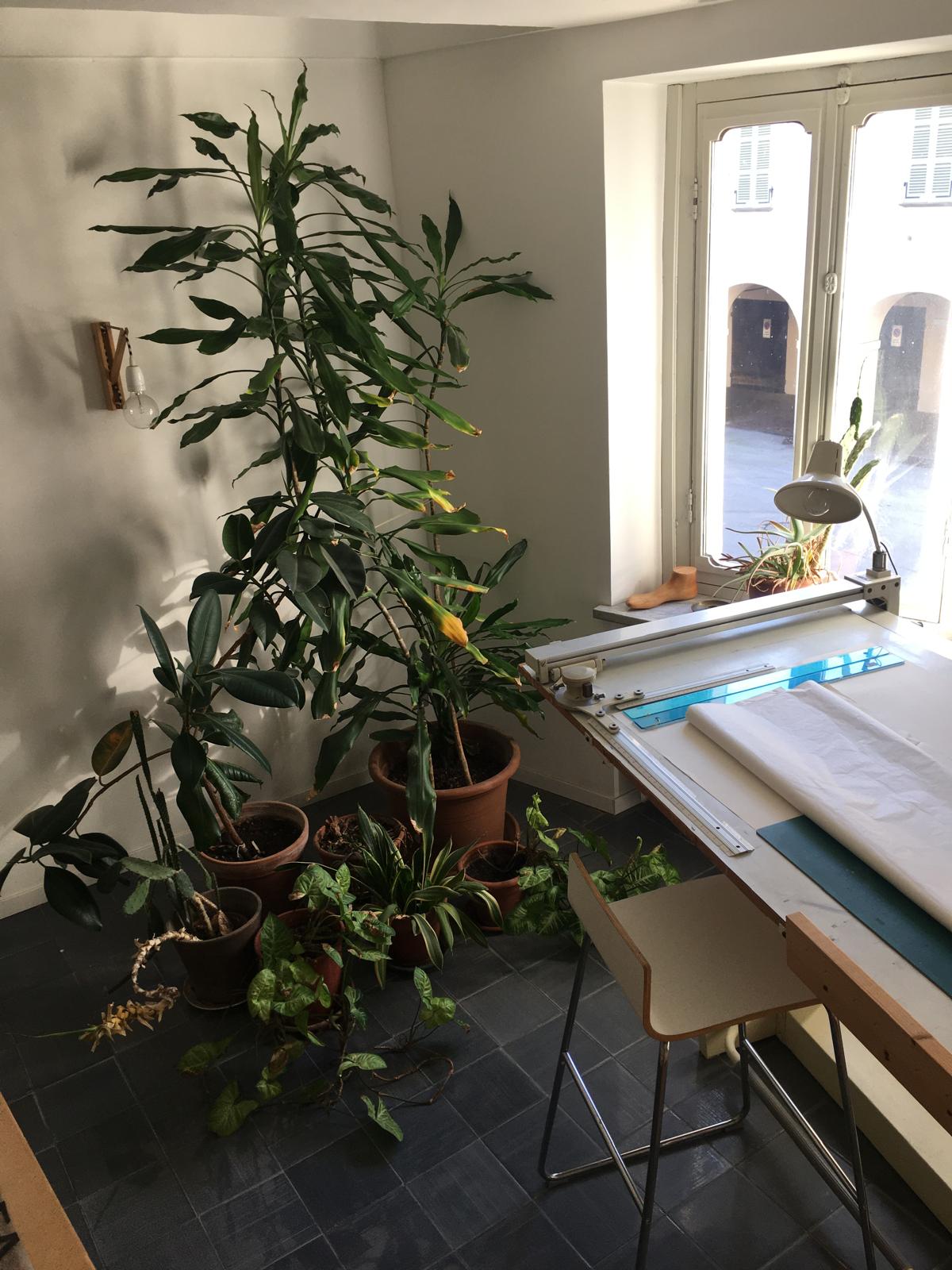
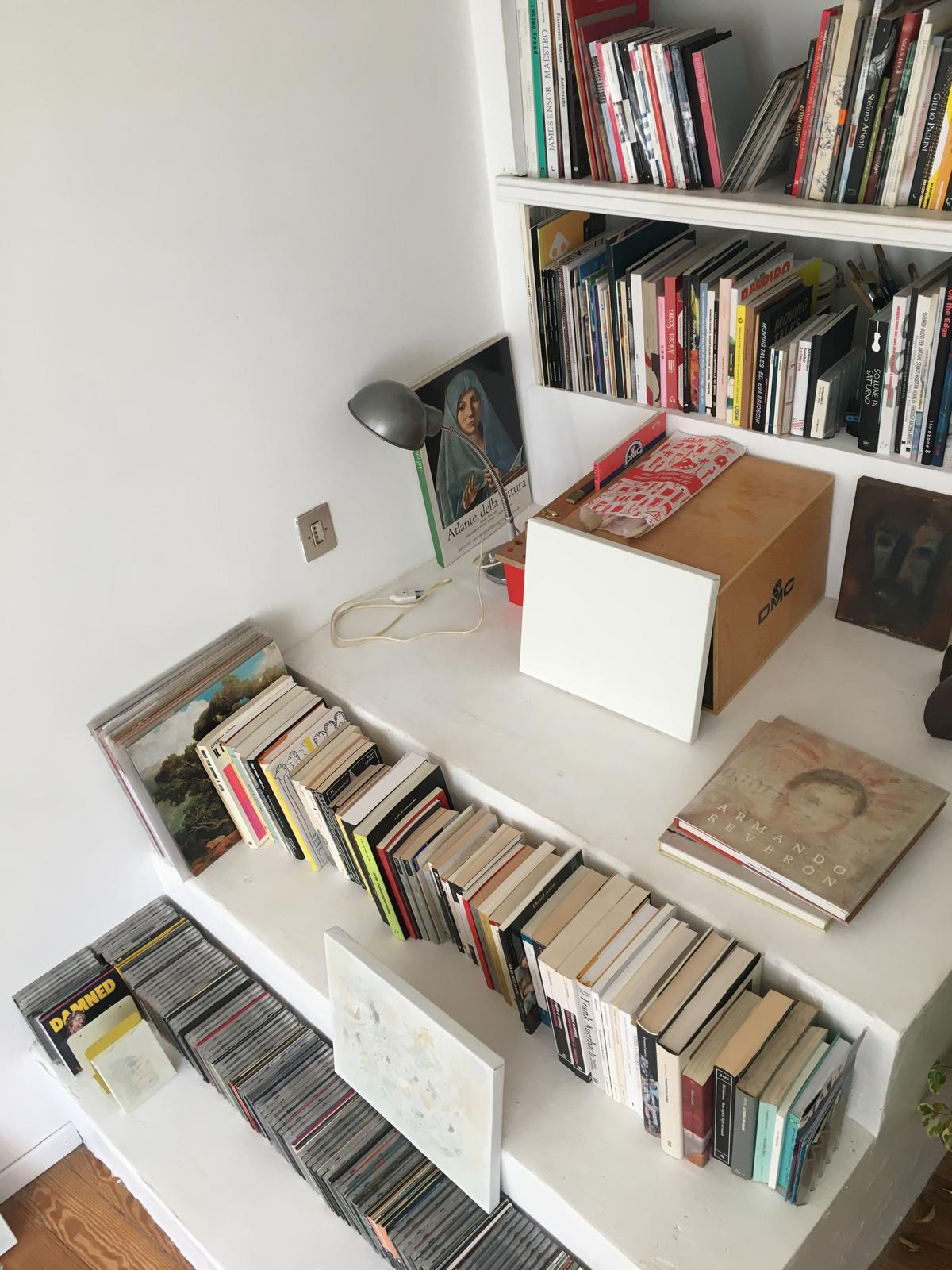
Alessandro Gioiello’s studio in Racconigi, Cuneo, January 2026, Courtesy the artist
And it is probably this deeply reflective relationship with life and with painting that drives the long maturation phase of many of his works, in which an underlying current emerges, capable of keeping the invisible relationships between individual subjects unchanged. These subjects may take the form of shells, plant arrangements, or landscapes, or that of a bouquet of flowers suspended—not anchored to the ground but entrusted to the air, weightless, as if endowed with an intangible force sustained solely by light.
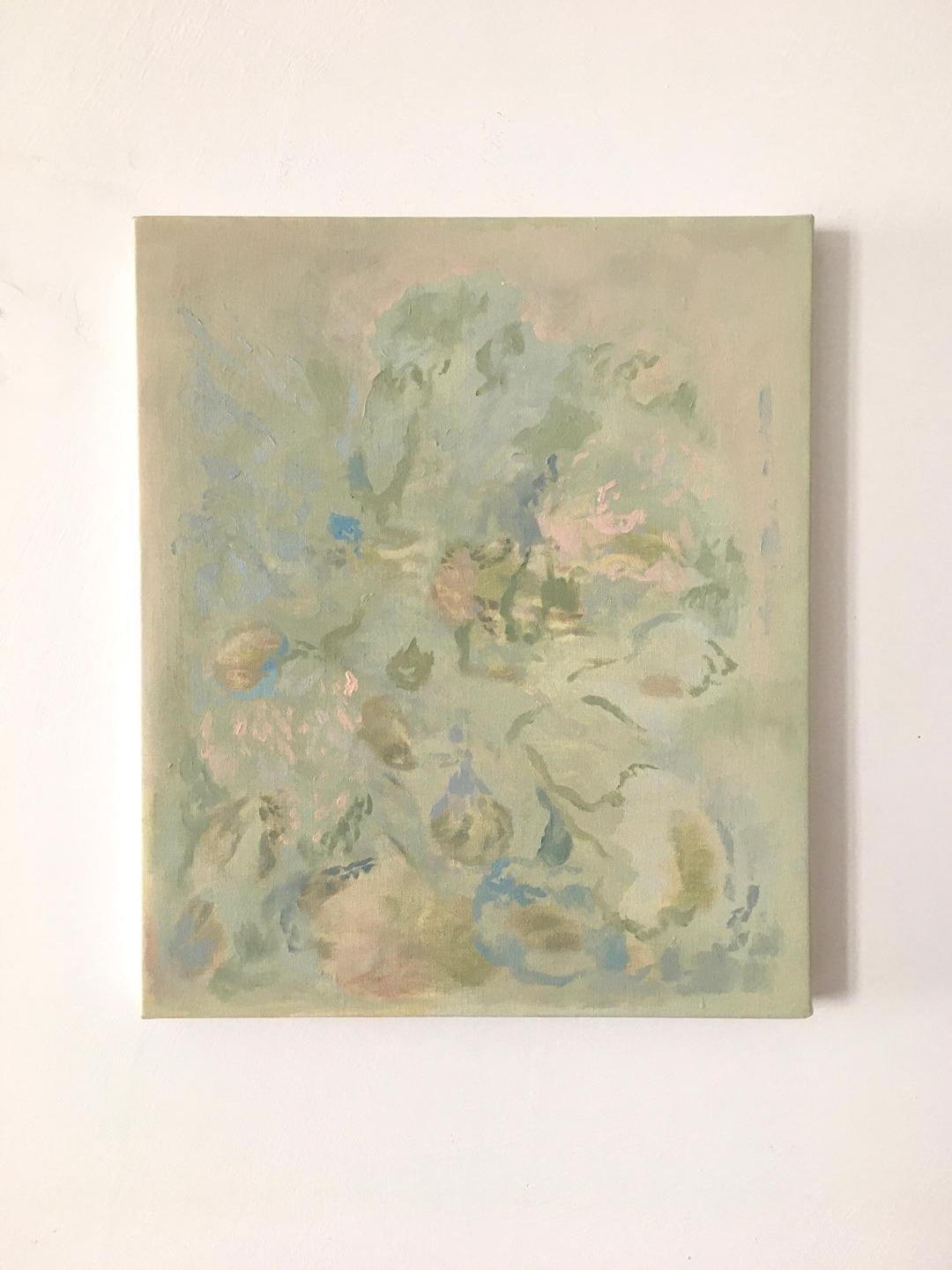
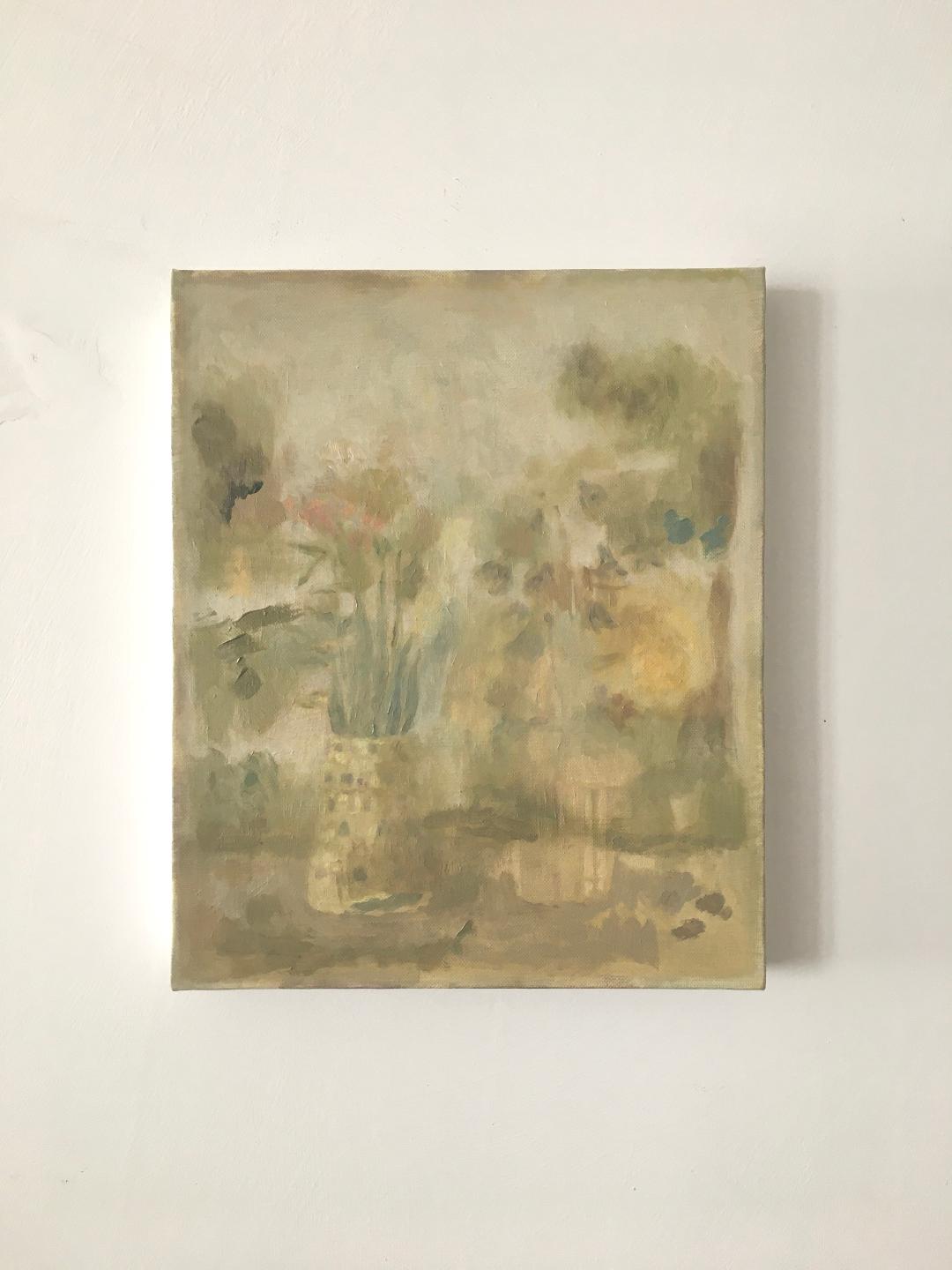
Alessandro Gioiello, Luce da est, 2025, oil on linen, 34×28 cm, Courtesy the artist / Alessandro Gioiello, Adorazione di Cecilia, 2022, oil on linen, 34×28 cm, Courtesy the artist
Maria Vittoria Pinotti in conversation with Alessandro Gioiello
Maria Vittoria Pinotti: How have you organized your studio space?
Alessandro Gioiello: The studio I’m currently working in is part of my home. The space is organized in a fairly functional way, I would say. I have a work table with a tilting top that, when needed, I use as an easel; a trolley with my palette and paints; and around me, small objects scattered that could become the subjects of my works. Some of the catalogs and art books I own are gathered here so I can leaf through them whenever I need comfort. There are also several plants spread throughout the room—they give me a sense of calm. I need to have only a few things around me, carefully chosen, and that don’t obstruct my visual field.
I also have a second studio, which I mainly use in the summer. It is more spacious and uncluttered, with just an easel and bare walls where I can hang the works as they are completed.
How does a workday unfold for you, and what rhythm does your painting follow?
Lately, my workdays have been, so to speak, fragmented due to teaching, but on Saturdays, Sundays, and free afternoons I try to work as much as possible.
When I have a whole day available, I start right after breakfast because I like to feel immersed in natural light while painting; after years of working in a basement space lit only by neon lights, it feels like a tremendous blessing.
I sit in front of the canvas and observe. When I find the color that interests me, I act quickly and then step back to look. The moments of inaction are longer than the moments of actual work. I rarely finish a piece in a single day. I start several works at the same time and let them rest for days before completing them.
Are there certain aspects of your studio that influence your artistic research?
The light that floods the studio (the wide façade of the building opposite amplifies its intensity) is certainly a stimulating element, an anchor for my practice.
I also need a certain order around me, along with silence and a sense of focus.
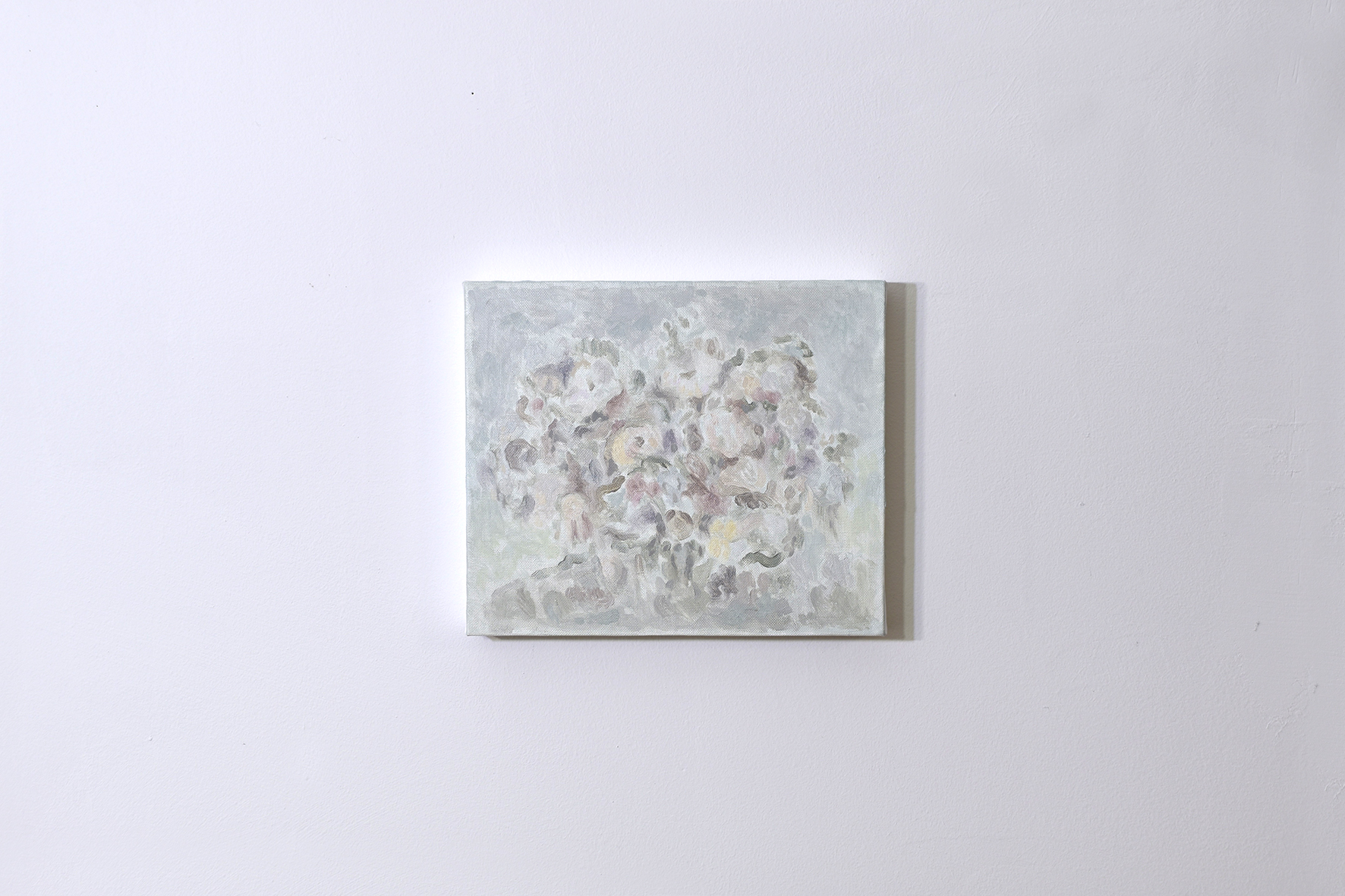
Alessandro Gioiello, Pop corn flowers, 2022, oil on linen, 23×27 cm, Courtesy the artist
Translated by Dobroslawa Nowak