


Giuditta Branconi, Cannon Fodder at the Collezione Maramotti
14.04.2026
The canvases overflow in Cannon Fodder, the first solo exhibition by Giuditta Branconi in an institutional space. Through a painting practice based on the accumulation of signs and symbols, the young artist saturates the space, erasing any hierarchy between styles, subjects, and dimensions. The reference to “cannon fodder” evokes those bodies deemed expendable in the name of a larger system—a violent system that crushes and overwhelms. Her canvases thus overload, exaggerate, and reject any form of moderation.
Drawing from an archive she has cultivated since 2019—newspaper pages, protest banner slogans, receipts, messages with friends—Branconi pours onto the canvas an emotional as well as political baggage through a diaristic dynamic, blending iconographic references from popular culture, literary sources, songs, and instant messaging.
The final result is a rich, luminous, positive aesthetic, yet the painter is keen to point out that this is “a misunderstanding”: the anger and dissent that drive her practice have in fact made the inclusion of written words necessary, in a kind of internal struggle between a fantastical imagery and unequivocal language. Within this dichotomy, the canvas is torn apart, struck and pierced everywhere: “cannon fodder.”
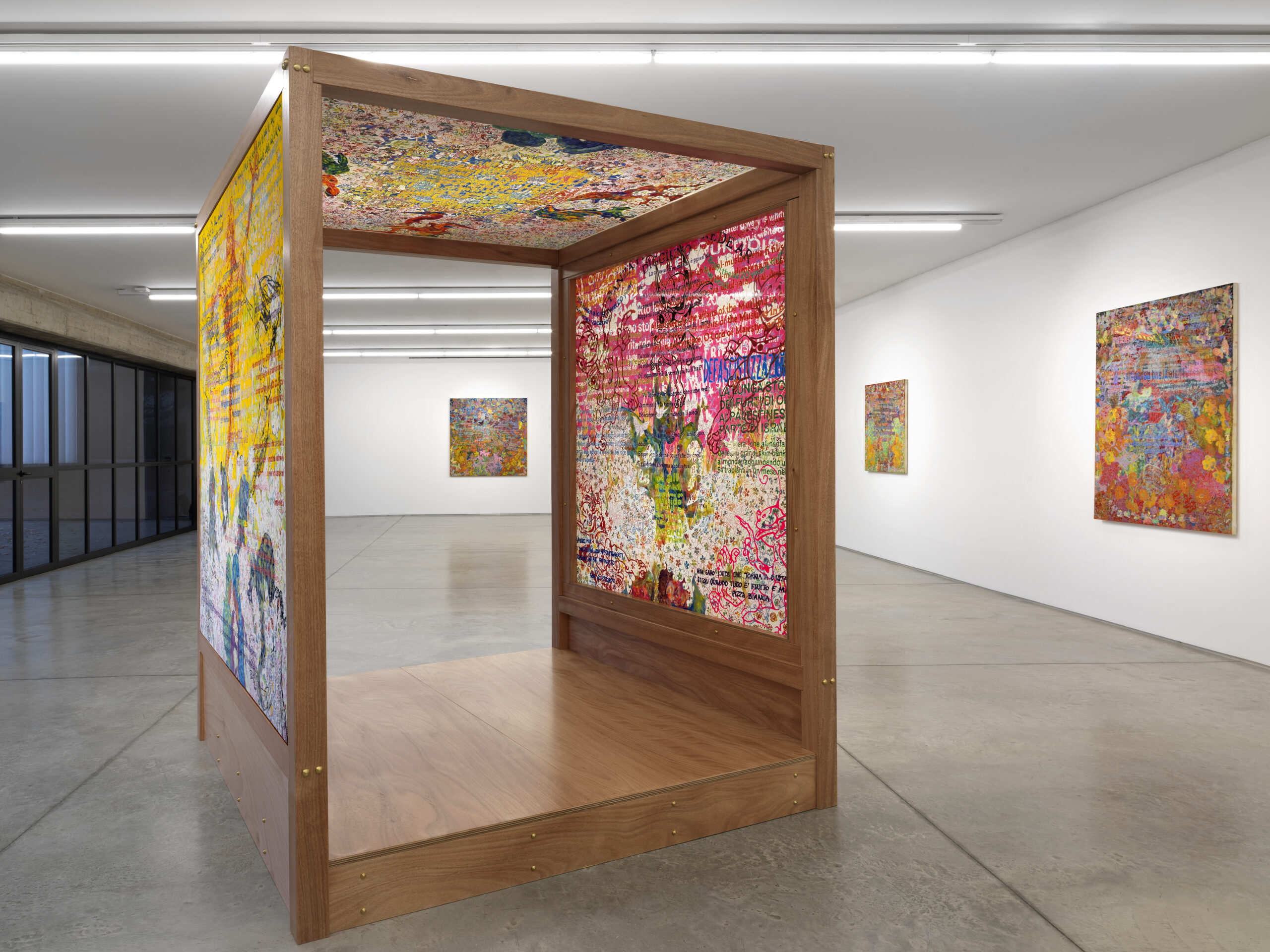
Giuditta Branconi, Cannon Fodder, Veduta di mostra/ exhibition view, Collezione Maramotti, Reggio Emilia, © Giuditta Branconi, Courtesy the artist; L.U.P.O Gallery, Milan, ph. Dario Lasagni
The title of the exhibition Cannon Fodder (“carne da cannone”) refers to “bodies that can be sacrificed, to raw material doomed to be swallowed up by a larger system”. The high density of your paintings and their heavily worked surfaces thus seem to be a transposition of this kind of “massacre.” Do your works also attempt to represent a way out, a kind of space in which to find relief?
Giuditta Branconi: My works represent what I experience and what we all experience—a very violent moment on both a political and economic level. I don’t think it’s possible to escape this awareness. I hope they are not a source of relief for anyone, but everyone is free to feel whatever they want when standing in front of a painting.
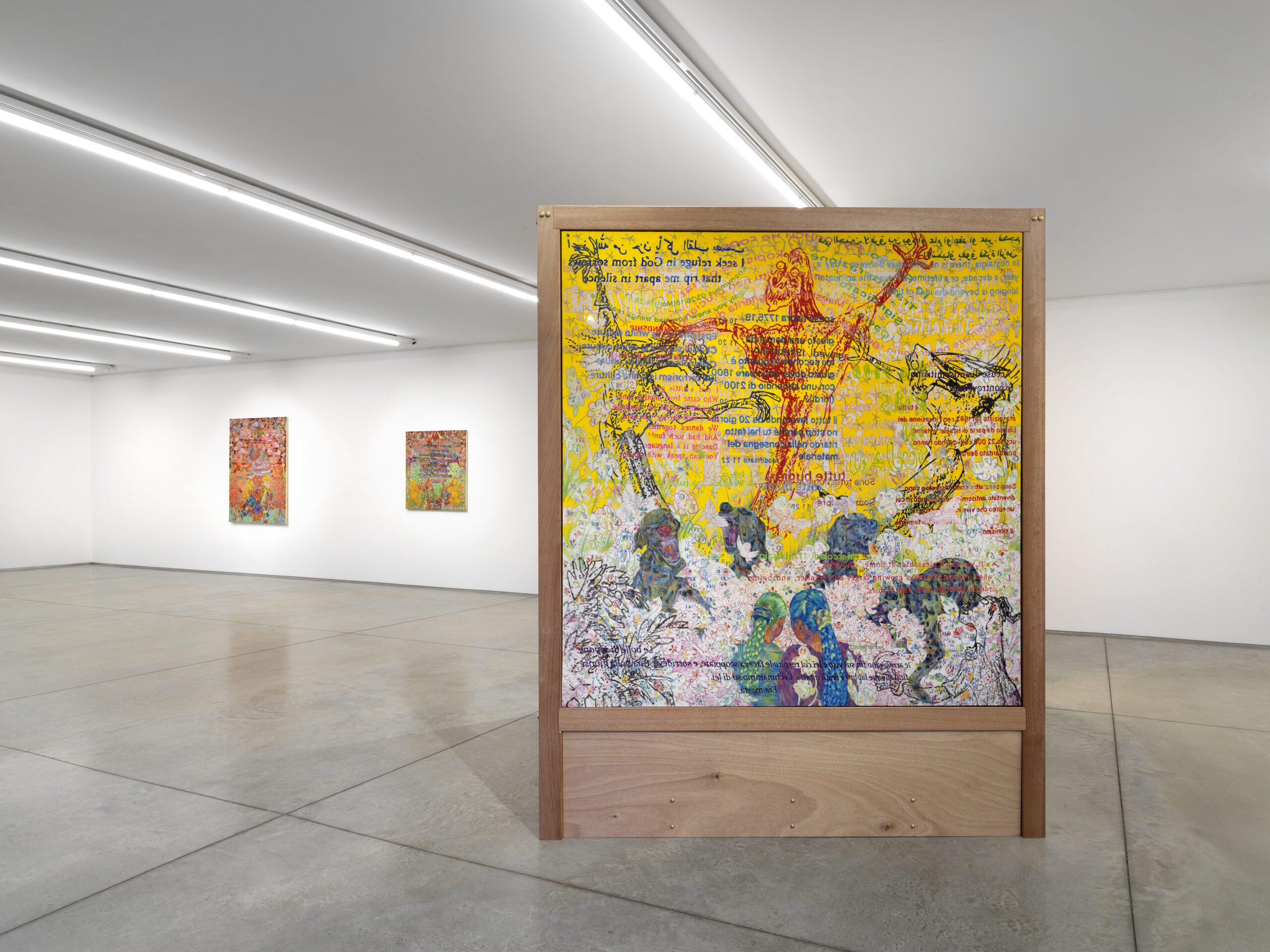
Giuditta Branconi, Cannon Fodder, Veduta di mostra/ exhibition view, Collezione Maramotti, Reggio Emilia, © Giuditta Branconi, Courtesy the artist; L.U.P.O Gallery, Milan, Ph. Dario Lasagni
The choice to paint both the front and the back of your canvases is interesting—it seems to represent a kind of sabotage of the canvas’s very function, which is to be hung and remain mostly fixed in one place. Your works instead embrace three-dimensionality, doubling expressive possibilities and at least partially entering the realm of installation. For you, can painting take on a hybrid nature without losing its identity, historically tied to two-dimensionality
Giuditta Branconi: My work stems from curiosity—I like to change fabrics, pigments, colors, and the technique of painting on both the front and the back increases expressive possibilities. As for the hybrid nature of painting, I think that historically painting’s identity has been precisely to challenge two-dimensionality: some have done so through perspective, others through trompe-l’œil, others through fresco or a more material, sculptural approach to painting, and finally others through installation—but the possibilities are endless, I believe.
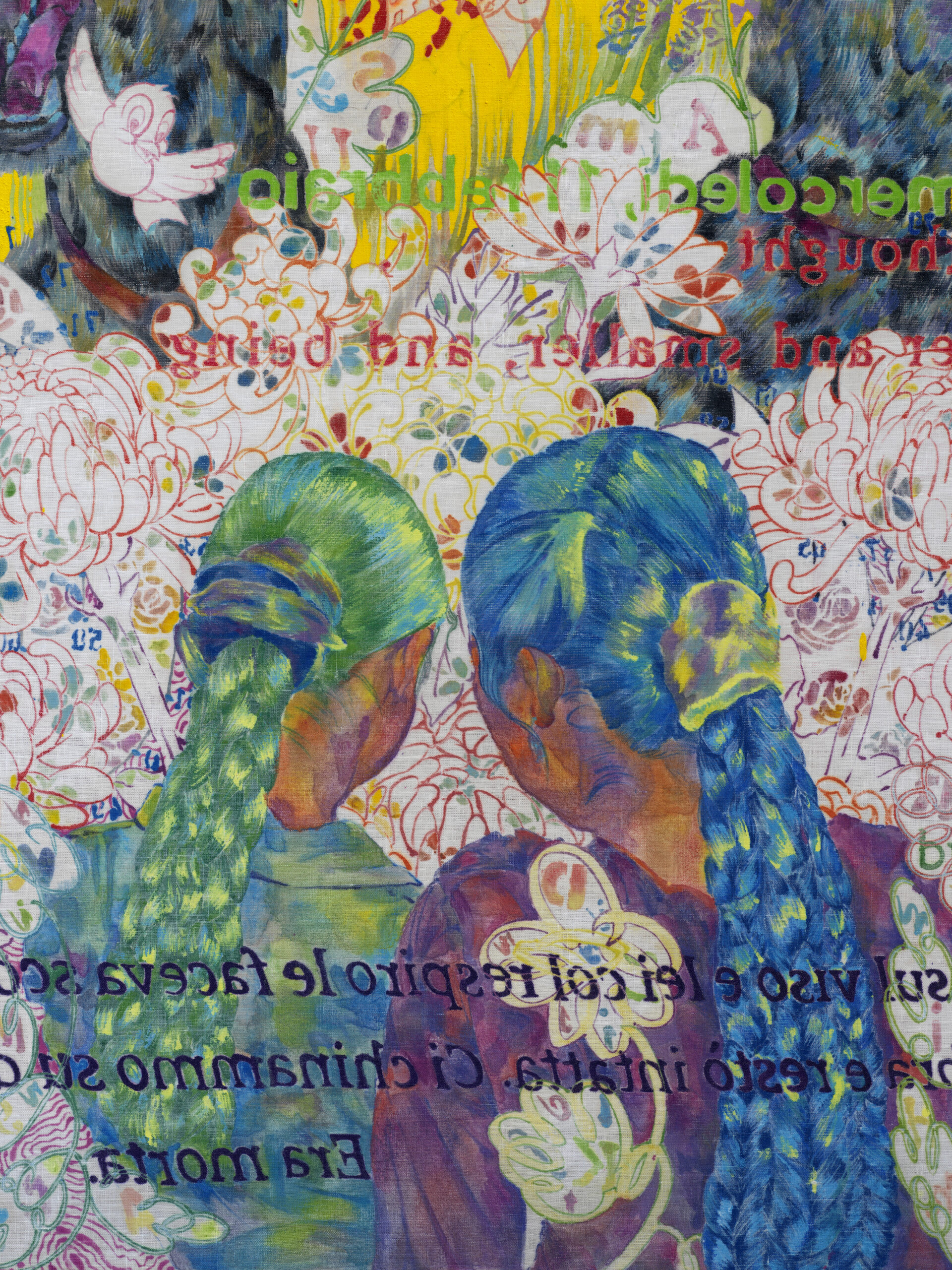
Giuditta Branconi, Se seguissi le molliche di pane (non torneresti qui mai più) / If you followed the breadcrumbs (you’d never get back here (dettaglio/detail), 2026, olio su lino, struttura di legno / oil on linen, wooden structure, © Giuditta Branconi, Courtesy the artist; L.U.P.O Gallery, Milan, Ph. Dario Lasagni
In your work there is an aesthetic that recalls medieval visual language; in particular, it makes me think of manuscripts produced by monastic scribes: an accumulation of symbols, writings, and numbers that saturate the space. On the other hand, this unrestrained accumulation challenges the hierarchies present in manuscripts and, more generally, in printed materials intended for reading: everything forms a single body, a single space filled with signs. From canvas to reality, does your work present itself as a challenge to power hierarchies?
Giuditta Branconi: I don’t believe I am such an authoritative voice as to challenge power hierarchies.
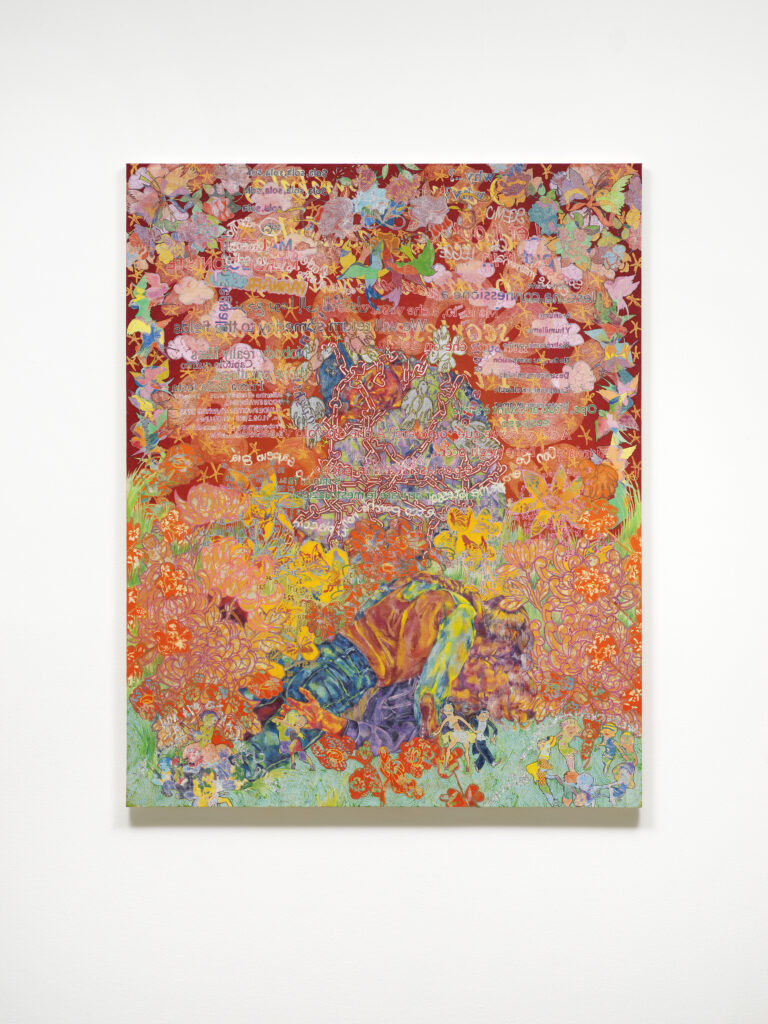
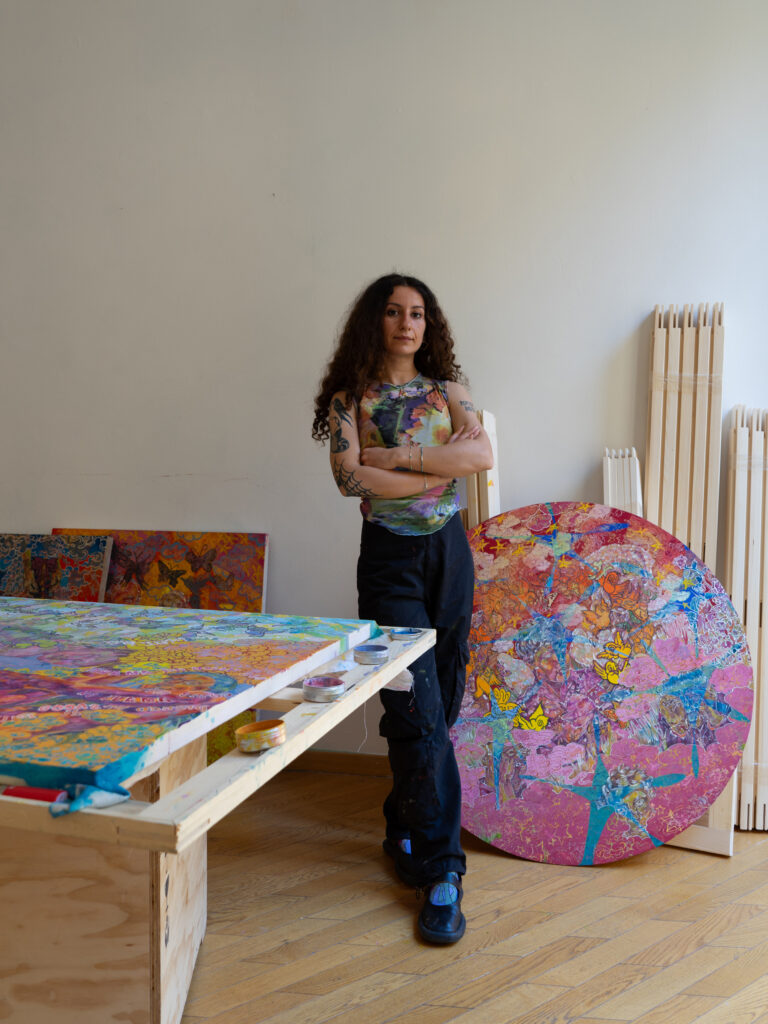
left: Giuditta Branconi, Mi ricordavo più felice di così / I remembered being happier than this, 2025, olio su lino / oil on linen, © Giuditta Branconi, Courtesy the artist; L.U.P.O Gallery, Milan, Ph. Dario Lasagni / right: Ritratto di Giuditta Branconi / Portrait of Giuditta Branconi, Ph. Pietro Cisani
Translated to English by Dobroslawa Nowak
Exhibition details:
Cannon Fodder
Giuditta Branconi
Collezione Maramotti, via Fratelli Cervi 66, Reggio Emilia
On view until 26 July 2026