

Il ragno d’oro
Dobrosława Nowak in Conversation with Claudio Onorato
Dobrosława Nowak | 24/11/2026 | Listen to the extended version of this interview on our Spotify account.
Claudio Onorato, an artist whose approach to research is open and versatile, works primarily with paper, more specifically through the technique of paper cutting, while remaining engaged with political issues. Closely connected to Milan, a city that often sparks ambivalent discussions, passions, and emotions among artists, he is the second guest in the series of conversations that The Italian Art Guide is presenting on its new Spotify channel.
During our conversation, we focused in particular on one of his works, “Il ragno d’oro”, available from today in The Italian Art Guide gallery.
The full conversation, in Italian, is available in audio format, while the written version can be read below.
I meet Claudio Onorato in Milan, at the artist’s home, which also serves as his archive and creative studio. We are standing in front of the work “Il ragno d’oro.”
Dobrosława Nowak: What can you tell us about this work?
Claudio Onorato: It is a sort of offshoot of the main work, which measures 2 metres by 1.4 metres in height and was made entirely by cutting paper. This one, on the other hand, was created from a photographic image using a photoengraving technique. I then took it, refined it, painted it, and worked on the entire frame with acrylic spray paint. The spider is gold, and the gold extends beyond the edges, too. The title is precisely “Il ragno d’oro”—the golden spider that lives inside Milan’s Galleria Vittorio Emanuele. This is clearly a place of excellence, where merchandise is elevated to absolute value and where everything converges: people visiting Milan, Milanese tourism, and much more besides. Cities have now become models that repeat themselves, with central areas—the ones that command enormous value—eventually being acquired by companies and brands that reproduce themselves in different settings. I liked the idea of introducing this kind of contamination in front of this spectacular vaulted roof, designed by Mengoni in the 1860s: a spider’s web stretching towards Piazza della Scala and Palazzo Marino, with this spider waiting there. The image is symbolic, but of course everyone is free to interpret its meaning.
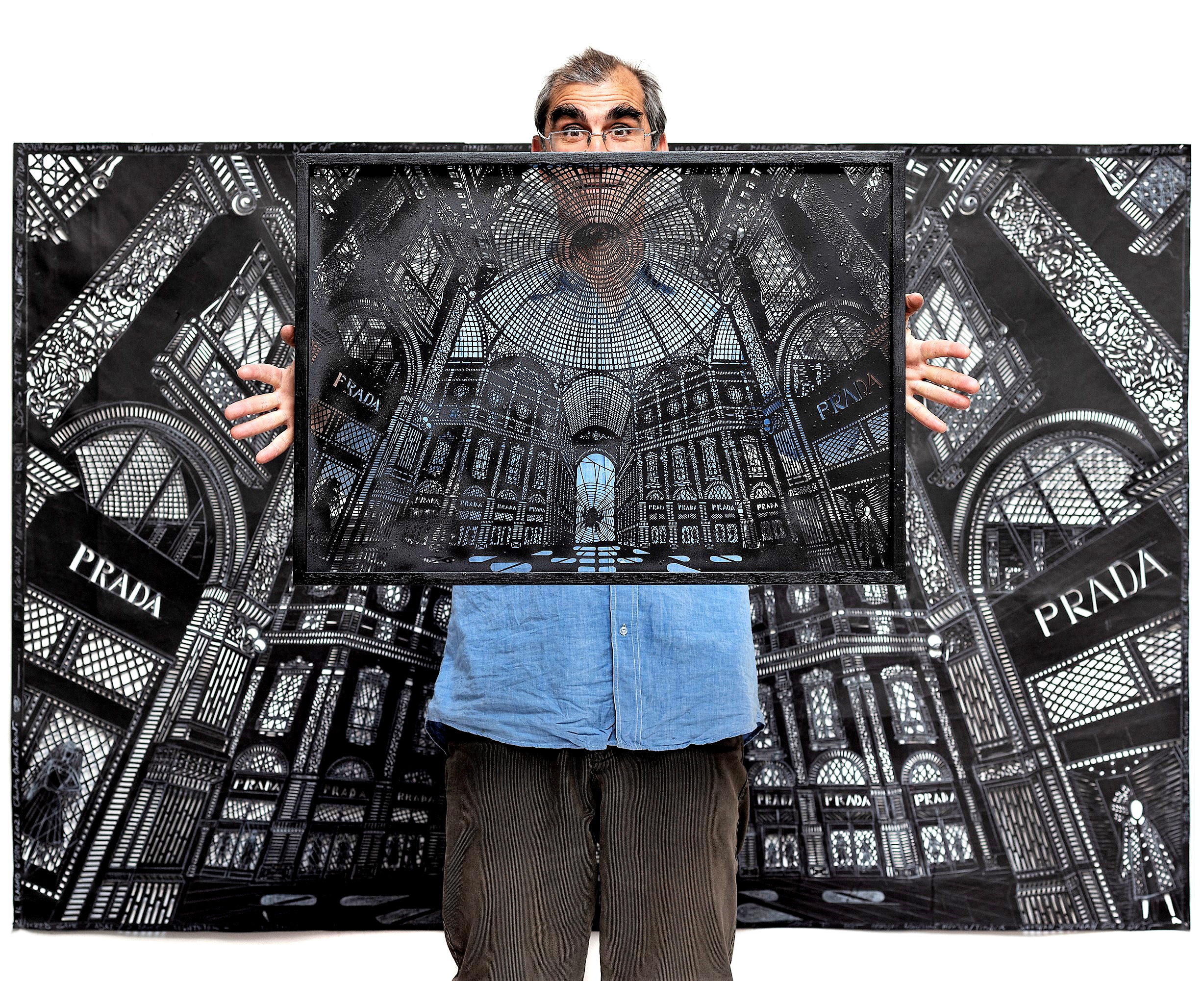
Claudio Onorato, Il ragno d’oro, Portrait © Armando Moneta 2021
DN: And what is this spider waiting for?
CO: I think everyone can make their own connections. I am somewhat of the opinion that not everything needs to be explained; you cannot say everything. This spider is in an area where value goes beyond money, because it carries a very strong symbolic significance. And there is beauty, too, I must admit—I don’t want to deny that. When we walk around the city centre, it is still quite a spectacle. It is wonderful to see these spaces, which are now 150 years old. It is a shame that they have been almost entirely privatised. Just think: the City Council puts all these spaces, which belong to the city, up for tender. They hold auctions, and whoever offers the most gets them. And who can afford to offer the most? It certainly wouldn’t be possible to establish a museum exhibition space there. Until quite recently, there were a couple of galleries inside, which have only just been evicted…
DN: There are certainly bookshops. And there is the Prada gallery…
CO: Yes, there is the new Prada gallery, which is expanding more and more. The surreal thing is that I actually come from the Prada world: the former Fabbrica Orobia is where Prada’s new district now stands, and I eventually had to leave because, with their arrival, prices went through the roof. Within two years, I had to get out and move here. Of course, I’m happy; it was a change. But if you drive through the Prada area, you’ll see Rem Koolhaas’s golden tower, Anderson’s Bar Luce, and, next door, on Via Orobia, a gate decorated with 16 passionflowers—the flower of passion—that I cut out myself. The gate is still there, and it has become part of Prada, too, because they bought the place where I used to work. You can still see it in the various posts published recently. Before they arrived, that was an area with a great deal of activity. It is still clearly a place of culture, but of a somewhat more standardised kind, because it is shaped by the museum world and the idea of excellence—the kind of culture that, in my opinion, is always somewhat more distant from people. It is not a culture that emerges spontaneously and takes root in the local area, but one imposed by the art market. Because there is art and art, isn’t there? Of course, there is the kind that gets imposed…
DN: …and independent one.
CO: Exactly. Ironically, Fabbrica Orobia—where I stayed for 31 years—was bought by Prada without me knowing it. Little by little, they acquired that beautiful industrial area, where they eventually built the whole complex.
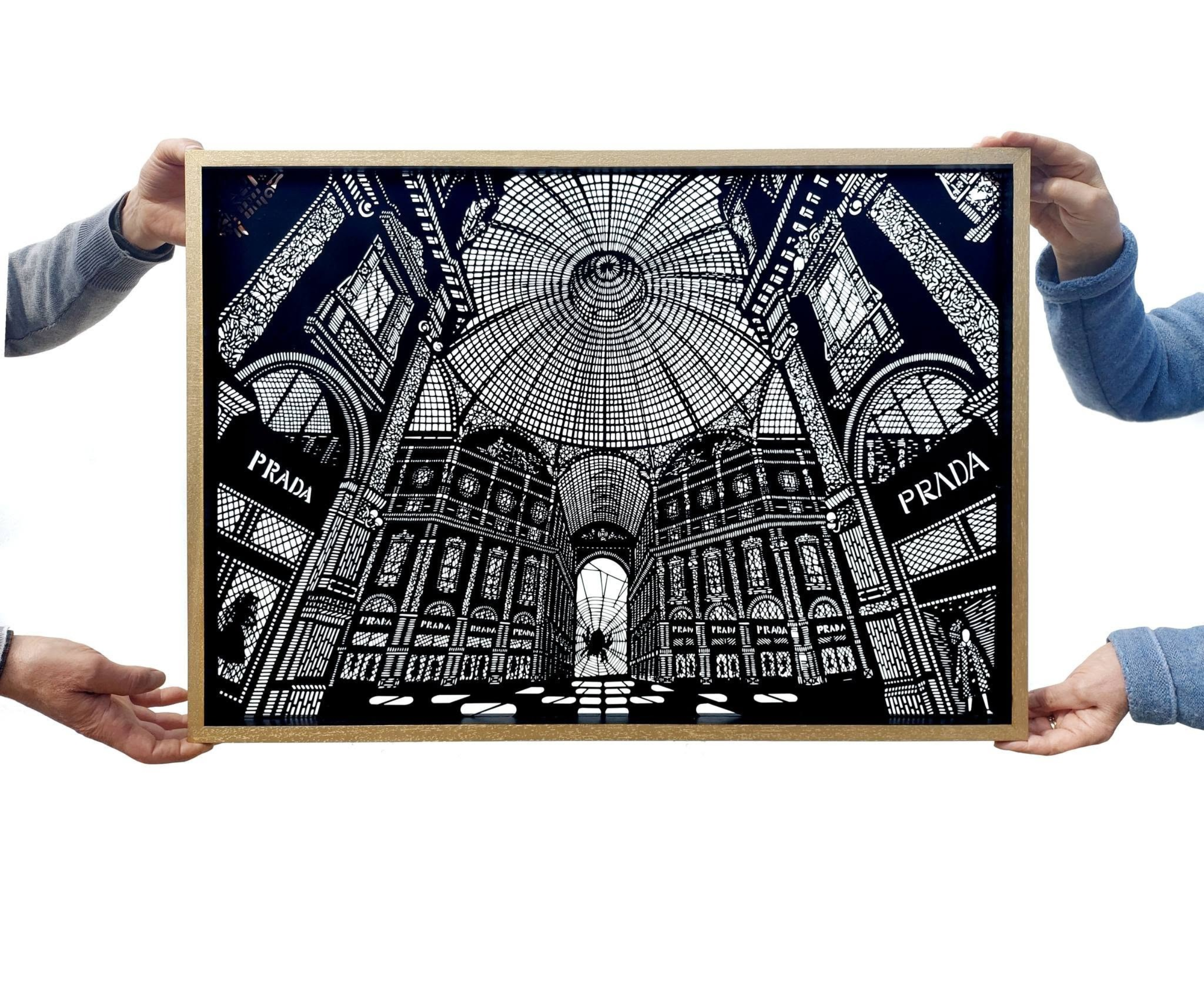
Claudio Onorato, Il ragno d’oro, 2021, 52,5 x 73,5 cm, cut out steel and acrylic paint, courtesy the artist
DN: But did that happen before this painting was made?
CO: Absolutely. Prada arrived 15 years ago, whereas this work is four or five years old. They bought the entire area around Largo Isarco, Via Lorenzini, and Via Orobia. I was happily settled at Via Orobia 15, and ten years later they acquired that space as well. I hope they keep the gate, because it remains a very interesting object. People still come by to see it and take photographs.
DN: So what is the emotional significance of this inscription [referring to the word “Prada” in “Il ragno d’oro”]? Is it a kind of continuation of the story of you two?
CO: I don’t know, but somehow our paths have become intertwined. As I said, this work was made after all these events had taken place. When I moved into that space—which would later become Fabbrica Orobia—35 years ago, it was a deserted, abandoned part of the city, made up of former industrial buildings. It was also dangerous: prostitution, neglect, drug dealing. I was 18, and it was frightening. Two people had been left dead on the pavement. It was a rather particular area, not somewhere just anyone would go. It took me a while to settle in, too; it wasn’t immediate. You can imagine the fears, including those within my family. But it is also true that, little by little, I found my place there…
The area on Via Orobia was home to a lightbulb factory and several courier companies. Gradually, they all left, or were forced to leave, because the city changes under the influence of its economic powers, too. The courier companies left because they could no longer afford the costs. The last to go was the lightbulb factory, called Imperia, about 15 years ago. At a certain point, I found myself alone for ten years in these wonderful spaces, where I organised exhibitions, shows, and raves, and invited artists to exhibit. We did some spectacular things in warehouse hangars measuring 2,000 square metres. The entire site, now bought by Prada, covers 5,000 square metres. For ten years, I was the only person occupying that space and, in a way, keeping it alive. It was truly unique, even among artists, to have access to a situation like that.
I stayed there for practical reasons—it suited the owners, among other circumstances that had gradually developed—because it was important to have someone there. In Milan, if a space is abandoned, someone will occupy it immediately. So I spent 20 years there alongside the other businesses, followed by 10 to 12 years on my own, developing the area. As an architect, I carried out renovation, restoration, and refurbishment work on the warehouses: I completely transformed the place. Where there had once been cold-storage rooms, I had all the floors removed, creating spaces that rose towards the sky: 12 to 14 metres high, like a small cathedral. In agreement with the owners, I designed, built, and installed 15 sets of bathroom facilities to accommodate large-scale events, and refurbished all the warehouses. It thus became a venue for fashion shows and major events in Milan, including cultural events. For five to seven years, it was known as Fabbrica Orobia. Nike held an event there, as did Annie Leibovitz, who came to present her latest project.
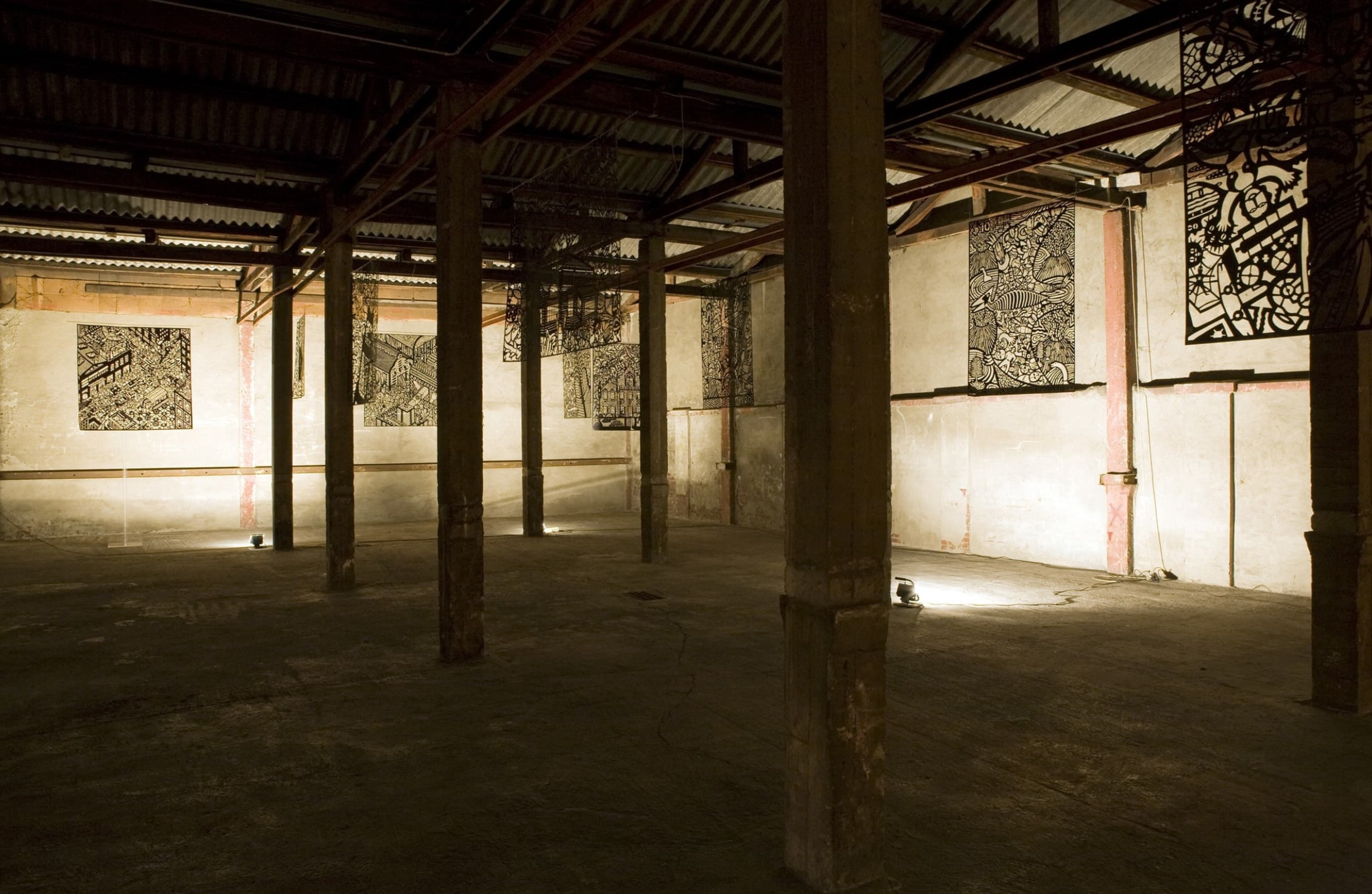
Claudio Onorato, Apparitions and magical disappearances, Fabbrica Orobia 2010, Milan
DN: How did Annie Leibovitz end up there?
CO: Through a network of acquaintances. We got in touch directly, and she organised a wonderful event, which you can also find online. McQueen’s first posthumous fashion show, after his death, was also held at Fabbrica Orobia. Nike organised an incredible event there, truly spectacular. It was a year in the making, with professionals, architects, and set designers recreating the history of Nike inside the warehouses…
With my exhibitions taking place at the same time, along with those of other artists I invited and other curators acting as intermediaries, the area gradually became a very lively place for about five years. Then its value skyrocketed and, inevitably, the next step was to sell it. That brought an era to an end.
DN: And what year did that happen?
CO: I think the sale of the site dates back to three months ago, so it is quite recent. For five or six years, I was the one creating and organising all the events. Then things continued on their own momentum, as often happens in these situations: the person who organises everything leaves, and others take over, much like in a start-up. The important thing is to get it off the ground. Then, when huge clients like Nike come along, the venue gains an international profile and begins to operate more or less on its own.
DN: And the owner had always been the same, hadn’t they?
CO: Yes, it had always been the same owner. But in the end, three months ago, they sold it; it was acquired.
DN: So this is a story that goes somewhat beyond the story of the painting.
CO: Very much so.

Claudio Onorato, Il ragno d’oro, 2021, 52,5 x 73,5 cm, cut out steel and acrylic paint, courtesy the artist
Translated to English by Dobroslawa Nowak